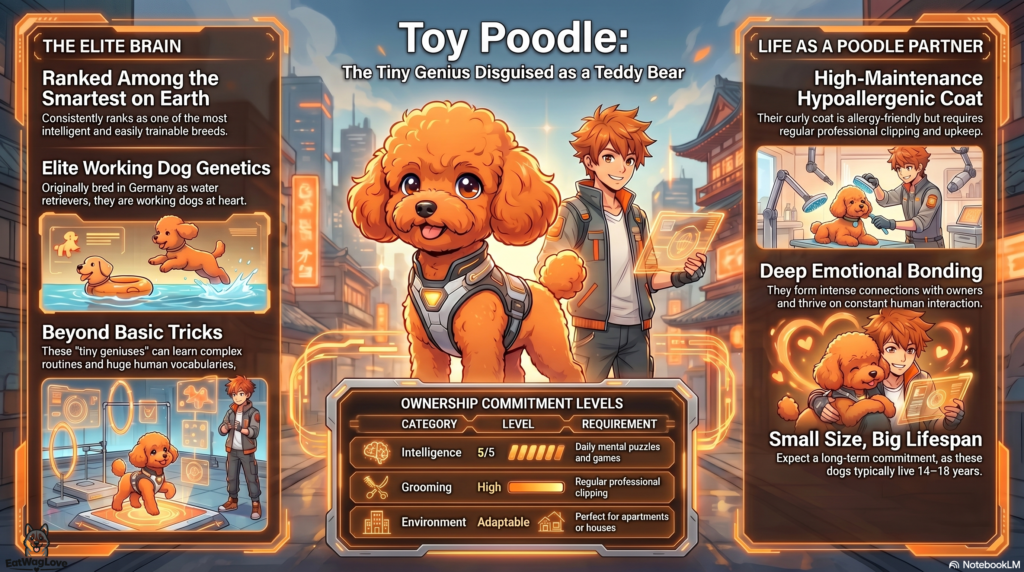





Intelligent, elegant, and full of charm — a small companion with a big personality and sharp mind.
🧠 QUICK SNAPSHOT
- Temperament: Intelligent, affectionate, alert
- Energy Level: Moderate
- Size: Small
- Good With Families: Yes
- Trainability: Very high
- Grooming: High
- Best For: Families, apartments, companionship
📚 OVERVIEW
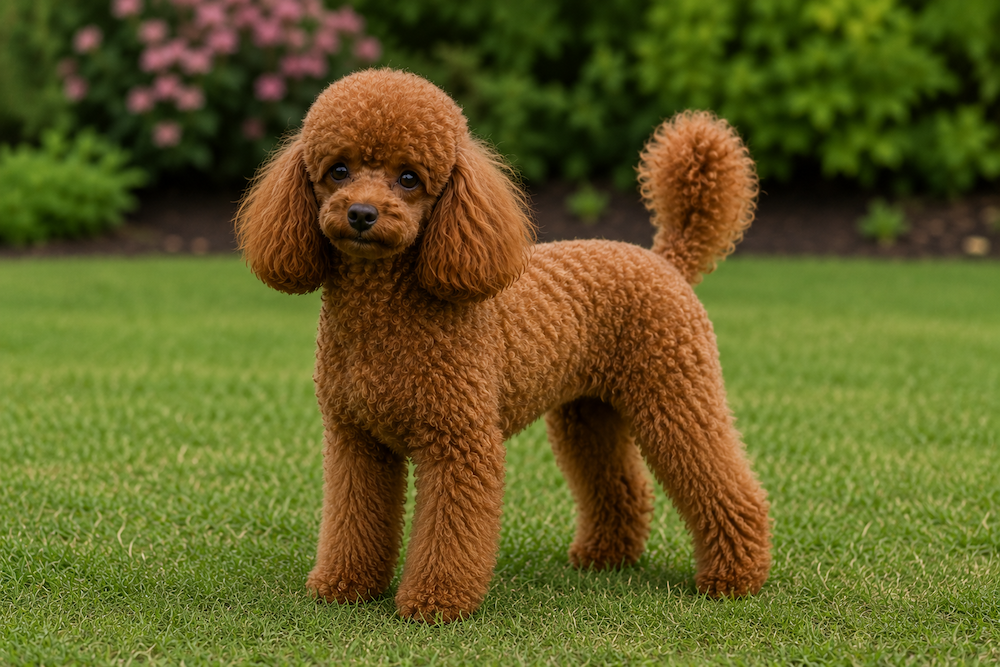
The Toy Poodle is the smallest of the Poodle varieties, known for its intelligence and elegant appearance. Despite their size, they are lively, alert, and highly trainable dogs that enjoy being part of family life.
They are affectionate companions that thrive on attention and interaction.
✅ PROS & CONS
Pros
- Extremely intelligent and easy to train
- Affectionate and people-focused
- Great for apartments
- Low shedding coat
Cons
- Needs regular grooming
- Can be sensitive
- Requires attention and stimulation
- May be prone to separation anxiety
Is a Toy Poodle a Good Family Dog?
Yes. Toy Poodles can make affectionate, intelligent and highly adaptable family dogs.
They form strong bonds with their owners and often enjoy being involved in almost everything the family does.
Their tiny size means they’re generally better suited to families where children understand how to handle small dogs gently.
Are Toy Poodles Good With Children?
Toy Poodles can be excellent with respectful children, particularly older children.
However, they’re small and relatively delicate, so rough handling or accidental falls can cause injuries.
Families with very young children may find the larger Miniature Poodle more robust.
How Much Exercise Does a Toy Poodle Need?
Most Toy Poodles need around 30–60 minutes of exercise each day, together with play and mental stimulation.
Despite their tiny size, they’re active, athletic dogs rather than purely decorative lap dogs.
Walks, retrieving, trick training and puzzle games can all help keep them occupied.
Are Toy Poodles Easy to Train?
Yes. Toy Poodles are generally exceptionally intelligent and highly trainable.
They learn commands and tricks quickly and usually respond very well to positive reinforcement.
Their intelligence means they also need mental stimulation to prevent boredom.
Do Toy Poodles Shed?
Toy Poodles are very low-shedding dogs.
Loose hairs tend to become trapped within their curly coat rather than falling extensively around the home.
However, low shedding comes with substantial grooming requirements.
Are Toy Poodles Hypoallergenic?
Toy Poodles are commonly described as hypoallergenic because they shed very little, but no dog is completely hypoallergenic.
Dog allergens are also present in saliva and skin secretions.
Some allergy sufferers tolerate Poodles better than heavily shedding breeds, but individual reactions vary.
How Often Should You Groom a Toy Poodle?
Toy Poodles require regular grooming.
Their coat should generally be brushed several times a week, potentially daily when kept longer, and most pet Poodles need professional clipping approximately every four to eight weeks.
Without proper grooming, their continuously growing curly coat can mat quickly.
What Health Problems Are Common in Toy Poodles?
Potential health concerns include patellar luxation, progressive retinal atrophy and other eye disorders, dental disease, Legg-Calvé-Perthes disease and certain inherited neurological conditions.
Their tiny jaws can make dental care particularly important.
Responsible breeders should perform appropriate health and genetic screening.
How Long Do Toy Poodles Live?
Toy Poodles commonly live around 14–18 years, and some live even longer.
They’re one of the longer-lived dog breeds.
Healthy body weight, good dental care, appropriate exercise and regular veterinary checks can help support longevity.
How Big Does a Toy Poodle Get?
Toy Poodles are the smallest Poodle variety.
Under the American Kennel Club standard, a Toy Poodle stands 10 inches (about 25 cm) or less at the shoulder. Standards vary between kennel organisations.
Adults commonly weigh around 2–4 kg, although individual size varies.
When Is a Toy Poodle Fully Grown?
Most Toy Poodles reach close to their adult height within their first year.
They may continue filling out slightly after reaching their full height.
Because they’re a small breed, they generally mature physically earlier than larger dogs.
Can a Toy Poodle Live in an Apartment?
Yes. Toy Poodles are excellent apartment dogs.
Their tiny size and manageable exercise requirements make them highly adaptable to smaller homes.
They still need daily walks, play, training and mental stimulation.
Can Toy Poodles Be Left Alone?
Adult Toy Poodles can learn to tolerate reasonable periods alone, but they’re strongly people-oriented dogs.
Many form extremely close attachments to their owners and may struggle with prolonged isolation.
Gradual alone-time training from puppyhood can be particularly useful.
Do Toy Poodles Bark a Lot?
They can.
Toy Poodles are alert and quick to notice unusual sounds or activity, which can result in considerable barking if the behaviour isn’t managed.
Early training and sufficient stimulation can help prevent excessive barking.
Are Toy Poodles Affectionate?
Yes. Toy Poodles are generally extremely affectionate with their families.
Many love cuddling, sitting on laps and following their owners around the home.
They combine the personality of a companion dog with the intelligence and athleticism of a much larger working breed.
Are Toy Poodles Good With Other Dogs?
Generally, yes.
Well-socialised Toy Poodles can live successfully with other dogs.
Because they’re so small, care should be taken when allowing them to play with much larger or particularly boisterous dogs.
Are Toy Poodles Good With Cats?
Yes. Many Toy Poodles can live very successfully with cats.
Early introductions and socialisation are helpful, but their small size and generally sociable personality can make them suitable for multi-pet households.
Are Toy Poodles High-Energy Dogs?
Toy Poodles are surprisingly energetic for their size.
They enjoy walking, playing, retrieving and learning new things.
However, their exercise needs are generally manageable because such a small dog can expend considerable energy without needing enormous distances.
Are Toy Poodles Smart?
Extremely.
Poodles are renowned for their intelligence, trainability and problem-solving ability, and the Toy variety retains these characteristics.
Toy Poodles can excel at trick training, obedience and activities that challenge their minds.
Do Toy Poodles Like Water?
Many do, although individual preferences vary.
Poodles have a strong historical connection with water retrieving, and some Toy Poodles retain an enthusiasm for swimming and retrieving.
Their tiny size means they should always be carefully supervised around water.
What Colours Do Toy Poodles Come In?
Toy Poodles occur in numerous colours, including black, white, brown, cream, apricot, red, silver and grey, depending on the kennel-club standard.
Some registries recognise additional colours or patterns differently.
Colour shouldn’t be prioritised over health and temperament when choosing a puppy.
What Is the Difference Between a Toy Poodle and a Miniature Poodle?
The main difference is size.
Toy Poodles are the smallest Poodle variety, while Miniature Poodles are taller and more robust.
Both share the characteristic curly coat, intelligence and general Poodle temperament, although individual personalities naturally vary.
What Is the Difference Between a Toy Poodle and a Standard Poodle?
Standard Poodles are dramatically larger than Toy Poodles.
Despite the size difference, they’re varieties of the same breed and share many characteristics, including high intelligence, curly low-shedding coats and strong trainability.
The Standard Poodle’s working and retrieving heritage is particularly obvious because of its larger athletic build.
Is a Toy Poodle the Smallest Poodle?
Yes, among the three Poodle varieties recognised by organisations such as the American Kennel Club, the Toy Poodle is the smallest, followed by the Miniature and Standard.
Some countries and organisations classify Poodle sizes differently.
Is a Teacup Poodle a Real Breed?
No. “Teacup Poodle” isn’t an officially recognised Poodle variety with major kennel clubs.
The term is generally used commercially to describe exceptionally small Toy Poodles.
Deliberately breeding for extreme smallness can increase the risk of health and injury problems, so prospective owners should prioritise responsible breeding over unusually tiny size.
Why Do Poodles Have Curly Hair?
The Poodle’s dense, curly coat developed alongside its history as a working water dog.
The coat offered protection during work in cold water while its texture helped distinguish the breed.
Modern grooming styles can make Poodles look highly ornamental, but the breed’s coat originated on a genuine working dog.
Why Do Poodles Have Fancy Haircuts?
Traditional Poodle clips have historical connections with their water-retrieving background.
Hair was removed from parts of the body to make swimming easier while leaving coat around important areas for protection from cold water.
Modern show clips became considerably more elaborate, but their origins weren’t simply decorative.
Where Does the Toy Poodle Come From?
The Poodle has deep historical associations with Germany and France, with its larger ancestors developing as water-retrieving dogs.
Smaller Poodles were subsequently selectively bred as companions.
Toy Poodles became particularly popular as companion dogs because they retained Poodle intelligence and trainability in a much smaller package.
Is the Poodle French or German?
The breed is strongly associated with France, where the Poodle became enormously popular and is regarded as a national breed.
However, the Poodle’s earlier development is generally linked to German water dogs, and the name “Poodle” derives from German terminology associated with splashing in water.
Both countries therefore play important roles in the breed’s history.
Is a Toy Poodle a Good First Dog?
Yes. Toy Poodles can be excellent first dogs.
They’re intelligent, affectionate, adaptable and exceptionally trainable.
The main considerations are their substantial grooming requirements, potential barking, need for companionship and physical delicacy.
What Makes the Toy Poodle Unique?
The Toy Poodle is a wonderful example of how misleading size can be.
It may weigh only a few kilograms and fit comfortably on someone’s lap, but inside that tiny body is essentially the same extraordinarily intelligent canine machinery that made Poodles famous working dogs.
Poodle ancestors retrieved from water.
Modern Toy Poodles may be more likely to retrieve a miniature tennis ball from underneath the sofa, but the intelligence, athleticism and enthusiasm for learning remain.
They’re also one of the breeds most responsible for the idea that a highly styled dog must somehow be delicate or unintelligent.
Quite the opposite.
Behind the elaborate haircut is an athletic, trainable and remarkably clever little dog.
The biggest problem with owning something this smart in such a small package?
It doesn’t take a Toy Poodle very long to work out exactly how well it has trained you.