





Tiny, playful, and full of personality — a lively companion that loves attention and fun.
🧠 QUICK SNAPSHOT
- Temperament: Playful, affectionate, energetic
- Energy Level: Moderate
- Size: Small
- Good With Families: Yes
- Trainability: High
- Grooming: Moderate
- Best For: Families, apartments, companionship
📚 OVERVIEW
The Yorkipoo is a cross between a Yorkshire Terrier and a Poodle, combining intelligence with a fun, lively personality. They are small dogs with big character, often forming strong bonds with their owners.
They thrive in environments where they receive attention and interaction.
✅ PROS & CONS
Pros
- Very affectionate and playful
- Intelligent and easy to train
- Great for small homes and apartments
- Low shedding (varies by coat)
Cons
- Can be vocal
- Needs regular grooming
- May develop separation anxiety
- Requires attention and engagement
Is a Yorkipoo a Good Family Dog?
Yes. Yorkipoos can make affectionate, intelligent and lively family dogs.
A Yorkipoo is a cross between a Yorkshire Terrier and a Poodle, usually a Toy or Miniature Poodle. Because it’s a crossbreed, temperament, size and coat characteristics can vary considerably between individual dogs.
Are Yorkipoos Good With Children?
Yorkipoos can be good with respectful children, particularly older children.
Their small size makes them vulnerable to accidental injury from rough handling, so they may not be ideal for very young children.
Supervision and gentle handling are important.
How Much Exercise Does a Yorkipoo Need?
Most Yorkipoos need around 30–60 minutes of exercise each day, together with play and mental stimulation.
They’re small dogs but often surprisingly energetic.
Walks, retrieving, puzzle toys and short training sessions can help keep them physically and mentally satisfied.
Are Yorkipoos Easy to Train?
Usually, yes.
Poodles are exceptionally trainable, while Yorkshire Terriers are intelligent but can have a more independent terrier personality.
Yorkipoos generally respond well to positive, consistent training, particularly when sessions are short and interesting.
Are Yorkipoos Hard to Toilet Train?
Some Yorkipoos can take patience to toilet train.
Small dogs have small bladders, while the Yorkshire Terrier side can contribute an independent streak.
Frequent toilet opportunities, a consistent routine and positive reinforcement are particularly useful during puppyhood.
Do Yorkipoos Shed?
Many Yorkipoos are low-shedding, but this isn’t guaranteed.
A Yorkipoo may inherit a curly Poodle-like coat, a straighter Yorkie-style coat or something between the two.
Individual coat characteristics can vary even between puppies from the same litter.
Are Yorkipoos Hypoallergenic?
Yorkipoos are often described as hypoallergenic, but no Yorkipoo can be guaranteed to be allergy-friendly.
Both parent breeds are relatively low shedding, which may help some allergy sufferers.
However, dog allergens are also found in saliva and skin secretions.
How Often Should You Groom a Yorkipoo?
Most Yorkipoos need brushing several times a week, while longer or curlier coats may require daily grooming.
Professional grooming is commonly needed approximately every six to eight weeks.
Regular grooming is essential because soft, curly coats can mat surprisingly quickly.
What Health Problems Are Common in Yorkipoos?
Potential health concerns include patellar luxation, dental disease, eye disorders, Legg-Calvé-Perthes disease and tracheal collapse, along with inherited conditions from Poodle lines.
Very small dogs can also be particularly vulnerable to accidental injuries.
Crossbreeding doesn’t automatically eliminate inherited disease, so responsible health testing remains important.
How Long Do Yorkipoos Live?
Yorkipoos commonly live around 12–15 years, with some potentially living longer.
Both Yorkshire Terriers and smaller Poodles are relatively long-lived dogs.
Good dental care, healthy weight, exercise and preventive veterinary care can help support longevity.
How Big Does a Yorkipoo Get?
Yorkipoos are generally small dogs, commonly weighing around 2.5–7 kg, although individuals can be larger.
Adult size depends heavily on whether a Toy or Miniature Poodle was used and the size of both parents.
There is no official Yorkipoo breed standard.
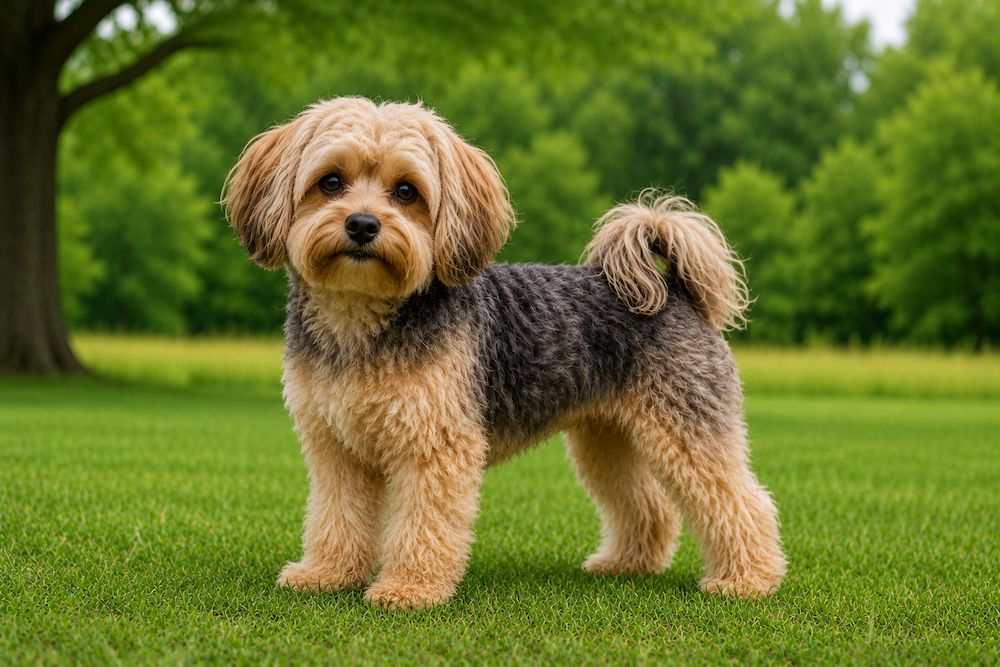
What Does a Yorkipoo Look Like?
Yorkipoos vary considerably in appearance.
Many have soft, wavy or curly coats, expressive eyes and a teddy-bear-like face.
Others inherit a straighter, silkier coat more reminiscent of the Yorkshire Terrier.
Can a Yorkipoo Live in an Apartment?
Yes. Yorkipoos are generally excellent apartment dogs.
Their small size and manageable exercise requirements make them well suited to smaller homes.
Their tendency to alert bark can be a more important consideration than the amount of living space available.
Can Yorkipoos Be Left Alone?
Adult Yorkipoos can learn to tolerate reasonable periods alone, but they’re usually strongly attached to their owners.
The Poodle side can contribute considerable people-orientation, while Yorkshire Terriers were also developed into highly devoted companions.
Gradual independence training from puppyhood is useful.
Do Yorkipoos Bark a Lot?
They can.
Yorkshire Terriers are famously alert little dogs, and Poodles are also highly observant.
A Yorkipoo may therefore be quick to announce visitors, noises in the hallway, passing dogs or anything else it considers suspicious.
Early training can help control excessive barking.
Are Yorkipoos Affectionate?
Yes. Yorkipoos are typically very affectionate.
Many enjoy cuddling, sitting on laps and following their owners around the house.
Their small size doesn’t prevent them from developing very large personalities.
Are Yorkipoos Good With Other Dogs?
Generally, yes, when properly socialised.
Yorkipoos can be playful and sociable with other dogs.
Because they’re small, interactions with much larger or particularly boisterous dogs should be supervised carefully.
Are Yorkipoos Good With Cats?
Many Yorkipoos can live successfully with cats, particularly when raised alongside them.
However, the Yorkshire Terrier was originally developed partly as a vermin hunter, so some Yorkipoos may inherit a noticeable chase instinct.
Individual temperament matters.
Do Yorkipoos Have a High Prey Drive?
Some do.
Yorkshire Terriers may look like glamorous companion dogs today, but their ancestors were working terriers used to control rats and other vermin.
A Yorkipoo can inherit some of this instinct to chase small moving animals.
Are Yorkipoos High-Energy Dogs?
Yorkipoos are usually moderately energetic.
They often enjoy energetic bursts of play but don’t generally require the enormous exercise commitment of larger working breeds.
Daily walks combined with play and mental stimulation are usually appropriate.
Are Yorkipoos Smart?
Yes. Yorkipoos can be extremely clever little dogs.
Poodles are renowned for intelligence and trainability, while Yorkshire Terriers bring classic terrier problem-solving ability and determination.
Puzzle toys, trick training and interactive games can provide excellent mental stimulation.
What Colours Do Yorkipoos Come In?
Yorkipoos can occur in numerous colours and combinations, including black, brown, cream, apricot, silver, grey, tan and combinations of these colours.
Their colouring may also change considerably as they mature.
This is particularly relevant because both Poodles and Yorkshire Terriers can undergo noticeable coat-colour changes with age.
What Is an F1 Yorkipoo?
An F1 Yorkipoo is a first-generation cross between a Yorkshire Terrier and a Poodle.
The term describes the dog’s parentage rather than predicting exactly how it will look or behave.
An F1 puppy can inherit different combinations of characteristics from either parent.
What Is an F1B Yorkipoo?
An F1B Yorkipoo is usually produced by crossing an F1 Yorkipoo back to a Poodle.
This may increase the likelihood of some Poodle-like coat characteristics.
However, F1B Yorkipoos still aren’t guaranteed to be completely non-shedding or hypoallergenic.
What Is the Difference Between a Yorkipoo and a Yorkshire Terrier?
A Yorkshire Terrier is an established pedigree breed, while a Yorkipoo is a Yorkshire Terrier–Poodle cross.
Yorkies have their characteristic long, silky coat and established size and breed standard.
Yorkipoos are less predictable and can vary considerably in coat texture, colour, size and appearance.
Is a Yorkipoo the Same as a Yorkiepoo?
Yes. Yorkipoo, Yorkiepoo and Yorkie-poo are different spellings commonly used for the Yorkshire Terrier–Poodle cross.
There is no universally standardised spelling because the Yorkipoo isn’t an officially recognised pedigree breed.
Is a Yorkipoo a Recognised Dog Breed?
No. The Yorkipoo isn’t generally recognised as a standardised pedigree breed by major kennel clubs.
There is therefore no official breed standard defining its exact size, coat, colour or temperament.
The characteristics of the actual parents are particularly important when choosing a puppy.
Where Did the Yorkipoo Come From?
Yorkshire Terrier–Poodle crosses became increasingly popular during the rise of deliberately bred Poodle crosses.
However, there isn’t a reliably documented single breeder, location or exact date responsible for creating the Yorkipoo.
Accidental or informal Yorkie–Poodle crosses likely existed before the Yorkipoo name became popular.
Is a Yorkipoo a Good First Dog?
Yes. A Yorkipoo can be a good first dog.
They’re generally small, affectionate, intelligent and adaptable, with manageable exercise requirements.
Owners should still be prepared for regular grooming, possible barking, patient toilet training and the occasional appearance of a surprisingly determined terrier personality.
What Makes the Yorkipoo Unique?
The Yorkipoo combines two dogs that prove appearances can be deceptive.
The Poodle may be famous today for elaborate grooming, but its ancestors were highly capable working water dogs.
The Yorkshire Terrier may now be associated with laps and bows, but its terrier ancestors earned their living pursuing rats and other vermin.
Put the two together and you can end up with a tiny, fluffy teddy bear containing a remarkable amount of intelligence and determination.
A Yorkipoo might weigh only a few kilograms.
Unfortunately, nobody remembered to tell the Yorkipoo.
So when a strange noise occurs outside, don’t be surprised if your miniature curly companion immediately reports for duty as:
Head of Household Security.