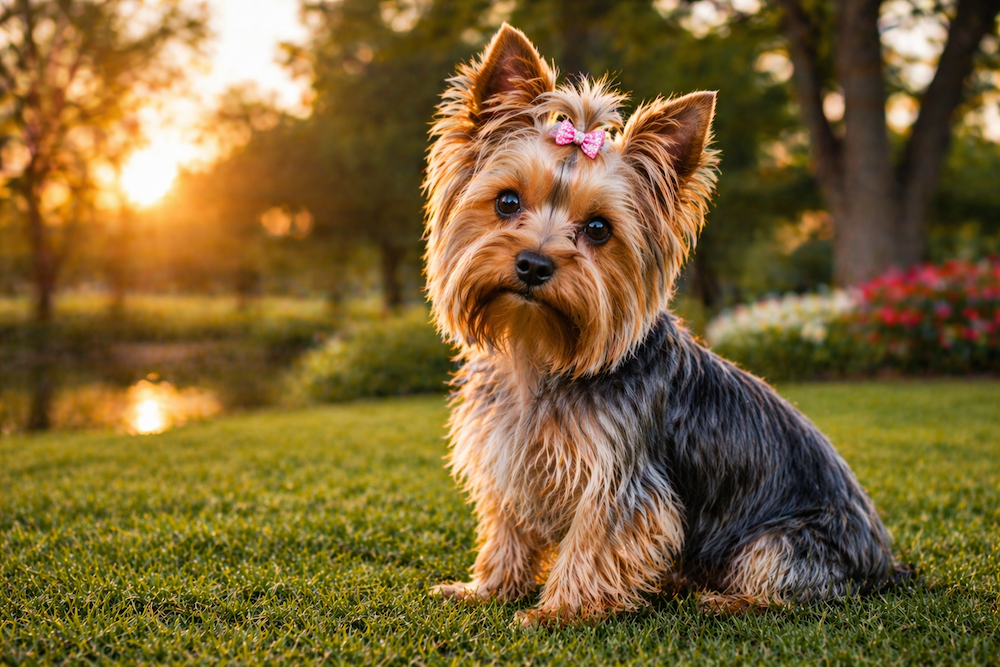







Tiny, confident, and full of attitude — a small dog with a big personality
🧠 QUICK SNAPSHOT
- Temperament: Bold, Affectionate, Lively
- Energy Level: Moderate
- Size: Small
- Good with Families: Yes (with care)
- Training Difficulty: Moderate
📚 OVERVIEW
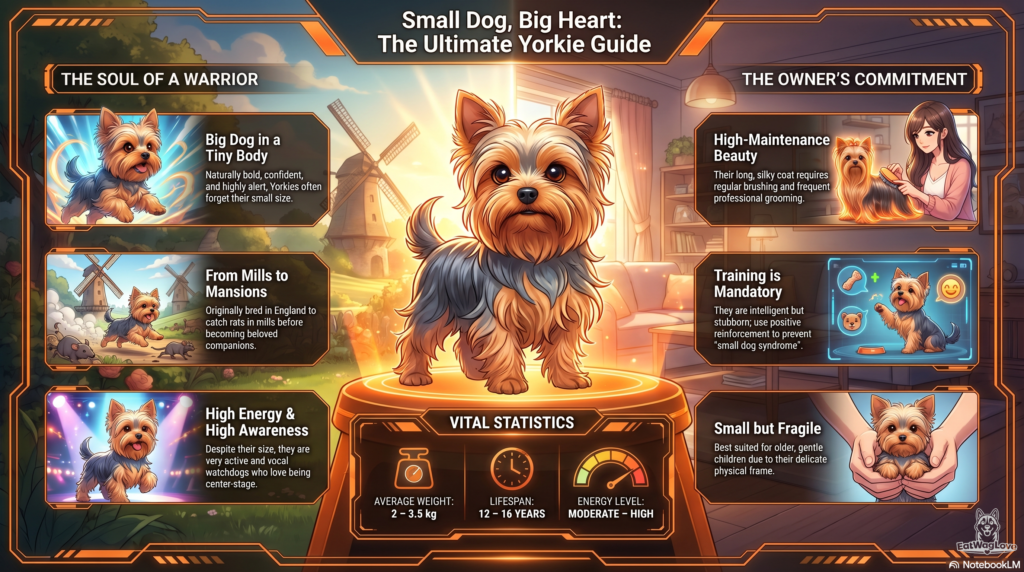
Yorkshire Terriers, or “Yorkies,” are small dogs with big personalities. Originally bred to catch rats in mills, they are confident, energetic, and full of character. Despite their tiny size, they are brave and often act like much larger dogs. They are also affectionate companions who enjoy close interaction with their owners.
✅ PROS & CONS
Pros
- Great for apartments and small homes
- Very affectionate and loyal
- Low shedding coat
Cons
- Requires regular grooming
- Can be vocal and alert
- May be fragile and need careful handling
Is a Yorkshire Terrier a Good Family Dog?
Yes. Yorkshire Terriers, commonly called Yorkies, can make affectionate, lively and devoted family dogs.
They’re tiny but have genuine terrier personalities, so owners should expect confidence, curiosity and considerably more attitude than their size might suggest.
Are Yorkshire Terriers Good With Children?
Yorkies can be good with respectful older children.
Because they’re very small and relatively delicate, rough handling or accidental falls can cause serious injuries. They’re generally less suited to households where very young children may unintentionally handle them roughly.
How Much Exercise Does a Yorkshire Terrier Need?
Most Yorkies need around 30–60 minutes of exercise each day, including walks and play.
They’re energetic little dogs but don’t require enormous distances.
Mental stimulation, training and opportunities to explore are also important.
Are Yorkshire Terriers Easy to Train?
Yorkies are intelligent and capable of learning quickly, but they can also be independent and determined.
Positive reinforcement and short, interesting training sessions usually work best.
Consistency is important because Yorkies are remarkably good at discovering which household rules aren’t actually enforced.
Are Yorkshire Terriers Hard to Toilet Train?
Some Yorkies can be challenging to toilet train.
Their small bladders mean they need frequent opportunities to go outside, particularly as puppies.
A consistent routine, close supervision and positive reinforcement can make training considerably easier.
Do Yorkshire Terriers Shed?
Yorkshire Terriers are very low-shedding dogs.
Their coat is unusual because it grows long and has a fine, hair-like texture rather than the typical fur of many breeds.
However, low shedding doesn’t mean low maintenance.
Are Yorkshire Terriers Hypoallergenic?
Yorkies are frequently described as hypoallergenic because they shed very little, but no dog is completely hypoallergenic.
Allergens are also present in saliva and skin secretions.
Some allergy sufferers tolerate Yorkies better than heavily shedding breeds, but individual reactions vary.
How Often Should You Groom a Yorkshire Terrier?
A Yorkie with a full-length coat may need daily brushing to prevent tangles and matting.
Many pet owners keep the coat in a shorter puppy-style clip, which is considerably easier to maintain.
Regular professional grooming, nail trimming, ear care and dental care are also important.
What Health Problems Are Common in Yorkshire Terriers?
Potential health concerns include patellar luxation, dental disease, tracheal collapse, Legg-Calvé-Perthes disease, eye problems and portosystemic liver shunts.
Their extremely small size can also make them vulnerable to accidental injury.
Responsible breeders should screen breeding dogs appropriately.
How Long Do Yorkshire Terriers Live?
Yorkshire Terriers commonly live around 13–16 years, and some live considerably longer.
They’re generally a long-lived breed.
Healthy body weight, good dental care and regular veterinary checks can help support longevity.
How Big Does a Yorkshire Terrier Get?
Yorkshire Terriers are tiny dogs.
Under major breed standards, adults generally weigh up to about 3.2 kg (7 lb) and commonly stand roughly 18–23 cm tall.
Despite their size, they’re usually confident and surprisingly robust in personality.
Can a Yorkshire Terrier Live in an Apartment?
Yes. Yorkies are excellent apartment dogs.
Their tiny size and manageable exercise requirements make them highly adaptable to smaller homes.
Barking can be a bigger issue than space, particularly in apartments with close neighbours.
Can Yorkshire Terriers Be Left Alone?
Adult Yorkies can learn to tolerate reasonable periods alone, but they’re strongly attached to their families.
Long periods of isolation can lead to boredom or separation-related problems.
Gradual independence training from puppyhood is useful.
Do Yorkshire Terriers Bark a Lot?
They can.
Yorkies are extremely alert and observant little dogs and often quickly announce visitors, strange noises or activity outside.
Early training can help prevent alert barking from becoming excessive.
Are Yorkshire Terriers Affectionate?
Yes. Yorkies are typically extremely affectionate with their families.
Many love sitting on laps, cuddling and following their owners from room to room.
They often combine the attachment of a companion dog with the confidence of a working terrier.
Are Yorkshire Terriers Good With Other Dogs?
They can be, particularly when properly socialised.
Yorkies sometimes seem completely unaware of their tiny size and may confidently approach much larger dogs.
Interactions with large or boisterous dogs should be supervised because of the Yorkie’s physical vulnerability.
Are Yorkshire Terriers Good With Cats?
Many Yorkies can live successfully with cats, especially when introduced while young.
However, they’re genuine terriers and may chase smaller animals.
Individual temperament and early socialisation are important.
Do Yorkshire Terriers Have a High Prey Drive?
Some do.
Yorkies were developed from working terriers used to control rats and other vermin, so the instinct to chase small, fast-moving animals can remain surprisingly strong.
Pet rodents should be kept securely separated.
Are Yorkshire Terriers High-Energy Dogs?
Yorkies are moderately energetic.
They’re active, curious dogs that enjoy walking, playing and investigating their surroundings, but their tiny size makes their overall exercise requirements relatively manageable.
They’re not simply decorative lap dogs.
Are Yorkshire Terriers Smart?
Yes. Yorkshire Terriers are intelligent and excellent problem solvers.
Their terrier ancestry contributes determination and persistence as well as intelligence.
They can learn tricks and obedience exercises quickly when properly motivated.
Do Yorkshire Terriers Get Cold Easily?
Yes. Yorkies can become cold relatively easily because of their small bodies and fine coats.
Many benefit from a properly fitted dog coat during cold or wet weather.
They’re indoor companion dogs and shouldn’t be expected to live outdoors.
What Colours Do Yorkshire Terriers Come In?
Adult Yorkshire Terriers are famous for their distinctive blue-and-tan colouring, although exact terminology varies between kennel standards.
The coat typically changes dramatically as the puppy matures.
This colour transformation is one of the breed’s most interesting characteristics.
Why Do Yorkshire Terrier Puppies Change Colour?
Yorkie puppies are generally born much darker than adults, typically black and tan.
As they mature, the coat gradually changes to the characteristic steel-blue and golden or tan colouring associated with adult Yorkshire Terriers.
The transformation can continue for several years.
Do Yorkshire Terriers Have Hair or Fur?
Yorkies are commonly described as having hair rather than typical dog fur.
Their fine coat grows continuously and can become extremely long if it isn’t trimmed.
This contributes to their low-shedding reputation but also creates substantial grooming requirements.
Is a Teacup Yorkie a Real Breed?
No. “Teacup Yorkie” isn’t an officially recognised Yorkshire Terrier variety with major kennel clubs.
The term is generally used commercially for exceptionally small Yorkies.
Breeding specifically for extreme miniature size can increase the risk of fragile bones, hypoglycaemia and other health problems.
What Is the Difference Between a Yorkshire Terrier and a Silky Terrier?
Yorkshire Terriers and Silky Terriers are separate breeds.
The Australian-developed Silky Terrier is generally larger and more substantial, while the Yorkshire Terrier is smaller and has its distinctive long, fine coat.
Both have genuine terrier ancestry despite their elegant appearance.
What Were Yorkshire Terriers Originally Bred For?
Yorkshire Terriers descended from small terriers used for ratting and vermin control in northern England.
Their ancestors worked around mills, mines and other industrial environments where rats were a serious problem.
The breed later became increasingly fashionable as a companion dog.
Where Does the Yorkshire Terrier Come From?
The Yorkshire Terrier was developed in northern England during the 19th century, particularly in Yorkshire and neighbouring areas.
Its ancestry involved several small terrier types brought into the region during the Industrial Revolution.
Selective breeding eventually produced the much smaller, long-coated Yorkie recognised today.
Who Was Huddersfield Ben?
Huddersfield Ben, born in 1865, was an enormously influential early Yorkshire Terrier.
Although he lived only a short life, he became a highly successful show and competition dog and was extensively used for breeding.
His influence was so significant that he’s often described as one of the principal foundation dogs of the modern Yorkshire Terrier.
Is a Yorkshire Terrier a Good First Dog?
Yes. Yorkies can be excellent first dogs.
They’re intelligent, affectionate, adaptable and have manageable exercise requirements.
Prospective owners should nevertheless be prepared for substantial grooming, possible barking, patient toilet training and regular dental care.
What Makes the Yorkshire Terrier Unique?
Few breeds have undergone a more dramatic career change than the Yorkshire Terrier.
Look at the modern Yorkie — tiny body, flowing silky coat, perhaps sitting comfortably on someone’s lap — and it can be difficult to imagine its ancestors working in the industrial north of England.
But that’s where the story begins.
Small terriers were used to hunt rats and control vermin around mills, mines and workplaces. They needed courage, speed and the determination to pursue animals into confined spaces.
Eventually, selective breeding transformed these working terriers into one of the world’s most recognisable companion dogs.
The glamorous coat arrived.
The tiny size arrived.
The comfortable sofa arrived.
But apparently nobody told the terrier underneath that it was supposed to retire.
That’s why a 3 kg Yorkie can still hear a suspicious noise at the front door and immediately conclude:
“Don’t worry. I’ll handle this.”