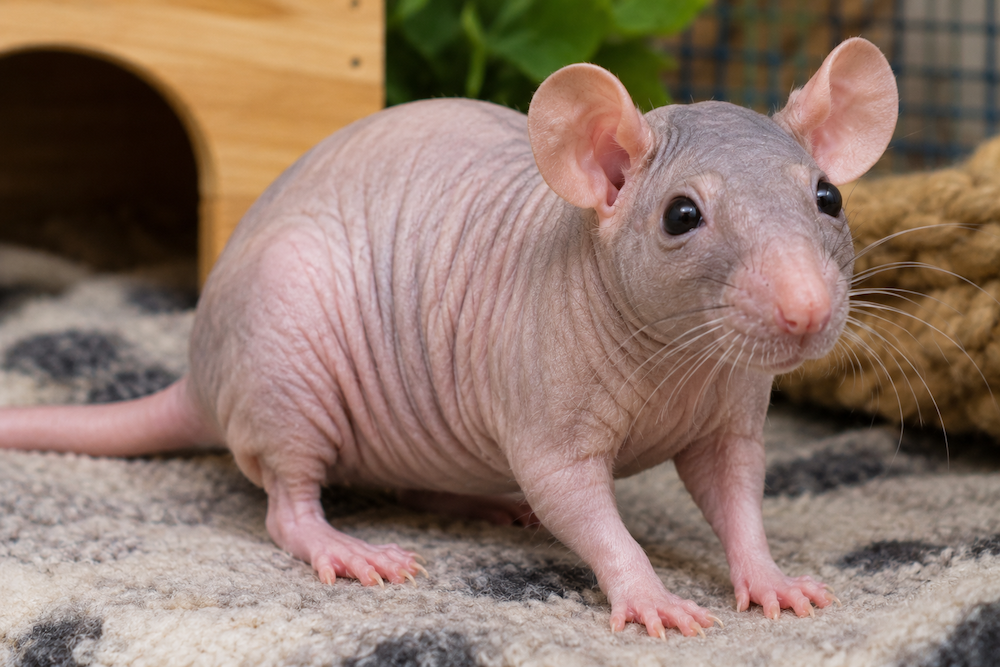







Unusually distinctive, remarkably intelligent and often wonderfully affectionate, the Hairless Rat is a fascinating variety of domestic fancy rat known for its exposed skin, oversized-looking ears, delicate whiskers and playful personality.
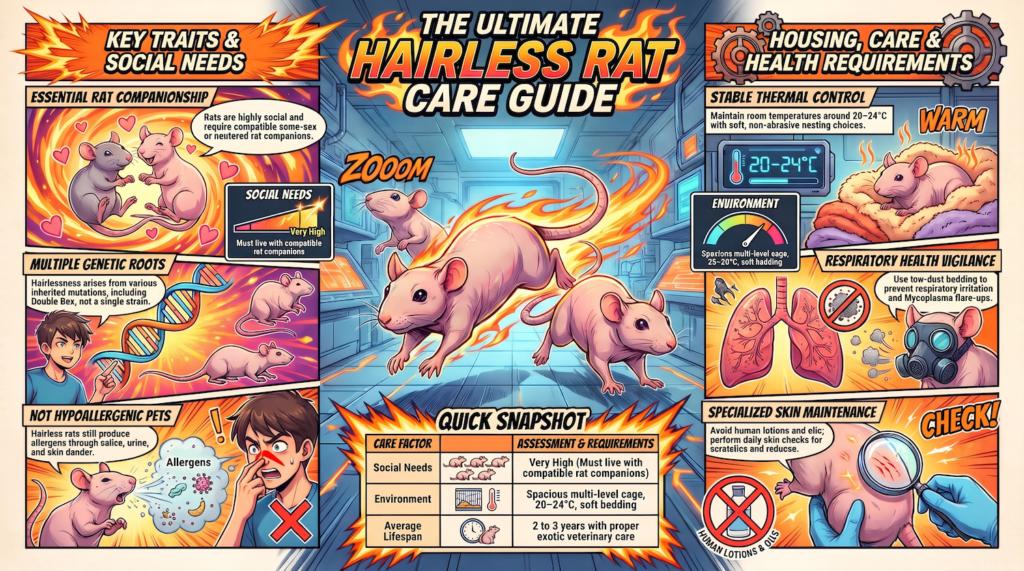
🧠 QUICK SNAPSHOT
Trait | Hairless Rat |
|---|---|
Scientific Name | Rattus norvegicus (domesticated form) |
Other Names | Naked Rat, Hairless Fancy Rat, Sphynx Rat |
Pet Type | Domestic Rat / Small Mammal |
Variety Origin | Developed through genetic variations within domestic rat populations |
Classification | Coat variety rather than a separate species |
Typical Lifespan | Approximately 2–3 years, although some genetic lines have shorter lifespans |
Adult Size | Approximately 20–28 cm body length, excluding tail |
Adult Weight | Commonly 250–650 g |
Coat Type | Hairless, nearly hairless or sparsely furred |
Skin Colours | Pink, grey, dark brown, black and various pigmentation patterns |
Whiskers | May be short, curled, sparse or absent |
Distinctive Feature | Little or no body fur and exposed, often wrinkled skin |
Diet | Omnivore |
Activity | Primarily crepuscular and nocturnal |
Temperament | Intelligent, curious, playful, social and often affectionate |
Noise Level | Generally quiet; communicates through audible and ultrasonic sounds |
Social Needs | Very high; requires compatible rat companionship |
Grooming | Regular skin inspections and occasional gentle cleaning |
Housing | Spacious, secure, multi-level enclosure with soft furnishings |
Temperature | Stable, comfortably warm conditions, generally around 22–26°C |
Exercise Needs | High; requires daily supervised exploration |
Training Ability | Excellent; capable of learning tricks and routines |
Beginner Friendly? | Better suited to experienced or particularly dedicated owners |
Famous Feature | Unusual hairless appearance and warmth-seeking behaviour |
📚 OVERVIEW
The Hairless Rat is one of the most unusual varieties of domestic fancy rat. Its exposed skin, delicate facial features and distinctive wrinkles create an appearance dramatically different from that of conventional furry rats.
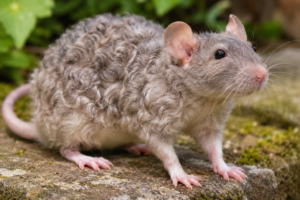
Hairlessness can result from several inherited genetic variations affecting hair follicle development and coat growth. Some Hairless Rats are almost completely bald, while others develop fine fuzz, sparse whiskers or temporary patches of fur. Double Rex Rats can also display a nearly hairless appearance, although their genetic characteristics may differ.
Despite their unusual appearance, Hairless Rats share the intelligence, curiosity and highly social nature of other domestic rats. Many enjoy exploring, learning tricks, interacting with companions and developing close relationships with familiar caregivers.
Their care requires compatible rat companionship, stable temperatures, soft bedding, balanced nutrition, daily enrichment and regular skin and health inspections. Their lack of protective fur makes them particularly vulnerable to temperature changes, scratches and skin irritation.
✅ PROS & CONS
👍 Pros
Extraordinary and distinctive appearance
Highly intelligent and trainable
Often affectionate with familiar caregivers
Playful, curious and entertaining
No conventional coat brushing required
Can learn numerous tricks and routines
Fascinating social behaviours
Can live with compatible furry rats
👎 Cons
Sensitive to cold temperatures and draughts
Exposed skin is vulnerable to scratches and irritation
May experience additional genetic health problems
Relatively short lifespan
Requires compatible rat companionship
Needs daily exercise and mental stimulation
Requires careful bedding and enclosure selection
Not genuinely hypoallergenic
Are Hairless Rats Good Pets?
Yes. Hairless Rats can make fascinating and rewarding companions for people prepared to meet their specialised care requirements.
They are intelligent, social and often affectionate, but their exposed skin and temperature sensitivity require additional attention compared with standard furry rats.
Are Hairless Rats Good for Beginners?
Hairless Rats are generally better suited to experienced rat owners or particularly dedicated beginners.
Although their basic care resembles that of other domestic rats, their skin protection, temperature management and potential genetic health concerns make ownership more demanding.
How Long Do Hairless Rats Live?
Hairless Rats commonly live approximately 2–3 years, although lifespan varies considerably between genetic lines.
Some hairless mutations are associated with additional health problems that may reduce life expectancy.
How Big Do Hairless Rats Get?
Adult Hairless Rats generally measure approximately 20–28 cm in body length, excluding their tails.
Their lack of fur can make them appear smaller and more slender than similarly sized furry rats.
How Much Do Hairless Rats Weigh?
Adult females commonly weigh approximately 250–450 grams, while males often weigh around 350–650 grams.
Regular weighing is particularly useful for monitoring nutrition, body condition and early signs of illness.
Why Are Hairless Rats Hairless?
Hairless Rats possess inherited genetic variations that affect hair follicle development or normal hair growth.
Several different mutations can produce a hairless appearance, meaning not all Hairless Rats have identical genetic or health characteristics.
Are Hairless Rats Completely Bald?
Not always.
Some Hairless Rats have almost entirely exposed skin, while others develop fine fuzz, sparse facial hair or small patches of fur.
Their appearance may also change as they mature.
What Is the Difference Between a Hairless Rat and a Double Rex Rat?
Hairless Rats may carry genetic variations that prevent normal coat development.
Double Rex Rats inherit two copies of a Rex coat variant in established Rex breeding lines and often develop sparse, patchy or periodically changing fur.
Although they can look similar, their genetic backgrounds may differ.
Do Hairless Rats Have Whiskers?
Some Hairless Rats possess short, curled or sparse whiskers, while others may have very few functional whiskers.
Whiskers are important sensory structures that help rats investigate their surroundings, particularly in low-light conditions.
What Colours Do Hairless Rats Come In?
Hairless Rats may have pink, grey, brown or darkly pigmented skin.
Some display distinct pigmentation patterns corresponding to the coat colours and markings they might otherwise have expressed.
Skin pigmentation can also change with age.
Why Do Hairless Rats Have Wrinkled Skin?
Without a coat covering their bodies, the natural folds and contours of their skin become much more visible.
Wrinkles are particularly noticeable around the neck, shoulders and limbs.
However, unusual changes in skin appearance should be monitored for potential health problems.
Are Hairless Rats Friendly?
Many Hairless Rats are friendly, curious and comfortable around familiar caregivers.
Their temperament depends primarily on genetics, socialisation and previous experiences rather than their lack of fur.
Are Hairless Rats Affectionate?
Yes. Many Hairless Rats enjoy climbing onto their caregivers, resting nearby or receiving gentle attention.
They may also seek warm resting places, including the folds of clothing, although warmth-seeking should not automatically be interpreted as affection.
Do Hairless Rats Recognise Their Owners?
Domestic rats can learn to recognise familiar people through scent, sound and other environmental cues.
Hairless Rats may respond to familiar voices, approach when called and become excited around established feeding routines.
Do Hairless Rats Like Being Held?
Many Hairless Rats tolerate or enjoy gentle handling once they feel secure.
Their bodies should always be properly supported, and care must be taken to avoid scratching or irritating their exposed skin.
Rats should never be lifted by their tails.
Are Hairless Rats Good With Children?
Hairless Rats can be suitable for families with older, responsible children under adult supervision.
However, their exposed skin and delicate bodies require particularly gentle handling.
Adults should remain responsible for their daily care and welfare.
Are Hairless Rats Intelligent?
Yes. Hairless Rats share the remarkable intelligence of other domestic fancy rats.
They can learn routines, navigate mazes, recognise cues and solve simple problems.
Regular mental stimulation is essential for their wellbeing.
Can Hairless Rats Learn Tricks?
Yes. Hairless Rats respond well to positive reinforcement and can learn numerous behaviours, including:
Coming when called
Following a target
Turning in circles
Retrieving small objects
Navigating tunnels and mazes
Completing simple agility courses
Entering a carrier voluntarily
Short, reward-based training sessions provide valuable mental enrichment.
Can Hairless Rats Be Litter Trained?
Yes, to a degree.
Many Hairless Rats can learn to use designated litter trays for droppings.
However, urine marking is a natural rat behaviour and may continue despite training.
Do Hairless Rats Need Companions?
Yes. Hairless Rats are highly social animals that generally require companionship from other compatible domestic rats.
A bonded pair or suitable group provides essential social interaction, play, mutual grooming and shared resting opportunities.
Human attention cannot fully replace rat companionship.
Can Hairless Rats Live With Furry Rats?
Yes. Hairless Rats can live successfully with compatible Standard, Dumbo, Rex and other domestic fancy rats.
Furry companions may also provide additional warmth when resting together.
However, owners should monitor interactions because scratches from rough play can be more noticeable on exposed skin.
Can Two Male Hairless Rats Live Together?
Yes. Compatible male Hairless Rats can develop strong social relationships.
Careful introductions, spacious accommodation and multiple sleeping and feeding areas can help reduce territorial conflict.
Are Hairless Rats Noisy?
Hairless Rats are generally quiet animals.
They may produce audible squeaks during social interactions and communicate through ultrasonic vocalisations that humans cannot normally hear.
Why Do Hairless Rats Grind Their Teeth?
This behaviour is known as bruxing.
Rats may grind their teeth when relaxed, content, stressed or experiencing discomfort.
The surrounding behaviour and circumstances help determine what the grinding may indicate.
Are Hairless Rats Active at Night?
Yes. Hairless Rats are generally most active during the evening and night.
However, they often adjust their activity patterns around household routines and may wake during the day to eat, explore or interact with their caregivers.
What Size Cage Does a Hairless Rat Need?
Hairless Rats require spacious accommodation with substantial climbing, exploration and resting opportunities.
For a pair, an enclosure measuring approximately 90 × 60 × 90 cm is a useful starting point, with larger accommodation preferable.
Solid platforms, soft hammocks and safe climbing structures are particularly important.
What Temperature Do Hairless Rats Need?
Hairless Rats benefit from stable, comfortably warm indoor conditions, generally around 22–26°C, with opportunities to select warmer or cooler resting areas.
Their lack of insulating fur makes them more vulnerable to cold conditions and draughts.
Excessive heat must also be avoided.
Do Hairless Rats Get Cold Easily?
Yes. Hairless Rats lose body heat more readily than furry rats because they lack normal coat insulation.
Soft nesting materials, enclosed sleeping areas, stable room temperatures and compatible companions help them remain comfortable.
Persistent huddling, lethargy or unusual behaviour may indicate a problem.
Do Hairless Rats Need Heat Lamps?
Generally, no.
Maintaining a comfortably warm room is usually safer than using direct heat lamps, which can cause overheating, dehydration or burns.
Any supplementary heating should be carefully controlled and allow the rats to move away from the heat source.
Can Hairless Rats Go Outside?
Hairless Rats are best housed indoors.
Their exposed skin makes them particularly vulnerable to direct sunlight, temperature fluctuations, insects and environmental hazards.
Any outdoor exposure should be brief, supervised, shaded and appropriately controlled.
Can Hairless Rats Get Sunburnt?
Yes. Their exposed skin is more vulnerable to ultraviolet radiation than skin protected by a normal coat.
Enclosures should be positioned away from strong direct sunlight.
Human sunscreen should not be applied without veterinary guidance because rats groom themselves and may ingest it.
What Bedding Is Best for Hairless Rats?
Hairless Rats benefit from soft, absorbent, low-dust bedding.
Suitable options include paper-based bedding and appropriately maintained fleece liners.
Rough, sharp, strongly scented or dusty materials should be avoided because they may irritate exposed skin or the respiratory system.
Do Hairless Rats Need Hammocks?
Hammocks and enclosed sleeping areas are excellent additions to a Hairless Rat enclosure.
Soft fabrics provide comfortable resting surfaces and help reduce heat loss.
Furnishings should be regularly washed and inspected for loose threads or damage.
Do Hairless Rats Need Exercise?
Yes. Hairless Rats require daily opportunities to explore, climb, forage and interact with their environment.
Supervised exercise outside the enclosure provides valuable physical and mental stimulation.
Exploration areas should be free from sharp objects and other hazards that could damage their skin.
What Do Hairless Rats Eat?
Hairless Rats are omnivores.
Their diet should consist primarily of a complete, nutritionally balanced commercial rat food, supplemented with suitable vegetables and occasional healthy treats.
Fresh drinking water must always be available.
Do Hairless Rats Need More Food Than Furry Rats?
Some Hairless Rats may have increased energy requirements because maintaining body temperature without insulating fur can require additional energy.
However, nutritional needs vary between individuals.
Food portions should be adjusted according to body condition, activity levels and veterinary advice rather than automatically increasing calorie intake.
Do Hairless Rats Need Extra Protein?
Not necessarily.
A high-quality complete rat diet should provide appropriate protein for most healthy adult Hairless Rats.
Additional protein should only be considered when justified by age, health, nutritional requirements or veterinary recommendations.
Do Hairless Rats Need Baths?
Usually not.
Hairless Rats groom themselves and their companions just like furry rats.
Occasional gentle spot-cleaning may be necessary, but frequent bathing can remove protective skin oils, cause irritation and contribute to chilling.
Do Hairless Rats Need Moisturiser?
Not routinely.
Healthy Hairless Rat skin generally doesn’t require regular application of oils, creams or moisturisers.
Persistent dryness, flaking, redness or irritation should be assessed by a veterinarian rather than treated with human skincare products.
Do Hairless Rats Shed?
Hairless Rats with little or no fur produce very little conventional hair shedding.
However, partially hairless individuals and Double Rex Rats may periodically grow and lose patches of fur.
They also naturally shed microscopic skin particles.
Are Hairless Rats Hypoallergenic?
No. Hairless Rats are not hypoallergenic.
Rat allergens are commonly associated with urine, saliva and skin particles rather than fur alone.
People with rat allergies may still experience significant reactions around Hairless Rats.
Do Hairless Rats Scratch Easily?
Yes. Without protective fur, their skin is more exposed to scratches from enclosure furnishings, companions and environmental objects.
Minor superficial scratches may heal normally, but deep wounds, swelling, redness or discharge require veterinary attention.
Do Hairless Rats Have Weaker Immune Systems?
Not all Hairless Rats have weakened immune systems.
However, certain genetic mutations associated with hairlessness, particularly those found in some specialised laboratory rat lines, can also affect immune function.
The health of individual animals depends considerably on their genetic background.
Responsible breeding should prioritise health and welfare over extreme hairlessness.
Are Hairless Rats Prone to Eye Problems?
Some Hairless Rats may experience eye irritation, particularly when they have abnormal or sparse eyelashes.
Dust, bedding particles and other environmental irritants may contribute to discomfort.
Persistent squinting, discharge, swelling or redness requires veterinary assessment.
Can Hairless Rats Breed With Furry Rats?
Yes. Hairless Rats belong to the same domesticated species as furry fancy rats and can reproduce with them.
Whether offspring develop hairless coats depends on the genetic variations carried by their parents.
Breeding should only be undertaken by experienced, welfare-focused breeders because some hairless genetic lines have significant health or reproductive concerns.
What Health Problems Are Common in Hairless Rats?
Potential concerns include skin irritation, scratches, abscesses, eye problems, respiratory disease, mammary tumours and temperature-related stress.
Certain genetic lines may also experience immune system abnormalities or reproductive difficulties.
Regular health inspections and access to a veterinarian experienced with small mammals are essential.
Are Hairless Rats Legal to Keep as Pets?
Hairless Rats are legal domestic pets in many countries, including much of Australia.
However, some countries or regions restrict or prohibit domestic rat ownership, breeding, sale or importation.
Prospective owners should verify local regulations and obtain animals from reputable, welfare-focused sources.
What Makes the Hairless Rat Unique?
Imagine a tiny, almost completely bald animal with delicate wrinkles, prominent ears, an inquisitive expression and enough intelligence to learn tricks, navigate mazes and recognise familiar people.
That’s the extraordinary Hairless Rat.
Among the many varieties of domestic fancy rats, few have an appearance as unusual or immediately recognisable as the Hairless Rat.
However, its lack of fur is only the beginning of a fascinating story involving genetics, biology, temperature regulation and remarkable social intelligence.
One of the most interesting facts about Hairless Rats is that there isn’t just one genetic explanation for their appearance.
Several inherited mutations can interfere with normal hair follicle development or coat growth.
Some rats never develop a substantial coat, while others grow sparse hair that subsequently falls out.
This means two almost identical-looking Hairless Rats may have considerably different genetic backgrounds.
The Double Rex Rat provides another fascinating example.
In established Rex breeding lines, inheriting two copies of the relevant Rex coat variant can result in extremely sparse or patchy fur.
Some Double Rex Rats repeatedly grow and lose patches of hair throughout their lives.
Their appearance can therefore change dramatically over time.
Another extraordinary characteristic of Hairless Rats is their relationship with temperature.
Fur normally provides an insulating layer that helps mammals retain body heat.
Without this protection, Hairless Rats can lose heat more readily and may seek warm sleeping areas more frequently than furry companions.
This helps explain why many Hairless Rats enjoy sleeping inside soft hammocks, resting beneath nesting materials or cuddling closely with other rats.
Their social behaviour provides both companionship and practical benefits.
A group of rats resting together can help conserve warmth while reinforcing their social relationships.
Hairless Rats also reveal features of rat anatomy that are normally concealed beneath fur.
Their skin pigmentation, muscular movements, natural wrinkles and body contours become particularly noticeable.
Even the small movements associated with breathing, grooming and exploration can be easier to observe.
Their whiskers are another fascinating characteristic.
Rats rely heavily on whiskers to gather information about nearby objects and navigate in low-light environments.
Some Hairless Rats possess short or curled whiskers, while others have very few.
This makes safe, predictable enclosure design especially important.
Despite their unusual appearance, Hairless Rats possess the same remarkable learning abilities associated with domestic rats.
They can recognise patterns, remember routes, solve problems and respond to reward-based training.
Some learn to retrieve objects, navigate obstacle courses or return to their caregivers when called.
Their social communication is equally extraordinary.
Rats communicate using scent, touch, body language and an extensive range of vocalisations.
Many of these sounds occur at ultrasonic frequencies beyond normal human hearing.
Researchers have identified ultrasonic calls associated with playful interactions and positive experiences, including calls sometimes popularly described as rat laughter.
Hairless Rats also display fascinating behaviours such as bruxing and boggling.
During bruxing, rats rapidly grind their teeth.
This can sometimes produce a visible movement of the eyes known as boggling, caused by the interaction of jaw muscles and surrounding tissues.
Although these behaviours may appear strange to unfamiliar observers, they are often seen during periods of relaxation.
Another common misconception is that Hairless Rats must be hypoallergenic because they lack fur.
In reality, many rat allergens originate from urine, saliva and skin particles.
Removing the coat doesn’t remove these allergens.
Perhaps the most important consideration surrounding Hairless Rats is responsible breeding.
While their unusual appearance attracts considerable attention, some genetic variations associated with hairlessness can also affect other biological functions.
Not every Hairless Rat experiences these problems, but breeding animals solely for extreme hairlessness without considering their health can create unnecessary welfare concerns.
Their comfort, sensory abilities, immune function and overall quality of life should always take priority over appearance.
Ultimately, what makes the Hairless Rat truly special isn’t simply its exposed skin.
Beneath those distinctive wrinkles is an intelligent, curious and highly social animal capable of learning, playing, exploring and developing meaningful relationships with its companions.
The Hairless Rat isn’t simply a rat without fur — it’s a fascinating example of genetic diversity, remarkable intelligence and extraordinary social behaviour, wrapped in one of the most unusual appearances in the small-pet world.