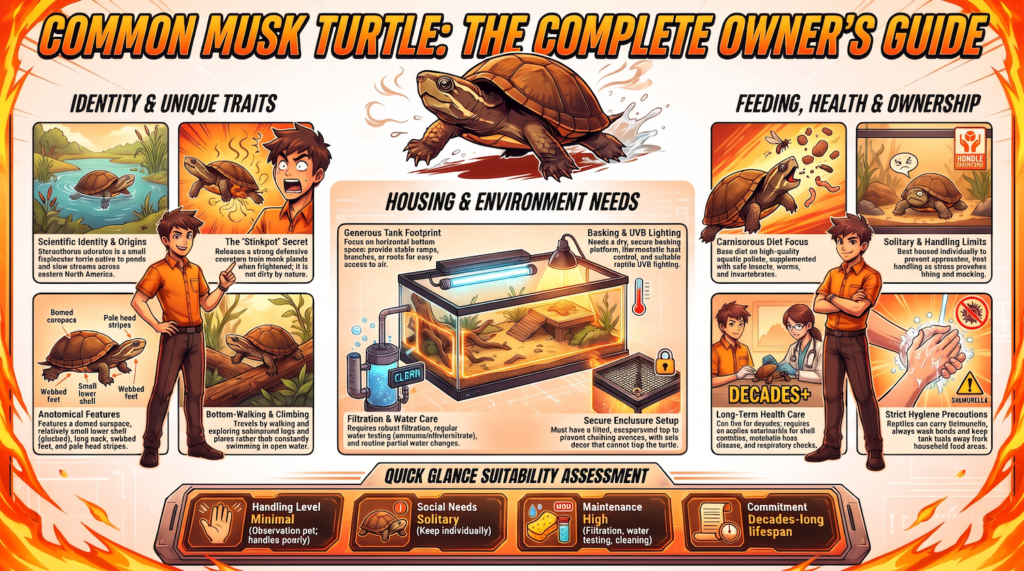







Small, curious and surprisingly full of personality, the Musk Turtle is a fascinating freshwater reptile famous for its distinctive musky defence mechanism, underwater walking abilities, powerful jaws and charmingly unusual appearance.
🧠 QUICK SNAPSHOT
Trait | Musk Turtle |
|---|---|
Scientific Name | Sternotherus odoratus (Common Musk Turtle) |
Other Names | Common Musk Turtle, Eastern Musk Turtle, Stinkpot Turtle |
Pet Type | Freshwater Reptile / Aquatic Turtle |
Natural Origin | Eastern North America |
Typical Lifespan | Approximately 20–30 years; some live considerably longer |
Adult Size | Commonly 8–13 cm shell length |
Adult Weight | Approximately 100–300 g, varying by individual |
Shell Type | Small, oval, usually dark brown or black |
Shell Colours | Brown, dark olive, grey-brown and black |
Distinctive Feature | Releases a strong-smelling defensive secretion |
Diet | Omnivore, with a strong preference for animal-based foods |
Activity | Often crepuscular or nocturnal; may also be active during the day |
Temperament | Curious, secretive, independent and sometimes defensive |
Noise Level | Virtually silent |
Social Needs | Solitary; individual housing generally recommended |
Housing | Spacious freshwater aquarium with accessible basking area |
Water Temperature | Approximately 23–27°C for many captive adults |
Basking Temperature | Approximately 29–32°C |
Lighting | UVB lighting and a consistent day-night cycle |
Water Depth | Sufficient for swimming, with easy access to resting and climbing structures |
Grooming | No conventional grooming required |
Maintenance | Moderate to high because of water quality requirements |
Handling | Minimal; observation preferred |
Beginner Friendly? | Suitable for prepared beginners with appropriate aquatic equipment |
Famous Feature | Musky defence glands and a preference for walking along underwater surfaces |
📚 OVERVIEW
The Musk Turtle is a small freshwater turtle belonging to the family Kinosternidae. The name commonly refers to several species within the genus Sternotherus, but the best-known pet species is the Common Musk Turtle, Sternotherus odoratus, native to eastern North America.
Unlike many larger aquatic turtles, Musk Turtles remain relatively small throughout their lives. Their compact size, dark shells and unusual behaviour have made them popular among reptile enthusiasts in countries where ownership is permitted. Despite their small size, they are hardy, long-lived animals with specialised aquatic requirements.
Musk Turtles spend much of their time exploring the bottoms of ponds, streams and other freshwater environments. Rather than constantly swimming through open water, they often walk along submerged branches, rocks and vegetation. Their strong claws and powerful limbs make them particularly well suited to investigating underwater habitats.
Their care requires a spacious, well-filtered aquarium, clean freshwater, appropriate heating, UVB lighting, an accessible basking area, suitable nutrition and minimal handling. Their long lifespan and sensitivity to poor water quality make them a substantial commitment.
✅ PROS & CONS
👍 Pros
Small adult size compared with many aquatic turtles
Fascinating underwater walking behaviour
Distinctive appearance and unusual natural history
Curious and entertaining to observe
Generally manageable dietary requirements
Can thrive in a well-designed aquatic enclosure
Relatively little direct handling required
Long-lived companion for dedicated reptile enthusiasts
👎 Cons
Requires powerful aquarium filtration
Can release unpleasant-smelling defensive secretions
May bite when frightened or restrained
Needs UVB lighting and suitable heating
Water quality requires regular monitoring
Can live for several decades
Not suitable for frequent handling
Ownership is restricted or prohibited in some countries or regions
Are Musk Turtles Good Pets?
Yes. Musk Turtles can make fascinating pets for people interested in aquatic reptiles.
Their small size, curious behaviour and unusual appearance make them appealing.
However, they require carefully maintained aquatic accommodation and are best appreciated through observation rather than frequent handling.
Are Musk Turtles Good for Beginners?
Musk Turtles can be suitable for prepared beginners.
Their relatively small adult size makes them more manageable than many larger turtle species.
However, beginners must understand aquarium filtration, water quality, heating, lighting and reptile nutrition before obtaining one.
How Long Do Musk Turtles Live?
Common Musk Turtles often live approximately 20–30 years in captivity.
Some individuals may live considerably longer, potentially exceeding 40 years.
Their lifespan depends on genetics, nutrition, water quality, environmental conditions and veterinary care.
How Big Do Musk Turtles Get?
Adult Common Musk Turtles generally reach approximately 8–13 cm in shell length.
Females are often slightly larger than males.
Their compact size makes them one of the smaller freshwater turtle species commonly discussed in the pet trade.
How Much Do Musk Turtles Weigh?
Adult Common Musk Turtles commonly weigh approximately 100–300 grams.
Weight varies according to age, sex, size and body condition.
Regular monitoring helps identify unusual weight loss or other health concerns.
Why Are They Called Musk Turtles?
Musk Turtles possess specialised glands that can release a strong-smelling defensive secretion.
The odour helps discourage potential predators.
This characteristic is responsible for the name Musk Turtle.
Why Are Musk Turtles Called Stinkpots?
The Common Musk Turtle is often nicknamed the Stinkpot Turtle.
When threatened, it may release an unpleasant-smelling substance from specialised glands.
This defensive behaviour is particularly associated with frightened or restrained individuals.
Do Musk Turtles Smell Bad?
Healthy Musk Turtles don’t constantly produce a strong odour.
Their defensive secretion may be released when they feel threatened.
An unpleasant-smelling aquarium is more commonly associated with poor water quality, accumulated waste or inadequate filtration.
What Are the Different Types of Musk Turtles?
Several species belong to the genus Sternotherus, including:
Common Musk Turtle (Sternotherus odoratus) — small, widespread and famous for its musky defence
Razor-Backed Musk Turtle (Sternotherus carinatus) — recognised for its sharply raised shell keel
Loggerhead Musk Turtle (Sternotherus minor) — known for its relatively large head and powerful jaws
Flattened Musk Turtle (Sternotherus depressus) — a rare, highly specialised species with conservation concerns
Intermediate Musk Turtle (Sternotherus intermedius) — a distinct species recognised through modern taxonomic research
Different species have different environmental needs, and some are protected or unsuitable for private keeping.
What Is the Difference Between a Musk Turtle and a Mud Turtle?
Musk Turtles and Mud Turtles are closely related members of the family Kinosternidae.
Musk Turtles generally belong to the genus Sternotherus, while many Mud Turtles belong to Kinosternon.
They differ in shell structure, anatomy, behaviour and habitat preferences, although both groups include relatively small freshwater turtles.
Are Musk Turtles Friendly?
Musk Turtles aren’t social or affectionate in the same way as dogs or cats.
However, many captive individuals become accustomed to feeding routines and the presence of their caregivers.
Some may approach the aquarium glass when anticipating food.
Do Musk Turtles Recognise Their Owners?
Musk Turtles can learn to associate familiar environmental cues with feeding and routine care.
Some appear to respond to particular people approaching their enclosure.
However, scientific evidence for individual human recognition in Musk Turtles is limited.
Do Musk Turtles Like Being Held?
Generally, no.
Musk Turtles are best treated as observation pets.
Frequent handling can cause stress and may trigger defensive biting or musking.
Handling should be limited to necessary health checks, enclosure maintenance and veterinary care.
Do Musk Turtles Bite?
Yes.
Musk Turtles possess strong jaws and may bite when frightened or restrained.
Although they are small, their bites can be painful.
They should never be handled carelessly or allowed to bite fingers during feeding.
Are Musk Turtles Aggressive?
Musk Turtles can display defensive behaviour.
This may include opening the mouth, attempting to bite or releasing musky secretions.
Such responses are usually associated with fear, stress or territorial interactions rather than aggression towards humans.
Are Musk Turtles Dangerous to Humans?
Musk Turtles are generally not dangerous when appropriately housed and handled.
However, their bites can cause injuries, and reptiles may carry Salmonella bacteria even when they appear healthy.
Thorough handwashing after contact with turtles, aquarium water or equipment is essential.
Are Musk Turtles Active?
Yes.
Musk Turtles often spend considerable time exploring underwater surfaces.
They may investigate plants, rocks, submerged branches and aquarium furnishings.
Activity levels vary according to temperature, lighting, feeding and individual behaviour.
Are Musk Turtles Nocturnal?
Common Musk Turtles are often most active during the evening and night.
However, they may also forage and explore during daylight hours.
Their activity patterns vary with environmental conditions.
Can Musk Turtles Live Together?
Musk Turtles are generally best housed individually.
Some individuals may tolerate other turtles, but aggression and competition can occur.
Males may be particularly territorial, and even apparently compatible turtles can injure one another.
Can Two Male Musk Turtles Live Together?
Housing two male Musk Turtles together is generally not recommended.
Males may fight, chase or bite one another.
Separate enclosures provide a safer arrangement.
Can Musk Turtles Live With Fish?
Keeping Musk Turtles with fish is risky.
Musk Turtles may hunt, injure or consume smaller fish.
Fish may also compete for food or introduce health concerns.
A species-only turtle enclosure is generally the safest choice.
Can Musk Turtles Live With Other Turtle Species?
Mixed-species turtle enclosures are generally discouraged.
Different species may have different environmental requirements.
Aggression, competition and disease transmission can also create problems.
Separate housing is usually preferable.
What Size Aquarium Does a Musk Turtle Need?
Despite their small size, Musk Turtles require substantial aquatic space.
For one adult Common Musk Turtle, an aquarium with a footprint of approximately 90 × 45 cm and a water volume around 150 litres or more is a useful starting point.
Larger aquariums provide additional swimming, walking and exploration opportunities.
How Deep Should Musk Turtle Water Be?
Musk Turtles can swim, but they often prefer exploring underwater surfaces.
Water depth should allow normal swimming while providing easy access to resting areas near the surface.
Branches, platforms and other secure structures are particularly useful in deeper aquariums.
Can Musk Turtles Swim?
Yes.
Musk Turtles are capable swimmers.
However, they frequently move by walking along the bottom or climbing submerged structures.
Their behaviour differs from that of some highly active open-water swimming turtles.
Do Musk Turtles Need Land?
Yes.
Musk Turtles should have access to a dry basking area.
Although some individuals bask less frequently than other aquatic turtles, the opportunity should always be available.
The platform must be stable and easy to access.
Do Musk Turtles Bask?
Yes, although basking frequency varies.
Some Musk Turtles bask regularly, while others spend much of their time submerged.
A suitable basking area with appropriate heat and UVB lighting should be provided.
What Water Temperature Do Musk Turtles Need?
Many captive Common Musk Turtles thrive with water temperatures around 23–27°C.
Exact requirements depend on age, health and environmental conditions.
A reliable aquarium thermometer and thermostatically controlled heater help maintain stable temperatures.
What Basking Temperature Do Musk Turtles Need?
A basking area around 29–32°C is generally suitable for Common Musk Turtles.
The turtle should be able to leave the basking area and return to cooler water.
Temperatures should be monitored to prevent overheating.
Do Musk Turtles Need UVB Lighting?
Yes.
Appropriate UVB lighting is recommended for captive Musk Turtles.
UVB exposure supports vitamin D synthesis and calcium metabolism.
A suitable UVB lamp should illuminate an accessible basking area while allowing the turtle to retreat into shade.
Do Musk Turtles Need a Water Filter?
Yes.
Effective biological and mechanical filtration is essential.
Turtles produce substantial waste relative to their size.
A filter designed to handle a greater biological load than a typical fish-only aquarium can help maintain water quality.
How Often Should You Clean a Musk Turtle Tank?
Cleaning frequency depends on aquarium size, filtration and feeding practices.
Partial water changes, removal of uneaten food and regular filter maintenance are important.
Water quality should be monitored using suitable aquarium test kits rather than relying only on appearance or odour.
What Water Quality Do Musk Turtles Need?
Musk Turtles require clean, appropriately conditioned freshwater.
Ammonia and nitrite should remain at undetectable levels in a properly established aquarium.
Nitrate should be controlled through suitable filtration, water changes and maintenance.
What Substrate Is Best for Musk Turtles?
Fine sand or a bare-bottom aquarium can be suitable.
Large, smooth stones may also be used if they cannot be swallowed or trap the turtle.
Small gravel that could be accidentally ingested should be avoided.
Do Musk Turtles Need Hiding Places?
Yes.
Musk Turtles benefit from secure underwater hiding places.
Suitable options include submerged driftwood, caves, plants and stable rock structures.
Hiding places help reduce stress and encourage natural exploratory behaviour.
What Do Musk Turtles Eat?
Musk Turtles are omnivores, although animal-based foods form an important part of their natural diet.
Wild individuals consume aquatic insects, snails, worms, crustaceans, molluscs and other small aquatic animals.
In captivity, a high-quality commercial aquatic turtle pellet can form the dietary foundation, supplemented with suitable invertebrates and other appropriate foods.
Can Musk Turtles Eat Fish?
Yes.
Some Musk Turtles consume small fish in the wild.
However, fish should not be their only food source.
Feeder fish can introduce parasites or create nutritional imbalances if used incorrectly.
Do Musk Turtles Eat Snails?
Yes.
Snails are a natural food source for many Musk Turtles.
Their strong jaws allow them to crush or manipulate shelled prey.
Captive snails must come from safe sources free from pesticides and parasites.
Do Musk Turtles Eat Vegetables?
Some Musk Turtles consume aquatic vegetation and other plant material.
However, many individuals strongly prefer animal-based foods.
Suitable plant foods can be offered as part of a varied diet, but the nutritional balance should reflect the species’ needs.
How Often Should You Feed a Musk Turtle?
Juvenile Musk Turtles generally require more frequent feeding than adults.
Many healthy adults can be fed approximately three or four times weekly, depending on diet, portion size and body condition.
Overfeeding should be avoided because obesity can cause serious health problems.
Do Musk Turtles Need Calcium?
Yes.
Calcium is essential for healthy shell and bone development.
A nutritionally balanced diet, appropriate UVB lighting and suitable calcium sources help maintain healthy mineral metabolism.
Additional supplementation should be guided by the overall diet and veterinary advice.
Do Musk Turtles Shed Their Shells?
Musk Turtles may shed outer layers of their shell scutes as they grow.
However, shedding patterns vary, and some species shed less noticeably than other aquatic turtles.
Soft areas, foul odours, unusual discolouration or damaged shell tissue require veterinary assessment.
Can Musk Turtles Breathe Underwater?
Musk Turtles breathe air using lungs and must periodically reach the surface.
However, they possess adaptations that allow limited gas exchange through specialised tissues while submerged.
These adaptations help them remain underwater for extended periods, particularly during periods of reduced activity.
Do Musk Turtles Hibernate?
Wild Musk Turtles in cooler regions may undergo winter dormancy, known as brumation.
During this period, activity and metabolism decrease.
Captive brumation isn’t necessary for every pet turtle and should not be attempted without appropriate knowledge and veterinary guidance.
How Do Musk Turtles Breed?
Musk Turtles reproduce by laying eggs.
Females deposit relatively small clutches in suitable nesting locations on land.
Clutch size and reproductive frequency vary according to species and individual condition.
Captive breeding requires appropriate nesting opportunities, nutrition and responsible planning for offspring.
What Health Problems Are Common in Musk Turtles?
Potential concerns include shell infections, respiratory disease, metabolic bone disease, vitamin deficiencies, parasites, obesity and injuries from unsuitable housing.
Poor water quality is a major contributor to many aquatic turtle health problems.
A reptile-experienced veterinarian should assess abnormal swimming, persistent refusal to eat, swollen eyes, shell damage or unusual breathing.
Are Musk Turtles Hypoallergenic?
Musk Turtles don’t produce fur or mammalian dander.
However, no pet is completely allergen-free.
Aquarium materials, food products and other environmental substances may still cause reactions in sensitive people.
Are Musk Turtles Legal to Keep as Pets?
Musk Turtles are legal pets in some countries, but some countries or regions restrict or prohibit their ownership, breeding, sale or importation.
In Australia, Common Musk Turtles are exotic reptiles and are generally prohibited as private pets under strict biosecurity and wildlife regulations.
Australian reptile enthusiasts should consider legally available native freshwater turtle species instead, subject to applicable state or territory licensing requirements.
What Makes the Musk Turtle Unique?
Imagine a tiny freshwater turtle that spends much of its life walking along the bottom of rivers and ponds, possesses surprisingly powerful jaws and can release an unpleasant-smelling substance when threatened.
That’s the extraordinary Musk Turtle.
Despite its modest size, the Common Musk Turtle possesses an impressive collection of adaptations that make it one of North America’s most fascinating freshwater reptiles.
One of its most unusual features is the defensive mechanism responsible for its name.
Musk Turtles possess specialised glands that can release a strong-smelling secretion.
When frightened or restrained, the turtle may produce this unpleasant odour to discourage potential predators.
This behaviour has earned the Common Musk Turtle its memorable nickname: the Stinkpot Turtle.
However, the turtle doesn’t constantly produce this smell.
It is primarily a defensive response.
Another remarkable feature is its unusual method of moving underwater.
While many people imagine turtles swimming gracefully through open water, Musk Turtles often prefer walking along the bottom.
Their strong limbs and claws allow them to investigate submerged branches, rocks and aquatic vegetation.
They can swim when necessary, but their bottom-walking behaviour is particularly distinctive.
This adaptation is well suited to their natural habitats.
Common Musk Turtles inhabit ponds, lakes, slow-moving streams and other freshwater environments across eastern North America.
They often favour habitats with soft bottoms, submerged vegetation and plentiful hiding places.
Their dark shells help them blend into underwater environments.
Another fascinating feature is their ability to remain submerged for extended periods.
Like other turtles, Musk Turtles possess lungs and must breathe atmospheric air.
However, some freshwater turtles can supplement lung breathing through limited gas exchange across specialised body tissues.
Musk Turtles possess adaptations that assist with underwater gas exchange, helping them remain submerged for long periods under suitable conditions.
This is particularly useful during periods of reduced activity.
Their feeding abilities are equally impressive.
Despite their small size, Musk Turtles possess strong jaws.
They use these jaws to capture and process a variety of aquatic prey.
Snails, aquatic insects, worms, crustaceans and other small animals may form part of their natural diet.
Their jaws are particularly useful when feeding on prey with relatively hard external structures.
Another unusual feature is their appearance.
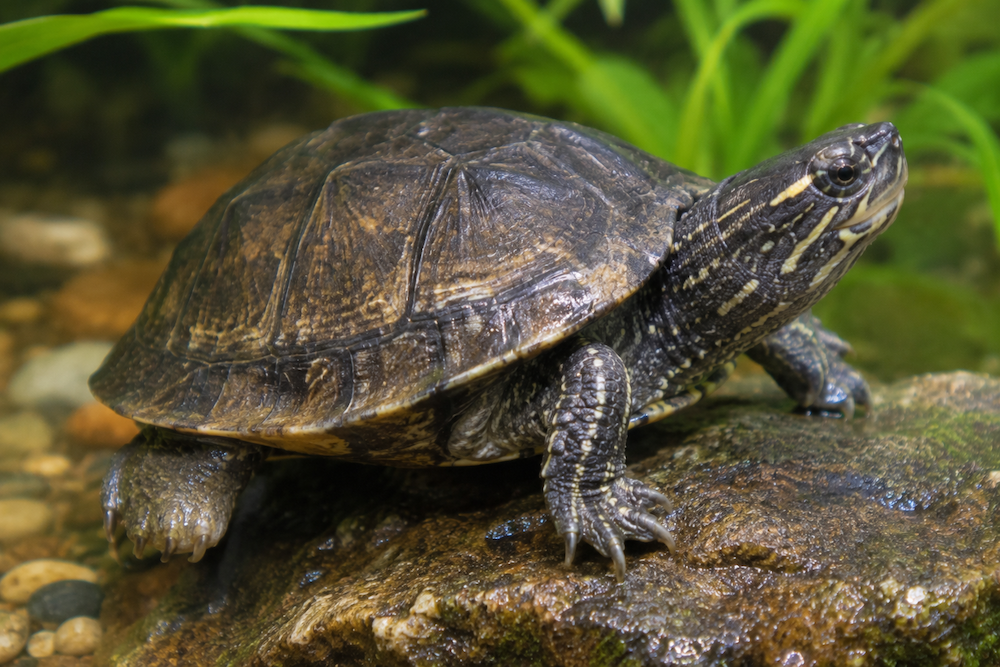
Common Musk Turtles have relatively small, oval shells that are often dark brown or black.
Many possess pale stripes along the sides of their heads.
Their compact shells and distinctive head markings create a recognisable appearance.
Unlike some freshwater turtles with brightly coloured shells, Musk Turtles rely largely on subdued colours that help them remain inconspicuous.
Their reproductive biology is another fascinating characteristic.
Female Musk Turtles lay eggs on land, despite spending most of their lives in water.
They must locate suitable nesting areas where eggs can develop under appropriate environmental conditions.
After hatching, the young turtles begin life as independent animals.
Their small size is also remarkable.
Many adult Common Musk Turtles measure only around 8–13 centimetres in shell length.
Yet these tiny reptiles can live for decades.
Their long lifespan is one of the most important considerations for anyone thinking about keeping them as pets.
Another interesting aspect of their behaviour is their tendency to remain hidden.
Musk Turtles often shelter beneath submerged objects or among vegetation.
This secretive behaviour helps protect them from predators.
When disturbed, they may retreat, bite or release defensive secretions.
Despite their small size, they are capable of defending themselves surprisingly effectively.
Their evolutionary history is equally fascinating.
Musk Turtles belong to the family Kinosternidae, a group of freshwater turtles that includes Mud Turtles and related species.
These reptiles possess a distinctive combination of shell structures, feeding adaptations and aquatic behaviours.
Their relatively small bodies and specialised lifestyles have allowed them to occupy a wide variety of freshwater habitats.
Perhaps the most surprising thing about Musk Turtles is how much fascinating behaviour is packed into such a small animal.
They aren’t simply miniature versions of larger turtles.
They are highly specialised freshwater reptiles with unusual defensive glands, impressive underwater mobility and remarkable feeding adaptations.
For reptile enthusiasts, observing a Musk Turtle explore its underwater environment can reveal an extraordinary world of natural behaviour.
The Musk Turtle isn’t simply a small freshwater turtle — it’s an extraordinary underwater explorer, equipped with powerful jaws, remarkable aquatic adaptations and one of the most unusual defensive mechanisms in the turtle world.