






Loving, energetic, and full of personality — is a Husky right for you?
🧠 QUICK SNAPSHOT
- Temperament: Friendly, Energetic, Independent
- Energy Level: High
- Size: Medium–Large
- Good with Families: Yes
- Training Difficulty: Moderate to Hard
📚 OVERVIEW
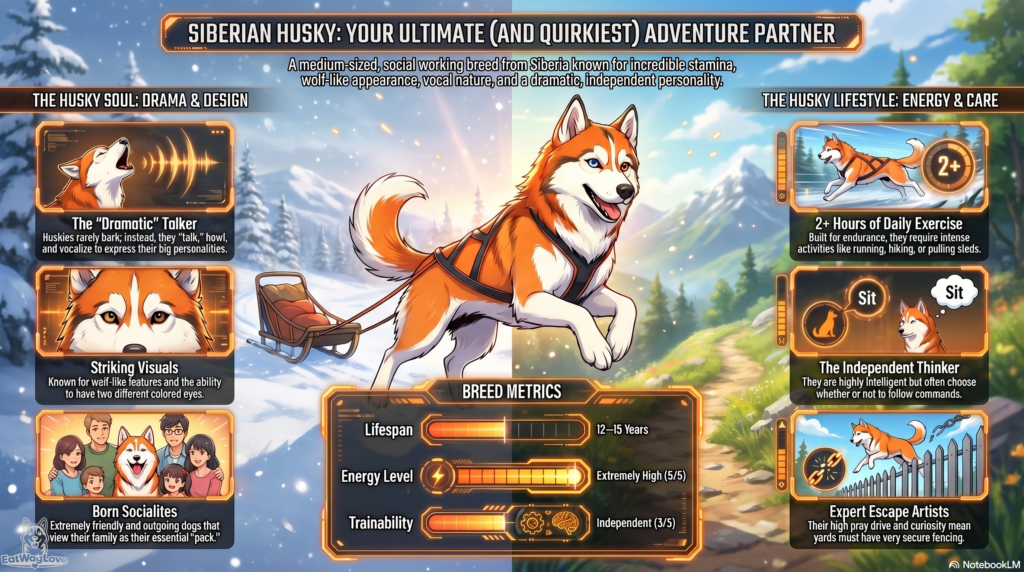
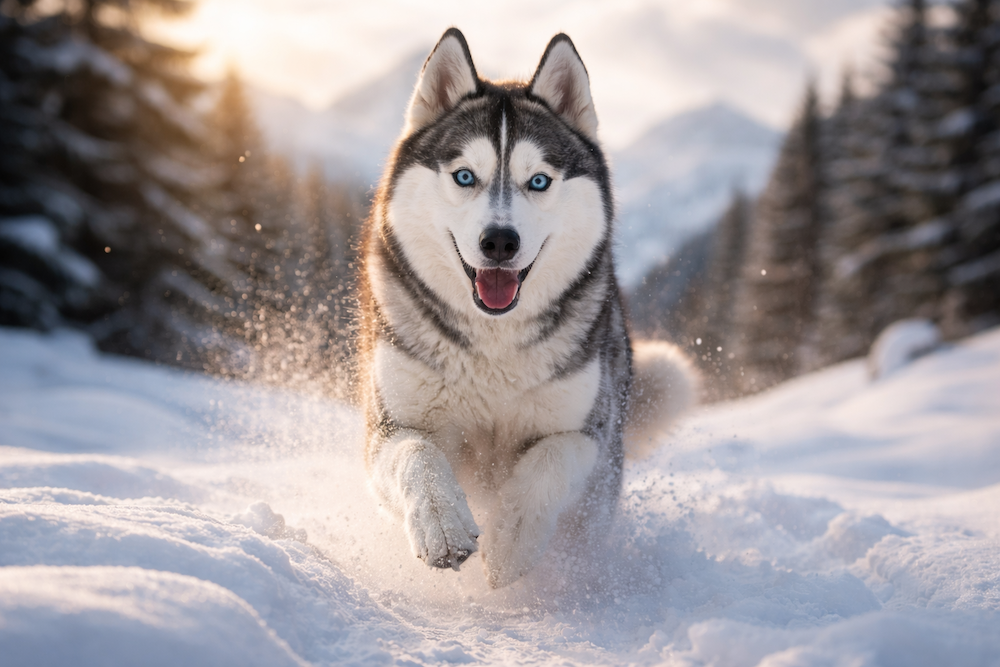
The Siberian Husky is a striking and energetic breed known for its wolf-like appearance and friendly personality. Originally bred as sled dogs, Huskies thrive in active environments and love being part of a pack. They are social, intelligent, and full of energy, making them a great fit for experienced owners who enjoy an active lifestyle.
✅ PROS & CONS
Pros
- Very friendly and social
- Great for active individuals or families
- Intelligent and playful
Cons
- Requires lots of exercise
- Can be stubborn and independent
- Heavy shedding
Is a Siberian Husky a Good Family Dog?
Yes. Siberian Huskies can be friendly, affectionate and playful family dogs for active households.
They’re typically sociable and enjoy being part of family life, but their high exercise needs, independence and strong prey drive mean they aren’t the easiest breed for every home.
Are Siberian Huskies Good With Children?
Generally, yes. Siberian Huskies are often playful and friendly with children.
Their energetic nature can make them excellent companions for active families, although enthusiastic Huskies can accidentally knock over small children.
As with any dog, interactions with young children should be supervised.
How Much Exercise Does a Siberian Husky Need?
Most adult Siberian Huskies need around 90 minutes to two hours of exercise each day, and some energetic individuals may want even more.
Running, hiking, walking and other active pursuits can help meet their physical needs.
Mental stimulation is also important because a bored Husky can become remarkably creative.
Are Siberian Huskies Easy to Train?
Siberian Huskies are intelligent but notoriously independent.
They can learn commands quickly while deciding for themselves whether responding is worthwhile.
Positive reinforcement, consistency and interesting training sessions generally work better than repetitive training.
Do Siberian Huskies Shed a Lot?
Yes. Siberian Huskies are very heavy shedders.
Their dense double coat sheds throughout the year and typically undergoes major seasonal coat blows, when enormous quantities of undercoat can be released.
Anyone considering a Husky should be comfortable with dog hair becoming part of everyday life.
Are Siberian Huskies Hypoallergenic?
No.
Siberian Huskies aren’t hypoallergenic and produce substantial amounts of loose hair and dander.
They’re generally unsuitable for someone specifically looking for a low-shedding dog.
How Often Should You Groom a Siberian Husky?
Siberian Huskies generally need brushing several times a week, increasing to daily during heavy seasonal shedding.
Their coat is relatively good at shedding dirt and usually doesn’t require frequent bathing.
Routine nail trimming, dental care and ear checks are also important.
Should You Shave a Siberian Husky?
Generally, no.
A Husky’s double coat provides insulation and protects the skin, and shaving it simply because the weather is warm isn’t recommended.
Regular brushing to remove loose undercoat is a better approach unless clipping is required for a medical reason.
What Health Problems Are Common in Siberian Huskies?
Important health concerns include eye disorders such as hereditary cataracts and progressive retinal atrophy, as well as hip dysplasia and certain other inherited conditions.
Responsible breeders should perform appropriate health screening before breeding.
Regular veterinary care and maintaining a healthy body weight are also important.
How Long Do Siberian Huskies Live?
Siberian Huskies commonly live around 12–14 years.
Some live considerably longer with good genetics, appropriate nutrition, exercise and preventive veterinary care.
They’re generally a relatively long-lived breed for their size.
How Big Does a Siberian Husky Get?
Siberian Huskies are medium-sized dogs rather than true giant sled dogs.
Adults commonly stand around 50–60 cm at the shoulder and weigh approximately 16–27 kg, with males generally larger than females.
Their thick coat can make them appear considerably heavier than they actually are.
Can a Siberian Husky Live in an Apartment?
It’s possible, but challenging.
Huskies need substantial daily exercise and can be vocal, energetic and destructive when bored.
A highly committed owner can keep a Husky successfully without a large backyard, but exercise and mental stimulation must be provided consistently.
Can Siberian Huskies Be Left Alone?
Adult Huskies can learn to tolerate reasonable periods alone, but they’re highly social dogs that were historically accustomed to living and working around other dogs and people.
Long periods of isolation can contribute to howling, digging, chewing and escape behaviour.
They’re generally happiest with plenty of companionship and activity.
Do Siberian Huskies Bark a Lot?
Huskies often bark less than many traditional watchdog breeds.
That doesn’t mean they’re quiet.
They’re famous for howling, whining, “talking” and producing an extraordinary variety of other sounds when they want to communicate.
Why Do Siberian Huskies Howl?
Howling is a natural form of canine communication and is particularly noticeable in Huskies.
They may howl in response to other dogs, sirens, music, excitement, loneliness or simply social interaction.
A group of Huskies can quickly turn one howl into a full canine chorus.
Are Siberian Huskies Affectionate?
Yes. Siberian Huskies are generally affectionate and sociable with their families.
Many enjoy attention and physical contact, although they can also be quite independent.
They’re often friendly with unfamiliar people as well, which distinguishes them from more naturally suspicious guarding breeds.
Are Siberian Huskies Good Guard Dogs?
Usually not.
Huskies may look intimidating to someone unfamiliar with the breed, but they’re generally too friendly and sociable with strangers to be reliable guard dogs.
They also weren’t developed specifically for territorial guarding.
Are Siberian Huskies Aggressive?
Siberian Huskies aren’t generally characterised as naturally aggressive toward people.
They’re typically sociable dogs, although temperament varies and proper training and socialisation remain important.
Their strong prey drive toward smaller animals shouldn’t be confused with human-directed aggression.
Are Siberian Huskies Good With Other Dogs?
Generally, yes.
Siberian Huskies historically worked in teams, and many remain highly sociable with other dogs.
Early socialisation is still important, but they often enjoy canine companionship and energetic play.
Are Siberian Huskies Good With Cats?
Some Huskies can live successfully with cats, particularly when raised alongside them, but caution is essential.
The breed can have a very strong prey drive, and some individuals may chase cats or other small animals.
A Husky that accepts a familiar household cat may still chase unfamiliar cats outdoors.
Do Siberian Huskies Have a High Prey Drive?
Yes. Many Siberian Huskies have a strong instinct to chase small animals.
Rabbits, rodents, birds and other fast-moving animals can trigger pursuit.
Secure fencing and careful management around small pets are particularly important.
Can Siberian Huskies Be Trusted Off Leash?
Many Huskies are unreliable off leash, particularly in unsecured areas.
Their independence, prey drive and instinct to run and explore can overpower even well-practised recall.
Securely fenced spaces are generally the safest places for unrestricted running.
Are Siberian Huskies Escape Artists?
Yes — the reputation is well deserved.
Huskies can be remarkably talented at digging under, climbing over and squeezing through fencing.
Secure fencing should be high, robust and regularly inspected for potential escape routes.
Do Siberian Huskies Dig a Lot?
Many do.
Digging can be instinctive and may also provide entertainment or a cool place to lie.
A bored Husky with unrestricted access to a carefully landscaped garden can undertake an impressive amount of unscheduled excavation.
Can Siberian Huskies Live in Hot Weather?
They can live in warmer climates with careful management, but heat requires serious consideration.
Exercise should be scheduled during cooler parts of the day, with constant access to shade, fresh water and cool indoor areas.
Owners should watch carefully for signs of overheating and avoid strenuous activity during hot conditions.
Why Do Siberian Huskies Have Blue Eyes?
Blue eyes in Siberian Huskies are strongly influenced by genetics affecting pigmentation around the eye.
The breed can naturally have blue eyes, brown eyes or one of each.
Blue eyes in a Husky aren’t automatically a sign of albinism or poor eyesight.
Can Siberian Huskies Have One Blue Eye and One Brown Eye?
Yes. This is known as heterochromia and is relatively well known in Siberian Huskies.
A Husky may have one blue eye and one brown eye, or variations in pigmentation within an individual eye.
In otherwise healthy Huskies, this can simply be normal inherited pigmentation.
What Colours Do Siberian Huskies Come In?
Siberian Huskies occur in a wide range of colours and markings.
These include combinations involving black, grey, red, sable and white, as well as predominantly white dogs.
Their facial markings can also vary dramatically between individuals.
What Were Siberian Huskies Originally Bred For?
Siberian Huskies were developed as endurance sled dogs, capable of pulling relatively light loads over long distances in extremely cold conditions.
They needed stamina, efficiency and the ability to work cooperatively within a team.
That heritage remains obvious in the breed’s energy and desire to run.
Where Does the Siberian Husky Come From?
The Siberian Husky’s ancestors were developed in northeastern Siberia by the Chukchi people.
The dogs were used for transportation and sled work across enormous distances and were also closely integrated into community life.
Dogs from Siberia were later taken to Alaska, where their sledding abilities attracted considerable attention.
What Was the 1925 Serum Run to Nome?
In 1925, teams of sled dogs transported life-saving diphtheria antitoxin across Alaska to Nome during dangerous winter conditions.
The relay covered hundreds of kilometres and became one of the most famous events in sled-dog history.
Two dogs in particular — Balto and Togo — became closely associated with the story.
Who Was Togo the Husky?
Togo was the lead sled dog of musher Leonhard Seppala and played an extraordinary role in the 1925 serum run.
Seppala’s team covered the longest and one of the most dangerous sections of the relay, including a hazardous crossing of Norton Sound.
Although Balto became more immediately famous because his team completed the final leg into Nome, Togo’s contribution is now widely recognised as exceptional.
Is a Siberian Husky a Good First Dog?
A Siberian Husky can be challenging for a first-time owner.
They’re intelligent and friendly, but their exercise requirements, heavy shedding, prey drive, independence and extraordinary escape abilities require substantial commitment.
They’re usually best suited to people who genuinely want an active lifestyle with their dog.
What Makes the Siberian Husky Unique?
The Siberian Husky wasn’t created merely to survive one of the harshest climates on Earth.
It was developed to run through it.
The Chukchi people of northeastern Siberia developed dogs capable of travelling enormous distances efficiently in bitter conditions. That heritage eventually produced one of history’s great endurance dogs.
Then came the 1925 serum run to Nome.
Teams of sled dogs carried desperately needed diphtheria antitoxin through brutal Alaskan winter conditions, creating legends such as Balto and Togo.
The modern Husky still carries much of that remarkable history in its behaviour.
It wants to run.
It likes company.
It can tolerate extraordinary cold.
And if there’s a tiny weakness somewhere in your supposedly escape-proof fence, there’s a reasonable chance your Husky will locate it before you do.
Those famous blue eyes may be beautiful.
But there’s often a highly intelligent escape engineer operating behind them.