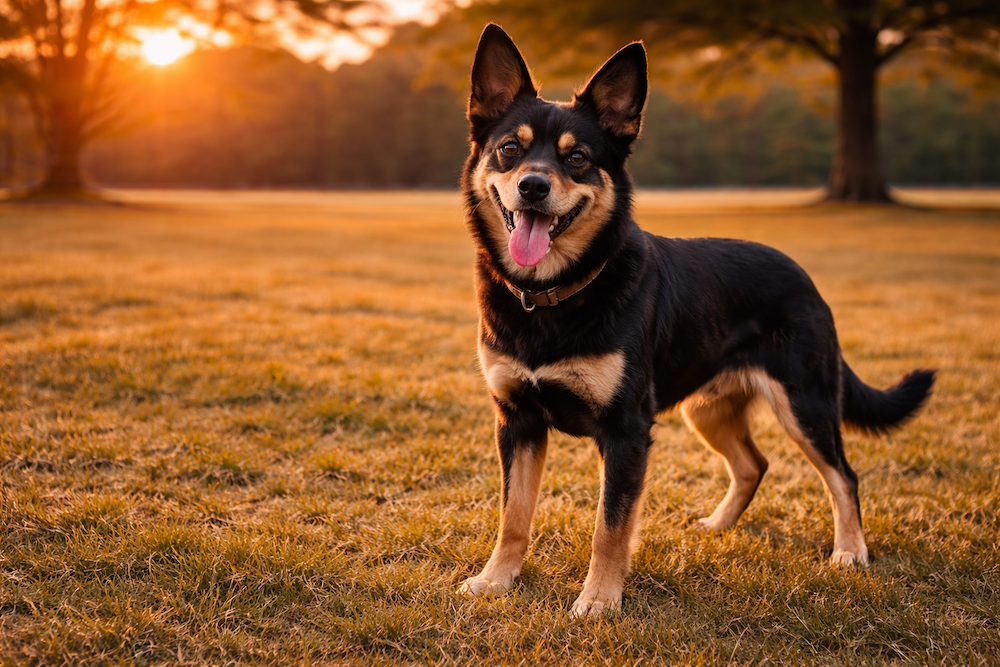







Hardworking, intelligent, and full of drive — built for action and purpose.
🧠 QUICK SNAPSHOT
- Temperament: Intelligent, Energetic, Loyal
- Energy Level: Very High
- Size: Medium
- Good with Families: Yes (active homes)
- Training Difficulty: Easy
📚 OVERVIEW
Australian Kelpies are highly intelligent working dogs bred for herding livestock across large distances. They are agile, driven, and extremely responsive, making them one of the most capable working breeds. They form strong bonds with their owners and thrive in environments where they can stay active and engaged.
✅ PROS & CONS
Pros
- Extremely intelligent and trainable
- Incredible work ethic and stamina
- Loyal and highly responsive
Cons
- Needs constant mental and physical stimulation
- Can become destructive if bored
- Not suited to sedentary or indoor-only homes
Is a Kelpie a Good Family Dog?
Yes, an Australian Kelpie can be an excellent family dog for an active household that understands working breeds.
Kelpies are loyal, intelligent and strongly bonded to their people, but they need substantial physical exercise and mental stimulation.
A bored Kelpie can invent jobs of its own, and those jobs may not resemble anything the owner had planned.
How Much Exercise Does a Kelpie Need?
Most adult Kelpies need around 90 minutes to two hours of activity each day, and highly driven working lines may require considerably more.
Exercise should include more than walking. Running, training, retrieving, scent work, agility and problem-solving are excellent outlets.
Mental work is particularly important.
Is a Kelpie a High-Energy Dog?
Extremely.
The Kelpie was developed to move livestock across enormous Australian properties, often in difficult heat and terrain.
Its combination of stamina, speed and work drive is one of the breed’s defining characteristics.
Is a Kelpie Easy to Train?
Yes, for someone who understands intelligent working dogs.
Kelpies learn extraordinarily quickly and respond well to clear, reward-based training.
The challenge isn’t usually teaching them something — it’s providing enough useful things for them to learn.
Are Kelpies Intelligent?
Exceptionally.
Kelpies need to read livestock, respond to a handler at distance and make independent decisions when necessary.
They’re outstanding problem-solvers and frequently excel in obedience, agility and advanced working tasks.
Are Kelpies Smarter Than Border Collies?
Both breeds are exceptionally intelligent working dogs, but intelligence isn’t meaningfully reduced to a single breed ranking.
Border Collies are famous for intense handler responsiveness and eye, while Kelpies were selected heavily for stamina, initiative and practical stock work under Australian conditions.
Their working styles differ more than their intelligence can sensibly be ranked.
Are Kelpies Stubborn?
They’re more accurately described as independent and driven.
A Kelpie that sees something interesting may make its own decision about what should happen next.
Good training channels that initiative rather than trying to eliminate it.
Does a Kelpie Shed?
Yes.
Kelpies generally have a short, weather-resistant double coat and shed moderately throughout the year, with heavier seasonal shedding.
Regular brushing helps control loose hair.
Is a Kelpie Hypoallergenic?
No.
Kelpies shed and produce normal canine allergens through their skin and saliva.
They’re not considered hypoallergenic.
How Often Should You Groom a Kelpie?
Usually once or twice a week.
Their practical working coat requires relatively little maintenance.
More frequent brushing can help during seasonal coat changes.
Should You Shave a Kelpie?
Generally, no.
The double coat provides environmental protection and helps insulate the dog.
Routine shaving isn’t necessary and can interfere with normal coat function and regrowth.
What Health Problems Are Common in Kelpies?
Kelpies are generally robust dogs, but potential concerns include hip dysplasia, eye disorders and certain inherited neurological conditions.
One particularly important inherited disease in the breed is cerebellar abiotrophy, which affects coordination and movement.
Responsible breeders should use relevant health testing.
What Is Cerebellar Abiotrophy in Kelpies?
Cerebellar abiotrophy is an inherited neurological disorder involving degeneration of cells within the cerebellum, the part of the brain important for coordination.
Affected dogs may develop tremors, poor balance, abnormal gait and difficulty coordinating movement.
DNA testing is available for relevant Kelpie populations and can help breeders avoid producing affected puppies.
Are Kelpies Prone to Hip Dysplasia?
It can occur.
Their athletic appearance doesn’t make them immune to inherited joint problems.
Responsible breeders should assess hip health, particularly in dogs intended for breeding or demanding work.
Are Kelpies Prone to Eye Problems?
Some inherited eye conditions occur within Kelpie populations.
Appropriate screening helps reduce risk.
Any sudden visual change or eye abnormality should be assessed by a veterinarian.
How Long Does a Kelpie Live?
Australian Kelpies commonly live around 12–15 years, with some reaching their mid-to-late teens.
Their functional structure and generally robust constitution contribute to good longevity.
Keeping a Kelpie lean and active can help preserve mobility as it ages.
How Big Does a Kelpie Get?
Kelpies are medium-sized dogs, generally around 43–51 cm tall at the shoulder.
Many weigh approximately 14–22 kg, although working populations can vary.
They’re deliberately athletic rather than heavily built.
Is There a Miniature Kelpie?
No.
There is no recognised Miniature Australian Kelpie.
Small individuals occur naturally, but “Mini Kelpie” isn’t an official breed variety.
Can a Kelpie Live in an Apartment?
It’s possible, but challenging.
The problem isn’t the Kelpie’s physical size — it’s the enormous amount of activity and stimulation packed inside it.
A highly committed owner could make apartment life work, but most Kelpies are better suited to homes offering substantial exercise opportunities.
Does a Kelpie Need a Farm?
No.
A Kelpie doesn’t literally need sheep or a farm, but it does need appropriate outlets for its working brain and athleticism.
Dog sports, running, hiking, scent work and advanced training can provide alternatives.
Does a Kelpie Need a Big Backyard?
A large garden is useful but doesn’t replace meaningful exercise.
A Kelpie can become bored on several acres if nothing interesting happens.
Conversely, an owner providing structured daily activity can successfully manage one on much less land.
Can a Kelpie Be Left Alone?
Adult Kelpies can learn to tolerate reasonable periods alone.
However, leaving a young energetic Kelpie without enough exercise or enrichment can result in digging, chewing, barking, pacing or escape behaviour.
Mental boredom is often the real problem.
Are Kelpies Prone to Separation Anxiety?
Some can be.
They’re strongly bonded to their handlers and accustomed to working closely with people.
Teaching independence gradually from puppyhood can help.
Are Kelpies Velcro Dogs?
Many are highly handler-focused.
Working Kelpies constantly monitor their handler, livestock and surroundings.
At home, that attentiveness can become following their favourite person from room to room.
Are Kelpies Cuddly?
Some are extremely affectionate, while others express attachment more through staying nearby and participating in activities.
They’re generally more work-oriented than traditional lapdogs.
After a sufficiently busy day, however, many are very happy to settle beside their owners.
Are Kelpies Good With Children?
They can be excellent with respectful children.
However, their herding instincts may produce chasing, circling or heel-nipping behaviour, particularly around running children.
Training and supervision are important.
Why Does My Kelpie Herd the Children?
Fast-moving children can trigger behaviour originally selected for controlling livestock.
The dog may circle, block movement or attempt to influence direction.
This isn’t a job the Kelpie should be allowed to assign itself.
Are Kelpies Good With Other Dogs?
Usually, when properly socialised.
Many working Kelpies spend considerable time around other dogs.
Individual temperament and early experience still matter.
Are Kelpies Good With Cats?
They can live successfully with cats, particularly when raised together.
However, movement can trigger chasing or herding behaviour.
Careful introductions and training are important.
Do Kelpies Have a Strong Prey Drive?
It varies.
Their strongest inherited behavioural tendency is usually stock movement and herding, rather than the prey drive seen in specialist hunting terriers or sighthounds.
Some individuals still have considerable chase drive.
Are Kelpies Good Off Leash?
Well-trained Kelpies can be outstanding off leash.
Working dogs need to respond to commands at considerable distances.
However, reliable recall still requires deliberate training and shouldn’t be assumed simply because the dog is a Kelpie.
Do Kelpies Run Away?
A fulfilled, well-trained Kelpie is often strongly handler-oriented.
A bored Kelpie may become an impressive escape artist.
Their athleticism means ordinary fences can occasionally become more of a suggestion than a boundary.
Can Kelpies Jump Fences?
Absolutely.
Kelpies are powerful jumpers and highly agile.
Some can clear or climb surprisingly high fencing, particularly if they’re motivated by something happening on the other side.
Can Kelpies Climb?
Yes — and this leads to one of the breed’s most remarkable working abilities.
Kelpies can jump onto the backs of sheep and move across them when working tightly packed mobs.
This behaviour is known as backing.
Why Do Kelpies Run Across the Backs of Sheep?
When sheep are packed tightly in yards or races, moving around them on the ground may be difficult.
A skilled Kelpie can jump onto the flock and run or walk across the sheep’s backs to reach another position.
It’s an extraordinary example of practical working-dog problem-solving.
Does Walking on Sheep Hurt Them?
Experienced working dogs move quickly across densely packed sheep and distribute their weight as they travel.
Backing is a specialised stock-working behaviour used in particular circumstances rather than something dogs constantly do.
Proper stock handling remains essential for animal welfare.
Are All Kelpies Good at Backing Sheep?
No.
Ability and willingness vary between dogs and working lines.
Some are naturally talented at backing, while others rarely need or choose to do it.
What Is Kelpie “Eye”?
“Eye” describes how strongly a herding dog visually fixes on livestock while controlling movement.
Kelpies generally use less intense eye than many Border Collies, although working style varies considerably between individuals and bloodlines.
This can help them work livestock more freely across large areas.
Do Kelpies Nip Sheep?
Some use controlled heeling or gripping when necessary, particularly with stubborn stock.
The objective is to move livestock, not injure it.
Good working dogs adjust their pressure according to the animals and situation.
Are Kelpies Only Sheep Dogs?
No.
They’re famous for sheep work but can also work cattle and other livestock.
Different lines and individual dogs may be better suited to particular stock.
Can Kelpies Work Cattle?
Yes.
Some working Kelpies are excellent cattle dogs.
Cattle work requires confidence and appropriate stock sense because cattle can be substantially more physically challenging than sheep.
How Far Can a Working Kelpie Run in a Day?
Working Kelpies can cover very large distances during a day’s stock work, sometimes many tens of kilometres depending on terrain and job.
Precise viral claims about extreme daily distances should be treated cautiously because conditions vary enormously.
What isn’t in doubt is their exceptional endurance.
Are Kelpies Good Running Dogs?
Excellent, once physically mature.
Healthy Kelpies can make superb running companions because of their stamina and athleticism.
Distance should still be increased gradually.
Are Kelpies Good Hiking Dogs?
Excellent.
They’re agile, lightweight, intelligent and capable of substantial endurance.
Long hikes also provide the environmental stimulation their busy minds enjoy.
Can Kelpies Swim?
Yes, most are physically capable swimmers and many enjoy water.
They’re not specialised water-retrieving dogs, so enthusiasm varies.
Swimming can provide useful low-impact exercise.
Do Kelpies Like Water?
Many do, especially in hot weather.
Farm Kelpies may happily enter dams, troughs or creeks.
Others prefer to keep their paws dry.
Can Kelpies Handle Hot Weather?
Kelpies were developed specifically for demanding work under Australian conditions, so they generally cope with warmth better than heavy northern breeds.
However, no dog is immune to heatstroke.
Hard exercise during extreme heat should still be avoided.
Can Kelpies Handle Cold Weather?
Generally, yes.
Their double coat provides useful insulation.
Working dogs routinely encounter cold mornings, rain and changing weather, although appropriate shelter should always be available.
Do Kelpies Bark a Lot?
It varies.
They’re often less constantly vocal than some smaller watchdog breeds, but excitement, boredom or stock work can produce barking.
A chronically under-stimulated Kelpie may become considerably noisier.
Are Kelpies Good Watchdogs?
Yes.
They’re highly alert and quickly notice unusual activity.
However, watchdog behaviour isn’t their primary historical purpose.
Are Kelpies Good Guard Dogs?
Not generally.
Some are protective of their property or family, but the breed wasn’t developed as a specialist protection dog.
Their strengths are herding, responsiveness and endurance, rather than guarding.
Are Kelpies Aggressive?
A well-bred Kelpie shouldn’t be indiscriminately aggressive.
Confidence, drive and assertiveness around livestock shouldn’t be confused with aggression toward people.
Good breeding and socialisation remain important.
When Does a Kelpie Calm Down?
Many become more settled between two and three years old, but the working drive doesn’t simply disappear.
A mature Kelpie still needs substantial activity.
Waiting for one to “grow out” of needing exercise is unlikely to be a successful strategy.
Do Kelpies Ever Get Tired?
Yes — despite widespread Australian jokes suggesting otherwise.
Kelpies have exceptional stamina but still require rest, hydration and recovery.
A highly motivated working dog may continue beyond sensible limits, so handlers need to monitor fatigue and heat.
Do Kelpies Get the Zoomies?
Absolutely.
Even a dog capable of spending all day working livestock may apparently discover an urgent need to complete several high-speed laps of the backyard.
Their acceleration can be spectacular.
What Does an Australian Kelpie Look Like?
The Kelpie is a medium-sized, athletic dog with upright ears, a wedge-shaped head, alert expression and functional weather-resistant coat.
Nothing about its structure should be exaggerated.
The breed’s appearance reflects its original purpose: work efficiently for long periods.
What Colours Can Kelpies Be?
Recognised colours commonly include black, black and tan, red, red and tan, chocolate, fawn and smoke blue, depending on the registry.
Working populations can show additional variation.
Colour has historically been far less important to stockmen than working ability.
Is a Red Kelpie a Different Breed?
No.
Red is simply one of the recognised Kelpie colours.
Red-and-tan dogs are also common and particularly iconic in Australia.
Is a Black Kelpie a Different Type?
No.
Black Kelpies belong to the same breed.
In fact, some of the most important dogs in early Kelpie history were black or black-and-tan.
What Is a Red Cloud Kelpie?
“Red Cloud” became associated with influential red Kelpie working lines, particularly through successful sheepdog trial dogs.
It isn’t a separate breed.
The term has sometimes been used more broadly or commercially for red Kelpies.
Can Kelpies Be Blue?
Yes.
Smoke blue is recognised in some Kelpie standards.
It results from dilution of black pigmentation and shouldn’t be confused automatically with merle.
Can Kelpies Be Merle?
Merle isn’t a traditional recognised Australian Kelpie colour.
A dog marketed as a merle purebred Kelpie should therefore prompt questions about ancestry.
Why Do Kelpies Have Upright Ears?
Erect ears contribute to their characteristic alert expression and may assist with locating sounds while working.
They also form part of the standardised modern breed appearance.
Young puppies may take time before their ears become fully erect.
Is an Australian Kelpie the Same as a Working Kelpie?
This requires some explanation.
In Australia, Working Kelpies and ANKC-registered Australian Kelpies can represent somewhat different breeding populations, even though they share the same historical ancestry.
Show breeders tend to select toward a formal conformation standard, while working breeders primarily select for stock-working performance.
What Is the Difference Between a Working Kelpie and a Show Kelpie?
Working Kelpies are bred primarily for stock sense, stamina, working style and practical ability.
Show or bench Kelpies are bred within a pedigree system that also emphasises conformation to a written breed standard.
The populations overlap historically but can differ noticeably in appearance and working drive.
Is a Working Kelpie a Separate Breed?
Not in the simple historical sense.
Both descend from the same Australian working-dog foundation.
However, separate registries and different breeding priorities have created increasingly distinct populations.
Is a Kelpie the Same as an Australian Cattle Dog?
No.
Both are iconic Australian working dogs, but they were developed differently.
Kelpies are primarily sheep and livestock herders, while Australian Cattle Dogs were developed particularly for driving cattle over long distances.
Is a Kelpie the Same as a Blue Heeler?
No.
Blue Heeler is a common name for a blue Australian Cattle Dog.
Kelpies are a separate Australian working breed.
Is a Kelpie the Same as a Border Collie?
No.
Both are elite sheep-working breeds, but they have different histories and working styles.
Border Collies developed around Britain, while the Kelpie was shaped in Australia from imported British working collie ancestry.
Is a Kelpie Related to the Border Collie?
Yes, broadly through their shared ancestry among British working collies.
However, the modern breeds developed along different paths.
Australian conditions strongly shaped the Kelpie into its own working population.
Is a Kelpie Related to the Collie?
Yes.
The breed developed from working collie-type dogs imported into Australia from Britain during the 19th century.
These weren’t necessarily identical to today’s Rough Collie or Border Collie.
“Collie” historically covered a broader range of British sheepdogs.
Does the Kelpie Have Dingo Ancestry?
This is one of the most persistent myths about the breed.
Historical and genetic evidence supports the Kelpie developing primarily from British working collie ancestry, rather than from deliberate Dingo crosses.
Stories about Dingo ancestry became part of Australian folklore, but they shouldn’t be presented as established breed history.
Were Kelpies Crossed With Dingoes to Make Them Heat Resistant?
There’s no good evidence that Dingo crossing was responsible for creating the breed.
The Kelpie’s suitability to Australian conditions can be explained through selection of working dogs that performed successfully in that environment.
Over generations, the dogs best suited to Australian stock work naturally became the breeding stock.
Why Do People Think Kelpies Are Part Dingo?
Their upright ears, lean build, toughness and Australian identity probably encouraged the story.
Australian working-dog folklore also contains numerous tales of Dingo crosses.
But resemblance and legend aren’t evidence of documented ancestry.
Is the Kelpie an Australian Breed?
Absolutely.
Although its foundation dogs came from British working collie stock, the Kelpie was developed as a distinct working dog in Australia.
Its temperament, stamina and working style were shaped by Australian livestock farming.
When Was the Kelpie Developed?
The breed began taking shape during the 19th century, particularly from the 1860s and 1870s onward.
Australia’s rapidly expanding sheep industry created enormous demand for dogs capable of managing livestock across vast properties.
Why Did Australia Need a New Sheepdog?
Imported British working dogs faced a very different environment.
Australian stations could cover enormous areas, temperatures could be extreme and livestock might need to be moved over long distances.
Farmers increasingly selected dogs that could handle heat, distance, difficult terrain and large mobs of sheep.
Where Does the Name Kelpie Come From?
The breed takes its name from an important early working dog called Kelpie.
Her name itself came from the kelpie of Scottish folklore, a supernatural water spirit often said to take the form of a horse.
So one of Australia’s most famous dogs carries a name derived from Scottish mythology.
What Is a Kelpie in Scottish Folklore?
A kelpie is a legendary shape-shifting water spirit from Scottish folklore, commonly associated with rivers and lochs and often appearing as a horse.
The name was brought into Australian working-dog history through an early foundation bitch.
Who Was the Original Kelpie Dog?
An important foundation bitch known as Kelpie was owned by Jack Gleeson during the early development of the breed.
She descended from imported Scottish working collie stock.
Her working ability became so admired that her name eventually became attached to dogs of the developing type.
Who Was Jack Gleeson?
Jack Gleeson was an Australian stockman associated with the famous foundation bitch Kelpie.
He acquired her during the early 1870s.
Her reputation as an outstanding sheepdog helped make both the dog and her name historically important.
Was the Original Kelpie Black and Tan?
The famous early Kelpie associated with Jack Gleeson is generally described as black and tan.
Early working dogs occurred in several colours, and performance mattered much more than producing a uniform appearance.
What Was King’s Kelpie?
A later dog known as King’s Kelpie became particularly famous after winning an important sheepdog trial.
Her success helped popularise the term Kelpie for dogs of this developing Australian working type.
This means the breed name became established through the reputation of more than one influential dog.
Did a Kelpie Win Australia’s First Sheepdog Trial?
King’s Kelpie famously won a major early sheepdog trial at Forbes, New South Wales, in 1879.
The victory helped spread the Kelpie name throughout Australia’s sheep industry.
Working success was far more persuasive to stockmen than appearance.
Who Was William King in Kelpie History?
William King owned the famous King’s Kelpie, whose trial success helped popularise the breed name.
Her achievements demonstrated the capabilities of the emerging Australian working-dog type to a wider audience.
Who Were Brutus and Jenny?
Brutus and Jenny were influential black-and-tan working collies imported from Scotland during the 19th century.
Their descendants contributed significantly to early Kelpie development.
Historical pedigrees surrounding these dogs form an important part of the breed’s foundation story.
Were the First Kelpies Smooth-Coated Collies?
The foundation dogs were British working collie types rather than modern show Rough Collies.
Many had relatively practical coats suited to work.
The terminology used for British sheepdogs in the 19th century doesn’t map perfectly onto today’s breed names.
Did the Kelpie Come From Scotland?
Its foundation ancestry was strongly Scottish and British, but the breed itself was created in Australia.
Imported working collies provided the genetic starting point.
Australian selection produced the Kelpie.
Where in Australia Was the Kelpie Developed?
Important early dogs and breeders were associated particularly with New South Wales and Victoria, although the emerging working dog quickly spread throughout Australia’s sheep-producing regions.
It wasn’t the creation of a single kennel in one location.
The Australian pastoral industry itself effectively became the testing ground.
Why Did the Kelpie Become So Successful?
It solved an enormous practical problem.
Australian graziers needed a dog capable of moving large numbers of sheep across huge distances with relatively little human assistance.
The Kelpie was agile, intelligent, inexpensive to maintain and seemingly willing to work all day.
Were Kelpies Used on Huge Australian Sheep Stations?
Yes.
This environment helped shape the breed.
A dog might need to travel considerable distances, work large mobs and respond to commands far from its handler.
Stamina and initiative weren’t optional characteristics.
Did Kelpies Replace Human Stockmen?
No, but they dramatically increased what one stockman could accomplish.
A skilled dog could control livestock across areas that would otherwise require considerably more human labour.
Australian agriculture became heavily dependent on capable working dogs.
Are Kelpies Still Used on Australian Farms?
Absolutely.
Working Kelpies remain essential on many Australian sheep and cattle properties.
Despite motorcycles, quad bikes and modern farm equipment, a good stock dog can still perform tasks machines can’t replicate effectively.
Are Kelpies Used Outside Australia?
Yes.
Australian Kelpies have been exported worldwide and work livestock in Europe, North America, New Zealand and many other regions.
Their reputation as versatile stock dogs has travelled far beyond Australia.
Are Kelpies Used for Search and Rescue?
Some are.
Their intelligence, stamina, agility and trainability can make them suitable for search, detection and rescue-related work.
Individual temperament and specialised training determine suitability.
Are Kelpies Used as Detection Dogs?
Yes.
Their drive, trainability and ability to work for extended periods can suit scent-detection roles.
Working-dog organisations increasingly recognise that farm-bred dogs can have talents extending well beyond livestock.
Can Kelpies Compete in Agility?
They can be exceptional agility dogs.
Their combination of speed, turning ability, intelligence and handler responsiveness makes them highly competitive.
Agility also provides an excellent outlet for a companion Kelpie’s working drive.
Are Kelpies Good at Flyball?
Yes.
Their acceleration, enthusiasm and ability to learn repetitive high-speed tasks can make them excellent flyball competitors.
Many thoroughly enjoy the combination of running and retrieving.
Are Kelpies Good at Sheepdog Trials?
Absolutely.
Trials have been part of Kelpie history since the breed’s early development.
Competition tests practical stock-working ability and has helped identify influential breeding dogs for generations.
What Is the Working Kelpie Council?
The Working Kelpie Council of Australia maintains pedigrees and promotes the working qualities of Kelpies bred specifically for stock work.
Its focus is performance and preservation of the working dog rather than primarily show-ring conformation.
What Is the Australian Kelpie Standard?
Kennel-club Australian Kelpies are bred to a formal conformation standard covering size, structure, coat, colour and temperament.
This show-oriented population shares its historical roots with working Kelpies but has developed under somewhat different selection pressures.
Why Do Working Kelpies Look So Different From Each Other?
Because historically ability mattered more than cosmetic uniformity.
A stockman was far more interested in whether the dog could work sheep all day than whether every marking matched a written standard.
Working lines therefore retain considerable variation in build, coat and colour.
Was Red Dog a Kelpie?
Yes — the real Red Dog, famous in Western Australia’s Pilbara region during the 1970s, was generally described as a Kelpie or Kelpie-type dog.
His story became part of Australian folklore and inspired books and the 2011 film Red Dog.
Who Was Red Dog?
Red Dog was a wandering red dog who became famous throughout the Pilbara region of Western Australia.
He travelled widely, formed friendships with numerous people and became particularly associated with the mining community around Dampier.
After his death in 1979, his story became legendary.
Is There a Statue of Red Dog?
Yes.
A statue commemorating Red Dog stands in Dampier, Western Australia.
It has become a popular landmark and a symbol of the remarkable real dog behind the story.
Was the Dog in the Red Dog Movie a Kelpie?
The title character in the 2011 film was portrayed by a red dog named Koko, a Kelpie-type dog.
Koko became famous in his own right through the film’s enormous popularity in Australia.
Is Red Dog the Most Famous Kelpie?
He’s certainly one of the most famous dogs associated with the breed.
For many Australians, Red Dog transformed the Kelpie from an agricultural icon into a broader symbol of loyalty, independence and Australian character.
Is the Kelpie on Australian Coins or Stamps?
Kelpies and Australian working dogs have appeared in various commemorative and cultural contexts, including stamps and collectibles.
Their importance to Australia’s agricultural history makes them a natural national symbol.
Is the Kelpie an Australian Icon?
Absolutely.
Few breeds are as closely associated with Australia’s rural identity.
The Kelpie represents sheep stations, stockmen, enormous landscapes and practical Australian working-dog ingenuity.
Is a Kelpie a Good First Dog?
It can be, but only for a genuinely active owner prepared to provide substantial training and stimulation.
Their intelligence makes them rewarding, but their drive makes neglecting their needs difficult.
A first-time owner who wants an hour-long couch companion after a ten-minute walk has selected the wrong Australian icon.
What Makes the Kelpie Unique?
The Kelpie wasn’t designed in a kennel according to appearance. It was effectively tested into existence by the Australian landscape.
Imported British working collies provided the foundation, but Australian stockmen kept breeding the dogs that could handle heat, distance, huge sheep stations and demanding livestock.
The result was an extraordinary working dog capable of controlling massive mobs, responding to commands at distance and even running across the backs of sheep when the ground route is blocked.
A Kelpie’s greatest feature isn’t its speed, stamina or intelligence individually.
It’s the fact that all three seem to arrive in the same medium-sized dog — and the dog usually wakes up each morning expecting you to have found something useful for them to do.