






Fast, gentle, and surprisingly calm — a sleek athlete with a soft heart.
🧠 QUICK SNAPSHOT
- Temperament: Gentle, Quiet, Affectionate
- Energy Level: Moderate (bursts of high speed)
- Size: Medium
- Good with Families: Yes
- Training Difficulty: Easy to Moderate
📚 OVERVIEW
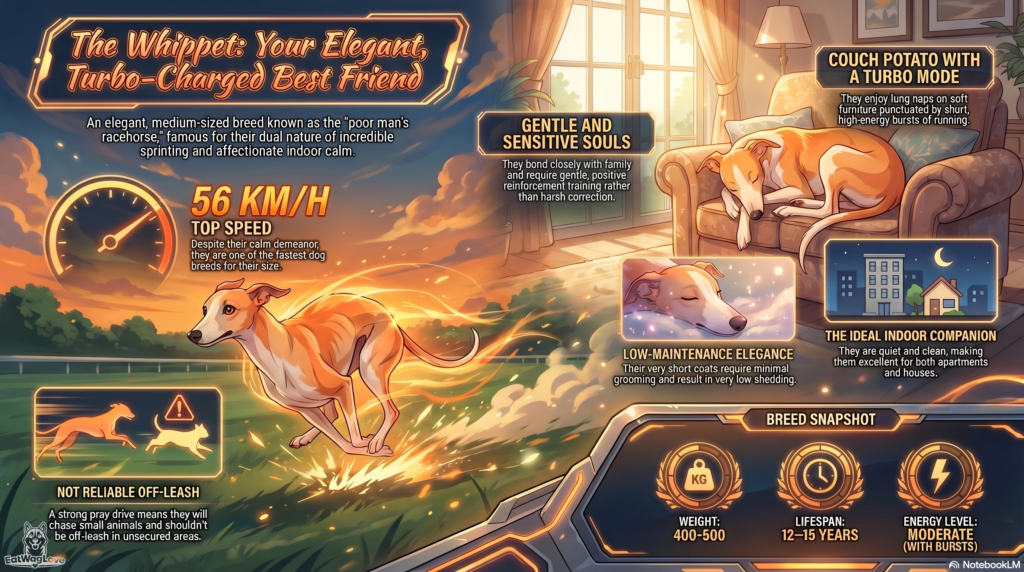
Whippets are sleek, athletic dogs known for their incredible speed and graceful build. Originally bred for racing and hunting, they are one of the fastest dog breeds. Despite this, they are calm and relaxed at home, often enjoying lounging and quiet time with their owners.
✅ PROS & CONS
Pros
- Calm and quiet indoors
- Very affectionate and gentle
- Low grooming requirements
Cons
- Needs space to run safely
- Sensitive to cold weather
- Strong prey drive
Is a Whippet a Good Family Dog?
Yes. Whippets can make gentle, affectionate and calm family dogs.
Although they’re extremely fast outdoors, they’re usually relaxed and quiet inside the home. They tend to form close bonds with their families and are often surprisingly fond of sofas, blankets and comfortable beds.
Are Whippets Good With Children?
Generally, yes. Whippets are typically gentle and affectionate with respectful children.
However, their slender build and relatively thin skin mean they can be injured by rough handling.
Supervision is particularly important with very young children.
How Much Exercise Does a Whippet Need?
Most adult Whippets need around 45–60 minutes of exercise each day, ideally including opportunities to run safely.
They enjoy walks but also benefit from short bursts of high-speed activity.
Despite their athletic appearance, they don’t usually require hours of continuous exercise.
Are Whippets Easy to Train?
Whippets are intelligent and can be trained successfully, although they’re often more independent than highly handler-focused working breeds.
They generally respond best to gentle, positive reinforcement.
Harsh training methods are unnecessary and can be particularly counterproductive with this sensitive breed.
Do Whippets Shed a Lot?
Whippets are relatively low-to-moderate shedders.
Their coat is extremely short and fine, so loose hair is usually less noticeable than with many breeds.
Regular light brushing helps remove dead hair.
Are Whippets Hypoallergenic?
No. Whippets aren’t considered hypoallergenic.
Although they have very short coats and relatively modest shedding, they still produce allergens through dander, saliva and skin secretions.
How Often Should You Groom a Whippet?
Whippets are very low-maintenance dogs when it comes to coat care.
A quick weekly brush or wipe is usually sufficient.
Regular nail trimming and dental care are important, and their thin skin should be checked for cuts or injuries after energetic outdoor activity.
What Health Problems Are Common in Whippets?
Whippets are generally considered a relatively healthy breed, but potential concerns include heart disease, eye disorders and certain inherited conditions.
Like other sighthounds, they also have physiological characteristics that veterinarians should consider when administering anaesthesia.
Responsible breeders should perform appropriate health screening.
How Long Do Whippets Live?
Whippets commonly live around 12–15 years.
Some live even longer.
Maintaining a healthy weight, providing appropriate exercise and obtaining regular veterinary care can help support a long life.
How Big Does a Whippet Get?
Whippets are medium-sized but very lightly built dogs.
Adults generally stand around 44–51 cm at the shoulder and commonly weigh approximately 9–18 kg.
Their deep chest, narrow waist and long legs create their distinctive streamlined appearance.
Can a Whippet Live in an Apartment?
Yes. Whippets can make excellent apartment dogs.
Once their exercise needs have been met, many are remarkably quiet and relaxed indoors.
Their tendency to spend substantial amounts of time sleeping makes them surprisingly adaptable to smaller homes.
Can Whippets Be Left Alone?
Adult Whippets can learn to tolerate reasonable periods alone, but they’re affectionate dogs that usually prefer company.
Some can develop separation-related problems.
Gradual independence training from puppyhood can help them become more comfortable when left alone.
Do Whippets Bark a Lot?
Usually not.
Whippets are generally fairly quiet dogs and aren’t renowned for excessive barking.
Individual dogs may still bark because of excitement, boredom, anxiety or unusual activity around the home.
Are Whippets Affectionate?
Very.
Whippets are often extremely affectionate with their families and may love cuddling, leaning against their owners or sleeping beside them.
Their gentle and physically affectionate nature can be surprising to people who know them primarily as racing or coursing dogs.
Are Whippets Good With Other Dogs?
Generally, yes.
Whippets often enjoy living with other dogs and can particularly appreciate the company of other sighthounds.
Their high-speed play can sometimes be overwhelming for very small or less athletic dogs.
Are Whippets Good With Cats?
Some Whippets live very successfully with cats, especially when raised alongside them.
However, Whippets are sighthounds with potentially strong prey drive, and some may chase unfamiliar cats.
Individual temperament and careful introductions are extremely important.
Do Whippets Have a High Prey Drive?
Many do.
Whippets were developed to pursue fast-moving prey using sight and speed.
Rabbits and other small animals can therefore trigger an extremely rapid chase response.
Are Whippets Good Off Leash?
Whippets should only be allowed off leash in safe, appropriately enclosed areas unless their recall is exceptionally reliable and the environment is suitable.
A Whippet that suddenly spots wildlife can accelerate remarkably quickly and cover considerable distance within seconds.
Secure fencing is particularly valuable for this breed.
How Fast Can a Whippet Run?
Whippets are among the fastest dog breeds and can reach speeds of around 55 km/h (35 mph) over short distances.
Their flexible spine, long legs, deep chest and lightweight body make them superb sprinters.
Only a handful of dog breeds can rival their acceleration and speed.
Are Whippets High-Energy Dogs?
Not in the way many people expect.
Whippets can be extraordinarily energetic during short bursts of running but are often calm and sleepy indoors.
They’re classic sprinters rather than endurance athletes.
This combination of explosive speed and domestic laziness is one of the breed’s defining characteristics.
Do Whippets Need a Big Backyard?
No.
A large backyard is helpful but isn’t essential if a Whippet receives appropriate daily exercise and opportunities to run safely.
A secure smaller garden combined with walks and access to enclosed exercise areas can work well.
Do Whippets Get Cold Easily?
Yes. Whippets can become cold relatively easily because they have very short coats and little body fat.
In cold or wet weather, many benefit from wearing a properly fitted dog coat.
They generally prefer living and sleeping indoors.
Can Whippets Live in Hot Weather?
Whippets can cope reasonably well with warm conditions because of their short coats, but they’re still vulnerable to overheating.
Exercise should be reduced during extreme heat, with shade and fresh water always available.
High-speed running generates considerable body heat and should be avoided during the hottest part of the day.
Why Are Whippets So Skinny?
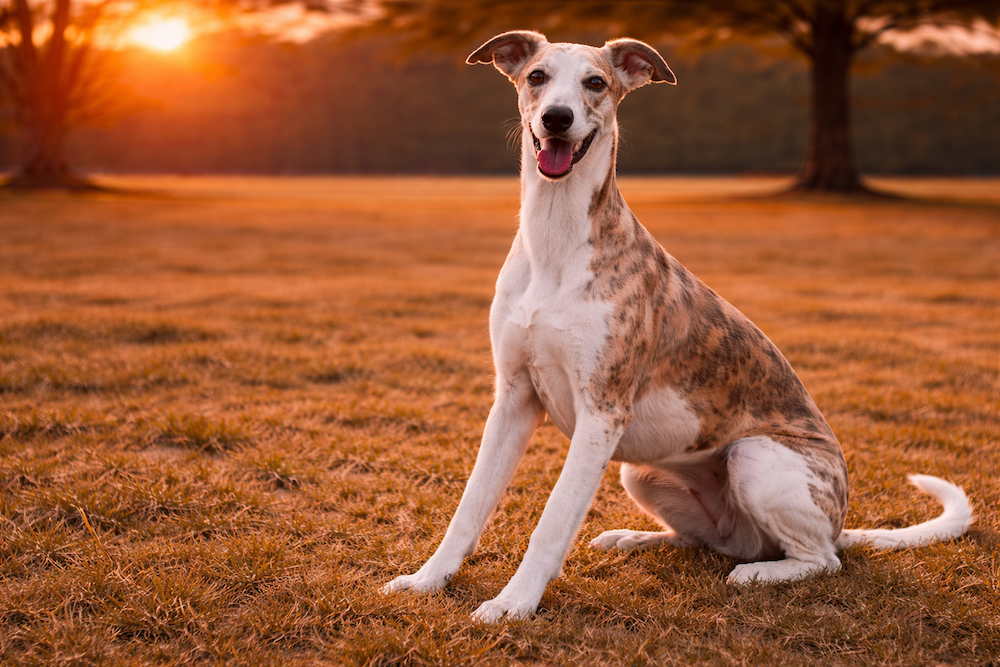
A healthy Whippet naturally has a lean, aerodynamic body.
Their narrow waist, deep chest and low body fat are characteristic of a breed developed for speed.
Visible body contours don’t automatically mean a Whippet is underweight, although excessive weight loss should always be assessed appropriately.
What Colours Do Whippets Come In?
Whippets occur in an enormous variety of colours and patterns.
These can include black, blue, fawn, red, cream, white and brindle, along with numerous combinations and markings.
Colour has little bearing on the dog’s suitability as a companion.
What Is the Difference Between a Whippet and a Greyhound?
Whippets resemble smaller Greyhounds but are a distinct breed.
Greyhounds are considerably larger, while Whippets usually weigh only around 9–18 kg.
Both are exceptionally fast sighthounds with gentle temperaments and a surprising tendency to relax for long periods indoors.
What Is the Difference Between a Whippet and an Italian Greyhound?
The Italian Greyhound is considerably smaller and more delicately built than the Whippet.
A Whippet is a medium-sized sporting sighthound, while the Italian Greyhound is a small companion breed with ancient sighthound ancestry.
Whippets are generally more robust physically.
What Were Whippets Originally Bred For?
Whippets were developed for coursing and hunting small game, particularly rabbits, using their extraordinary speed and visual tracking ability.
They later became popular for racing.
Their ability to accelerate rapidly made them particularly suited to short-distance competition.
Why Were Whippets Called the Poor Man’s Racehorse?
Whippet racing became especially popular among working-class communities in Britain during the 19th century.
The dogs provided people who couldn’t afford horses with an opportunity to breed, train and race extraordinarily fast animals.
This helped produce the famous nickname “the poor man’s racehorse.”
Where Does the Whippet Come From?
The modern Whippet was developed in Britain, particularly during the 18th and 19th centuries.
Its ancestry is associated with Greyhound-type dogs and smaller sporting or terrier-type dogs used for coursing and racing.
The breed became especially closely associated with industrial communities in northern England.
Is a Whippet a Good First Dog?
Yes. Whippets can be excellent first dogs.
They’re generally affectionate, quiet, relatively easy to groom and calm indoors.
The main considerations are their prey drive, need for secure running opportunities, sensitivity to cold and potentially unreliable recall around wildlife.
What Makes the Whippet Unique?
The Whippet contains one of the greatest contradictions in the dog world.
Take it outside, give it somewhere safe to run and you can witness a dog accelerating towards around 55 km/h, powered by long legs, a flexible spine and a body engineered for sprinting.
Bring the same dog home and the transformation can be remarkable.
Suddenly this elite canine athlete has one overwhelming ambition:
finding the softest blanket in the house.
That combination helped make the Whippet famous. Once known as the “poor man’s racehorse,” it gave working families in Britain their own extraordinarily fast racing dog.
Today, the Whippet remains capable of breathtaking speed.
It just doesn’t necessarily see why that should interfere with the other important part of its daily schedule:
approximately 17 excellent naps.