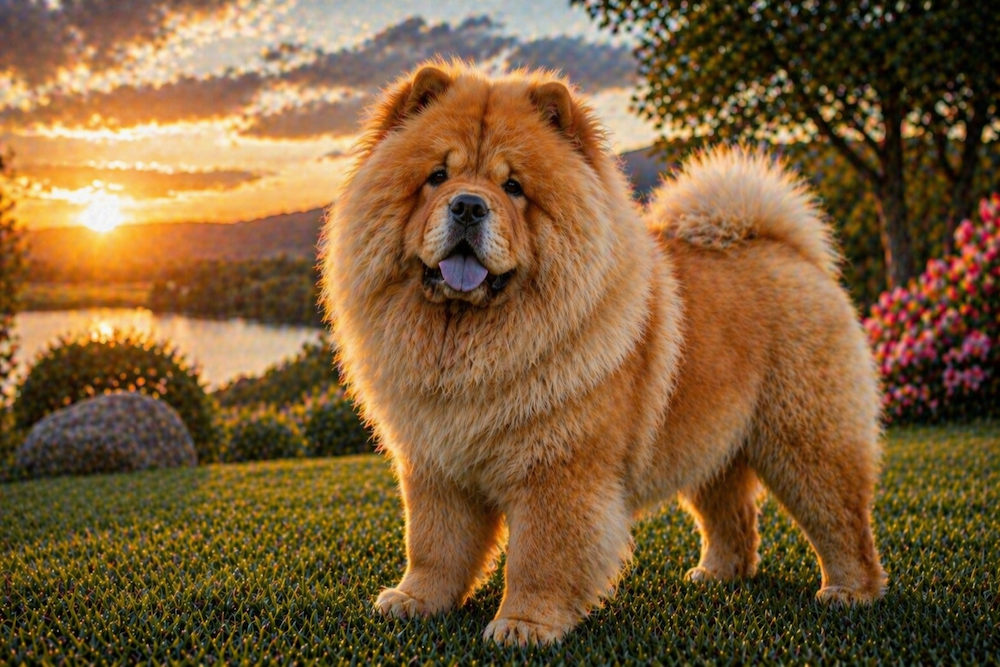







Fluffy, independent, and dignified — a unique companion with a lion-like presence.
🧠 QUICK SNAPSHOT
- Temperament: Independent, Loyal, Reserved
- Energy Level: Low to Moderate
- Size: Medium–Large
- Good with Families: Yes (with proper socialisation)
- Training Difficulty: Moderate to Hard
📚 OVERVIEW
Chow Chows are an ancient breed known for their distinctive lion-like mane and unique blue-black tongue. They are calm, dignified, and often reserved, forming strong bonds with their owners but remaining aloof with strangers. Their independent nature sets them apart from more social breeds.
✅ PROS & CONS
Pros
- Calm and relatively low energy
- Loyal to their owners
- Unique and striking appearance
Cons
- Can be aloof or reserved
- Requires experienced handling
- Needs regular grooming
Is a Chow Chow a Good Family Dog?
A Chow Chow can be a good family dog for an experienced household, but it isn’t usually the easiest breed for first-time owners.
Chows tend to be loyal, calm and deeply attached to their families while remaining independent and often reserved with strangers.
They’re generally less demonstratively affectionate than breeds such as Golden Retrievers.
Early socialisation is extremely important, particularly around children, visitors and other animals. A well-bred, properly socialised Chow should be confident and composed rather than fearful or indiscriminately aggressive.
How Much Exercise Does a Chow Chow Need?
Most adult Chow Chows need around 45–60 minutes of moderate exercise each day.
Regular walks and opportunities to explore are generally more appropriate than intense endurance exercise.
Their heavy coats make them vulnerable to overheating, particularly in warm and humid conditions.
Exercise should therefore be scheduled for cooler parts of the day during hot weather.
A Chow is usually happier patrolling the neighbourhood at a dignified pace than training for a marathon.
Is a Chow Chow Easy to Train?
Chow Chows are intelligent but famously independent.
They don’t necessarily possess the eager-to-please attitude found in many working or sporting breeds.
Positive, consistent training from puppyhood works best.
Harsh methods can damage trust and potentially increase defensive behaviour.
A Chow may understand exactly what you’ve asked and still appear to be considering whether your suggestion deserves implementation.
Does a Chow Chow Shed?
Yes. Chow Chows can shed very heavily, particularly during seasonal coat changes.
They have dense double coats consisting of a soft undercoat protected by a harsher outer coat.
Regular brushing is essential to remove loose hair and prevent matting.
During major shedding periods, enormous quantities of undercoat can be released.
Anyone considering a Chow should be comfortable with both grooming and a considerable amount of dog hair.
Is a Chow Chow Hypoallergenic?
No. Chow Chows aren’t considered hypoallergenic.
Their dense double coats shed substantially.
Dog allergens are primarily proteins found in saliva, skin secretions and dander rather than the hair itself.
The Chow is therefore generally a poor choice for someone specifically seeking a low-shedding dog.
What Health Problems Are Common in Chow Chows?
Chow Chows can be affected by several important inherited health conditions.
These include hip and elbow dysplasia, entropion and other eye problems, patellar luxation and thyroid disease.
Their heavily wrinkled facial structure can contribute to eye and skin problems in some dogs.
Chows can also be vulnerable to heat-related illness because of their dense coats and relatively compact facial structure.
Responsible breeding should prioritise sound movement, healthy eyes and moderate anatomy.
How Long Do Chow Chows Live?
Chow Chows commonly live around 8–12 years, although individual dogs can live longer.
Genetics, healthy body weight, joint health, appropriate exercise and regular veterinary care all influence longevity.
Their thick coats can hide weight gain surprisingly well.
Owners should assess body condition by actually feeling the dog’s ribs rather than relying entirely on appearance.
How Big Does a Chow Chow Get?
The Chow Chow is a medium-sized but powerfully built dog.
Adults generally stand approximately 43–51 cm at the shoulder and commonly weigh around 20–32 kg, although individuals vary.
Their enormous coats can make them appear substantially larger than they actually are.
Underneath all that fur is a compact, muscular dog rather than a small bear — despite appearances.
Can a Chow Chow Live in an Apartment?
Yes, a Chow Chow can live successfully in an apartment if adequately exercised and trained.
They’re generally relatively calm indoors and don’t require enormous amounts of exercise.
Temperature control can be important because Chows cope poorly with excessive heat.
Their territorial tendencies and potential wariness of unfamiliar people also make early socialisation valuable in buildings with lifts, corridors and frequent encounters with neighbours.
Can a Chow Chow Be Left Alone?
Adult Chow Chows can often tolerate reasonable periods alone better than many highly dependent companion breeds.
They’re naturally independent and don’t necessarily need constant physical contact with their owners.
However, independence doesn’t mean they should be socially isolated.
They still require interaction, exercise and involvement in family life.
A Chow permanently relegated to a backyard is unlikely to develop into the stable family companion owners want.
Are Chow Chows Affectionate?
Yes, but Chow Chows often show affection in a more reserved way than many other dogs.
Some enjoy physical contact and cuddling, while others prefer simply being near their favourite person.
They’re frequently described as somewhat cat-like in their independence.
A Chow quietly lying beside you may be expressing just as much attachment as another breed that climbs directly onto your lap.
Do Chow Chows Bond With One Person?
Chow Chows can form particularly strong attachments to one or several family members.
They’re known for loyalty but may remain emotionally reserved around unfamiliar people.
Good socialisation helps prevent this natural selectiveness from developing into excessive suspicion.
Owners should encourage puppies to have positive experiences with many different people rather than allowing them to become dependent on one individual.
Are Chow Chows Aggressive?
Chow Chows shouldn’t be indiscriminately aggressive, but they can be territorial, reserved and less tolerant of unwanted interaction than many breeds.
Poor breeding, inadequate socialisation and inappropriate handling can increase behavioural problems.
Their warning signals should be respected rather than punished.
Responsible ownership means developing a confident dog capable of calmly accepting normal situations without expecting it to behave like an enthusiastically social Labrador.
Are Chow Chows Good With Strangers?
Chow Chows are typically reserved with strangers.
This is considered characteristic of the breed.
They may acknowledge unfamiliar people without showing any particular interest in becoming friends.
Early socialisation is important so that reserve remains calm neutrality rather than fear or aggression.
A well-socialised Chow doesn’t need to love every visitor — it does need to behave safely around them.
Are Chow Chows Good Guard Dogs?
Chow Chows can be effective natural watchdogs and guardians.
They’re alert, territorial and often suspicious of unfamiliar activity around their home.
They don’t usually require encouragement to become protective.
In fact, deliberately increasing guarding behaviour can be counterproductive.
Training should instead emphasise control, socialisation and the owner’s ability to tell the dog when a situation is safe.
Do Chow Chows Bark a Lot?
Chow Chows aren’t generally known as constant barkers.
They may bark when someone approaches their property or when something unusual occurs.
Their relatively quiet nature can make them pleasant indoor companions.
Excessive barking can still develop through boredom, anxiety or territorial behaviour.
A Chow’s silence shouldn’t be mistaken for lack of awareness — they’re often watching considerably more than they announce.
Are Chow Chows Good With Other Dogs?
Chow Chows can live successfully with other dogs, but some individuals can be selective or intolerant of unfamiliar dogs, particularly dogs of the same sex.
Early socialisation is important.
They aren’t necessarily suited to chaotic dog-park environments where unfamiliar dogs repeatedly invade their personal space.
Owners should judge the individual rather than assuming every Chow will enjoy socialising with every dog it encounters.
Are Chow Chows Good With Cats?
Chow Chows can live successfully with cats, particularly when introduced during puppyhood.
Individual prey drive varies.
A Chow may accept its household cat while reacting very differently to unfamiliar animals outdoors.
Careful introductions and supervision are important.
Can Chow Chows Handle Hot Weather?
Chow Chows generally struggle in hot weather.
Their extraordinarily dense double coats provide excellent insulation but can make cooling difficult during high temperatures.
Exercise should be restricted during hot periods, with constant access to shade and fresh water.
Air-conditioned indoor environments can be particularly valuable in hot climates.
Heavy panting, weakness, confusion or collapse can indicate heatstroke and require emergency veterinary treatment.
Should You Shave a Chow Chow in Summer?
Generally, a Chow Chow shouldn’t be routinely shaved simply because the weather is hot.
Its double coat provides insulation and some protection from sunlight as well as cold.
Removing it doesn’t magically transform a Chow into a heat-tolerant dog and can expose the skin to sunburn.
Regular brushing to remove dead undercoat is much more useful.
Medical shaving may sometimes be necessary, but this should be distinguished from routinely clipping the entire dog for summer.
Why Does a Chow Chow Have a Blue-Black Tongue?
The Chow Chow’s famous blue-black tongue is caused by heavy pigmentation.
Chow puppies are generally born with pink tongues, which darken as pigmentation develops during the first weeks of life.
The colour can range from blue-grey to almost black.
It’s one of the breed’s most distinctive features, although the Chow isn’t the only dog capable of having strongly pigmented oral tissues.
Are Chow Chows Born With Blue Tongues?
No. Chow Chow puppies are generally born with pink tongues.
Dark pigmentation begins developing as they grow.
Within the first weeks of life, the tongue gradually becomes the characteristic blue-black colour associated with the breed.
Watching this transformation is one of the more unusual features of raising a Chow puppy.
Is the Chow Chow the Only Dog With a Blue Tongue?
No. The Chow Chow isn’t the only dog breed with a blue or heavily pigmented tongue.
The Chinese Shar-Pei is also famous for blue-black pigmentation.
Individual dogs of numerous other breeds can have dark spots on their tongues.
What makes the Chow unusual is that a solid blue-black tongue is such a characteristic feature of the breed.
Why Does a Chow Chow Look Like a Lion?
The Chow’s massive ruff of hair around its head and shoulders creates its famous lion-like appearance.
This is especially dramatic in Rough Coat Chows.
Its broad skull, small ears and compact body enhance the effect.
The resemblance is so striking that historical descriptions and modern nicknames frequently compare the breed with lions.
However, that spectacular mane is simply specialised coat growth — there is obviously no lion ancestry involved.
Are There Rough and Smooth Chow Chows?
Yes. There are two recognised Chow Chow coat varieties: Rough and Smooth.
The Rough Coat is much more familiar, with abundant hair and a dramatic mane or ruff around the neck.
The Smooth Coat has shorter, dense hair without the same extensive feathering.
Both have double coats and can shed heavily.
A Smooth Chow isn’t a crossbreed or shaved Rough Chow — it’s a genuine coat variety.
What Colours Can Chow Chows Be?
Traditional Chow Chow colours include red, black, blue, cinnamon and cream, although terminology can vary slightly between kennel organisations.
Red is probably the colour most strongly associated with the breed.
Chow colours should generally be solid, although shading can occur.
Unusual colours advertised as extremely “rare” should never be valued above sound health, temperament and responsible breeding.
Why Does a Chow Chow Walk So Stiffly?
The Chow has a distinctive short, stilted gait related partly to the structure of its relatively straight hind legs.
Breed standards have historically described this characteristic movement.
However, deliberately exaggerating structural traits can compromise normal movement.
A Chow should still move soundly and comfortably.
Severe stiffness, limping or reluctance to move shouldn’t be dismissed as simply “how Chows walk” because joint disease can also affect the breed.
Why Are a Chow Chow’s Back Legs So Straight?
Chow Chows characteristically have relatively straight hind legs with limited angulation compared with many other breeds.
This contributes to their distinctive stilted gait.
The characteristic should remain functional rather than exaggerated.
Dogs still need healthy joints and comfortable movement.
Breeding solely for extreme appearance can transform a breed characteristic into a welfare problem.
Why Does the Chow Chow Have Such Small Ears?
The Chow’s small, thick, upright ears contribute significantly to its distinctive scowling expression.
They’re set relatively widely apart and carried firmly erect.
Combined with the broad skull, deep-set eyes and heavy facial coat, they help create the breed’s instantly recognisable bear-or-lion-like appearance.
Despite the apparently serious expression, it doesn’t necessarily indicate the dog’s emotional state.
Why Does a Chow Chow Always Look Grumpy?
The Chow’s apparently “grumpy” expression comes largely from its anatomy, not its mood.
Deep-set eyes, small upright ears, broad skull and heavy facial coat combine to create a naturally serious expression.
A relaxed and perfectly content Chow may therefore appear to be deeply disappointed with everyone in the room.
Reading the dog’s whole body language is much more reliable than judging its emotional state from its face alone.
What Does the Name Chow Chow Mean?
Surprisingly, “Chow Chow” probably isn’t the breed’s original Chinese name.
One widely accepted explanation links the term to old English maritime or trading language, where “chow-chow” referred broadly to miscellaneous goods or curiosities carried aboard ships.
Dogs arriving from China may have been included among such cargo and eventually became known by the term.
The precise etymology isn’t completely certain, so overly specific origin stories should be treated cautiously.
What Is the Chow Chow Called in China?
The breed has historically been associated with Chinese terms including Songshi Quan, commonly translated as something like “puffy-lion dog” or “lion dog”.
Different historical names and descriptions have been associated with Chow-type dogs in China.
The modern Western name “Chow Chow” therefore doesn’t directly represent the breed’s traditional Chinese identity.
Is the Chow Chow an Ancient Dog Breed?
The Chow Chow has very old East Asian ancestry and is frequently described as one of the world’s ancient dog breeds.
Genetic studies have placed Chow-type dogs among lineages that diverged relatively early within domestic dog history.
However, this doesn’t mean the modern pedigree Chow has remained completely unchanged for thousands of years.
Today’s breed appearance was shaped through much more recent organised breeding and kennel-club selection.
Is the Chow Chow Related to Wolves?
Chow Chows aren’t part wolf, despite occasionally being described as unusually “wolf-like” genetically.
All domestic dogs ultimately share ancestry with ancient wolf populations.
Some Asian breeds, including the Chow, belong to relatively old dog lineages and may retain genetic characteristics associated with early-diverging domestic dog populations.
That is very different from having recent wolf ancestry.
A Chow is entirely a domestic dog.
What Were Chow Chows Originally Bred For?
Chow-type dogs in China appear to have been versatile working animals rather than dogs created for one single job.
Historical accounts associate them with guarding, hunting, pulling and general utility work.
They were also kept as companions.
Because the breed’s history stretches so far back, claims about one precise original purpose are difficult to prove.
The Chow’s independence, strength and territorial nature make considerably more sense when viewed against this broad working background.
Were Chow Chows Used as Hunting Dogs?
Yes. Historical Chinese Chow-type dogs were reportedly used in hunting as well as guarding and other working roles.
Their modern appearance may suggest an ornamental companion, but they were historically far more functional.
Their independence and determination are therefore not accidental personality quirks created by modern pet ownership.
They reflect a dog whose ancestors often needed to work without constant human direction.
Were Chow Chows Kept by Chinese Emperors?
Chow-type dogs have long been associated with Chinese nobility and imperial households.
One frequently repeated historical claim states that an emperor of the Tang dynasty maintained thousands of Chow-like hunting dogs and enormous numbers of handlers.
Exact numbers in ancient breed histories should be treated cautiously because stories are often repeated long after their original sources become difficult to verify.
Nevertheless, dogs resembling the Chow clearly have deep historical connections with China.
Were Chow Chows Really Used for Their Fur and Meat?
Historical sources indicate that dogs were used for food and fur in parts of China, and Chow-type dogs have sometimes been associated with these practices.
However, breed histories often present this subject too simplistically, as though this were the Chow Chow’s primary purpose.
The dogs also had important roles as hunters, guards and companions.
Historical practices varied enormously across regions and periods and shouldn’t be projected onto modern Chinese culture or today’s Chow Chow.
How Did the Chow Chow Come to Britain?
Chow-type dogs began appearing in Britain during the 18th and 19th centuries, arriving through trade with China.
They were initially regarded as unusual exotic dogs.
Growing European interest eventually led to more organised breeding and the development of the modern breed standard.
Britain played a significant role in transforming China’s diverse Chow-type dogs into the internationally standardised pedigree Chow Chow recognised today.
Did Queen Victoria Own a Chow Chow?
Queen Victoria is frequently associated with the early popularity of the Chow Chow in Britain.
Historical accounts report that she received a Chow-type dog during the 19th century, helping draw attention to the exotic Chinese breed.
Her famous enthusiasm for dogs made royal ownership particularly influential on Victorian fashion.
As happened with several breeds, association with the British royal family helped turn an unfamiliar imported dog into a fashionable companion.
Is the Chow Chow Related to the Shar-Pei?
The Chow Chow and Chinese Shar-Pei are distinct breeds, but both have ancient Chinese ancestry and share the famous tendency towards blue-black tongue pigmentation.
Genetic research also places both among relatively old East Asian dog lineages.
Their modern appearances are dramatically different, but the similarities aren’t purely coincidental.
They represent two fascinating branches of China’s long domestic dog history.
Where Does the Chow Chow Come From?
The Chow Chow comes from China, where dogs resembling the breed have existed for a very long time.
Historical Chow-type dogs were used for multiple purposes, including guarding, hunting and general work, while some were associated with elite households.
Dogs exported from China eventually attracted considerable interest in Britain, where organised breeding helped establish the modern pedigree Chow.
Its blue-black tongue, lion-like ruff, unusual gait and independent temperament make it unmistakable today — but beneath that extraordinary coat is the legacy of one of East Asia’s oldest and most distinctive dog lineages.