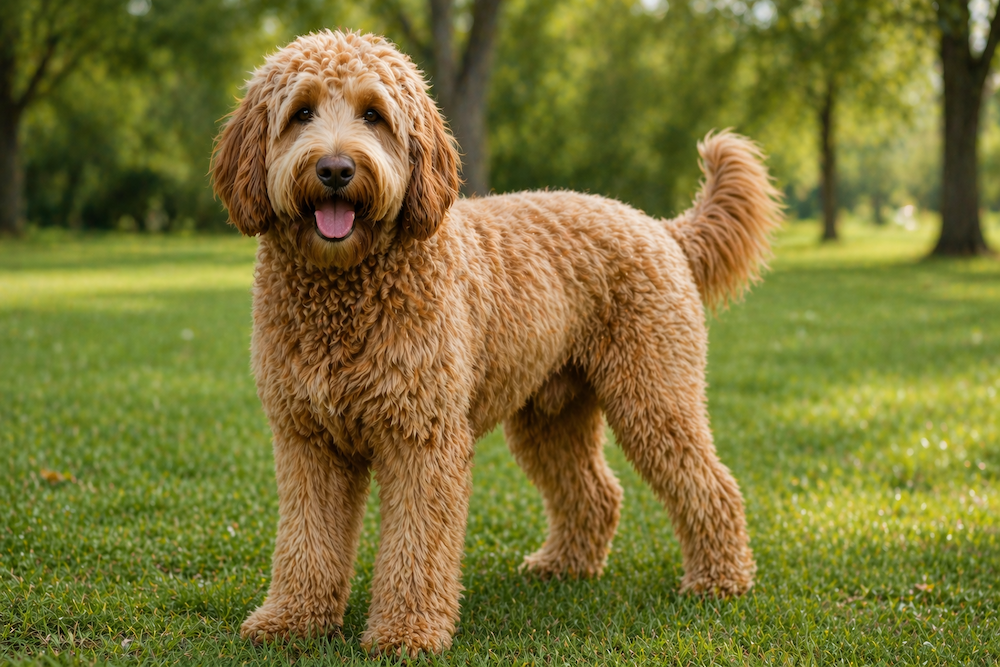






Friendly, intelligent, and full of energy — a playful companion that thrives on attention and connection.
🧠 QUICK SNAPSHOT
- Temperament: Friendly, social, affectionate
- Energy Level: High
- Size: Medium to large
- Good With Families: Yes
- Trainability: High
- Grooming: Moderate to high
- Best For: Active families and social homes
📚 OVERVIEW
The Labradoodle is a popular cross between a Labrador Retriever and a Poodle, known for its intelligence, friendly nature, and low-shedding coat. They are highly social dogs that love being part of the family and are often chosen for their playful, easy-going personality.
They thrive in environments where they get plenty of attention and activity.
✅ PROS & CONS
Pros
- Very friendly and social
- Great with families and children
- Intelligent and easy to train
- Low shedding (varies by coat type)
Cons
- Needs regular grooming
- High energy levels
- Can develop separation anxiety
- Requires daily attention and stimulation
Is a Labradoodle a Good Family Dog?
Yes. A well-bred Labradoodle can be an affectionate, intelligent, playful and highly social family dog.
Both Labradors and Poodles were developed as working retrievers and generally enjoy cooperating with people.
However, Labradoodles vary considerably in size, coat, temperament and energy, particularly across different generations and breeding programmes.
How Much Exercise Does a Labradoodle Need?
Most adult Labradoodles need around 60–90 minutes of daily exercise, with particularly active individuals requiring more.
Walking, retrieving, swimming, training and scent games are excellent choices.
They’re usually considerably more energetic than their teddy-bear appearance suggests.
Is a Labradoodle a High-Energy Dog?
Usually, yes.
Labradors are energetic sporting dogs, while Poodles are athletic working dogs rather than decorative lapdogs.
Combining them often produces a dog that needs substantial physical activity and mental stimulation.
Is a Labradoodle Easy to Train?
Generally, yes.
Both parent breeds are intelligent and highly trainable.
Labradoodles usually respond extremely well to positive reinforcement, food rewards and interactive training.
Are Labradoodles Intelligent?
Very.
Poodles are exceptional problem-solvers, while Labradors have been selected for generations to cooperate closely with people.
Many Labradoodles excel in obedience, assistance work, therapy work and dog sports.
Are Labradoodles Stubborn?
Some can be.
Adolescents in particular may combine Labrador enthusiasm with Poodle intelligence and discover that following instructions isn’t always their highest priority.
Consistent, interesting training usually works well.
Does a Labradoodle Shed?
Some shed very little, while others shed considerably.
This is one of the most misunderstood characteristics of the Labradoodle.
Coat inheritance is variable, particularly in first-generation crosses, so being a Labradoodle doesn’t guarantee a non-shedding coat.
Is a Labradoodle Hypoallergenic?
Not reliably.
Some individuals with Poodle-like coats release relatively little loose hair and may be better tolerated by certain allergy sufferers.
However, allergens are also present in saliva and skin secretions, so no Labradoodle can honestly be guaranteed hypoallergenic.
Why Do Some Labradoodles Shed More Than Others?
Coat genetics from the Labrador and Poodle interact in complex ways.
A dog can inherit a straighter, Labrador-like coat, a furnished wavy coat or a tightly curled Poodle-like coat.
Generation alone doesn’t perfectly predict shedding.
What Does Furnished Mean in a Labradoodle?
“Furnishings” refers to the longer hair around the muzzle, eyebrows and face that creates the characteristic shaggy Doodle appearance.
Dogs lacking furnishings often have smoother, more Labrador-like faces.
Furnishings can also influence how the coat behaves and sheds.
Can a Labradoodle Have a Flat Coat?
Yes.
Some Labradoodles inherit a relatively straight, flat coat resembling the Labrador.
These dogs may shed substantially more than curly or furnished individuals.
They’re sometimes called flat-coated or unfurnished Labradoodles.
What Is a Fleece Labradoodle Coat?
“Fleece” is a breeder term commonly used for a soft, flowing, wavy or loosely curled coat.
It’s especially associated with Australian Labradoodle breeding programmes.
It isn’t a scientifically precise coat category, and texture can still vary considerably.
What Is a Wool Labradoodle Coat?
“Wool” generally describes a denser, curlier, more Poodle-like coat.
These coats often shed relatively little but require intensive grooming.
Loose hair can remain trapped inside the curls rather than falling onto the floor.
Do Labradoodles Need a Lot of Grooming?
Usually, yes.
Many require thorough brushing several times a week and professional grooming approximately every six to eight weeks.
Curly and fleece-type coats can mat severely if grooming is neglected.
Why Do Labradoodles Mat So Easily?
Their coats can combine Poodle curl with softer hair inherited through the cross.
Loose hairs become trapped rather than falling away and can twist together close to the skin.
Areas behind the ears, under the collar, armpits, legs and tail are particularly vulnerable.
How Often Should a Labradoodle Be Groomed?
Most longer-coated Labradoodles should be brushed and combed several times each week, sometimes daily.
Professional clipping is commonly needed every six to eight weeks.
A comb should reach all the way to the skin rather than simply brushing the surface.
Can You Shave a Labradoodle?
A badly matted Labradoodle may need to be clipped very short for welfare reasons.
Regular pet clips are also common.
Unlike double-coated breeds such as Huskies, many Labradoodle coats are routinely clipped as part of normal maintenance.
Why Does My Labradoodle Look Different After a Haircut?
Much of the classic Doodle appearance comes from its long facial furnishings and fluffy coat.
A short clip reveals the dog’s actual body shape and facial structure.
Owners are occasionally surprised to discover there has been a fairly athletic dog hiding underneath the teddy bear.
What Health Problems Are Common in Labradoodles?
Potential concerns include hip and elbow dysplasia, eye disorders, progressive retinal atrophy, certain inherited neurological diseases, allergies, ear problems and some cardiac conditions.
Because both Labradors and Poodles have inherited disorders, responsible breeding requires health testing relevant to both sides of the pedigree.
Are Labradoodles Prone to Hip Dysplasia?
Yes.
Hip dysplasia occurs in both Labradors and Standard Poodles.
Breeding dogs should receive appropriate hip assessment rather than assuming crossbreeding eliminates the risk.
Are Labradoodles Prone to Ear Infections?
They can be.
Floppy ears reduce ventilation, while some dogs grow substantial hair around or within the ear canal.
Swimming can add moisture, making regular ear monitoring particularly important.
Are Labradoodles Prone to Allergies?
Some are.
Skin allergies and sensitivities occur in both parent populations.
Persistent itching, recurrent ear infections or paw licking should receive veterinary assessment.
Are Labradoodles Prone to Eye Problems?
Potentially.
Inherited eye diseases occur in both Labradors and Poodles, including forms of progressive retinal atrophy.
Responsible breeders should use appropriate ophthalmic and DNA testing.
How Long Does a Labradoodle Live?
Labradoodles commonly live around 12–15 years, although size influences lifespan.
Miniature Labradoodles may live somewhat longer on average than very large Standard dogs.
Genetics, weight, exercise and veterinary care all matter.
How Big Does a Labradoodle Get?
Size varies enormously.
Standard Labradoodles commonly weigh around 20–35 kg or more, while Miniature and Medium breeding programmes produce considerably smaller dogs.
The size of the Poodle ancestry has a major influence.
What Is a Standard Labradoodle?
A Standard Labradoodle generally has a Standard Poodle in its recent ancestry and is the largest commonly produced size.
Exact size definitions differ between breeders and organisations because Labradoodles don’t have one universal global standard.
What Is a Medium Labradoodle?
Medium is an informal size category used by many Labradoodle breeders.
These dogs generally fall between Miniature and Standard sizes.
The precise height and weight range depends on the breeding programme.
What Is a Mini Labradoodle?
A Mini Labradoodle usually results from breeding Labradoodle lines involving a Miniature Poodle.
They can be substantially smaller than Standard Labradoodles.
However, size remains less predictable in early-generation crosses.
Is There a Toy Labradoodle?
Some breeders advertise Toy or Petite Labradoodles, usually using very small Poodle ancestry or multigenerational lines.
These aren’t universally recognised size categories.
Prospective owners should focus on health and parent size rather than marketing labels.
Is There a Teacup Labradoodle?
There is no universally recognised Teacup Labradoodle.
Breeding for extreme smallness can introduce additional health concerns.
“Teacup” should be treated as a marketing description rather than a recognised breed variety.
Can a Labradoodle Live in an Apartment?
Yes, particularly smaller Labradoodles, provided their exercise needs are met.
Standard Labradoodles are physically larger and often energetic, making apartment living more demanding.
Daily activity matters much more than simply having access to a backyard.
Does a Labradoodle Need a Backyard?
No.
A secure garden is convenient but doesn’t replace walks, training and interaction.
A Labradoodle can become bored on a large property if its owner assumes space automatically equals exercise.
Can a Labradoodle Be Left Alone?
Adult Labradoodles can learn to tolerate reasonable periods alone.
However, both Labradors and Poodles are strongly people-oriented.
Long periods of isolation can contribute to boredom, destructive behaviour or separation problems.
Are Labradoodles Prone to Separation Anxiety?
Some are.
The same strong human attachment that makes Labradoodles attractive companions can make independence difficult.
Gradual alone-time training should begin during puppyhood.
Are Labradoodles Velcro Dogs?
Many are.
Poodles often form intense bonds with their people, while Labradors have been selected to cooperate closely with humans.
A Labradoodle may therefore consider following its owner into every room an important responsibility.
Are Labradoodles Cuddly?
Usually.
Many are affectionate and physically demonstrative.
Individual personality varies, but the combination of two highly people-oriented breeds often produces an enthusiastic companion.
Are Labradoodles Good With Children?
Generally, yes.
Well-socialised Labradoodles are often playful, tolerant and affectionate.
Large adolescent dogs can be extremely enthusiastic, so supervision around small children remains important.
Are Labradoodles Good With Other Dogs?
Usually.
Both parent breeds tend to be relatively sociable with other dogs.
Early socialisation still matters.
Are Labradoodles Good With Cats?
Many can live successfully with cats, particularly when raised together.
Their sporting ancestry can produce chase behaviour, but extreme prey drive isn’t generally their defining characteristic.
Controlled introductions are recommended.
Do Labradoodles Have a Strong Prey Drive?
Usually moderate rather than extreme.
Both Labradors and Poodles descend from hunting and retrieving dogs, so birds and wildlife can attract attention.
Training and individual temperament determine how manageable this becomes.
Are Labradoodles Good Off Leash?
Many can develop excellent recall.
Both parent breeds were developed to work cooperatively with handlers at distance.
Reliable recall still requires deliberate training, particularly through adolescence.
Do Labradoodles Bark a Lot?
It varies.
They’re generally not among the most extreme barking dogs, although Poodle alertness can contribute to watchdog barking.
Boredom and separation distress can also increase vocalisation.
Are Labradoodles Good Watchdogs?
Many will alert their owners to visitors or unusual noises.
However, their typically sociable personality means they’re rarely intimidating guard dogs.
Are Labradoodles Good Guard Dogs?
Generally, no.
Their size may deter someone, but the typical Labradoodle has been bred primarily for companionship, assistance work or family life.
Many are far more interested in meeting visitors than protecting the premises from them.
When Does a Labradoodle Calm Down?
Many begin settling noticeably between two and three years old.
Labrador adolescence can last surprisingly long, while Poodles also remain energetic and playful.
A young Labradoodle may therefore remain exuberant well beyond puppyhood.
Do Labradoodles Get the Zoomies?
Absolutely.
Their combination of athleticism and enthusiasm can produce impressive high-speed laps.
Long coats can make the dog appear to be travelling considerably faster than its legs.
Are Labradoodles Good Running Dogs?
Healthy adult Standard and Medium Labradoodles can make excellent running companions.
Both parent breeds are athletic.
Structured distance running should wait until physical maturity.
Are Labradoodles Good Hiking Dogs?
Yes.
Many have excellent stamina and love exploring outdoors with their owners.
Regular grooming after hiking helps remove seeds, burrs and debris from longer coats.
Can Labradoodles Swim?
Usually very well.
Both Labradors and Poodles have strong historical connections with water retrieving.
Many Labradoodles enthusiastically inherit this love of water.
Why Do Labradoodles Love Water?
Both parent breeds were developed around retrieving waterfowl.
The Labrador’s water-working history is obvious, but the Poodle was also originally a water retriever.
A Labradoodle therefore receives aquatic credentials from both sides of its family tree.
Do Labradoodles Play Fetch?
Many are obsessed with it.
Retrieving behaviour exists strongly in both parent breeds.
Fetch provides an excellent combination of exercise, training and instinctive satisfaction.
Are Labradoodles Good Therapy Dogs?
They can be excellent therapy dogs.
Their intelligence, sociability and human orientation suit the work when the individual dog has a calm, stable temperament.
Proper assessment and training remain essential.
Are Labradoodles Good Assistance Dogs?
Yes — and assistance work is central to the Labradoodle’s modern history.
The best-known early purposeful breeding programme was specifically attempting to create a guide dog suitable for a person whose household had concerns about dog allergies.
Are Labradoodles Good Guide Dogs?
Some can be.
Both Labradors and Poodles have qualities useful in assistance work.
However, not every Labradoodle has the temperament, health or predictability required for professional guide-dog work.
What Does a Labradoodle Look Like?
There is enormous variation.
Labradoodles can have straight, shaggy, wavy or curly coats, and their build can range from strongly Labrador-like to distinctly Poodle-like.
Multigenerational breeding programmes generally aim for greater consistency.
What Colours Can Labradoodles Be?
Labradoodles occur in numerous colours including cream, gold, apricot, red, black, chocolate, silver, grey and combinations of these colours.
Some have white markings or parti patterns.
Colour terminology varies between breeding organisations.
Do Labradoodles Change Colour?
Some do.
Poodle ancestry can introduce genes that cause coats to fade or clear with age.
A dark chocolate, black, red or apricot puppy may become noticeably lighter as it matures.
Can a Labradoodle Be Black?
Yes.
Black is a perfectly normal colour produced through either parent ancestry.
Some black Labradoodles remain dark while others fade toward grey or silver.
Can a Labradoodle Be Chocolate?
Yes.
Chocolate Labradoodles are common.
Coat shade may range from deep brown to lighter café tones, particularly as fading genes take effect.
Can a Labradoodle Be Red?
Yes.
Selective breeding has produced rich red Labradoodles, particularly through Poodle lines carrying strong red pigmentation.
Red can fade substantially as the dog matures.
Can a Labradoodle Be Parti-Coloured?
Yes.
Parti Labradoodles have substantial white areas combined with another colour.
They’re particularly common within some multigenerational breeding programmes.
Can a Labradoodle Be Merle?
Merle Labradoodles exist, but merle isn’t a traditional colour in either the Labrador Retriever or Poodle.
A genuine merle pattern therefore indicates that another breed entered the ancestry somewhere, regardless of how many generations back it occurred.
Merle-to-merle breeding also carries serious hearing and eye risks.
Can Labradoodles Have Blue Eyes?
Occasionally, but blue eyes aren’t characteristic of the traditional Labrador-Poodle cross.
They can be associated with unusual pigmentation, including merle ancestry.
A rare eye colour shouldn’t be prioritised over health.
What Is an F1 Labradoodle?
An F1 Labradoodle is a first-generation Labrador Retriever × Poodle cross.
On average, it receives approximately half its ancestry from each breed.
Appearance, coat and shedding can still vary dramatically between littermates.
What Is an F1B Labradoodle?
An F1B Labradoodle is usually produced by breeding an F1 Labradoodle back to a Poodle.
This increases the proportion of Poodle ancestry and can increase the likelihood of a curly, lower-shedding coat.
It still doesn’t guarantee a hypoallergenic dog.
What Is an F1BB Labradoodle?
An F1BB generally results from breeding an F1B Labradoodle back to a Poodle again.
This produces an even higher proportion of Poodle ancestry.
Generation labels describe pedigree structure rather than guaranteeing temperament, health or coat behaviour.
What Is an F2 Labradoodle?
An F2 usually results from breeding two F1 Labradoodles together.
Second-generation dogs can show substantial genetic variation.
F2 doesn’t automatically mean more predictable than F1.
What Is a Multigenerational Labradoodle?
A multigenerational Labradoodle has Labradoodle parents from established breeding lines rather than being a recent first-generation Labrador-Poodle cross.
Careful multigenerational breeding can improve consistency in size, coat and temperament.
The quality of the breeding programme remains more important than the label itself.
Is a Labradoodle a Recognised Breed?
The Labradoodle isn’t universally recognised as a pedigree breed by major traditional kennel organisations.
However, dedicated Labradoodle organisations maintain registries, pedigrees and breeding standards.
Some programmes are deliberately working toward greater consistency across generations.
Is a Labradoodle a Designer Dog?
The term is commonly applied, but the Labradoodle has a more interesting history than many modern designer crosses.
One of its most influential early breeding programmes arose from a specific assistance-dog objective, rather than simply creating a fashionable appearance.
What Is the Difference Between a Labradoodle and an Australian Labradoodle?
This distinction is extremely important.
A Labradoodle can simply mean a Labrador Retriever × Poodle cross.
The Australian Labradoodle generally refers to multigenerational breeding programmes developed under particular Australian breed associations and may include additional breeds in its historical foundation.
Is an Australian Labradoodle Just a Labradoodle Born in Australia?
No.
“Australian Labradoodle” doesn’t simply mean a Labradoodle whose birthplace happens to be Australia.
Within established breeding programmes, it describes a particular multigenerational population with its own development history and breeding goals.
What Breeds Are in an Australian Labradoodle?
Australian Labradoodle development began with Labrador and Poodle ancestry but later programmes incorporated other breeds.
Depending on the historical line and registry, ancestry has included breeds such as the English Cocker Spaniel and American Cocker Spaniel, among others used during development.
Modern registered lines are bred multigenerationally rather than continually recreating the original mixture.
Is an Australian Labradoodle a Recognised Breed?
It’s recognised and registered by dedicated Australian Labradoodle organisations rather than universally by major traditional kennel clubs.
Breeders working within these organisations aim for consistent type, temperament, coat and health across generations.
Is a Cobberdog the Same as a Labradoodle?
Not exactly.
The Australian Cobberdog developed from Australian Labradoodle-type lines but is now promoted and registered as a separate developing breed under its own standards and breeding programme.
The names shouldn’t simply be treated as interchangeable.
What Does Labradoodle Mean?
The name combines Labrador and Poodle.
“Doodle” subsequently became a general naming convention for numerous Poodle crosses.
The Labradoodle was one of the crosses that helped make the term internationally famous.
Where Did the Labradoodle Come From?
The modern Labradoodle is most famously associated with Australia, particularly the Royal Guide Dogs Association of Australia breeding programme during the late 1980s.
However, Labrador-Poodle crosses existed before that programme.
Australia’s importance lies in turning the cross into a widely publicised purposeful concept.
Who Created the Labradoodle?
Wally Conron, then working with the Royal Guide Dogs Association of Australia, is frequently called the creator of the Labradoodle.
That’s an oversimplification.
Labrador-Poodle crosses existed earlier, but Conron’s 1989 breeding programme became the pivotal event that popularised the modern Labradoodle internationally.
Why Did Wally Conron Breed a Labradoodle?
The programme was responding to a request for a guide dog for a blind woman whose husband reportedly had dog allergies.
The aim was to combine the Labrador’s established guide-dog qualities with the Poodle’s lower-shedding coat.
It was a practical assistance-dog experiment, not initially an attempt to launch a designer-dog craze.
What Was the First Famous Labradoodle Called?
One of the puppies from Wally Conron’s famous 1989 litter was named Sultan.
Sultan reportedly met the required temperament and allergy-related criteria and became a guide dog.
His litter helped launch the Labradoodle concept internationally.
Were There Labradoodles Before Wally Conron?
Yes.
Labrador-Poodle crosses had been produced before Conron’s programme, including earlier documented references to the term Labradoodle.
Conron’s significance lies primarily in popularising the cross through an Australian guide-dog programme, not literally producing the first Labrador-Poodle mating in history.
Was the Word Labradoodle Used Before 1989?
Yes.
The term had appeared decades earlier.
A frequently cited example comes from 1950s Britain, where Labrador-Poodle crosses were described using the name Labradoodle.
The term therefore predates the Australian guide-dog programme.
Why Did the Labradoodle Become So Popular?
The concept offered an irresistible combination: Labrador personality, Poodle intelligence and the possibility of a lower-shedding coat.
Media attention surrounding the Australian guide-dog story helped spread the idea.
The teddy-bear appearance of later breeding lines accelerated popularity further.
Did Wally Conron Call the Puppies Labradoodles as a Marketing Strategy?
Conron later explained that attracting interest in the cross was initially difficult.
Using the memorable “Labradoodle” name helped generate attention.
What began as an assistance-dog breeding problem soon became a global phenomenon.
Did Wally Conron Regret Creating the Labradoodle?
Conron later expressed significant regret about the designer-dog boom that followed, particularly irresponsible breeding and the proliferation of poorly bred Poodle crosses.
His comments are sometimes simplified into “he regretted the Labradoodle.”
More accurately, much of his concern centred on what happened after the idea became commercially fashionable.
Did Wally Conron Say He Created a Frankenstein?
He used strongly critical language in later interviews when discussing the consequences of the designer-dog craze.
These comments reflected concern about indiscriminate breeding, health problems and breeders prioritising novelty or profit.
They weren’t evidence that every Labradoodle is inherently unhealthy or problematic.
Why Did the Labradoodle Start the Doodle Craze?
Its enormous publicity demonstrated that combining a Poodle with another popular breed could become commercially successful.
Soon came Goldendoodles, Bernedoodles, Cavoodles, Schnoodles and countless other combinations.
The suffix “-doodle” effectively became its own category of dog marketing.
Was the Labradoodle Originally Bred to Be Hypoallergenic?
The famous Australian programme was indeed attempting to produce a guide dog suitable for a household affected by allergies.
However, the resulting litter also demonstrated the problem with assuming crosses will behave predictably.
Not every puppy necessarily inherited the desired coat and allergy characteristics.
Why Can’t Labradoodle Breeders Guarantee Hypoallergenic Puppies?
Because allergen production and coat inheritance are more complicated than simply crossing a shedding dog with a Poodle.
Even puppies from the same litter can inherit very different coats.
Human allergy responses also vary between individuals.
Is the Labradoodle Healthier Than a Labrador or Poodle?
Not automatically.
Crossbreeding can increase genetic diversity, but Labradoodles can still inherit diseases found in either parent population.
Health depends far more on genetic testing, screening, pedigree selection and responsible breeding than on the fact that the dog is a cross.
Does Hybrid Vigour Make Labradoodles Healthier?
Hybrid vigour can provide benefits when genetically distinct populations are crossed, particularly for traits affected by inbreeding.
It doesn’t erase harmful genes.
If both parent breeds carry inherited disease risks, their crossbred offspring still need responsible health screening.
Why Are Well-Bred Labradoodles Expensive?
Responsible breeding can involve hip and elbow assessments, eye examinations, DNA testing, pedigree analysis, reproductive care, puppy socialisation and temperament assessment.
Regular professional grooming also makes lifetime ownership expensive.
A high purchase price alone, however, doesn’t prove responsible breeding.
What Should You Look for in a Labradoodle Breeder?
Look for documented health testing relevant to both Labrador and Poodle ancestry, stable parent temperaments, transparent pedigrees and careful puppy socialisation.
Breeders should be honest about shedding and size variability rather than promising impossible guarantees.
They should also be willing to discuss what happens if an owner can no longer keep the dog.
Are Labradoodles Used as Guide Dogs Today?
Some Labradoodles and Australian Labradoodles continue to work successfully as assistance, therapy and service dogs.
However, Labradors, Golden Retrievers and their crosses remain more common in many major guide-dog programmes because established breeding populations offer greater predictability.
Is the Labradoodle Australian?
The cross itself can be produced anywhere, and Labrador-Poodle crosses predate the famous Australian programme.
But Australia played a central role in the modern Labradoodle story through Wally Conron’s guide-dog breeding programme and the later development of Australian Labradoodle lines.
Few modern crossbreeds have such a strong Australian connection.
Is a Labradoodle a Good First Dog?
Yes, for many owners.
They’re usually intelligent, affectionate and highly trainable, but prospective owners need to be prepared for substantial exercise, expensive grooming, adolescent exuberance and possible separation issues.
Choosing a responsibly bred dog is especially important because Labradoodles vary so widely.
What Makes the Labradoodle Unique?
The Labradoodle didn’t become famous because someone simply decided that two popular dogs would look cute together.
Its defining modern story began in Australia with a practical problem: could the qualities of a Labrador guide dog be combined with a lower-shedding Poodle coat?
That experiment helped create one of the biggest changes in modern dog breeding. The Labradoodle became globally popular, inspired an entire “-doodle” naming phenomenon and eventually led its most famous early breeder, Wally Conron, to publicly question what the craze had become.
And underneath all the curls, there’s another wonderfully appropriate detail: both of its parent breeds were originally retrievers.
So despite the teddy-bear haircut, the Labradoodle’s family tree is essentially two water-working dogs meeting in the middle — which explains why so many Labradoodles see a perfectly clean swimming pool, muddy dam or enormous puddle and immediately conclude that somebody has finally provided them with a job.