
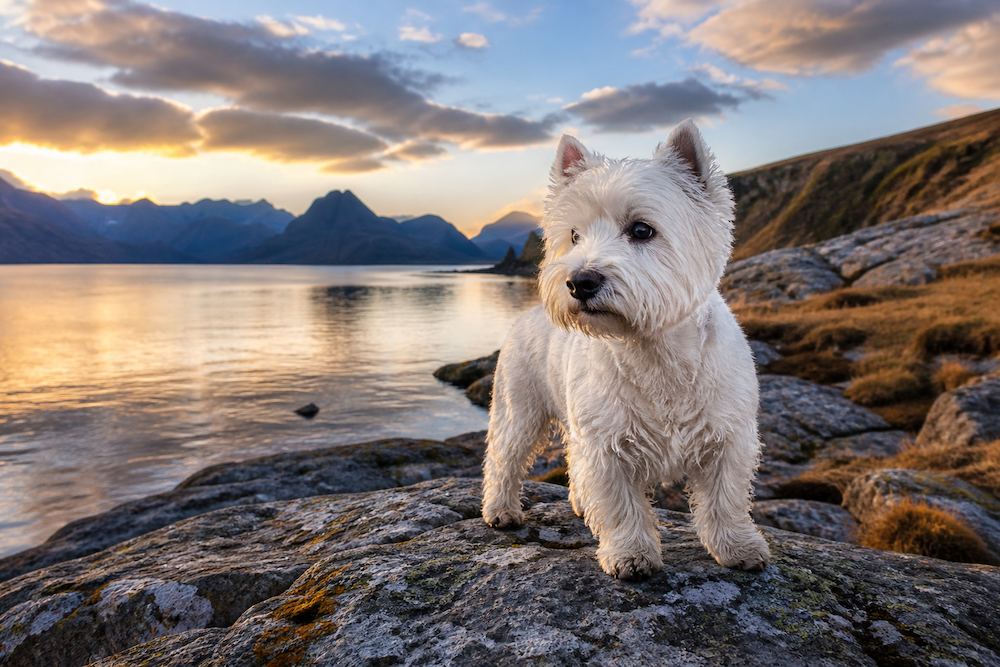







Bright, confident, and full of charm — a small dog with a bold personality and a big heart.
🧠 QUICK SNAPSHOT
- Temperament: Friendly, confident, lively
- Energy Level: Moderate to high
- Size: Small
- Good With Families: Yes
- Trainability: Moderate
- Grooming: Moderate
- Best For: Families, apartments, active owners
📚 OVERVIEW
The West Highland Terrier, often called the “Westie,” is a small but sturdy breed known for its bright white coat and confident personality. Originally bred for hunting, they are alert, energetic, and full of character.
They are affectionate with their families and adapt well to different living environments, making them a popular companion dog.
✅ PROS & CONS
Pros
- Friendly and affectionate
- Compact and adaptable
- Confident and lively personality
- Low shedding coat
Cons
- Can be stubborn
- Strong prey drive
- Needs regular grooming
- Can be vocal
Is a West Highland White Terrier a Good Family Dog?
Yes. West Highland White Terriers, commonly called Westies, can make affectionate, confident and entertaining family dogs.
They’re small but sturdy, with considerably more personality and energy than their size might suggest. They generally do best with families prepared for regular exercise, training and typical terrier behaviour.
Are Westies Good With Children?
Westies can be good with respectful children, particularly older children.
They’re sturdier than many similarly sized companion breeds but may not tolerate rough handling or teasing.
Interactions between dogs and young children should always be supervised.
How Much Exercise Does a Westie Need?
Most Westies need around 45–60 minutes of exercise each day, along with play and mental stimulation.
They enjoy walks, exploring, scent games and interactive play.
Despite their small size, they’re genuine terriers rather than sedentary lap dogs.
Are Westies Easy to Train?
Westies are intelligent but can also be independent and strong-minded.
They usually respond well to short, interesting training sessions using positive reinforcement.
Consistency is important because a Westie can quickly discover when household rules are negotiable.
Do Westies Shed a Lot?
Westies are generally low-shedding dogs compared with many breeds.
Their double coat consists of a harsh outer coat and softer undercoat.
Although they don’t usually leave enormous quantities of hair around the home, regular grooming is still necessary.
Are Westies Hypoallergenic?
Westies are sometimes described as hypoallergenic because they shed relatively little, but no dog is completely hypoallergenic.
Dog allergens are also found in saliva and skin secretions.
People with allergies should spend time around Westies before deciding whether the breed is suitable.
How Often Should You Groom a Westie?
Westies should generally be brushed several times a week.
Pet coats are often clipped periodically, while traditional show coats are hand-stripped to maintain their harsh texture.
Regular grooming also provides an opportunity to monitor the breed’s sometimes sensitive skin.
What Health Problems Are Common in Westies?
Potential health concerns include skin allergies and dermatitis, patellar luxation, Legg-Calvé-Perthes disease and certain inherited neurological or skeletal conditions.
Westies are particularly well known for their susceptibility to skin problems.
Responsible breeding and appropriate veterinary care are important.
Why Do Westies Have Skin Problems?
Westies can have a genetic predisposition to allergic skin disease, which may cause itching, redness, recurrent infections and hair loss.
Environmental or food allergens may contribute in individual dogs.
Persistent scratching, licking or skin irritation should be assessed by a veterinarian rather than assumed to be normal for the breed.
How Long Do Westies Live?
West Highland White Terriers commonly live around 13–15 years, with some living longer.
Their small size contributes to a relatively long potential lifespan.
Healthy weight, regular exercise, dental care and preventive veterinary care can help support longevity.
How Big Does a Westie Get?
Westies are small but robust dogs.
Adults generally stand around 25–28 cm at the shoulder and commonly weigh approximately 6–10 kg.
Their substantial coat can make them look larger than they actually are.
Can a Westie Live in an Apartment?
Yes. Westies can adapt very well to apartment living.
Their small size is convenient, provided they receive sufficient daily exercise and stimulation.
Barking can be a consideration because Westies are naturally alert and quick to respond to interesting noises.
Can Westies Be Left Alone?
Adult Westies can generally learn to tolerate reasonable periods alone.
They’re often somewhat more independent than highly dependent companion breeds, but they still need regular interaction and stimulation.
Bored Westies may entertain themselves by barking, chewing or investigating things their owners would rather they didn’t.
Do Westies Bark a Lot?
They can.
Westies are alert, confident terriers and may readily bark at visitors, unfamiliar noises or activity outside.
Early training can help prevent alert barking from becoming excessive.
Are Westies Good Watchdogs?
Yes. Their size prevents them from functioning as conventional guard dogs, but Westies can make excellent watchdogs.
They’re alert, confident and usually quick to announce something unusual.
They’re unlikely to let a suspicious noise pass unnoticed.
Are Westies Affectionate?
Yes. Westies are generally affectionate and loyal to their families.
Many enjoy cuddling and spending time with their owners while retaining more independence than some traditional lap-dog breeds.
They’re often described as confident little dogs with very big personalities.
Are Westies Good With Other Dogs?
Generally, yes, particularly when properly socialised.
However, Westies can be bold and assertive and may occasionally forget how small they are when interacting with larger dogs.
Early positive social experiences are valuable.
Are Westies Good With Cats?
Some Westies can live successfully with cats, particularly when raised alongside them.
However, their terrier ancestry means they can have a strong instinct to chase smaller animals.
Individual temperament and careful introductions are important.
Do Westies Have a High Prey Drive?
Many do.
Westies were developed to hunt rats, foxes and other quarry, so chasing small moving animals can be highly instinctive.
Pet rodents and similarly small animals should be kept securely separated.
Do Westies Dig?
Yes. Digging is a very natural Westie behaviour.
Their ancestors needed to pursue quarry into rocky ground and underground spaces.
A modern Westie investigating a garden bed may therefore simply be applying centuries of professional experience to a location where nobody requested it.
Can Westies Be Trusted Off Leash?
Caution is advisable.
A well-trained Westie can develop good recall, but its prey drive may suddenly become much more important than its owner’s instructions when a rabbit or other small animal appears.
Secure areas are generally safest for unrestricted running.
Are Westies High-Energy Dogs?
Westies are moderately energetic.
They don’t require the enormous exercise levels of large working breeds, but they’re active, curious terriers that need daily walks and play.
They’re generally happiest when given regular opportunities to explore and investigate.
Why Are Westies Always White?
The Westie’s distinctive white coat was deliberately selected during the breed’s development.
One commonly told historical explanation is that white working terriers were easier for hunters to distinguish from the quarry they were pursuing.
Selective breeding eventually established white as the defining colour of the breed.
Are All West Highland Terriers White?
Yes. The recognised West Highland White Terrier is, as its name suggests, white.
Dogs marketed as black, brown or other-coloured “Westies” aren’t standard West Highland White Terriers.
The white coat is one of the breed’s defining characteristics.
What Is the Difference Between a Westie and a Scottish Terrier?
Westies and Scottish Terriers are separate Scottish breeds.
The Westie is always white and generally has a more upright, compact appearance, while the Scottish Terrier commonly appears in black, brindle or wheaten and has its distinctive long head and beard.
Both retain strong terrier personalities and hunting instincts.
What Were Westies Originally Bred For?
Westies were developed as working earth terriers used to hunt and control vermin and pursue quarry such as foxes.
Their compact bodies allowed them to negotiate difficult terrain and underground spaces.
This working history explains their modern determination, prey drive and enthusiasm for digging.
Where Does the West Highland White Terrier Come From?
The West Highland White Terrier originated in Scotland.
Small working terriers had been used throughout the Scottish Highlands for generations, with white-coated strains becoming increasingly established during the 19th century.
The breed was eventually standardised as the West Highland White Terrier.
Why Is the Westie Associated With Colonel Malcolm of Poltalloch?
Colonel Edward Donald Malcolm of Poltalloch is strongly associated with the development and popularisation of white Scottish terriers that contributed to the modern Westie.
A famous story claims he favoured white dogs after a reddish-brown terrier was accidentally mistaken for quarry during a hunt.
The story has become part of Westie folklore, although historical accounts of exactly how the white breed developed are more complicated than this single incident.
Is a Westie a Good First Dog?
Yes. A Westie can be a good first dog for someone comfortable with terrier behaviour.
They’re conveniently small, adaptable and relatively manageable in their exercise needs.
Owners should still be prepared for independent thinking, barking, prey drive, digging, regular grooming and potential skin problems.
What Makes the Westie Unique?
The Westie is one of those dogs whose appearance doesn’t entirely reveal what lies underneath.
That immaculate white coat, pointed ears and cheerful face can make it look like a small decorative companion.
Historically, it was anything but.
Westies descended from tough Scottish working terriers expected to pursue quarry through rough Highland terrain and even underground.
That required courage, persistence and an impressive willingness to investigate holes.
Those characteristics haven’t completely disappeared.
Today’s Westie may spend much more time on the sofa than hunting foxes, but put an unexplained hole in the garden in front of one and centuries of instinct can suddenly return.
The result is one of the dog world’s great contrasts:
a pristine little white dog with the heart of a muddy Scottish terrier.