





Fearless, loyal, and full of spirit — a fiery terrier with a big heart and endless determination.
🧠 QUICK SNAPSHOT
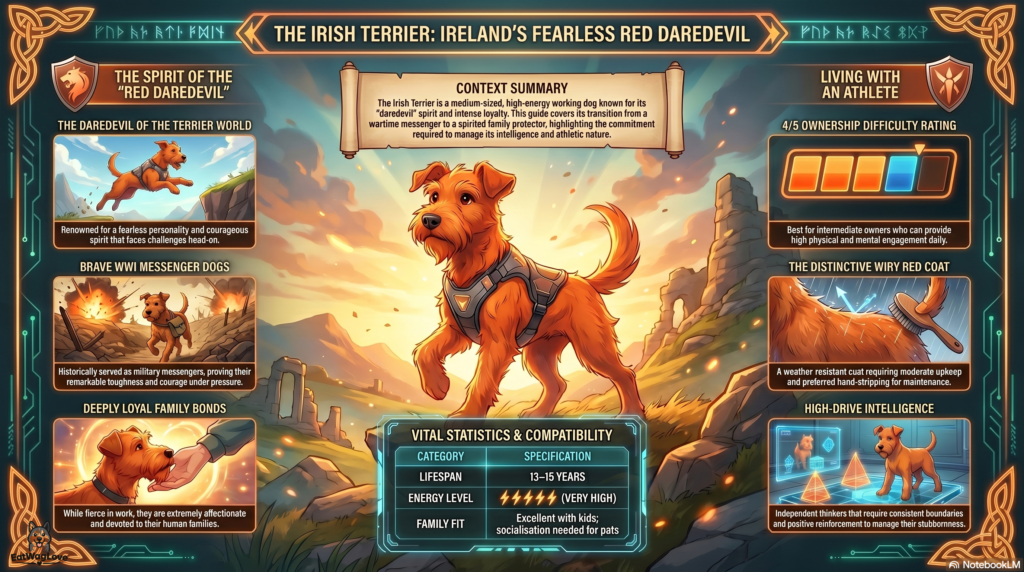
- Temperament: Brave, loyal, energetic
- Energy Level: High
- Size: Medium
- Good With Families: Yes
- Trainability: Moderate
- Grooming: Low to moderate
- Best For: Active owners, terrier lovers
📚 OVERVIEW
The Irish Terrier is one of the oldest terrier breeds, known for its fiery red coat and fearless personality. Originally bred for hunting and farm work, it is energetic, alert, and highly devoted to its family.
They are confident dogs that enjoy activity, companionship, and having a sense of purpose.
✅ PROS & CONS
Pros
- Loyal and affectionate
- Brave and confident personality
- Low shedding coat
- Energetic and playful
Cons
- Can be stubborn
- Strong prey drive
- Needs regular exercise
- Requires consistent training
Is an Irish Terrier a Good Family Dog?
Yes, particularly for an active family prepared for a confident terrier personality.
Irish Terriers are typically loyal, affectionate, energetic and courageous. They can form extremely strong bonds with their families while remaining considerably more independent than many companion breeds.
Early training and socialisation are important.
How Much Exercise Does an Irish Terrier Need?
Most adult Irish Terriers need around 60–90 minutes of exercise each day, along with play and mental stimulation.
They’re athletic dogs that enjoy walking, hiking, running, games and training.
A bored Irish Terrier is quite capable of inventing entertainment that its owner hadn’t planned.
Is an Irish Terrier Easy to Train?
Irish Terriers are intelligent and capable learners, but they aren’t blindly obedient.
They can be independent, determined and easily distracted by movement or wildlife.
Positive reinforcement, consistency and interesting training sessions generally work much better than repetitive or harsh methods.
Are Irish Terriers Intelligent?
Yes.
They combine problem-solving ability with the independent thinking typical of working terriers.
Historically, Irish Terriers performed numerous jobs requiring initiative, including hunting vermin, guarding property, carrying messages and working around farms.
Are Irish Terriers Stubborn?
They can be extremely determined.
Terriers were bred to continue working despite difficult conditions, so persistence was historically an advantage.
An Irish Terrier that decides something is worth investigating may demonstrate impressive commitment to the project.
Does an Irish Terrier Shed?
Irish Terriers are generally low-shedding dogs.
Their harsh, wiry outer coat tends to release less visible hair around the home than many smooth-coated breeds.
However, low shedding doesn’t mean maintenance-free.
Is an Irish Terrier Hypoallergenic?
Irish Terriers are sometimes described as allergy-friendly because they shed relatively little, but no dog is completely hypoallergenic.
Allergens are also produced through saliva and skin secretions.
Individual allergy sufferers can react differently to the same breed.
What Type of Coat Does an Irish Terrier Have?
The Irish Terrier has a dense, wiry outer coat with a softer undercoat.
The coat should lie relatively close to the body rather than appearing fluffy.
Its texture helped protect working dogs from rough vegetation and difficult weather.
How Often Should You Groom an Irish Terrier?
Routine brushing once or twice weekly is usually sufficient for basic coat maintenance.
However, preserving the classic harsh coat requires periodic hand stripping, particularly for show dogs.
Nails, teeth and ears also need regular attention.
What Is Hand Stripping an Irish Terrier?
Hand stripping involves removing dead outer hairs by hand or with specialised stripping tools.
This allows fresh wiry hairs to grow through while preserving the coat’s natural colour and texture.
It isn’t the same as pulling out healthy growing hair.
Can You Clip an Irish Terrier Instead of Hand Stripping?
Yes, particularly for a companion dog.
Clipping is faster and often cheaper, but repeated clipping can make the coat softer, paler and less weather-resistant.
Owners wanting the traditional hard terrier coat generally choose hand stripping.
Why Does a Clipped Irish Terrier Change Colour?
Clipping removes hair at the surface rather than removing the entire dead hair.
Over time, this can leave the coat looking softer and less intensely coloured.
Hand stripping encourages new strongly pigmented, harsh hairs to replace the old coat.
What Health Problems Are Common in Irish Terriers?
Irish Terriers are generally considered a relatively robust breed, but potential concerns include eye problems, hip issues and certain inherited metabolic or muscular conditions.
A particularly important historical concern is hereditary hyperkeratosis of the footpads.
Responsible breeding and available genetic testing have helped reduce inherited disease.
What Is Hyperkeratosis in Irish Terriers?
Hereditary footpad hyperkeratosis causes the pads to become abnormally thickened, hard and sometimes cracked.
The condition was historically associated with Irish Terriers.
Genetic testing and responsible breeding have made it much easier to avoid producing affected puppies.
Do Irish Terriers Have Sensitive Feet?
Not normally, but hereditary hyperkeratosis can cause painful footpad abnormalities in affected dogs.
Any persistent cracking, thickening or discomfort should be examined by a veterinarian.
Healthy Irish Terriers should be active, athletic dogs with functional feet.
How Long Does an Irish Terrier Live?
Irish Terriers commonly live around 13–15 years, with some living longer.
Their relatively moderate body structure contributes to good overall longevity.
Healthy weight, exercise, dental care and responsible breeding remain important.
How Big Does an Irish Terrier Get?
Irish Terriers are medium-sized dogs.
They stand around 46 cm at the shoulder, with adults commonly weighing approximately 11–13 kg, although individual and regional breed-standard differences occur.
Their long-legged outline makes them appear larger than their weight suggests.
Is the Irish Terrier a Small or Medium Dog?
It’s generally considered a medium-sized terrier.
Irish Terriers are considerably taller and more athletic than small earth-working terriers such as the Cairn or Norfolk Terrier.
They’re built for speed and versatility rather than extreme compactness.
Can an Irish Terrier Live in an Apartment?
Yes, provided its exercise requirements are met.
Their moderate size suits apartment living better than many large working dogs.
However, barking, prey drive and high activity levels require management.
Can an Irish Terrier Be Left Alone?
A well-adjusted adult can learn to tolerate reasonable periods alone.
However, Irish Terriers are strongly attached to their families and require substantial exercise and stimulation.
Bored dogs may become destructive or vocal.
Are Irish Terriers Velcro Dogs?
They can be extremely devoted without necessarily behaving like classic lapdog-style Velcro dogs.
Many want to remain involved in whatever their family is doing.
Their combination of affection and independence is a defining part of the breed’s character.
Are Irish Terriers Cuddly?
Many are surprisingly affectionate.
Behind the tough terrier exterior is often a dog that loves physical contact with its favourite people.
They’re generally more emotionally demonstrative with family than their rugged appearance suggests.
Are Irish Terriers Good With Children?
They can be excellent with respectful children.
Their sturdy build and playful temperament can suit active families.
As with any dog, interactions with young children should be supervised, and both child and dog should learn appropriate boundaries.
Are Irish Terriers Good With Other Dogs?
This requires more caution.
Irish Terriers can be assertive and sometimes confrontational with other dogs, particularly dogs of the same sex.
Early socialisation helps, but owners shouldn’t assume every Irish Terrier will enjoy dog parks or unfamiliar canine company.
Are Irish Terriers Aggressive?
They shouldn’t be indiscriminately aggressive toward people.
However, traditional terrier courage and assertiveness can contribute to dog-to-dog conflict in some individuals.
Responsible breeding, socialisation and sensible management are important.
Are Irish Terriers Good With Cats?
Some can live successfully with cats when raised with them.
However, Irish Terriers have genuine terrier prey drive and may chase unfamiliar cats or other small animals.
Individual temperament matters considerably.
Do Irish Terriers Have a Strong Prey Drive?
Yes, many do.
They were historically expected to control rats and other vermin, making interest in small fast-moving animals entirely unsurprising.
Recall training and secure management are important around wildlife.
Are Irish Terriers Good Off Leash?
Some can develop excellent recall, but terrier instincts can make off-leash reliability difficult.
A rabbit suddenly appearing may temporarily become more important than every training session the dog has ever attended.
Secure off-leash areas are safest.
Do Irish Terriers Dig?
Many enjoy digging.
Digging is deeply connected with terrier behaviour, particularly breeds historically used around vermin and underground prey.
Providing an acceptable digging area can sometimes save the rest of the garden.
Do Irish Terriers Bark a Lot?
They’re generally alert and can be vocal.
They may bark at visitors, unusual activity or exciting events.
Early training can prevent alert barking from developing into excessive barking.
Are Irish Terriers Good Watchdogs?
Yes.
They’re naturally alert, confident and strongly attached to their families.
Their bark can make them effective watchdogs despite their moderate size.
They tend to notice unusual activity quickly.
Are Irish Terriers Good Guard Dogs?
They’re exceptionally courageous but aren’t specialist protection dogs.
An Irish Terrier may show remarkable determination when defending its home or family, but its size limits its physical guarding ability compared with larger guardian breeds.
Are Irish Terriers Protective?
They can be.
The breed has a long-standing reputation for loyalty and courage, and many are naturally watchful around their families.
Protection shouldn’t be encouraged into uncontrolled aggression.
Are Irish Terriers Friendly With Strangers?
Many are friendly once properly introduced but may initially be more watchful than highly outgoing breeds such as Labradors.
Temperament should be confident rather than fearful.
Good socialisation helps produce appropriate judgement around unfamiliar people.
Are Irish Terriers High-Energy Dogs?
Yes.
They’re athletic, lively terriers with substantial stamina.
They generally need more activity than their moderate size might suggest.
A short walk followed by an entire day on the sofa isn’t an ideal routine.
When Does an Irish Terrier Calm Down?
Many become noticeably more settled between two and three years of age, although terrier energy and curiosity can persist throughout life.
They often remain playful well into their senior years.
Mental maturity doesn’t necessarily mean losing their enthusiasm.
Are Irish Terriers Good Running Dogs?
Healthy adult Irish Terriers can make excellent running companions.
Their relatively long legs and athletic construction distinguish them from many shorter-legged terriers.
Distance should be increased gradually after skeletal maturity.
Are Irish Terriers Good Hiking Dogs?
Excellent.
They’re hardy, energetic and generally enthusiastic about exploring.
Their coat offers useful protection in rough vegetation, while their manageable size makes them practical adventure companions.
Can Irish Terriers Swim?
Many can swim, although they’re not specialised water dogs.
Individual enthusiasm varies.
Dogs should be introduced gradually and supervised around deep, cold or fast-moving water.
Are Irish Terriers Fast?
Yes.
The breed is relatively long-legged and athletic for a terrier.
Irish Terriers historically needed enough speed and endurance to work across farms and countryside rather than only entering underground dens.
Are Irish Terriers Good at Dog Sports?
Yes.
They can enjoy agility, obedience, rally, scent work, tracking and various terrier activities.
Their intelligence and athleticism are significant advantages.
Training works best when the dog finds the activity worthwhile.
What Does an Irish Terrier Look Like?
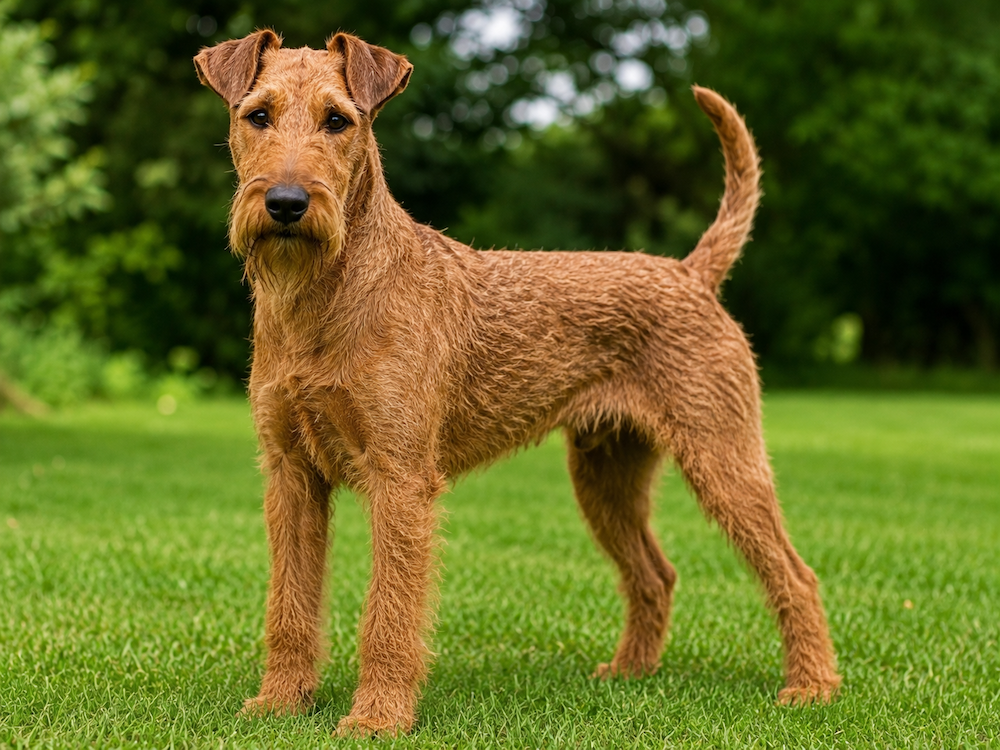
The Irish Terrier is an athletic, rectangular dog with long legs, a narrow head, small folded ears, dark expressive eyes and a harsh wiry coat.
A beard gives the face its characteristic terrier expression.
The overall appearance should suggest speed, strength and endurance.
What Colours Can Irish Terriers Be?
Recognised colours are shades of red, red-wheaten and wheaten.
Modern Irish Terriers are generally relatively uniform in colour.
Small amounts of white may occasionally occur on the chest.
Were Irish Terriers Always Red?
No.
Early Irish Terriers showed considerably greater colour variation, including black-and-tan, brindle and wheaten dogs.
During the development of the modern breed, breeders increasingly selected for solid red colouring.
Eventually, red became one of the breed’s defining characteristics.
Why Are Irish Terriers Red?
The distinctive red coat was reinforced through selective breeding during the 19th century.
Breeders favoured solid-coloured dogs and gradually eliminated much of the earlier colour variation.
The result was the unmistakable red terrier recognised today.
Can an Irish Terrier Be Wheaten?
Yes.
Wheaten and red-wheaten are recognised shades within the breed.
The colour is generally much deeper and more terrier-like in texture than the soft pale coat of a Soft Coated Wheaten Terrier.
Can Irish Terriers Be Black?
Solid black isn’t a normal modern breed colour.
Black-and-tan dogs occurred historically among early Irish Terrier populations, but organised breeding eventually established the characteristic red and wheaten shades.
Do Irish Terrier Puppies Change Colour?
Puppies can change somewhat as their adult wiry coat develops.
The mature coat’s colour and texture may become more obvious after puppy coat is removed.
Grooming method can also affect the apparent richness of the colour.
Why Does an Irish Terrier Have a Beard?
Longer facial furnishings create the characteristic beard and whiskers.
These are part of the traditional wire-coated terrier appearance.
The beard can also provide some protection around the muzzle when working in vegetation or confronting quarry.
Why Are an Irish Terrier’s Ears Folded?
The small V-shaped ears naturally fold forward close to the head.
This creates the classic terrier expression and keeps the ears relatively compact.
Ear shape is an established characteristic of the breed rather than the result of cropping.
Are Irish Terrier Ears Cropped?
No.
The characteristic folded ears are natural.
Ear cropping isn’t required to produce the traditional Irish Terrier appearance.
Is an Irish Terrier the Same as a Soft Coated Wheaten Terrier?
No.
Both originated in Ireland, but they’re distinct breeds.
The Wheaten has a soft, flowing coat, while the Irish Terrier has a harsh, wiry coat and is generally red.
Their historical roles overlap as versatile Irish farm dogs.
Is an Irish Terrier the Same as an Irish Wolfhound?
Definitely not.
The Irish Wolfhound is a giant sighthound historically associated with hunting large game.
The Irish Terrier is a medium-sized terrier used for vermin control, guarding and general farm work.
They share Irish origins but little else physically.
Is an Irish Terrier Related to the Kerry Blue Terrier?
They belong to Ireland’s broader terrier tradition but are separate breeds.
The Kerry Blue developed its characteristic blue-grey coat, while the Irish Terrier became famous for its red wire coat.
Their exact early ancestral relationships aren’t completely documented.
Is an Irish Terrier Related to the Soft Coated Wheaten Terrier?
There are likely historical connections among Ireland’s native terrier populations.
Before formal breed standards, rural working terriers were selected primarily for usefulness rather than pedigree purity.
The Irish Terrier and Wheaten eventually developed into clearly separate breeds.
Is an Irish Terrier Related to the Glen of Imaal Terrier?
Both are native Irish terriers and share broader historical roots in Ireland’s working-terrier tradition.
The Glen is shorter, heavier and substantially different in structure.
The Irish Terrier is taller, faster and more lightly built.
How Many Native Irish Terrier Breeds Are There?
Four breeds are generally recognised as Ireland’s native terriers:
Irish Terrier, Kerry Blue Terrier, Soft Coated Wheaten Terrier and Glen of Imaal Terrier.
Each developed a distinct appearance while preserving elements of Ireland’s practical farm-terrier tradition.
Is the Irish Terrier the Oldest Irish Terrier Breed?
It’s frequently described as one of the oldest Irish terrier breeds, but claims that it’s definitively the oldest should be treated cautiously.
Working terriers existed in Ireland long before modern pedigree records.
The Irish Terrier was, however, among the earliest Irish terriers to become formally standardised.
Where Does the Irish Terrier Come From?
The breed developed in Ireland, probably from diverse local working terriers.
These dogs were selected for practical abilities rather than appearance.
They controlled vermin, guarded homes and farms, hunted small game and accompanied their owners across the countryside.
What Were Irish Terriers Originally Bred For?
They were versatile farm and vermin dogs rather than specialists with only one job.
Irish Terriers hunted rats and other pests, guarded property, accompanied hunters and served as family companions.
Their versatility explains the breed’s combination of courage, speed, intelligence and loyalty.
Did Irish Terriers Hunt Rats?
Yes.
Vermin control was an important function of traditional terriers.
Rats could destroy stored food and spread disease, so an effective ratting dog had genuine economic value on farms and around homes.
Did Irish Terriers Hunt Foxes?
Irish Terriers were historically used for various forms of hunting and vermin work, including fox-related work.
Their relatively long legs allowed them to travel efficiently with hunters.
They weren’t shaped as extremely low-to-the-ground earth dogs.
Were Irish Terriers Farm Dogs?
Yes.
The breed’s history is strongly associated with practical rural life in Ireland.
A useful farm terrier might control vermin, watch the property, accompany its owner and interact with the family.
Versatility mattered more than specialisation.
Why Does the Irish Terrier Have Such Long Legs?
Longer legs gave the breed speed, stamina and the ability to travel over rough countryside.
This distinguishes it from terriers designed primarily to follow quarry into extremely narrow underground spaces.
The Irish Terrier needed to be mobile as well as courageous.
When Did the Modern Irish Terrier Develop?
The modern pedigree breed emerged during the 19th century, when dog shows and organised breeding began standardising Britain’s and Ireland’s working dogs.
By the 1870s, Irish Terriers were appearing prominently at dog shows.
Breed clubs and standards soon followed.
When Did Irish Terriers First Appear at Dog Shows?
Irish Terriers were being exhibited during the 1870s, with early classes helping establish a more consistent type.
As breeders compared dogs from different regions, the modern red-coated breed gradually emerged.
When Was the Irish Terrier Club Founded?
The Irish Terrier Club was established in 1879.
It became one of the important early organisations promoting consistent breed type and standards.
This places the Irish Terrier among the earlier formally organised terrier breeds.
Did Irish Terrier Breeders Help Stop Ear Cropping?
Yes — and this is one of the breed’s most important historical stories.
The Irish Terrier Club took a strong stand against ear cropping, which was still common among some terriers during the 19th century.
The club refused to accept cropped dogs for competition, helping push the practice out of fashion.
When Was Ear Cropping Banned in Irish Terrier Shows?
In the late 19th century, the Irish Terrier Club introduced rules excluding dogs with cropped ears from competition.
This was an unusually progressive welfare position for the era.
The campaign contributed to wider opposition to cosmetic ear cropping in British dog showing.
Why Is the Irish Terrier Important in Dog-Welfare History?
Its breed club became an early organised opponent of cosmetic ear cropping.
At a time when altering terriers’ ears was relatively common, Irish Terrier enthusiasts actively promoted the natural ear.
That makes the breed part of an important chapter in the development of modern canine welfare attitudes.
Was the Irish Terrier Popular in Victorian Britain?
Yes.
Once standardised, its combination of smart appearance, courage and practical usefulness attracted considerable attention.
By the late 19th century, Irish Terriers were well established in Britain as both show and working dogs.
When Did Irish Terriers Come to America?
Irish Terriers reached the United States during the late 19th century and became established relatively quickly.
Their reputation as courageous, versatile dogs appealed to both working-dog owners and the developing dog-show community.
Was the Irish Terrier One of the Early AKC Breeds?
Yes.
The Irish Terrier was recognised relatively early in the history of organised American dog breeding.
By the early 20th century, it was already well established internationally.
Were Irish Terriers Used in World War I?
Yes. Irish Terriers gained considerable fame during World War I.
They served as messenger and communication dogs and performed other duties under extremely dangerous battlefield conditions.
Their courage and determination became legendary among soldiers.
What Did Irish Terriers Do During World War I?
Irish Terriers were used to carry messages between positions, sometimes crossing terrain exposed to artillery and gunfire.
Dogs could travel through conditions that made human movement extremely dangerous.
Their intelligence, speed and determination made them useful military messengers.
Were Irish Terriers Messenger Dogs?
Yes.
Messenger work is one of the breed’s best-known wartime roles.
A trained dog could carry information between units when telephone lines were destroyed or human messengers faced enormous danger.
Were Irish Terriers Afraid of Gunfire?
Individual dogs obviously differed, but wartime accounts praised the breed for remarkable courage around gunfire, explosions and battlefield chaos.
Military dogs were selected and trained for stability under difficult conditions.
The Irish Terrier’s reputation for fearlessness became strongly reinforced during this period.
Did Irish Terriers Save Soldiers’ Lives?
Military messenger dogs could absolutely contribute to saving lives by delivering critical communications.
Specific stories vary in documentation, so dramatic individual claims should be treated carefully.
What is well established is that dogs provided valuable communication support under dangerous battlefield conditions.
Why Is the Irish Terrier Called a “Daredevil”?
The breed has long been associated with the nickname “Daredevil” because of its extraordinary reputation for courage.
Irish Terriers were expected to confront vermin and defend themselves despite relatively modest size.
Their wartime service strengthened this image considerably.
Why Is the Irish Terrier Called the “Red Daredevil”?
“Red Daredevil” combines the breed’s characteristic red coat with its reputation for exceptional courage and determination.
It’s one of the most memorable nicknames in the dog world.
The description became particularly appropriate after the breed’s celebrated military service.
Why Was the Irish Terrier Known as the “Poor Man’s Sentinel”?
Historical descriptions sometimes portrayed the Irish Terrier as a practical household and farm guardian for ordinary families.
It didn’t require the resources of a huge guard dog yet remained alert, courageous and fiercely loyal.
The phrase reflects the breed’s role as a versatile working companion rather than an aristocratic specialist.
What Did Jack London Say About Irish Terriers?
Writer Jack London became an enthusiastic admirer of Irish Terriers.
He owned dogs of the breed and praised their character, intelligence and courage.
His writings helped reinforce their romantic image as tough but devoted companions.
Did Jack London Own Irish Terriers?
Yes.
Jack London owned Irish Terriers and wrote admiringly about them.
His enthusiasm is frequently mentioned in breed histories and contributed to the Irish Terrier’s cultural profile during the early 20th century.
Was an Irish Terrier Featured in Firehouse Dog?
Yes. The 2007 film Firehouse Dog featured a dog character named Rexxx, portrayed as an Irish Terrier.
The breed’s expressive face, athleticism and distinctive red coat made it particularly memorable on screen.
Why Aren’t Irish Terriers More Popular Today?
They combine several characteristics that don’t suit every modern household: high energy, prey drive, independence and potential dog-to-dog assertiveness.
Their wire coat also requires specialised grooming if owners want to preserve its traditional texture.
For enthusiasts, those same characteristics are part of the appeal.
Are Irish Terriers Rare?
They’re considerably less common than breeds such as Labradors, Golden Retrievers or French Bulldogs.
However, established breeding populations exist internationally.
Their relative rarity can make finding a responsible breeder more difficult.
Is an Irish Terrier a Good First Dog?
It can be, but the owner should genuinely appreciate terrier temperament.
Irish Terriers are intelligent and affectionate, but they can also be determined, energetic, prey-driven and occasionally challenging around other dogs.
They’re generally easier for someone comfortable with consistent training and active daily exercise.
Why Are Irish Terriers Considered So Brave?
Their historical jobs repeatedly rewarded courage.
A useful terrier couldn’t retreat every time a rat fought back, while farm guarding and hunting also demanded confidence.
Later, World War I messenger work transformed that working courage into one of the breed’s defining legends.
Where Did the Irish Terrier’s Famous Courage Come From?
It wasn’t simply an aesthetic trait deliberately added to a show dog.
Generations of working terriers were selected for the persistence needed to control vermin, hunt, guard property and cope with difficult rural conditions.
Dogs lacking determination were simply less effective workers.
Where Does the Irish Terrier Come From?
The Irish Terrier developed in Ireland from practical local working terriers, long before breeders cared greatly about producing identical-looking dogs. These tough farm dogs controlled vermin, guarded homes, hunted and accompanied their families through the Irish countryside.
During the 19th century, breeders began standardising the type, gradually replacing the earlier variety of colours with the distinctive red coat seen today. The Irish Terrier Club, founded in 1879, also became notable for campaigning against cosmetic ear cropping.
The breed’s reputation reached another level during World War I, when Irish Terriers served as messenger dogs and became celebrated for continuing to work amid battlefield gunfire and explosions. Their extraordinary reputation for courage helped produce the enduring nickname “Red Daredevil.”
It’s an unusually appropriate name. Beneath that neat red coat is a dog descended from generations expected to catch rats, protect the farm, hunt across rough country and — when history demanded it — carry messages through a battlefield.