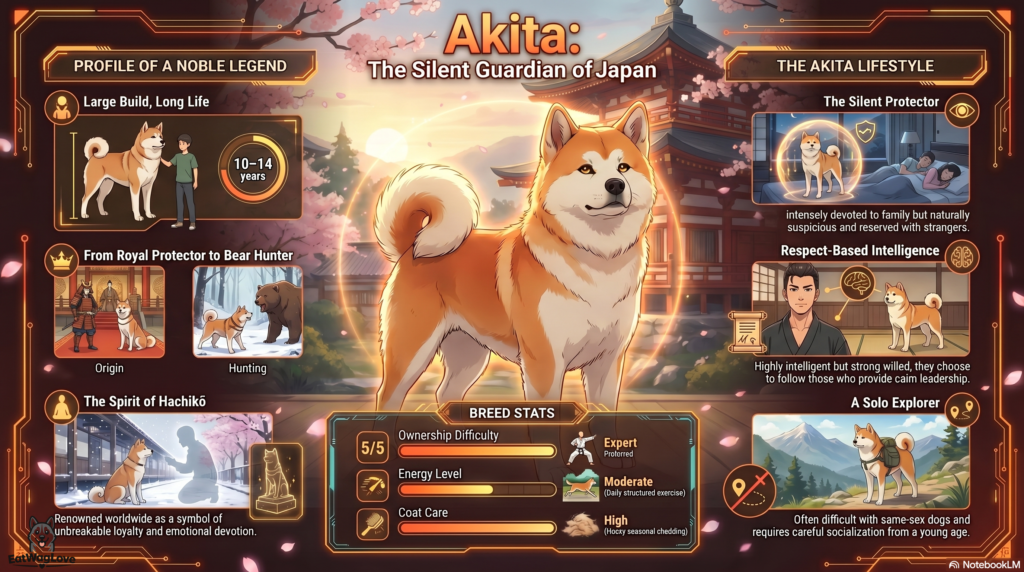
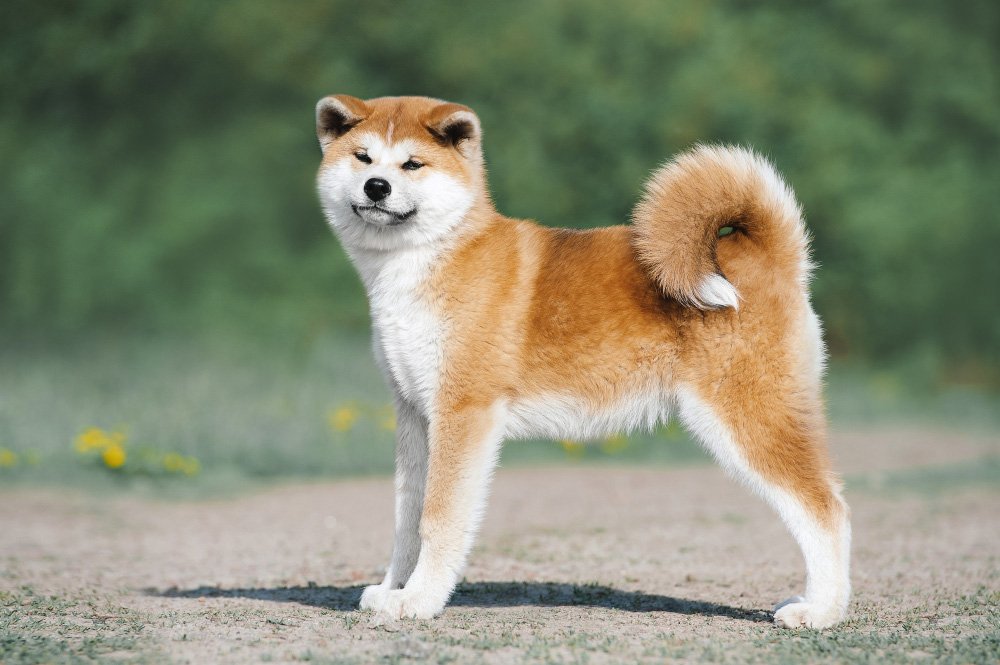







Powerful, loyal, and deeply dignified — a fearless guardian with a calm and devoted nature.
🧠 QUICK SNAPSHOT
- Temperament: Loyal, independent, protective
- Energy Level: Moderate to high
- Size: Large
- Good With Families: Yes (experienced homes)
- Trainability: Moderate
- Grooming: High (seasonal shedding)
- Best For: Experienced owners, secure homes
📚 OVERVIEW
The Akita is a large Japanese breed known for its strength, loyalty, and calm confidence. Originally bred for guarding and hunting, they are naturally protective and form incredibly strong bonds with their family.
They are quiet, dignified dogs that prefer structure and consistency, making them best suited to experienced owners.
✅ PROS & CONS
Pros
- Extremely loyal and devoted
- Strong protective instincts
- Calm and composed temperament
- Powerful and impressive presence
Cons
- Can be dominant or stubborn
- Heavy seasonal shedding
- Needs early socialisation
- Not always friendly with other dogs
Is an Akita a Good Family Dog?
Yes, an Akita can be a deeply loyal and devoted family dog, but it is generally best suited to experienced owners who understand powerful, independent breeds.
Akitas tend to form extremely strong bonds with their household and can be calm and affectionate at home. They’re often naturally reserved around strangers rather than immediately sociable.
They can live successfully with respectful children, particularly when raised with them, but their size and strength mean supervision is important.
Early socialisation, consistent training and responsible management are essential.
The Akita isn’t usually a dog that wants to become friends with everyone it meets.
Its loyalty tends to be selective — and extraordinarily strong.
How Much Exercise Does an Akita Need?
A healthy adult Akita generally needs around 60–90 minutes of exercise each day, although individual requirements vary.
Daily walks, controlled exploration and opportunities for mental stimulation usually suit the breed well.
Akitas are powerful and athletic but aren’t generally as relentlessly energetic as breeds such as the Border Collie or Australian Cattle Dog.
Mental exercise is important too.
Training, scent games and food puzzles can provide useful stimulation.
Exercise should be moderated while puppies are developing to protect growing joints.
A well-exercised adult Akita can be surprisingly calm around the home — but that calmness should come after its needs have been met, not instead of meeting them.
Is an Akita Easy to Train?
Akitas are highly intelligent but independent, which means they’re capable of learning quickly without necessarily being eager to obey every request.
They were developed to be confident, powerful dogs capable of functioning with considerable independence.
Positive reinforcement, consistency and clear boundaries generally produce the best results.
Repetitive training can cause an Akita to lose interest, while harsh methods risk damaging trust or creating confrontation.
Early socialisation is just as important as obedience training.
An Akita needs to learn how to remain calm and controlled around unfamiliar people, dogs and environments.
This isn’t usually the ideal breed for someone wanting a dog whose main ambition in life is earning approval for following instructions.
Does an Akita Shed?
Yes. Akitas shed heavily, despite their relatively neat-looking coat.
They have a dense double coat developed to protect them in cold conditions.
Moderate shedding occurs throughout the year, but once or twice annually many Akitas dramatically “blow” their undercoat.
During these periods, enormous amounts of loose fur can come away.
Regular brushing helps remove dead coat and reduces the amount distributed around the home.
More frequent grooming is usually needed during seasonal coat changes.
Routine bathing, nail trimming, dental care and ear checks should also form part of normal maintenance.
Anyone wanting an Akita should become comfortable with one unavoidable reality:
the dog isn’t the only thing in the house that will eventually be covered in Akita hair.
What Health Problems Are Common in Akitas?
Akitas can be affected by several inherited and acquired health conditions.
Hip dysplasia is an important concern and can contribute to arthritis and mobility problems.
Autoimmune disorders occur within the breed, including conditions affecting the skin, eyes and other body systems.
Akitas can also develop hypothyroidism and inherited eye disorders.
As a large, deep-chested breed, they’re at risk of gastric dilatation-volvulus (GDV or bloat), a potentially fatal emergency requiring immediate veterinary treatment.
Responsible breeders should perform appropriate health screening and provide documented results.
Maintaining a healthy body weight is also particularly important for protecting joints throughout the dog’s life.
How Long Do Akitas Live?
Akitas typically live around 10–14 years, although individual lifespan varies.
Genetics, nutrition, body weight, exercise and preventive veterinary care all influence longevity.
Large dogs often have shorter average lifespans than smaller breeds, making responsible health screening especially important.
Senior Akitas may need adjustments to exercise and diet as joint mobility changes, but they still benefit from regular physical and mental activity.
An older Akita may become slower.
That doesn’t necessarily mean it becomes any less certain about how the household should be organised.
Are Akitas Aggressive?
Akitas should not be indiscriminately aggressive, but they are powerful guardian-type dogs with strong territorial instincts, and aggression toward other dogs can be a genuine concern within the breed.
Some Akitas can be particularly intolerant of dogs of the same sex.
They may also be naturally suspicious or reserved around unfamiliar people.
Early socialisation and lifelong management are therefore essential.
Owners shouldn’t deliberately encourage guarding or aggressive behaviour.
The Akita already possesses confidence, physical strength and protective instincts.
Responsible ownership focuses on developing stability, control and appropriate responses, not making the dog more suspicious.
Are Akitas Good With Other Dogs?
Akitas can be challenging with other dogs, particularly dogs of the same sex.
Some individuals live peacefully in multi-dog households, especially when carefully introduced and appropriately matched.
Others strongly prefer being the only dog.
This isn’t a breed where owners should assume that extensive puppy socialisation guarantees lifelong enjoyment of dog parks.
Maturity can change social behaviour.
Interactions with unfamiliar dogs should be managed carefully, and owners should learn to recognise their Akita’s body language.
The goal doesn’t need to be an Akita that wants to play with every dog.
A dog capable of remaining calm and controlled around others is a much more realistic priority.
Are Akitas Good With Cats and Small Animals?
Some Akitas can live peacefully with cats they’ve been raised with, but the breed’s strong prey drive means caution is essential.
Historically, Akitas were used to hunt substantial game, and chasing instinct can remain powerful.
A dog that accepts its own household cat may still pursue unfamiliar cats or wildlife outdoors.
Small pets such as rabbits, rodents and birds require particularly careful management.
Early socialisation can help, but prey drive isn’t something owners should assume training can completely eliminate.
Secure fencing and controlled exercise are important.
Can an Akita Live in an Apartment?
An Akita can adapt to apartment living when its exercise and behavioural needs are consistently met, although its large size makes a spacious home more convenient.
Adult Akitas are often surprisingly calm indoors.
They’re not usually dogs that spend every waking moment racing around the house.
The bigger challenges are exercise, access to outdoor areas and safely managing encounters with unfamiliar dogs in communal spaces.
Secure outdoor space is useful but isn’t a substitute for daily walks and interaction.
An apartment isn’t automatically unsuitable.
But sharing a tiny lift every morning with three unfamiliar dogs may not be the Akita’s preferred social arrangement.
Can an Akita Be Left Alone?
A mature, properly trained Akita can usually tolerate reasonable periods alone, although no dog should routinely spend most of its life isolated.
Akitas are often more independent than highly dependent companion breeds.
That independence doesn’t mean they aren’t strongly attached to their families.
Puppies should gradually learn to spend short periods alone so independence develops naturally.
Exercise and mental stimulation before longer absences can also help prevent boredom.
An Akita may not follow its owner from room to room demanding constant entertainment, but it still expects to be a genuine member of the household.
Do Akitas Bark a Lot?
Akitas are generally not excessive barkers.
Many are relatively quiet and tend to bark when they believe there’s a reason.
Their natural alertness means they may vocalise when unfamiliar people approach the property or something unusual occurs.
Training can help prevent alert barking from becoming excessive.
Interestingly, Akitas can produce an assortment of other vocalisations, including grumbles, groans and expressive noises when interacting with their families.
Their reputation for quietness is particularly notable given their history as powerful guardians.
When an Akita does decide something deserves an announcement, however, people generally notice.
What Is the Difference Between a Japanese Akita and an American Akita?
The Japanese Akita Inu and American Akita developed into noticeably different types, and many kennel organisations now recognise them separately.
The Japanese Akita generally has a lighter, more refined appearance with a fox-like head and more restricted accepted colours.
The American Akita is typically heavier and more substantial, with a broader, bear-like head and a wider range of colours and markings.
Both trace their ancestry to Japanese Akita-type dogs, but breeding history during and after the 20th century led to increasingly different appearances.
Terminology can vary between countries and registries, so prospective owners should check which type a breeder is discussing.
Where Does the Akita Come From?
The Akita originates in Japan, particularly the mountainous Akita Prefecture in northern Honshu.
Its ancestors were powerful Japanese hunting dogs used to pursue animals including wild boar and deer, and historically even large game such as bears.
Over time, Akita-type dogs also became associated with guarding, status and Japanese culture.
The breed experienced dramatic changes during the 20th century, including crossbreeding and severe population disruption during World War II.
Post-war breeding programs ultimately helped produce the Japanese and American types seen today.
The modern Akita may live on a sofa, but its ancestry belongs to the mountains of northern Japan.
Who Was Hachikō and Why Is He Famous?
Hachikō was an Akita who became one of the world’s most famous symbols of canine loyalty.
Born in Japan in 1923, Hachikō belonged to Professor Hidesaburō Ueno of Tokyo Imperial University.
Hachikō regularly accompanied his owner to Shibuya Station and returned to meet him.
When Professor Ueno died unexpectedly in 1925, Hachikō continued returning to the station for years afterward.
His devotion became nationally famous in Japan, and a statue honouring him was erected at Shibuya Station.
Hachikō died in 1935, but his story remains internationally recognised.
Today, the Hachikō statue is one of Tokyo’s best-known meeting places.
Few individual dogs have influenced the public image of an entire breed as profoundly as the Akita that kept waiting for his person to come home.