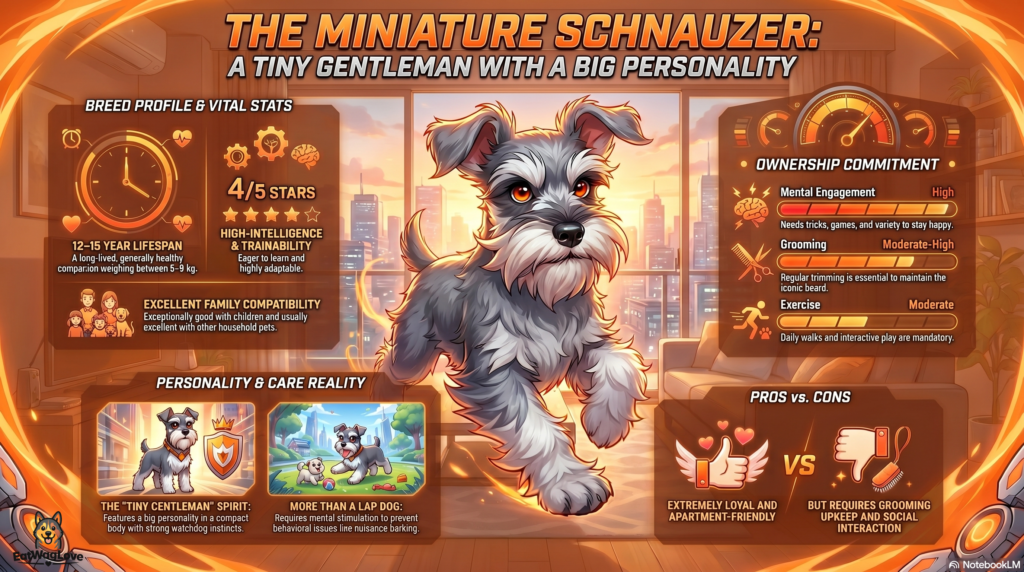
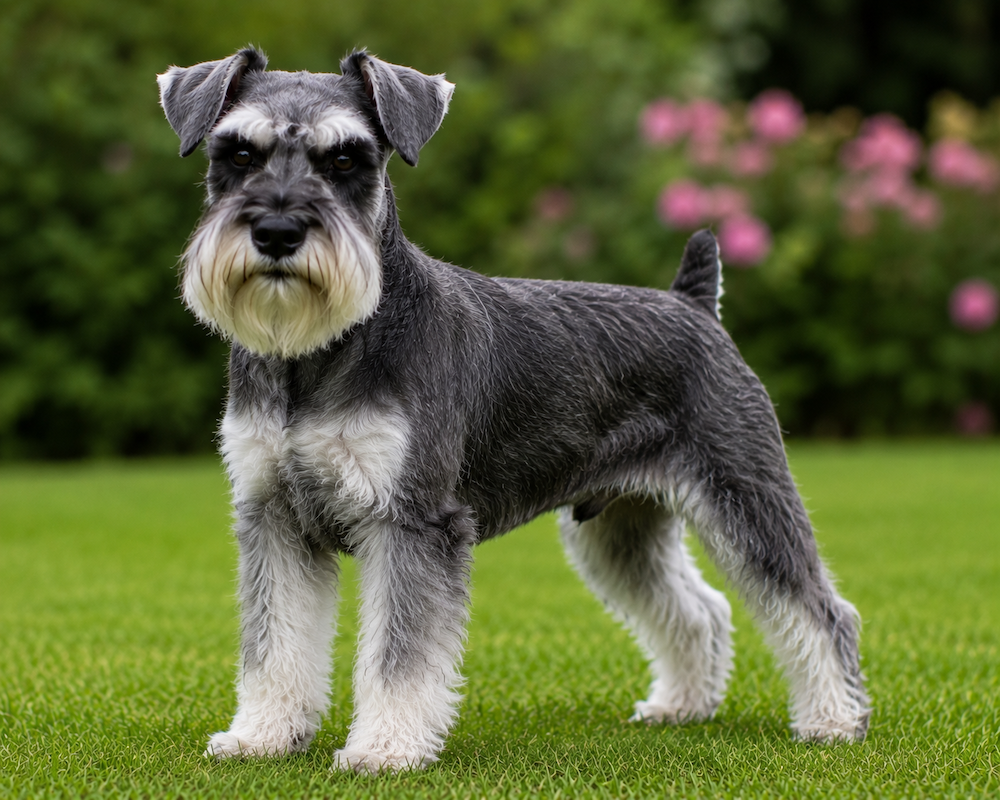







Smart, spirited, and full of personality — a compact companion with a bold attitude and distinctive beard.
🧠 QUICK SNAPSHOT
- Temperament: Intelligent, alert, friendly
- Energy Level: Moderate
- Size: Small
- Good With Families: Yes
- Trainability: High
- Grooming: Moderate
- Best For: Families, apartments, companionship
📚 OVERVIEW
The Miniature Schnauzer is a small working breed known for its distinctive beard, expressive eyebrows, and lively personality. Originally bred for farm work and ratting, they are alert, intelligent dogs that enjoy being involved in family life.
They are affectionate companions with a confident and entertaining nature.
✅ PROS & CONS
Pros
- Highly intelligent and trainable
- Friendly and affectionate
- Compact and adaptable size
- Low shedding coat
Cons
- Can be vocal
- Needs regular grooming
- Requires mental stimulation
- May become stubborn without structure
Is a Miniature Schnauzer a Good Family Dog?
Yes. The Miniature Schnauzer is generally an affectionate, intelligent, lively and adaptable family dog.
They’re usually highly involved with their households and combine the personality of a terrier-like working dog with the size of a convenient companion.
They can be excellent with respectful children and often enjoy being part of almost every family activity.
How Much Exercise Does a Miniature Schnauzer Need?
Most Miniature Schnauzers need around 45–60 minutes of exercise each day, although energetic individuals may happily do more.
Daily walks should ideally be combined with play, training and mental stimulation.
They’re small dogs, but they’re considerably more athletic than their size might suggest.
Is a Miniature Schnauzer a High-Energy Dog?
Usually moderately to highly energetic.
They tend to be lively, alert and playful without requiring the extreme exercise levels of some working breeds.
A well-exercised Miniature Schnauzer will often settle happily indoors while remaining ready for the next adventure.
Is a Miniature Schnauzer Easy to Train?
Generally, yes.
Miniature Schnauzers are intelligent, attentive and quick learners.
They can also have an independent streak, so short, rewarding and varied training sessions usually work better than repetitive drilling.
Are Miniature Schnauzers Intelligent?
Very.
Their ancestors needed to identify and pursue vermin while also functioning as versatile farm dogs.
Modern Miniature Schnauzers often excel at obedience, tricks, scent work, agility and other activities requiring problem-solving.
Are Miniature Schnauzers Stubborn?
They can be.
They’re clever enough to understand what you want while occasionally having their own opinion about whether it’s currently worth doing.
Consistency and positive reinforcement usually produce much better results than confrontation.
Are Miniature Schnauzers Difficult to Toilet Train?
Usually not.
They’re intelligent and generally respond well to consistent routines.
Frequent toilet opportunities, supervision and immediate rewards make puppy training considerably easier.
Does a Miniature Schnauzer Shed?
Very little.
The breed has a double coat with a wiry outer layer and softer undercoat, and loose hair tends to remain trapped rather than falling freely around the home.
This low-shedding coat is one of the breed’s major attractions.
Is a Miniature Schnauzer Hypoallergenic?
No dog is completely hypoallergenic, but Miniature Schnauzers are often considered a better option for some allergy sufferers because they shed relatively little.
Allergens are still present in saliva, skin secretions and dander.
Anyone with significant dog allergies should spend time around the breed before bringing one home.
How Often Should You Groom a Miniature Schnauzer?
The coat should generally be brushed several times each week.
The beard, legs and furnishings can tangle easily and may collect food, dirt and debris.
Most pet Miniature Schnauzers also require professional grooming approximately every six to eight weeks.
Does a Miniature Schnauzer Need Haircuts?
Yes.
Unlike short-coated breeds, a Miniature Schnauzer’s coat needs regular trimming or hand stripping.
Most pet dogs are clipped for convenience, while show coats are traditionally maintained through hand stripping.
What Is Hand Stripping a Miniature Schnauzer?
Hand stripping involves removing dead outer hairs by hand rather than cutting them with clippers.
This encourages the growth of the breed’s traditional hard, wiry outer coat.
Clipping is easier for most pet owners but can gradually make the coat softer and sometimes alter its colour.
Why Does a Clipped Miniature Schnauzer’s Coat Become Softer?
Clippers cut both the harsh outer hairs and softer undercoat rather than removing mature outer hairs from the follicle.
Over repeated grooming, the softer undercoat can become more visually dominant.
This is why clipped pets often feel much softer than hand-stripped show dogs.
Why Does a Miniature Schnauzer Have a Beard?
The beard is part of the breed’s distinctive appearance and historically may also have offered some protection to the face while dealing with vermin.
Today it gives the Miniature Schnauzer its famous elderly-professor expression.
It also collects an impressive quantity of water immediately after the floor has been cleaned.
How Do You Keep a Miniature Schnauzer’s Beard Clean?
Regular combing and wiping after meals can help.
Wet beards can trap food particles and develop odour if they’re never cleaned.
Some owners wash the beard separately between full baths.
What Health Problems Are Common in Miniature Schnauzers?
Potential concerns include pancreatitis, hyperlipidaemia, urinary stones, diabetes, eye disorders and dental disease.
Some inherited neurological and muscular disorders also occur in particular bloodlines.
Responsible breeders should perform appropriate health screening rather than breeding solely for appearance.
Are Miniature Schnauzers Prone to Pancreatitis?
Yes.
Miniature Schnauzers have a recognised predisposition to pancreatitis.
High blood triglyceride levels can be an important contributing factor in some dogs.
Vomiting, abdominal pain, reduced appetite or unusual lethargy should receive veterinary attention.
Are Miniature Schnauzers Prone to High Cholesterol and Triglycerides?
Yes.
The breed is particularly associated with primary hyperlipidaemia, in which blood lipid levels can become abnormally elevated.
This can contribute to other medical problems, including pancreatitis.
Veterinary monitoring may be recommended for affected dogs.
Are Miniature Schnauzers Prone to Bladder Stones?
Yes.
They’re predisposed to certain types of urinary stones.
Frequent urination, straining, blood in the urine or difficulty passing urine should never be ignored.
Complete urinary obstruction is a veterinary emergency.
Are Miniature Schnauzers Prone to Diabetes?
They have an increased risk compared with some breeds.
Maintaining a healthy body weight and recognising changes in thirst, appetite or urination can help with early detection.
Diabetes is manageable but requires veterinary treatment.
Are Miniature Schnauzers Prone to Eye Problems?
Some inherited eye disorders occur in the breed, including cataracts and retinal conditions.
Responsible breeding programmes use appropriate ophthalmic examinations and genetic testing where available.
Any sudden change in vision requires veterinary assessment.
What Is Myotonia Congenita in Miniature Schnauzers?
Myotonia congenita is an inherited disorder affecting normal relaxation of the muscles after contraction.
Affected dogs can develop unusually stiff movement and prominent musculature.
Genetic testing can help breeders avoid producing affected puppies.
How Long Does a Miniature Schnauzer Live?
Miniature Schnauzers commonly live around 12–15 years, with some reaching their late teens.
They’re generally a long-lived breed.
Healthy weight, dental care, appropriate diet and regular veterinary monitoring are particularly important.
How Big Does a Miniature Schnauzer Get?
Most adults stand approximately 30–36 cm at the shoulder and weigh around 5–9 kg.
They’re compact and sturdy rather than delicate.
Their substantial beard and leg furnishings can make them appear larger than they actually are.
Is There a Toy Miniature Schnauzer?
No officially recognised Toy Miniature Schnauzer exists.
Dogs marketed as “Toy Schnauzers” are generally unusually small Miniature Schnauzers or dogs bred specifically for reduced size.
Toy isn’t an established Schnauzer variety under major traditional kennel standards.
Is There a Teacup Miniature Schnauzer?
No.
“Teacup Schnauzer” is a marketing term rather than a recognised breed or size.
Extreme miniaturisation can increase the risk of fragility and other health problems.
Can a Miniature Schnauzer Live in an Apartment?
Yes.
Their manageable size and adaptability make them good apartment dogs provided they receive sufficient exercise and mental stimulation.
The biggest potential apartment issue is often barking, not lack of space.
Does a Miniature Schnauzer Need a Backyard?
No.
Daily walks, training and play can meet their needs without a garden.
If a yard is available, secure fencing is important because interesting scents and small animals can encourage exploration.
Can a Miniature Schnauzer Be Left Alone?
Adult dogs can learn to tolerate reasonable periods alone.
However, Miniature Schnauzers tend to be highly involved with their families and shouldn’t routinely spend very long periods isolated.
Gradual independence training is useful.
Are Miniature Schnauzers Prone to Separation Anxiety?
Some can be.
Their strong attachment to family members can become excessive if they never learn to relax independently.
Exercise, enrichment and gradual alone-time training can reduce the risk.
Are Miniature Schnauzers Velcro Dogs?
Many are.
They often want to know where their owners are and what they’re doing.
A Miniature Schnauzer can simultaneously patrol the house independently and remain deeply offended that someone went to the bathroom without inviting it.
Are Miniature Schnauzers Cuddly?
Many are very affectionate.
Some are dedicated lap dogs, while others prefer sitting immediately beside their owners.
They’re generally much more family-oriented than their serious bearded expression suggests.
Are Miniature Schnauzers Good With Children?
Usually.
They’re sturdy enough to enjoy active play but still small enough to be manageable around a family home.
Children should always be taught respectful handling.
Are Miniature Schnauzers Good With Other Dogs?
Generally, particularly with good socialisation.
They can be confident and sometimes assertive, but many live happily in multi-dog households.
Individual temperament remains important.
Are Miniature Schnauzers Good With Cats?
Many can live successfully with cats, especially when raised together.
Their historical vermin-hunting instincts mean unfamiliar small animals can still trigger pursuit.
Careful introductions are essential.
Can Miniature Schnauzers Live With Rabbits or Guinea Pigs?
Caution is necessary.
Miniature Schnauzers were deliberately developed to control rats and other vermin.
A friendly family dog may still respond instinctively to small, rapidly moving pets.
Do Miniature Schnauzers Have a Strong Prey Drive?
Many do.
Rodents, squirrels, rabbits and other small animals can attract intense attention.
The breed’s neat beard and eyebrows shouldn’t disguise the fact that its ancestors were serious ratters.
Are Miniature Schnauzers Good Off Leash?
They can develop excellent recall with training.
However, prey drive and curiosity can suddenly become powerful distractions.
Secure fenced areas remain the safest places for unrestricted running.
Do Miniature Schnauzers Bark a Lot?
They can.
Miniature Schnauzers are famously alert and often extremely enthusiastic about announcing visitors, passing dogs and unusual noises.
Early training is valuable because alert barking can otherwise become habitual.
Why Is My Miniature Schnauzer So Vocal?
Vocal communication fits the breed’s historical role as an alert farm dog.
A useful farm dog needed to notice unusual activity and draw attention to it.
Modern Schnauzers sometimes apply that ancient responsibility to delivery drivers, neighbours and suspicious-looking wheelie bins.
Are Miniature Schnauzers Good Watchdogs?
Excellent.
They’re highly alert, observant and usually quick to announce anything unusual.
Their compact size doesn’t reduce their enthusiasm for household security.
Are Miniature Schnauzers Good Guard Dogs?
They’re much better watchdogs than physical guard dogs.
A Miniature Schnauzer will often provide an excellent alarm.
At 5–9 kg, however, it isn’t designed to physically defend property against a determined intruder.
Are Miniature Schnauzers Aggressive?
A well-bred Miniature Schnauzer shouldn’t be indiscriminately aggressive.
They can be confident, territorial and reactive if poorly socialised.
Early positive exposure to different people, dogs and environments is important.
Are Miniature Schnauzers Friendly With Strangers?
Many are initially alert but become friendly once introduced.
Some individuals are naturally more reserved.
Good socialisation helps ensure watchdog instincts don’t turn into unnecessary suspicion.
When Does a Miniature Schnauzer Calm Down?
Many become noticeably calmer around two to three years old.
They generally remain playful and alert throughout adulthood.
Even older Schnauzers often retain considerable enthusiasm for walks and games.
Do Miniature Schnauzers Get the Zoomies?
Absolutely.
Their compact bodies can produce impressive acceleration.
A Miniature Schnauzer with the zoomies can temporarily convert an ordinary living room into a surprisingly technical racing circuit.
Are Miniature Schnauzers Good Walking Dogs?
Yes.
They’re energetic enough to enjoy substantial daily walks without being physically difficult for most adults to handle.
Regular exploration also provides valuable mental stimulation.
Are Miniature Schnauzers Good Running Dogs?
Healthy adults can enjoy shorter runs.
They’re athletic but aren’t primarily long-distance running dogs.
Exercise should be introduced gradually after physical maturity.
Are Miniature Schnauzers Good Hiking Dogs?
Yes.
Their stamina, manageable size and adventurous temperament can make them excellent hiking companions.
Wildlife encounters require sensible management because of their prey drive.
Can Miniature Schnauzers Swim?
Many can swim, although enthusiasm varies.
They’re not specialised water retrievers.
A life jacket is sensible around deep or moving water until the dog’s swimming ability is known.
Do Miniature Schnauzers Get Cold Easily?
They tolerate moderate cold reasonably well, but clipped dogs lose much of the insulation provided by their coat.
A coat may be useful in genuinely cold weather.
Very young, elderly or recently groomed dogs can be particularly sensitive.
Can Miniature Schnauzers Handle Hot Weather?
Generally, but exercise should be reduced during extreme heat.
Fresh water, shade and cool indoor areas are essential.
Long facial furnishings can become wet and messy but don’t provide meaningful protection from overheating.
What Does a Miniature Schnauzer Look Like?
The Miniature Schnauzer is a compact, squarely built dog with a wiry coat, rectangular head, bushy eyebrows and unmistakable beard.
Its appearance is alert and robust rather than delicate.
The furnishings around the face and legs create the classic Schnauzer silhouette.
Why Does a Miniature Schnauzer Have Bushy Eyebrows?
The eyebrows are part of the breed’s characteristic facial furnishings.
Historically, harsh facial hair may have provided some protection while the dog confronted vermin.
Today those eyebrows are primarily responsible for making a Miniature Schnauzer look as though it’s constantly evaluating your decisions.
What Colours Can Miniature Schnauzers Be?
Traditional recognised colours include salt and pepper, black, and black and silver.
Some kennel organisations also recognise white, while others don’t.
Breed standards differ internationally.
What Is Salt and Pepper in a Miniature Schnauzer?
Salt and pepper describes hairs containing alternating light and dark banding, producing an overall grey or silver appearance.
It’s one of the breed’s most iconic colours.
Individual dogs can range from relatively light silver to much darker grey.
Can a Miniature Schnauzer Be Black?
Yes.
Solid black is a traditional recognised Miniature Schnauzer colour.
A good black coat can appear particularly dramatic against the breed’s characteristic beard and eyebrows.
Can a Miniature Schnauzer Be Black and Silver?
Yes.
Black-and-silver dogs have a dark body with lighter silver markings in characteristic areas such as the eyebrows, muzzle, chest and legs.
The pattern can superficially resemble the black-and-tan markings seen in several other breeds.
Can a Miniature Schnauzer Be White?
Yes, genetically and within some recognised breed populations.
However, kennel organisations differ over whether white is accepted for exhibition.
White Miniature Schnauzers are recognised under some international standards but not all major national standards.
Can a Miniature Schnauzer Be Brown or Chocolate?
Brown-based colours can occur, particularly in populations bred outside traditional show standards.
However, chocolate isn’t one of the classic colours accepted by many major kennel organisations.
“Rare colour” marketing should never be prioritised over health testing and temperament.
Can a Miniature Schnauzer Be Merle?
Merle isn’t a traditional Miniature Schnauzer colour.
A merle dog marketed as purebred should raise questions about ancestry because the merle gene isn’t historically established within the recognised breed population.
Why Does a Miniature Schnauzer’s Colour Fade?
Coat colour can change with age and grooming.
Repeated clipping can alter coat texture and sometimes make colours appear lighter.
Salt-and-pepper dogs can also change noticeably as their adult coat develops.
Is a Miniature Schnauzer a Terrier?
This depends on what you mean.
The Miniature Schnauzer performed terrier-like vermin-control work and is placed in the Terrier Group by some kennel organisations, including the AKC.
Historically, however, Schnauzers belong to the German pinscher-schnauzer family, not the traditional British terrier family.
Is the Miniature Schnauzer the Smallest Schnauzer?
Yes.
There are three recognised Schnauzer sizes:
Miniature Schnauzer, Standard Schnauzer and Giant Schnauzer.
The Miniature is by far the smallest.
Is a Miniature Schnauzer Just a Small Standard Schnauzer?
Not quite.
The Standard Schnauzer provided the foundation, but breeders used smaller dogs from other breeds or types to reduce size while preserving the Schnauzer’s appearance and working ability.
The Miniature therefore became its own established breed rather than simply being continuously selected small Standard Schnauzers.
What Is the Difference Between a Miniature and Standard Schnauzer?
The Standard Schnauzer is larger, generally more powerful and represents the original Schnauzer size.
The Miniature was developed later for smaller-scale farm work and ratting.
Both share the characteristic wiry coat, beard, eyebrows and alert temperament.
What Is the Difference Between a Miniature and Giant Schnauzer?
The Giant Schnauzer is dramatically larger and was developed for demanding farm, driving and guarding work.
The Miniature was designed primarily as a compact farmyard ratter and watchdog.
Despite the shared appearance, their physical management requirements are very different.
Is a Miniature Schnauzer Related to the Miniature Pinscher?
Yes, broadly through the German pinscher-schnauzer family, although they’re distinct breeds.
Historically, wire-haired and smooth-coated pinscher-type dogs were closely related.
Over time, the wire-haired dogs developed into Schnauzers while smooth-coated populations became modern Pinschers.
Where Does the Miniature Schnauzer Come From?
The Miniature Schnauzer developed in Germany during the late 19th century.
Breeders wanted a smaller version of the versatile Standard Schnauzer that could work effectively as a farmyard ratter while remaining an alert watchdog and companion.
Its German heritage remains fundamental to the breed.
What Does “Schnauzer” Mean?
The name is associated with the German word Schnauze, meaning muzzle or snout.
It’s particularly appropriate for a breed whose most recognisable feature is the substantial hair surrounding its muzzle.
The name Schnauzer itself became established relatively late in the breed’s history.
Were Schnauzers Originally Called Wire-Haired Pinschers?
Yes.
Before “Schnauzer” became the established breed name, dogs of this type were commonly known as Wire-Haired Pinschers.
Smooth and wire-coated pinscher-type dogs were historically much more closely associated than their modern breed names suggest.
How Did the Name Schnauzer Become Popular?
A famous early show dog named Schnauzer is often associated with helping popularise the term during the 19th century.
Over time, the descriptive name displaced “Wire-Haired Pinscher” and became attached to the entire breed type.
The characteristic whiskered muzzle made the name particularly appropriate.
What Was the Miniature Schnauzer Originally Bred For?
Its principal historical jobs included ratting, controlling farmyard vermin and acting as an alert watchdog.
Its small size allowed it to pursue rodents effectively around barns and stables.
It was a practical working dog before becoming a popular companion.
Were Miniature Schnauzers Farm Dogs?
Yes.
The breed developed within the agricultural environment of Germany.
A useful small farm dog could kill rats, alert the household to visitors and accompany people during everyday work.
This versatility remains obvious in the modern breed’s personality.
Were Miniature Schnauzers Used in Stables?
Yes.
Stables and barns attracted rodents because they contained grain, animal feed and shelter.
A compact, determined ratter could provide valuable pest control.
The Miniature Schnauzer’s whiskered face was attached to a very practical little working dog.
What Breeds Created the Miniature Schnauzer?
The Standard Schnauzer was the primary foundation.
Affenpinscher and small Pinscher-type dogs are commonly associated with reducing size, while Poodle influence is also sometimes suggested in historical accounts.
Early breeding records aren’t complete enough to assign exact percentages.
Was the Affenpinscher Used to Create the Miniature Schnauzer?
Affenpinscher ancestry is widely associated with the Miniature Schnauzer’s development.
The Affenpinscher was itself a small German vermin-catching dog, making it a logical contributor when breeders wanted to reduce Schnauzer size while preserving working ability.
Was the Poodle Used to Create the Miniature Schnauzer?
Poodle influence is sometimes proposed, particularly in discussions of early coat and colour development.
The historical record isn’t sufficiently complete to treat every proposed cross as certain.
The Standard Schnauzer remains the breed’s fundamental foundation.
When Did the First Miniature Schnauzers Appear?
Dogs recognisable as Miniature Schnauzers were being recorded in Germany by the late 19th century.
One frequently cited early dog is Findel, a black female born in 1888.
Formal breeding developed rapidly around the turn of the century.
Who Was Findel the Miniature Schnauzer?
Findel, born in 1888, is frequently cited in breed histories as one of the earliest recorded Miniature Schnauzers.
She represents the period when breeders were beginning to document the smaller Schnauzer type systematically.
The modern breed was still developing at that point.
When Did Miniature Schnauzers First Appear at Dog Shows?
The smaller Schnauzer type began appearing in organised German dog exhibitions around the end of the 19th century.
As pedigrees and standards developed, the Miniature became increasingly distinct from the Standard Schnauzer.
What Was the Pinscher-Schnauzer Club?
German breed organisations played a major role in standardising Pinschers and Schnauzers.
The Pinscher-Schnauzer-Klub became the principal German organisation associated with preserving these related breeds.
Systematic registration helped transform regional working dogs into established pedigree breeds.
When Did Miniature Schnauzers Reach America?
Miniature Schnauzers arrived in the United States during the early 20th century.
American enthusiasts subsequently developed a strong breeding population.
The breed eventually became one of the most successful and recognisable small dogs in North America.
When Did the AKC Recognise the Miniature Schnauzer?
The American Kennel Club recognised the Miniature Schnauzer in 1926.
It was ultimately classified within the Terrier Group in the United States because of its traditional ratting work.
That classification differs from systems that group Schnauzers differently.
Why Is the Miniature Schnauzer in the Terrier Group in America?
Its traditional role as a vermin-catching farm dog closely resembles the work performed by terriers.
The AKC therefore places it in the Terrier Group.
Its actual breed ancestry, however, comes from Germany’s pinscher-schnauzer tradition rather than Britain’s classic terrier breeds.
Did World War I and World War II Affect Miniature Schnauzers?
Yes.
German dog breeding was disrupted by both wars through food shortages, economic hardship and loss of breeding animals.
Populations established outside Germany helped ensure the breed survived and continued developing internationally.
Why Did the Miniature Schnauzer Become So Popular?
It combines several highly desirable characteristics:
manageable size
low shedding
intelligence
distinctive appearance
strong family attachment
good watchdog ability
substantial personality
It effectively offers many working-dog characteristics in a relatively compact package.
Why Does My Miniature Schnauzer Chase Squirrels?
Because generations of its ancestors were selected to notice and pursue small animals.
A squirrel is remarkably close to the sort of moving target that would once have activated a farm ratter.
Training can improve control, but the underlying instinct remains understandable.
Why Does My Miniature Schnauzer Shake Its Toys?
Grabbing and shaking resembles part of the predatory sequence used by vermin-catching dogs.
Modern toys provide a safe outlet for these instincts.
Many Schnauzers particularly enjoy toys they can chase, grab and vigorously shake.
Why Does My Miniature Schnauzer Patrol the House?
Watchfulness was useful on a farm.
A dog that noticed visitors, animals or unusual activity could alert the household.
The modern Miniature Schnauzer often continues this tradition by conducting frequent inspections of doors, windows and garden boundaries.
Why Does My Miniature Schnauzer Stare at Me?
They’re highly observant dogs and quickly learn human routines.
A Schnauzer may stare because it expects food, a walk, play or simply wants to know what happens next.
Those spectacular eyebrows make the behaviour considerably more noticeable.
Why Does My Miniature Schnauzer Paw at Me?
Pawing is often a learned way of requesting attention.
If pawing produces stroking, food or play, an intelligent Schnauzer can quickly decide it’s an effective communication system.
Ignoring unwanted pawing while rewarding alternative behaviour can help.
Why Does My Miniature Schnauzer Follow Me Everywhere?
The breed combines alertness with strong family attachment.
Many want to remain close enough to monitor both their owner and the surrounding environment.
Essentially, the Schnauzer is simultaneously providing companionship and conducting surveillance.
Why Does My Miniature Schnauzer Look Grumpy?
Usually because of the eyebrows and beard.
Those facial furnishings can produce an extremely serious expression even when the dog is perfectly happy.
A Miniature Schnauzer can look deeply disappointed in your life choices while actually waiting enthusiastically for a biscuit.
Are Miniature Schnauzers Good at Agility?
Yes.
Their intelligence, speed and compact athletic build can make them excellent agility dogs.
They also enjoy rally, obedience, scent work, trick training and other interactive sports.
Are Miniature Schnauzers Good at Scent Work?
Yes.
Searching for hidden scents provides both mental stimulation and an outlet for natural investigative behaviour.
It’s particularly useful for dogs whose prey drive makes unrestricted outdoor chasing inappropriate.
Are Miniature Schnauzers Still Used for Ratting?
Some still retain strong vermin-catching ability, although most modern Miniature Schnauzers are family companions.
Their instincts often remain obvious when rodents or other small animals appear.
Dog sports and controlled games can provide safer outlets for these drives.
Are Miniature Schnauzers Good Therapy Dogs?
They can be.
Friendly, calm and well-socialised individuals can make excellent therapy dogs because they’re intelligent, manageable in size and strongly people-oriented.
Not every highly alert Schnauzer will enjoy the work, so individual temperament matters.
Is a Miniature Schnauzer a Good Dog for Older People?
Often, yes.
Their manageable size, low shedding and affectionate temperament can make them excellent companions for active older people.
Regular grooming costs and exercise requirements should still be considered.
Is a Miniature Schnauzer a Good First Dog?
Yes, for many people.
They’re intelligent, trainable, manageable in size and strongly attached to their families.
The principal challenges are regular grooming, barking, prey drive and keeping a clever working mind occupied.
What Makes the Miniature Schnauzer Unique?
The Miniature Schnauzer looks so distinguished that it’s easy to imagine the breed was created primarily to sit beside a fireplace looking important.
Its real history is considerably less refined.
The breed developed in Germany from the Standard Schnauzer and other small working dogs to create a compact farmyard ratter. Its job was to hunt the rodents attracted to barns, stables and stored animal feed while also keeping watch over the property.
That explains a surprising amount about the modern Miniature Schnauzer.
The beard surrounds the face of a former vermin hunter. The spectacular eyebrows belong to an alert watchdog. The barking comes from generations of dogs expected to report unusual activity. And the small dog staring intensely at a squirrel through the window isn’t imagining itself as a hunter.
It actually is one.
The remarkable part is that all of this working-dog history survives inside a compact, low-shedding companion that can happily live in an apartment, learn tricks, compete in dog sports and spend the evening curled beside its family.
It may look like a tiny elderly gentleman with magnificent eyebrows.
But somewhere underneath that beard, the farm’s rat-control department is still open for business.