






Elegant, calm, and incredibly fast — a graceful sighthound with a gentle and independent nature.
🧠 QUICK SNAPSHOT
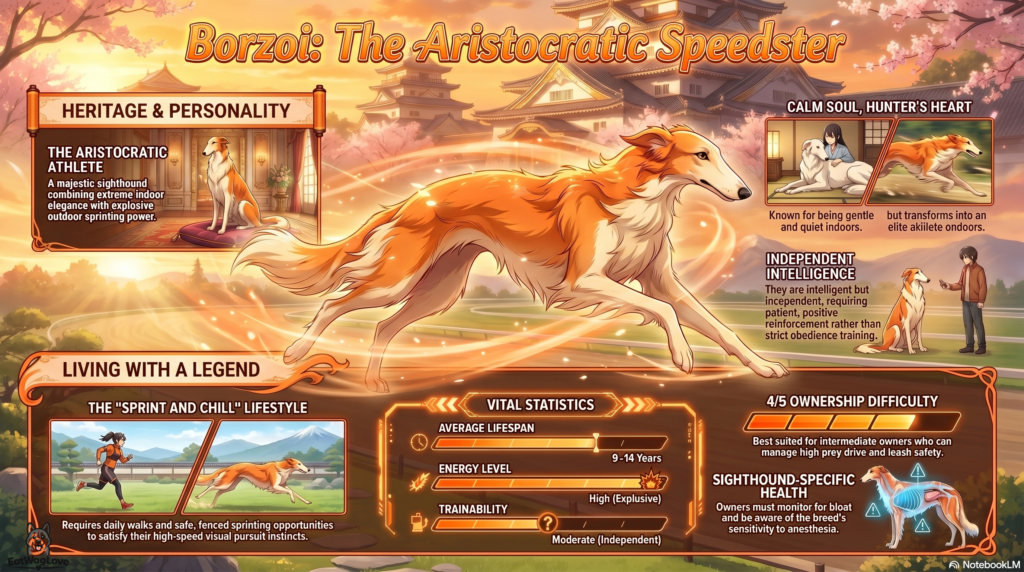
- Temperament: Gentle, independent, quiet
- Energy Level: Moderate
- Size: Large
- Good With Families: Yes
- Trainability: Moderate to low
- Grooming: Moderate
- Best For: Calm homes, experienced owners
📚 OVERVIEW
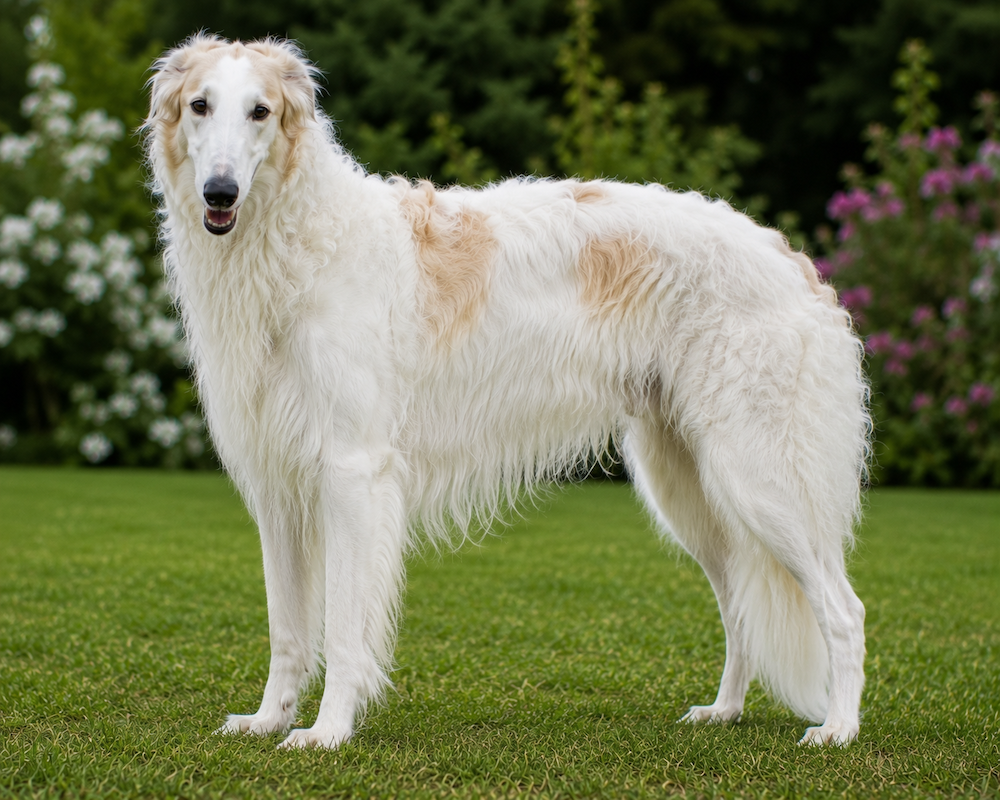
The Borzoi is a large Russian sighthound known for its elegant appearance, silky coat, and incredible speed. Originally bred to hunt wolves across open terrain, they are athletic outdoors but surprisingly calm and relaxed indoors.
They are affectionate with their family but tend to be independent and reserved rather than overly clingy.
✅ PROS & CONS
Pros
- Calm and gentle temperament
- Beautiful, elegant appearance
- Quiet indoors
- Fast and athletic outdoors
Cons
- Strong prey drive
- Can be difficult to train
- Needs secure areas to run
- Sensitive and independent nature
Is a Borzoi a Good Family Dog?
Yes, a Borzoi can be a gentle, affectionate and surprisingly calm family companion, particularly in a quieter household.
Borzois tend to be sensitive and devoted without necessarily demanding constant attention. Many enjoy lounging around the house and can be wonderfully affectionate with people they know.
They can live well with respectful children, although their large size and somewhat sensitive nature make supervision sensible.
The Borzoi isn’t usually the boisterous family entertainer. Its personality is often more dignified — at least until you see one fold itself into an absurd sleeping position on the sofa.
How Much Exercise Does a Borzoi Need?
Most adult Borzois need around 60–90 minutes of daily exercise, including opportunities to run safely.
They’re often surprisingly relaxed indoors, but they’re powerful sighthounds capable of explosive speed.
Walks alone may not completely satisfy their desire to stretch out and run.
Any off-lead exercise should take place in a securely fenced area because movement can instantly trigger the chase instinct.
They’re built for short periods of tremendous athleticism rather than endless high-intensity exercise.
Is a Borzoi Easy to Train?
Borzois are intelligent but independent, so they don’t usually approach training like highly handler-focused working breeds.
They were developed to sight, pursue and catch quarry while making decisions at speed and considerable distance from people.
Positive reinforcement, patience and short training sessions generally work best.
Harsh methods can be particularly counterproductive with this sensitive breed.
A Borzoi may understand perfectly well what you’re asking and still appear to spend a moment considering whether your proposal deserves its cooperation.
Does a Borzoi Shed?
Yes. Borzois shed regularly, and seasonal shedding can be substantial.
Their long, silky coat needs brushing several times a week to remove loose hair and prevent tangles, particularly around the feathering.
The coat is generally less difficult to maintain than its glamorous appearance might suggest, but it isn’t low-maintenance.
During heavier shedding periods, more frequent brushing is useful.
Borzois aren’t considered hypoallergenic.
What Health Problems Are Common in Borzois?
Borzois can be affected by several important health conditions.
As a large, deep-chested breed, they’re at risk of gastric dilatation-volvulus (GDV or bloat), which is a life-threatening veterinary emergency.
Cardiac disease and certain eye disorders can also occur, while some lines may be affected by degenerative myelopathy and other inherited conditions.
Responsible breeders should use appropriate health screening and understand health problems within their bloodlines.
Owners should also learn the warning signs of GDV because rapid treatment can be lifesaving.
How Long Do Borzois Live?
Borzois typically live around 9–14 years, although individual longevity varies.
That’s a reasonably broad range for such a large dog.
Genetics, healthy body condition, appropriate exercise and preventive veterinary care all influence lifespan.
Because they’re naturally lean dogs, owners unfamiliar with sighthounds sometimes mistakenly believe a healthy Borzoi is underweight.
A Borzoi should be elegant and athletic rather than deliberately fattened to resemble a heavier-bodied breed.
How Big Does a Borzoi Get?
The Borzoi is a very tall sighthound.
Adult males commonly stand at least around 71 cm at the shoulder, while females are generally somewhat smaller. Many males are substantially taller.
Adults commonly weigh somewhere around 25–48 kg, with males usually considerably heavier than females.
Despite their height, Borzois shouldn’t look bulky.
They’re built around long limbs, a deep chest, flexible spine and athletic body designed for speed.
Few breeds manage to combine such enormous height with such an elegant silhouette.
Can a Borzoi Live in an Apartment?
Surprisingly, a Borzoi can live successfully in a sufficiently spacious apartment if its exercise needs are properly met.
Adult Borzois are often calm and quiet indoors.
The obvious difficulty is their physical size. Beds, hallways, cars, lifts and furniture suddenly seem much smaller when shared with a very tall sighthound.
Regular walks and opportunities to run safely remain essential.
A huge backyard is useful but doesn’t automatically replace proper exercise.
Can a Borzoi Be Left Alone?
Borzois can usually learn to spend reasonable periods alone, particularly when gradually accustomed to it.
They’re often less intensely demanding of constant interaction than some companion breeds.
However, they still form strong bonds with their families and shouldn’t routinely be isolated for very long periods.
Boredom or separation distress can lead to destructive behaviour.
Comfortable resting areas are particularly appreciated — preferably something approximately the size of a small sofa.
Do Borzois Bark a Lot?
Borzois are generally fairly quiet dogs.
They aren’t usually known for constant alert barking and were historically developed primarily to hunt by sight rather than serve as vocal watchdogs.
Individuals may still bark at unusual activity, during excitement or when frustrated.
Their generally quiet indoor behaviour is one reason some people are surprised by how manageable they can be in the home despite their enormous size.
Are Borzois Good With Other Dogs?
Borzois can be very good with other dogs, particularly when properly socialised.
Many are calm and polite around canine companions.
However, play between sighthounds can involve extremely fast chasing, and large size differences should be considered.
Small running dogs can occasionally trigger predatory behaviour in individuals with strong prey drive.
Careful introductions and appropriate supervision remain important.
Are Borzois Good With Cats?
Some Borzois can live successfully with cats, especially when raised with them, but the breed’s prey drive must be taken seriously.
Borzois were developed to chase fast-moving animals.
A familiar indoor cat may be accepted completely while an unfamiliar cat running outside can trigger pursuit.
Small pets such as rabbits and guinea pigs require particularly careful separation.
Individual prey drive varies, so cat compatibility shouldn’t be assumed purely because one Borzoi lives peacefully with cats.
Can a Borzoi Be Trusted Off Lead?
Borzois should generally be allowed off lead only in securely fenced areas.
Their recall can disappear extraordinarily quickly when they spot something worth chasing.
As sighthounds, they’re particularly responsive to distant movement.
Once pursuit begins, their speed allows them to cover enormous distances before an owner can intervene.
Even a well-trained Borzoi retains instincts created through centuries of selective breeding.
Good obedience can improve safety, but training can’t guarantee that prey drive will disappear.
How Fast Can a Borzoi Run?
Borzois are extremely fast runners, capable of speeds often estimated at around 55–60 km/h over shorter distances.
Their anatomy is designed for high-speed pursuit.
Long legs provide enormous stride length, while a flexible spine allows the body to extend dramatically during the gallop.
A deep chest supports substantial heart and lung capacity.
Watching a Borzoi resting on a sofa gives very little indication of the athlete hidden underneath.
Why Does a Borzoi Have Such a Long Narrow Head?
The Borzoi’s extraordinarily long, narrow head is one of the breed’s most distinctive characteristics.
It’s part of an overall body shape refined through generations of sighthound breeding, producing an elegant, aerodynamic appearance alongside powerful visual hunting ability.
The skull should be long and narrow without becoming weak or exaggerated to the point that health and function are compromised.
The profile contributes enormously to the Borzoi’s unmistakable appearance.
Even among sighthounds, few breeds have such an instantly recognisable silhouette.
Why Does a Borzoi Have Such a Curved Back?
The Borzoi’s characteristic topline is associated with its sighthound structure and powerful galloping ability.
The back and loin provide flexibility and strength as the dog extends and contracts its body at speed.
The curvature is generally more pronounced in males.
This shouldn’t be confused with spinal deformity.
A correctly built Borzoi combines the characteristic topline with fluid movement, muscular strength and athletic function.
What Were Borzois Originally Bred to Hunt?
Borzois were developed in Russia primarily for coursing wolves, hares and other fast-moving game across open country.
The dogs hunted by sight rather than following scent trails.
Wolf hunts could involve teams of Borzois working together after mounted hunters and scent hounds had located the quarry.
The Borzois were expected to sprint after the wolf, catch it and hold it until hunters arrived.
This required extraordinary speed, courage and athleticism.
Did Borzois Really Hunt Wolves?
Yes. Borzois were historically used in Russia for wolf coursing, although romanticised accounts can sometimes oversimplify how these hunts operated.
Borzois didn’t typically wander around independently looking for wolves to fight.
Traditional organised hunts involved hunters, horses, scent hounds and teams of sighthounds.
Once a wolf was driven into suitable open terrain, Borzois could be released to pursue and restrain it.
Their historical Russian name reflected this speciality: Russkaya Psovaya Borzaya, essentially referring to a fast, long-coated Russian sighthound.
What Does the Name Borzoi Mean?
The name Borzoi comes from Russian terminology associated with speed or swiftness.
Historically, the breed was known in English-speaking countries as the Russian Wolfhound.
During the 20th century, “Borzoi” became the standard name used in many countries.
The Russian breed name is Russkaya Psovaya Borzaya.
The modern name is particularly appropriate because speed isn’t merely something the Borzoi happens to possess — it was central to the dog’s original purpose.
Why Were Borzois Associated With Russian Aristocracy?
For centuries, elaborate hunting with Borzois became strongly associated with Russian aristocrats and wealthy landowners.
Maintaining large kennels, horses, staff and extensive hunting estates required enormous resources.
Some aristocratic kennels contained substantial numbers of carefully bred sighthounds.
These hunts weren’t simply practical hunting expeditions; they could become elaborate social events demonstrating wealth and prestige.
As a result, the Borzoi developed an enduring association with imperial Russia, grand estates and the aristocratic world that existed before the Russian Revolution.
What Happened to Borzois During the Russian Revolution?
The Russian Revolution of 1917 and its aftermath were disastrous for many Borzois associated with aristocratic estates.
Because the breed was closely linked with the nobility, dogs and kennels disappeared as the old social order collapsed.
Fortunately, Borzois had already been exported to other parts of Europe and North America.
Those overseas populations became extremely important in preserving the breed internationally.
Borzois continued to exist in Russia as well, but the enormous aristocratic kennels of the imperial period largely vanished.
Why Did Borzois Become Popular in Art and Fashion?
The Borzoi’s extreme elegance and distinctive silhouette made it particularly attractive to artists, illustrators and advertisers.
During the late 19th and early 20th centuries, Borzois frequently appeared in paintings, Art Deco imagery, fashion photography and luxury advertising.
Their association with Russian aristocracy added an additional sense of glamour and exoticism.
Few dogs can look quite as naturally theatrical while apparently doing absolutely nothing.
The Borzoi didn’t need to pose like a glamorous model — it already looked like one.
Where Does the Borzoi Come From?
The Borzoi comes from Russia, where large sighthounds were developed over centuries for hunting across vast open landscapes.
Russian breeders selected dogs for speed, endurance, courage and the ability to pursue animals including wolves and hares.
The long coat also provided protection in Russia’s harsh climate.
By the 19th century, sophisticated aristocratic breeding programmes had produced distinct lines of Russian wolfhounds, and dogs were increasingly exported to Europe and North America.
Today, the Borzoi remains one of the most visually distinctive reminders of that history: an elegant companion whose extraordinary body was originally engineered for high-speed pursuit across the Russian countryside.