






Beautiful, gentle, and incredibly affectionate — a luxurious companion that loves comfort and companionship.
🧠 QUICK SNAPSHOT
- Temperament: Gentle, affectionate, calm
- Energy Level: Low
- Size: Medium to large
- Good With Families: Yes
- Trainability: Moderate
- Grooming: Very high
- Best For: Indoor living, relaxed households, companionship
📚 OVERVIEW
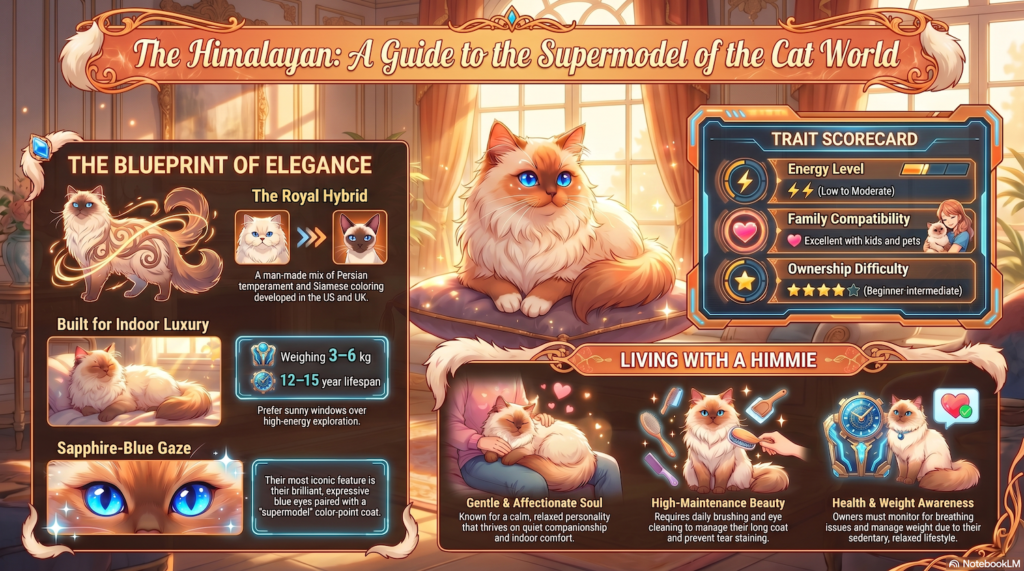
The Himalayan is a stunning breed that combines the luxurious coat of the Persian with the striking colour points and blue eyes of the Siamese. Known for their sweet temperament and elegant appearance, they are devoted companions that enjoy a calm and comfortable lifestyle.
They thrive indoors and prefer peaceful environments where they can spend time close to their family.
✅ PROS & CONS
Pros
- Extremely affectionate and loving
- Stunning blue eyes and luxurious coat
- Calm and relaxed personality
- Excellent indoor companion
Cons
- Requires daily grooming
- Can be prone to health issues associated with flat-faced breeds
- Sensitive to heat
- Needs regular coat and eye care
Is a Himalayan a Good Family Cat?
Yes. Himalayan cats are generally gentle, affectionate and calm family companions.
They typically enjoy attention and close contact but are usually less demanding and athletic than highly active breeds such as Bengals or Abyssinians.
Their peaceful temperament can suit quieter households particularly well, provided owners are prepared for substantial grooming and potential health concerns associated with their Persian ancestry.
Is a Himalayan a Persian Cat?
Essentially, yes — depending on the registry.
The Himalayan was created by combining Persian cats with Siamese colourpoint genetics.
Some major cat organisations classify the Himalayan as a colourpoint division of the Persian rather than a completely separate breed, while others recognise it separately.
Why Is the Himalayan Cat Called a Himalayan?
Surprisingly, Himalayan cats didn’t originate in the Himalayas.
The name refers to their colourpoint pattern, which resembles markings seen in certain animals historically described as Himalayan, including Himalayan rabbits.
The breed itself was developed primarily through organised breeding programmes in Europe and North America.
Can a Himalayan Cat Live Indoors or in an Apartment?
Yes. Himalayans are exceptionally well suited to indoor and apartment living.
They’re generally calm, relatively quiet and don’t require enormous spaces.
Indoor living also protects their long coat from dirt and tangles while reducing exposure to traffic, predators, parasites and infectious disease.
How Much Exercise and Play Does a Himalayan Need?
Most Himalayans need several short interactive play sessions each day rather than prolonged high-intensity exercise.
Wand toys, rolling toys, puzzle feeders and gentle chasing games can encourage activity.
Because they’re naturally relaxed cats, preventing obesity can require deliberate daily play.
Are Himalayan Cats Lazy?
They can certainly be laid-back.
Himalayans tend to have the calm temperament associated with Persians, making them considerably less active than many Oriental breeds.
They still enjoy playing, particularly as kittens, but an adult Himalayan generally considers lounging an entirely legitimate daily occupation.
Is a Himalayan Cat Easy to Train?
Yes, although they’re not usually as intensely trainable as highly active breeds.
Himalayans can learn routines, come when called and use puzzle toys.
Positive reinforcement and food rewards work well.
Their calm temperament often makes household training relatively straightforward.
Does a Himalayan Cat Shed?
Yes — substantially.
Himalayans have long, dense coats that shed throughout the year, often more heavily during seasonal changes.
Anyone wanting a genuinely low-shedding cat should look elsewhere.
Regular grooming helps control loose hair before it becomes part of the furniture.
Is a Himalayan Cat Hypoallergenic?
No.
Himalayans produce normal feline allergens, including Fel d 1, and their long coats can distribute dander and saliva-coated hairs around the home.
They’re not considered a suitable breed specifically for allergy sufferers.
How Often Should You Groom a Himalayan Cat?
Ideally, every day.
Their long, dense coat tangles and mats easily, particularly around the armpits, belly, chest and hindquarters.
Regular grooming also removes loose hair and provides an opportunity to check the skin for problems.
Do Himalayan Cats Get Mats Easily?
Yes.
Their fine, dense coat can tangle surprisingly quickly, particularly if daily grooming is missed.
Mats can pull painfully against the skin and eventually become severe enough to require professional clipping.
Prevention is considerably easier than removing established matting.
Can You Shave a Himalayan Cat?
Sometimes.
A veterinarian or professional groomer may recommend clipping when severe matting can’t be safely brushed out.
Some owners also use shorter trims for easier maintenance.
Shaving shouldn’t replace regular coat care, and cats shouldn’t be clipped unnecessarily without considering skin and temperature protection.
What Is a Lion Cut on a Himalayan Cat?
A lion cut involves clipping most of the body short while leaving longer hair around the head, lower legs and tail tip.
It can make coat maintenance easier for cats that repeatedly develop severe mats.
It creates a memorable appearance, although the cat may not share the owner’s enthusiasm for its temporary career as a miniature lion.
Do Himalayan Cats Need Their Faces Cleaned?
Many do.
Flat-faced Himalayans frequently experience tear overflow, leaving staining or moisture beneath the eyes.
Gentle daily cleaning can help keep the facial folds and surrounding coat dry and clean.
Persistent eye irritation or excessive discharge should be assessed by a veterinarian.
Why Do Himalayan Cats Have Tear Stains?
Their shortened facial structure can interfere with normal tear drainage.
Tears may therefore spill onto the face rather than draining efficiently through the nasolacrimal system.
The pale facial hair of many Himalayans makes staining particularly visible.
What Health Problems Are Common in Himalayan Cats?
Important concerns include brachycephalic airway problems, eye disorders, dental crowding, polycystic kidney disease, skin-fold problems and heat intolerance.
Because Himalayans are essentially Persian-derived cats, many Persian health concerns also apply.
Responsible breeding should prioritise moderate structure and appropriate health testing.
Do Himalayan Cats Have Breathing Problems?
Some do.
Extremely flat-faced Himalayans can have brachycephalic airway abnormalities that restrict airflow.
Noisy breathing, exercise intolerance and persistent respiratory difficulty shouldn’t simply be accepted as normal because the cat has a flat face.
Why Do Himalayan Cats Have Flat Faces?
The flattened face results from selective breeding for brachycephalic Persian-type features.
Earlier Himalayans and Persians often had more prominent muzzles.
Over time, show breeding increasingly favoured the very short nose and round facial appearance seen in many modern cats.
What Is a Doll-Face Himalayan?
“Doll-face Himalayan” is an informal term for cats with a more traditional, less extremely flattened facial structure.
It’s not generally a separate recognised breed.
These cats retain the Himalayan colourpoint appearance while having a more prominent muzzle.
What Is a Peke-Face Himalayan?
“Peke-face” describes the extremely flat facial structure seen in some Persian and Himalayan lines.
The term references the similarly flattened appearance of the Pekingese dog.
Extreme brachycephaly can increase respiratory, eye and dental problems, so appearance shouldn’t take priority over health.
Are Himalayan Cats Prone to Polycystic Kidney Disease?
They can be.
Polycystic kidney disease (PKD) historically affected Persian-derived populations and causes multiple kidney cysts that can eventually impair kidney function.
A DNA test is available, allowing responsible breeders to avoid producing affected kittens.
Are Himalayan Cats Prone to Eye Problems?
Yes.
Their prominent eyes and shortened facial structure can increase the risk of excessive tearing, corneal injury and other ocular problems.
Eye abnormalities should be assessed promptly because corneal problems can become painful very quickly.
Are Himalayan Cats Prone to Dental Problems?
They can be.
A shortened skull can create dental crowding and abnormal tooth alignment.
Regular veterinary dental assessment is valuable.
Home dental care can also reduce periodontal disease.
Are Himalayan Cats Sensitive to Heat?
Yes.
Their dense long coat combined with brachycephalic facial structure can make heat management more difficult.
They should have access to cool indoor environments during hot weather, particularly during Australian summers.
How Long Does a Himalayan Cat Live?
Himalayan cats commonly live around 12–15 years, although some live longer.
Genetics, kidney health, respiratory structure, body condition, dental care and indoor living can all influence longevity.
How Big Does a Himalayan Cat Get?
Himalayans are medium-sized cats but can look considerably larger because of their enormous coats.
Adults commonly weigh around 3–6 kg, although larger individuals occur.
Beneath the fur they have the sturdy, compact body associated with Persians.
Are Himalayan Cats Heavy?
They’re usually solidly built rather than particularly tall or long.
Their Persian-type body is compact with substantial bone.
The dense coat adds visual volume, making a Himalayan appear considerably larger than the actual cat underneath.
Are Himalayan Cats Affectionate?
Very often.
Himalayans typically enjoy gentle physical affection and spending time close to their owners.
Many are lap cats, although individual personality varies.
They tend to express affection calmly rather than constantly demanding attention.
Are Himalayan Cats Lap Cats?
Many are excellent lap cats.
Their relaxed temperament and strong companion instincts make quiet physical contact particularly appealing.
A comfortable lap, soft blanket and peaceful room can satisfy several major Himalayan ambitions simultaneously.
Are Himalayan Cats Cuddly?
Generally, yes.
Many enjoy being stroked and sitting beside or on their owners.
However, cats should always be allowed to choose when physical interaction occurs rather than being repeatedly picked up simply because they look exceptionally cuddly.
Are Himalayan Cats Vocal?
Usually not excessively.
They may communicate with soft meows and gentle vocalisations, but they’re generally much quieter than their Siamese ancestors.
The Persian temperament has had a strong influence on the modern breed.
Do Himalayan Cats Have a Siamese Voice?
Usually not to the same extent.
Although Siamese ancestry introduced the colourpoint genetics, Himalayans generally inherited much of the quieter Persian temperament.
Some individuals are more talkative than others, but the classic loud Siamese conversational style isn’t normally expected.
Are Himalayan Cats Good With Children?
Yes, particularly with calm, respectful children.
They generally prefer gentle interaction rather than rough play or constant chasing.
A noisy household with very young children may be less comfortable for a particularly quiet individual.
Are Himalayan Cats Good With Other Cats?
Usually.
Their calm temperament can make them compatible with other friendly cats.
Introductions should still be gradual because even an easygoing Himalayan may object to an unfamiliar cat suddenly appearing in its territory.
Are Himalayan Cats Good With Dogs?
They can be.
Himalayans often coexist successfully with calm, cat-friendly dogs.
Their relatively relaxed personality may make them less reactive than some breeds, but they should always have safe elevated areas where a dog can’t disturb them.
Can Himalayan Cats Go Outside?
They can physically go outdoors, but they’re generally particularly well suited to indoor living or secure enclosed outdoor spaces.
Their long coat collects debris easily, and their calm temperament and brachycephalic structure don’t make them ideal roaming cats.
A secure catio can provide outdoor stimulation with fewer risks.
Are Himalayan Cats Good Hunters?
They retain normal feline hunting instincts, but they’re generally less athletic and intensely predatory than many working or naturally developed cat breeds.
Their long coat, compact body and flat facial structure also make them poorly suited to a demanding outdoor hunting lifestyle.
Do Himalayan Cats Climb?
They can climb, but many aren’t particularly interested in reaching extreme heights.
Lower cat trees, window platforms and stable furniture often suit them well.
Their Persian-derived body is generally stockier and less athletic than breeds such as Siamese or Abyssinians.
Do Himalayan Cats Like Water?
Most aren’t particularly famous for enjoying water.
Individual cats may become fascinated with dripping taps or running water.
Their long coat can take substantial time to dry if it becomes thoroughly wet.
What Does a Himalayan Cat Look Like?
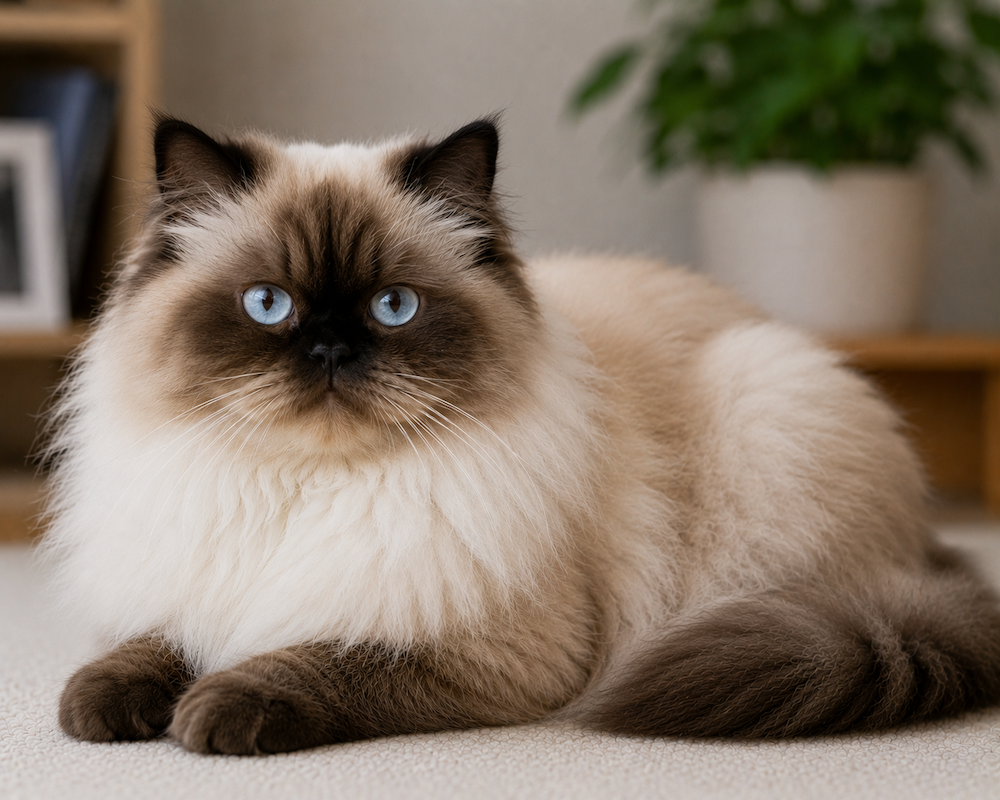
The Himalayan combines the long, luxurious coat and compact body of a Persian with the colourpoint pattern and blue eyes associated with Siamese cats.
They typically have a broad round head, small ears, short nose, large eyes, short legs and heavily plumed tail.
Why Do Himalayan Cats Have Blue Eyes?
The same colourpoint genetics responsible for their pale bodies and darker extremities also influence eye pigmentation.
Colourpoint cats characteristically have blue eyes.
A Himalayan’s intense blue eyes are therefore genetically connected with its Siamese-style coat pattern.
Why Do Himalayan Cats Have Dark Faces, Ears, Legs and Tails?
Himalayans carry a temperature-sensitive form of tyrosinase, an enzyme involved in melanin production.
Pigment develops more strongly in cooler areas of the body.
The ears, face, feet and tail are cooler than the central torso, so they become darker.
Are Himalayan Cats Born White?
Himalayan kittens are generally born very pale or almost completely white.
Inside the mother’s uterus, their bodies are uniformly warm, suppressing much of the temperature-sensitive pigment production.
Their darker points gradually develop after birth as cooler areas of the body begin producing more pigment.
Why Do Himalayan Kittens Get Darker as They Grow?
Once kittens leave the uniformly warm environment of the womb, their extremities cool.
The colourpoint gene then allows greater pigment production in those cooler areas.
Their mask, ears, legs and tail become progressively more obvious over the following weeks and months.
Can a Himalayan Cat Get Darker in Cold Weather?
Potentially, yes.
Because pigmentation is temperature sensitive, cooler conditions can influence coat darkness.
Age and individual genetics also affect colour, so the relationship isn’t as simple as the cat changing colour every time the weather changes.
Can Shaving Change a Himalayan Cat’s Coat Colour?
Temporarily, it can.
After an area is shaved, the exposed skin may become cooler, causing new hair to grow back darker because of temperature-sensitive pigment production.
The colour may become lighter again during later coat cycles.
It’s a fascinating visible demonstration of colourpoint genetics.
What Colours Can Himalayan Cats Be?
Common point colours include seal, blue, chocolate, lilac, red and cream, along with tortie and lynx-patterned variations.
The body remains substantially lighter than the points.
Exact accepted colours depend on the registry.
What Is a Seal Point Himalayan?
A seal point Himalayan has very dark brown points against a lighter cream or fawn body.
The nose leather and paw pads are also dark.
Seal point is one of the classic Himalayan appearances.
What Is a Blue Point Himalayan?
Blue point Himalayans have cool grey-blue points rather than dark brown.
Their bodies are typically pale and cool-toned.
“Blue” in cat terminology means a diluted grey colour, not literal blue.
What Is a Chocolate Point Himalayan?
Chocolate point Himalayans have warmer milk-chocolate-coloured points.
They’re genetically distinct from darker seal points.
Chocolate historically became one of the more sought-after colours during development of the breed.
What Is a Lilac Point Himalayan?
Lilac point is a dilute form of chocolate.
The points appear pale, frosty grey with subtle pinkish tones.
Lilac Himalayans are among the palest colourpoint varieties.
What Is a Flame Point Himalayan?
Flame point is another term for red point.
These cats have red or orange pigmentation on the face, ears, legs and tail.
The body remains much lighter.
What Is a Lynx Point Himalayan?
Lynx point Himalayans have tabby striping within their darker points.
The facial mask, legs and tail show visible striped markings rather than solid colour.
They’re sometimes called tabby-point Himalayans in different registries.
What Is a Tortie Point Himalayan?
Tortie point Himalayans display a mixture of dark and red or cream colouring within their points.
Like tortoiseshell cats generally, they’re overwhelmingly female because of the genetics controlling orange pigmentation.
Can Himalayan Cats Have Green Eyes?
A true Himalayan should have blue eyes associated with the colourpoint gene.
Green or copper eyes would be inconsistent with the classic Himalayan colourpoint phenotype and may suggest different ancestry or classification.
What Is the Difference Between a Himalayan and a Persian?
The primary visual difference is colour.
Himalayans have colourpoint coats and blue eyes, while Persians occur in numerous other colours and can have different eye colours.
Structurally and temperamentally, they’re extremely similar — which is why some registries classify Himalayans simply as colourpoint Persians.
What Is the Difference Between a Himalayan and a Siamese?
A Himalayan has the long coat, stocky body and round Persian head, while a modern Siamese is short-haired, slender and extremely athletic with a wedge-shaped head.
Both can share colourpoint coats and blue eyes because the Himalayan’s point genetics originally came from Siamese ancestry.
What Is the Difference Between a Himalayan and a Ragdoll?
Both can be long-haired, blue-eyed colourpoint cats, but they’re different breeds.
Ragdolls are generally larger, more moderately faced and semi-longhaired, while Himalayans have the compact Persian body and much denser coat.
Their developmental histories are also completely different.
What Is the Difference Between a Himalayan and a Birman?
Birmans have colourpoint coats, blue eyes and distinctive white gloves on their paws.
They generally have more moderate facial structures and less demanding coats than Himalayans.
The Himalayan has much stronger Persian influence in body and head shape.
Is a Himalayan the Same as a Colourpoint Persian?
In some registries, effectively yes.
The Himalayan is genetically and structurally a Persian carrying colourpoint genetics.
Different cat associations made different decisions about whether to classify it as a separate breed or a Persian division.
Was the Himalayan Created by Crossing Persians and Siamese Cats?
Yes.
The Himalayan was deliberately developed by crossing Persian and Siamese cats, followed by selective breeding.
The goal was straightforward but genetically challenging: create a cat with Persian structure and long coat while preserving Siamese colourpoints and blue eyes.
Why Was the Himalayan Cat Created?
Breeders wanted to combine two highly distinctive characteristics:
The Persian’s luxurious long coat and body type with the Siamese cat’s colourpoint pattern and blue eyes.
It became one of the most successful examples of deliberate breed development based around introducing a specific colour gene into an established breed type.
When Was the Himalayan Cat Created?
Experimental Persian-Siamese breeding occurred during the 1920s and 1930s, with important programmes in both Europe and North America.
Development continued for decades as breeders worked to produce cats that looked increasingly Persian while retaining colourpoint genetics.
Who Created the Himalayan Cat?
There wasn’t one single creator.
Several breeding programmes contributed independently.
In the United States, Virginia Cobb and Dr Clyde Keeler conducted particularly important experimental Persian-Siamese crosses during the 1930s.
British breeders also pursued similar goals.
Who Was Virginia Cobb?
Virginia Cobb was an American cat breeder associated with the Newton Cattery.
Working with geneticist Dr Clyde Keeler, she participated in a deliberate breeding programme investigating inheritance of Siamese colourpoints and Persian long hair.
Their work became an important part of Himalayan breed history.
Who Was Dr Clyde Keeler?
Dr Clyde Keeler was a geneticist whose research included hereditary traits in animals.
His collaboration with Virginia Cobb used controlled breeding to investigate how long hair and Siamese colourpoint genetics were inherited.
Their work illustrates how unusually scientific some early Himalayan development was.
Who Was Newton’s Debutante?
Newton’s Debutante, born in the 1930s, is frequently identified as an important early long-haired colourpoint cat produced by Virginia Cobb and Clyde Keeler’s breeding experiments.
The cat demonstrated that Persian-style long hair and Siamese colourpoint genetics could be combined successfully.
Were Early Himalayans Part of a Genetics Experiment?
In an important sense, yes.
Some early breeding wasn’t simply aimed at producing attractive pets.
Researchers and breeders were deliberately studying Mendelian inheritance, particularly the interaction between long-hair and colourpoint genes.
The Himalayan therefore has an unusually strong connection with early practical feline genetics.
Was the Himalayan Developed in Britain Too?
Yes.
British breeders also worked on creating long-haired colourpoint cats, particularly during the mid-20th century.
In Britain, these cats became known historically as Colourpoint Longhairs.
Development on both sides of the Atlantic contributed to the modern Himalayan type.
What Was a Colourpoint Longhair?
“Colourpoint Longhair” was a historical British name for cats combining Persian-type long hair with Siamese-style colourpoints.
The terminology reflects exactly what breeders were trying to create.
Different registries eventually classified these cats in different ways.
When Was the Himalayan Officially Recognised?
Recognition varied between cat organisations.
By the 1950s, Himalayan-type cats were gaining formal breed recognition in major registries.
Later, some organisations reversed the concept of a completely separate breed and incorporated Himalayans into the Persian breed as a colour division.
Why Did Some Cat Registries Merge the Himalayan With the Persian?
After generations of selective breeding, Himalayans became essentially Persian in structure, coat and temperament, differing primarily through their colourpoint genetics and blue eyes.
This led some organisations to conclude that they were better classified as a Persian colour division than an entirely separate breed.
Is the Himalayan a Natural Cat Breed?
No.
The Himalayan is a deliberately created breed/type resulting from planned Persian-Siamese crosses and subsequent selective breeding.
Its history is therefore very different from naturally developed populations such as some regional landrace cats.
Does a Himalayan Have More Persian or Siamese Ancestry?
Modern Himalayans are generally much more Persian in overall type.
Siamese ancestry was primarily introduced to establish the colourpoint gene.
Repeated selective breeding toward Persian structure produced the heavily coated, compact cats recognised today.
Why Doesn’t a Himalayan Look Much Like a Siamese?
Because breeders repeatedly selected for Persian body, head and coat characteristics after introducing Siamese colourpoint genetics.
The Siamese contribution remains dramatically visible in the coat pattern and blue eyes rather than overall body shape.
Did Himalayan Cats Help Scientists Understand Genetics?
The early breeding programmes were closely connected with research into how recessive traits are inherited.
Long hair and colourpoint expression provided visually obvious characteristics that could be followed through generations.
This makes Himalayan development an unusually interesting intersection between cat breeding and genetics.
Why Are Himalayan Cats Sometimes Called “Himmies”?
“Himmie” or “Himmy” is simply an affectionate nickname used by owners and breeders.
It has no formal genetic or registry meaning.
Given that “Himalayan” itself has little to do with the cat’s actual geographic origin, the nickname arguably adds no further confusion.
Did Himalayan Cats Actually Come From the Himalayas?
No.
Despite one of the most geographically convincing names in the cat world, the Himalayan wasn’t developed in Nepal, Tibet, India or the Himalayan mountains.
Its modern development occurred primarily through Persian-Siamese breeding programmes in Britain and North America.
Why Is the Himalayan Name So Misleading?
The name was inspired by the Himalayan colour pattern seen in other domesticated animals, rather than the cat’s geographic origin.
Himalayan rabbits, for example, also have pale bodies with darker extremities.
The similarity comes from temperature-sensitive pigmentation.
Are Himalayan Cats Rare?
They’re established internationally but less common than many mainstream breeds.
Their intensive grooming requirements and Persian-associated health concerns can limit their appeal.
Within Persian populations, however, the colourpoint appearance remains extremely recognisable and popular.
Is a Himalayan a Good First Cat?
It can be, particularly for someone wanting a quiet, affectionate indoor companion.
The major consideration is maintenance.
Daily grooming, facial cleaning and attention to respiratory, eye, dental and kidney health make the Himalayan more demanding than its relaxed personality initially suggests.
Where Does the Himalayan Cat Come From?
Despite its name, the Himalayan doesn’t come from the Himalayas at all.
The breed was deliberately developed by crossing Persian cats with Siamese cats, with experimental breeding beginning during the early 20th century. Breeders wanted the Persian’s luxurious long coat, round body and calm personality combined with the Siamese cat’s blue eyes and temperature-sensitive colourpoint pattern.
In the United States, breeder Virginia Cobb and geneticist Dr Clyde Keeler conducted important breeding experiments during the 1930s, producing the famous early colourpoint longhair Newton’s Debutante. British breeders independently pursued similar goals, eventually producing cats known as Colourpoint Longhairs.
After generations of breeding back toward Persian type, the modern Himalayan became so Persian-like that some major registries eventually classified it as a colourpoint Persian rather than a separate breed.
So the Himalayan has one of the more misleading names in the cat world: a Persian-Siamese creation developed thousands of kilometres from the Himalayas, named after a colour pattern also seen in rabbits.