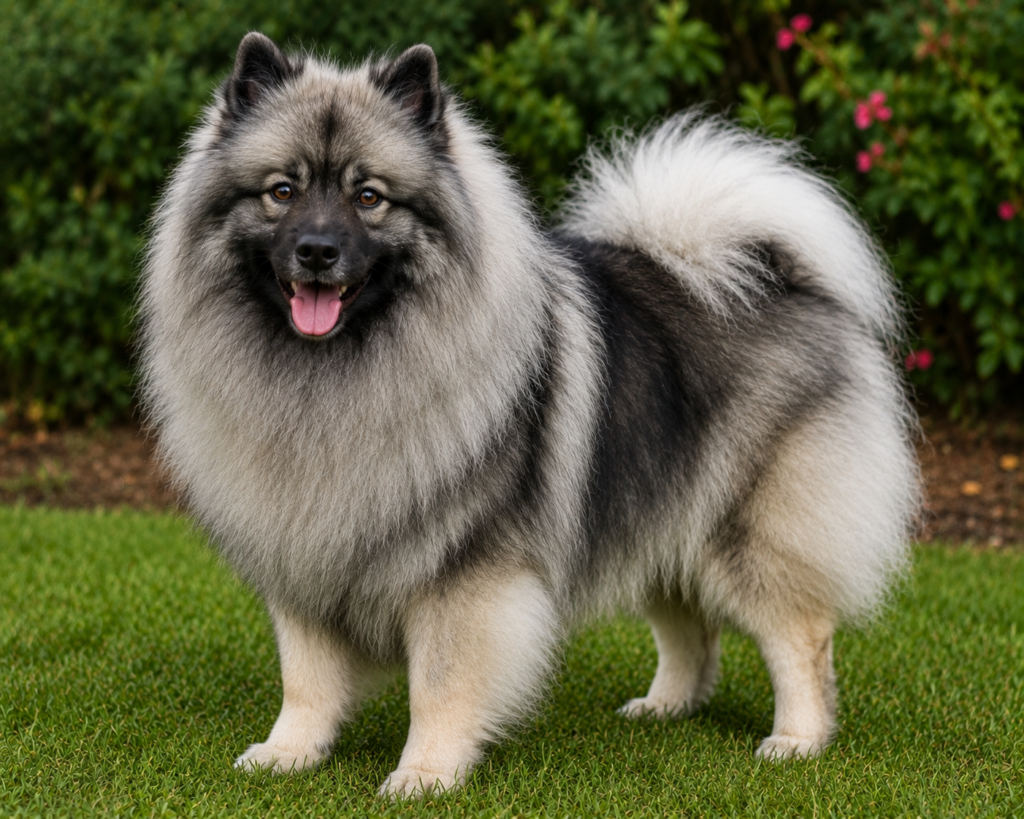







Friendly, fluffy, and always smiling — a devoted family companion with a cheerful personality and striking appearance.
🧠 QUICK SNAPSHOT
- Temperament: Friendly, affectionate, alert
- Energy Level: Moderate
- Size: Medium
- Good With Families: Yes
- Trainability: High
- Grooming: High
- Best For: Families, companionship, active households
📚 OVERVIEW
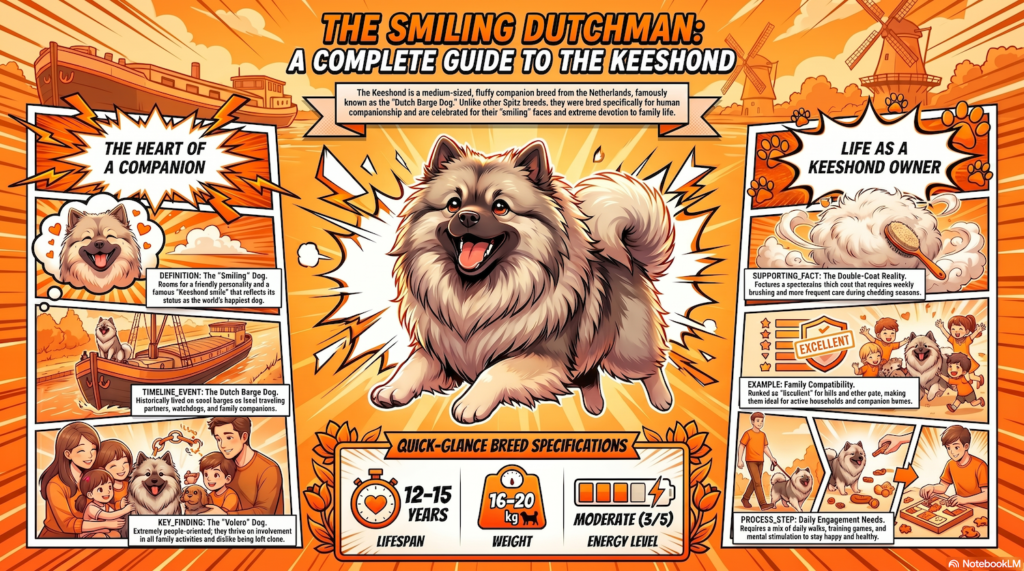
The Keeshond is a beautiful Spitz-type breed known for its thick silver-and-black coat, distinctive “spectacles” around the eyes, and famous smiling expression. Originally kept as a companion and watchdog on Dutch barges, the Keeshond thrives on human companionship and enjoys being involved in family activities.
They are affectionate, intelligent, and highly social dogs that generally get along well with children and other pets.
✅ PROS & CONS
Pros
- Extremely friendly and affectionate
- Great with families and children
- Intelligent and easy to train
- Excellent companion dog
Cons
- Heavy seasonal shedding
- Requires regular brushing
- Can be vocal when alerting owners
- Doesn’t enjoy being left alone for long periods
Is a Keeshond a Good Family Dog?
Yes. The Keeshond is generally an affectionate, friendly, playful and highly people-oriented family dog.
Unlike many Spitz breeds developed primarily for hunting, sledding or guarding livestock, the Keeshond has a long history as a companion and watchdog around Dutch boats and households.
They usually want to be wherever their family is.
How Much Exercise Does a Keeshond Need?
Most adult Keeshonden need around 45–60 minutes of exercise each day, along with play and mental stimulation.
They enjoy walks, training, games and moderate hiking.
They’re active without usually requiring the enormous workload of breeds such as Huskies or Border Collies.
Is a Keeshond Easy to Train?
Usually, yes.
Keeshonden are intelligent, responsive and strongly interested in their owners.
Positive reinforcement works particularly well because they’re sensitive dogs and generally respond poorly to harsh training methods.
Are Keeshonden Intelligent?
Yes.
They learn quickly, read human behaviour well and can excel at obedience, rally, tricks and other dog sports.
Their long history living closely with people likely helped reinforce their highly social, attentive nature.
Are Keeshonden Stubborn?
They can have a mild independent streak, but they’re generally cooperative compared with many other Spitz breeds.
Boredom and repetitive training can reduce enthusiasm.
Keeping sessions varied and rewarding usually produces excellent results.
Does a Keeshond Shed?
Yes — a lot.
The Keeshond has a thick double coat consisting of a harsh outer coat and extremely dense soft undercoat.
Seasonal coat blowing can release astonishing quantities of fur.
Is a Keeshond Hypoallergenic?
No.
Keeshonden shed heavily and produce normal canine allergens.
They’re definitely not considered hypoallergenic.
How Often Should You Groom a Keeshond?
A thorough brushing around two or three times each week is generally appropriate, with considerably more grooming during heavy seasonal shedding.
The dense undercoat needs to be brushed all the way through rather than simply smoothing the surface.
Does a Keeshond Need Haircuts?
No.
The natural double coat should generally be maintained through brushing rather than routinely cut short.
Minor tidying around the feet and hygiene areas may occasionally be useful.
Should You Shave a Keeshond?
Generally, no.
The double coat provides insulation and skin protection, and shaving can interfere with normal regrowth.
Medical clipping is different and should follow veterinary advice.
Why Does a Keeshond Have Such a Thick Coat?
The dense coat protected these dogs against the cold, damp conditions of northern Europe.
Living around Dutch waterways meant exposure to wind, rain and chilly weather.
The coat’s spectacular appearance began with a very practical purpose.
Why Does My Keeshond Shed So Much?
The soft undercoat is periodically replaced, producing heavy seasonal shedding.
Loose undercoat can sometimes come out in handfuls during grooming.
The amount of fur removed from one relatively modest-sized dog can appear to violate several laws of physics.
What Health Problems Are Common in Keeshonden?
Potential concerns include hip dysplasia, patellar luxation, eye disorders, epilepsy, certain heart conditions and primary hyperparathyroidism.
Responsible breeding has been particularly important in reducing inherited primary hyperparathyroidism through DNA testing.
What Is Primary Hyperparathyroidism in Keeshonden?
Primary hyperparathyroidism causes abnormal overproduction of parathyroid hormone, leading to excessively high blood calcium levels.
Keeshonden historically had an important inherited form of the disease.
Development of a DNA test allowed breeders to identify carriers and dramatically improve breeding decisions.
Are Keeshonden Prone to Hip Dysplasia?
They can be.
Although they’re not giant dogs, hip dysplasia occurs within the breed.
Responsible breeders should use appropriate hip screening before breeding.
Are Keeshonden Prone to Patellar Luxation?
It can occur.
Patellar luxation causes the kneecap to move out of its normal groove.
Affected dogs may intermittently skip or carry a hind leg.
Are Keeshonden Prone to Eye Problems?
Several inherited eye conditions can occur within the breed.
Regular ophthalmic screening of breeding dogs helps reduce risk.
Any sudden visual changes, eye pain or persistent redness should receive veterinary attention.
Are Keeshonden Prone to Epilepsy?
Epilepsy occurs within the breed and responsible breeders should be familiar with seizure history in their bloodlines.
A seizure doesn’t automatically mean inherited epilepsy because many medical conditions can cause seizures.
Veterinary investigation is essential.
How Long Does a Keeshond Live?
Keeshonden commonly live around 12–15 years.
Their moderate size contributes to relatively good longevity.
Healthy weight, dental care, exercise and responsible breeding can all influence lifespan.
How Big Does a Keeshond Get?
Keeshonden are medium-sized dogs.
Adults are generally around 43–46 cm tall, with many weighing approximately 16–20 kg.
Their enormous coat makes them look considerably larger than they actually are.
Is There a Miniature Keeshond?
No.
There is no recognised Miniature Keeshond variety.
Smaller Spitz breeds may resemble miniature versions, but they’re separate breeds or varieties.
Is There a Teacup Keeshond?
No recognised Teacup Keeshond exists.
Extreme miniaturisation isn’t part of the breed standard.
Claims of rare “Teacup Keeshonden” should therefore be approached cautiously.
Can a Keeshond Live in an Apartment?
Yes, surprisingly well.
Keeshonden are moderate in size and usually settle indoors after appropriate exercise.
The main apartment challenge is often barking, since they have a strong watchdog heritage.
Does a Keeshond Need a Large Backyard?
No.
A secure garden is useful, but daily walks and family interaction matter more.
Historically, these dogs often lived in relatively confined environments around boats, barges and waterside properties.
Can a Keeshond Be Left Alone?
Keeshonden generally don’t enjoy being left alone for very long.
They’re strongly people-oriented and were historically accustomed to living closely alongside humans.
Long periods of isolation can contribute to barking, destructive behaviour or separation distress.
Are Keeshonden Prone to Separation Anxiety?
Some are.
Their intense attachment to family is one of the breed’s greatest qualities but can become problematic without independence training.
Puppies should gradually learn that short periods alone are normal and safe.
Are Keeshonden Velcro Dogs?
Very often.
A Keeshond commonly wants to know where its people are and what they’re doing.
They tend to follow family members between rooms and position themselves where household activity can be monitored.
Are Keeshonden Cuddly?
Usually, yes.
They’re affectionate dogs that often enjoy close physical contact.
The enormous coat makes them exceptionally effective living pillows, although considerably warmer than most furniture.
Are Keeshonden Good With Children?
Generally, yes.
They’re typically playful, affectionate and patient with respectful children.
As always, interactions between dogs and young children should be supervised.
Are Keeshonden Good With Other Dogs?
Usually.
The breed is generally sociable and isn’t known for extreme dog aggression.
Early socialisation helps develop confident and appropriate behaviour.
Are Keeshonden Good With Cats?
Many live successfully with cats.
Their prey drive is generally moderate compared with many hunting breeds.
Early introductions and sensible supervision remain important.
Do Keeshonden Have a Strong Prey Drive?
Usually not exceptionally strong.
They weren’t primarily developed as specialist hunting dogs.
Individuals may still chase squirrels, birds or other small animals, but intense prey drive isn’t normally a defining characteristic.
Are Keeshonden Good Off Leash?
Many can develop reliable recall because they’re strongly people-oriented.
However, no dog should be trusted off leash before recall is properly established.
Secure environments remain the safest choice.
Do Keeshonden Bark a Lot?
They can.
Keeshonden have a long history as alert watchdogs, and many quickly announce visitors, unusual noises or activity outside.
Early training can prevent alert barking from becoming excessive.
Are Keeshonden Good Watchdogs?
Excellent.
Their natural alertness means they’re quick to notice something unusual.
Historically, this was one of their most useful functions around barges, boats and homes.
Are Keeshonden Good Guard Dogs?
Not particularly.
They may sound impressive, but most are too friendly and people-oriented to function as serious protection dogs.
They’re much better at announcing a visitor than preventing one from entering after a proper introduction.
Are Keeshonden Aggressive?
They shouldn’t be.
The typical Keeshond is friendly, confident and affectionate.
Excessive aggression or extreme shyness isn’t characteristic of the ideal temperament.
Are Keeshonden Friendly With Strangers?
Usually.
They may initially bark to announce someone, then become friendly once they understand the visitor is welcome.
This combination of alertness and sociability reflects their historical watchdog role.
Are Keeshonden High-Energy Dogs?
They’re moderately energetic.
They enjoy activity and play but generally settle well indoors.
This makes them more manageable for many households than some higher-drive Spitz breeds.
When Does a Keeshond Calm Down?
Many begin settling noticeably between 18 months and three years.
However, Keeshonden often retain a playful, youthful personality well into adulthood.
Do Keeshonden Get the Zoomies?
Yes.
A Keeshond can suddenly transform from dignified grey fluff into a high-speed blur circling the house.
The enormous coat makes the performance look even faster and considerably larger than it really is.
Are Keeshonden Good Running Dogs?
Healthy adults can enjoy moderate running.
They’re not specialised endurance runners, and their dense coat requires additional caution in warm weather.
Exercise should be adjusted to temperature and fitness.
Are Keeshonden Good Hiking Dogs?
Yes.
They generally enjoy moderate hikes and outdoor adventures with their family.
Cooler conditions suit their heavy coat particularly well.
Can Keeshonden Swim?
Most can physically swim, although individual enthusiasm varies.
Their dense coat becomes extremely heavy when saturated.
Supervision and safe entry and exit points are important around deep water.
Do Keeshonden Like Cold Weather?
Usually, very much.
Their thick double coat provides excellent insulation.
Many become noticeably more energetic when temperatures fall.
Can Keeshonden Handle Hot Weather?
They can live in warmer climates with careful management, but their dense northern coat makes overheating a concern.
In Australia, summer exercise should occur during cooler parts of the day, with plenty of shade, water and access to cool indoor conditions.
What Does a Keeshond Look Like?
The Keeshond is a medium-sized Spitz with a thick silver-grey and black coat, pointed ears, fox-like face, curled plumed tail and distinctive dark markings around the eyes.
Its enormous neck ruff is particularly impressive.
What Colour Is a Keeshond?
The characteristic coat combines grey, black and cream.
Individual hairs are often banded, producing the richly shaded appearance.
The muzzle and ears are darker, while the undercoat is considerably paler.
Why Does a Keeshond Have Black-Tipped Fur?
Dark tips on the guard hairs create the characteristic shaded appearance of the coat.
This patterning is an important part of the traditional breed appearance.
It gives the Keeshond considerably more visual depth than a simple solid-grey dog.
What Are Keeshond Spectacles?
“Spectacles” are the distinctive dark lines and shading around the eyes, including a fine dark line extending toward the ears.
They’re one of the breed’s most recognisable features.
A good set of spectacles gives the Keeshond an unusually expressive face.
Why Does a Keeshond Look Like It’s Wearing Glasses?
The combination of dark eye rims, surrounding shading and the characteristic line extending from the outer corner of the eye creates the appearance of spectacles.
The marking is so distinctive that it’s specifically emphasised in breed standards.
Why Does a Keeshond Have a Mane?
The dense coat around the neck and shoulders forms a dramatic ruff or mane, particularly in males.
This is part of the breed’s natural double coat rather than something created through trimming.
Why Does a Keeshond Have a Curled Tail?
The tightly curled, heavily feathered tail carried over the back is a classic Spitz characteristic.
It contributes significantly to the breed’s compact, fluffy silhouette.
Is a Keeshond a Wolf Dog?
No.
Its grey-and-black coat can create a wolf-like appearance, but the Keeshond isn’t a wolf hybrid.
It’s a long-established domestic Spitz breed.
Is a Keeshond the Same as a German Spitz?
The breeds are closely related historically, and international classification can be confusing.
The Keeshond belongs to the broader German Spitz family, and the FCI recognises the Wolfspitz/Keeshond within that group.
Other kennel organisations treat the Keeshond as a distinct breed.
Is a Keeshond the Same as a Wolfspitz?
The names overlap substantially.
In continental Europe, Wolfspitz has traditionally described the large grey Spitz population closely associated with the Keeshond.
Modern kennel organisations differ somewhat in terminology and classification.
What Does Wolfspitz Mean?
It essentially refers to a wolf-coloured Spitz.
The name describes the grey, black-tipped coat rather than suggesting recent wolf ancestry.
The Keeshond is entirely a domestic dog.
Is a Keeshond Related to the Pomeranian?
Yes, through the broader German Spitz family.
Both share classic Spitz features including pointed ears, dense double coats and tails carried over the back.
The Pomeranian is dramatically smaller and occurs in a much wider range of colours.
Is a Keeshond Related to the American Eskimo Dog?
They’re part of the broader European Spitz tradition and share considerable physical resemblance.
The American Eskimo Dog developed largely from white German Spitz-type dogs in the United States.
The Keeshond retained its characteristic wolf-grey colouring.
Is a Keeshond Related to the Japanese Spitz?
They share broader Spitz ancestry and appearance, but their modern histories are different.
The Japanese Spitz was developed in the 20th century using imported white Spitz dogs.
The Keeshond has a much older European history.
Is a Keeshond Related to the Samoyed?
Only more broadly as members of the larger Spitz-type dog family.
The Samoyed developed as a northern working dog in Siberia, while the Keeshond is associated with European Spitz dogs and Dutch companion/watchdog history.
Their fluffy appearance reflects some common Spitz characteristics rather than one being descended directly from the other.
Is a Keeshond a Dutch Breed or a German Breed?
This question has a complicated answer.
The dogs behind the Keeshond belong to the continental European/German Spitz tradition, but the Keeshond identity became deeply connected with the Netherlands.
Its name, political symbolism and barge-dog history are particularly Dutch.
Where Does the Name Keeshond Come From?
The name is traditionally associated with Cornelis “Kees” de Gyselaer, a prominent leader of the Dutch Patriot movement during the late 18th century.
A Spitz-type dog became closely associated with him and the movement.
“Kees” combined with the Dutch word hond, meaning dog, produced the name Keeshond.
What Does Keeshond Mean?
“Hond” simply means dog in Dutch.
The “Kees” portion is traditionally connected with the name or nickname of Patriot leader Cornelis de Gyselaer.
The resulting name can therefore be understood loosely as “Kees’s dog.”
How Do You Pronounce Keeshond?
English speakers commonly pronounce it approximately “KAYZ-hond” or “Kees-hond”, with variations depending on accent.
The plural traditionally used by breed enthusiasts is Keeshonden.
What Is the Plural of Keeshond?
The traditional Dutch-style plural is Keeshonden.
“Keeshonds” is also encountered in English usage, but Keeshonden is widely preferred within breed circles.
What Was the Keeshond Originally Bred For?
The Keeshond functioned primarily as a companion and watchdog.
Dogs of this type were associated with farms, households and especially boats and barges travelling Dutch waterways.
They alerted their owners to approaching people or unusual activity.
Was the Keeshond Really a Barge Dog?
Yes. The Keeshond became famously associated with Dutch barges and canal boats.
Their manageable size, alertness and companionship made them well suited to life aboard vessels.
This eventually produced the popular nickname “Dutch Barge Dog.”
What Did Keeshonden Do on Dutch Barges?
They served primarily as watchdogs and companions.
A Keeshond could alert the crew to people approaching the vessel while requiring relatively little space compared with a large guard dog.
They also simply provided companionship during life on the waterways.
Did Keeshonden Pull Barges?
No.
The “barge dog” description sometimes creates the mistaken impression that they hauled boats.
Their role was principally companionship and watchdog work rather than pulling heavy loads.
Why Were Keeshonden Good Boat Dogs?
They combined moderate size, alertness, intelligence and strong attachment to people.
Their weather-resistant double coat was also useful in the damp climate of the Netherlands.
A boat effectively became their home territory.
Were Keeshonden Used on Farms Too?
Yes.
Spitz-type dogs similar to the Keeshond were found around farms and homes across parts of continental Europe.
They could act as watchdogs while remaining close companions to the household.
What Was the Dutch Patriot Movement?
The Patriots were an 18th-century Dutch political movement that opposed the power of the House of Orange and sought political reform.
The movement became associated with a Keeshond-type dog.
That association transformed an ordinary Spitz into an unusually important political canine symbol.
Who Was Cornelis de Gyselaer?
Cornelis de Gyselaer was a prominent Dutch Patriot leader during the 1780s.
He became closely associated with a Spitz-type dog, traditionally called Kees.
His political prominence helped turn the dog into an emblem of the Patriot cause.
Did Cornelis de Gyselaer Own a Keeshond Named Kees?
Breed tradition strongly associates de Gyselaer with a dog named or nicknamed Kees.
Historical details surrounding the exact dog and origin of the breed name aren’t perfectly documented, so some aspects should be treated as traditional breed history rather than absolute certainty.
The association itself became enormously influential.
How Did the Keeshond Become a Political Symbol?
Supporters of the Dutch Patriot movement adopted the Kees-type Spitz as an emblem.
The opposing House of Orange was associated with the Pug.
Dogs therefore became visual symbols representing competing political loyalties during a turbulent period of Dutch history.
Was the Pug Really the Political Rival of the Keeshond?
Symbolically, yes.
The Keeshond became associated with the Patriots, while the Pug was linked with supporters of the House of Orange.
It’s one of the more unusual moments in canine history: two companion dogs representing opposing sides of a political struggle.
What Happened to Keeshonden After the Patriots Lost Power?
When the Patriot movement was defeated in the late 18th century, association with its symbol became politically unfashionable.
Some owners reportedly distanced themselves from the dogs.
The population declined and the Keeshond identity became much less prominent for a period.
Did the Keeshond Nearly Disappear?
The breed declined substantially before dedicated enthusiasts revived it during the early 20th century.
Spitz-type dogs still existed, particularly around farms and waterways, providing a population from which enthusiasts could rebuild the recognised breed.
Who Saved the Keeshond Breed?
Baroness van Hardenbroek van Ammerstol is one of the most important figures in the modern revival of the Keeshond.
During the 1920s, she searched the Netherlands for surviving dogs of the traditional type and developed a breeding programme.
Her work helped transform a declining local dog into an internationally recognised breed.
Why Is Baroness van Hardenbroek Important to the Keeshond?
She actively sought out suitable dogs from farms and other locations rather than relying solely on an established show population.
This allowed her to rebuild and promote the traditional Dutch type.
Without the early breed enthusiasts of this period, the modern Keeshond might look very different — or potentially have disappeared altogether.
When Was the Dutch Keeshond Club Founded?
Organised breed development accelerated during the 1920s, when Dutch enthusiasts established formal clubs and standards.
This period marked the transition from traditional local Spitz-type dogs into the modern pedigree Keeshond.
Who Introduced the Keeshond to Britain?
Mrs Wingfield-Digby became an important figure in establishing and promoting the breed in Britain during the 1920s.
British interest helped expand the Keeshond beyond the Netherlands and contributed significantly to its international future.
When Did the Keeshond Come to America?
Keeshonden became established in the United States during the early 20th century as interest in the revived European breed spread internationally.
The American Kennel Club recognised the Keeshond in 1930.
Why Did the Keeshond Become Popular Outside the Netherlands?
The breed offered an appealing combination of striking appearance, manageable size, intelligence and companionable temperament.
Its dramatic Dutch history also gave enthusiasts an unusually memorable story around which to promote the breed.
Is the Keeshond an Ancient Breed?
Its Spitz ancestors are old, but the modern standardised Keeshond shouldn’t simply be described as an unchanged ancient breed.
Dogs of this general type existed in continental Europe long before modern kennel clubs.
The recognisable pedigree Keeshond was formalised mainly during the 19th and early 20th centuries.
Why Is the Keeshond Called the “Smiling Dutchman”?
The nickname “Smiling Dutchman” reflects both the breed’s Dutch association and its naturally cheerful facial expression.
Dark eyes, raised mouth corners and an alert expression can make the dog appear almost permanently happy.
Its typically outgoing temperament makes the nickname particularly appropriate.
Why Does a Keeshond Look Like It’s Smiling?
The shape of the muzzle and mouth, combined with bright eyes and dark facial markings, creates a naturally cheerful expression.
The famous spectacles further emphasise the face.
A Keeshond can look delighted even when its main achievement for the day has been covering the sofa in undercoat.
Are Keeshonden Good Therapy Dogs?
They can be excellent candidates.
Their friendly temperament, strong human orientation and manageable size can suit therapy work when the individual dog has appropriate training and confidence.
Their spectacular coat also makes them particularly inviting to touch.
Are Keeshonden Good at Dog Sports?
Yes.
They can enjoy obedience, rally, agility, scent work and trick training.
Their intelligence and desire to interact with people often make training activities particularly rewarding.
Is a Keeshond a Good First Dog?
Yes, for many owners.
They’re generally affectionate, trainable and moderate in exercise requirements.
Prospective owners need to be comfortable with heavy shedding, regular grooming, alert barking and a dog that strongly prefers human company.
What Makes the Keeshond Unique?
Few breeds combine such an unusual collection of roles.
The Keeshond has been a barge companion, household watchdog, political symbol and family dog, all while wearing one of the most spectacular coats in the canine world.
Its famous spectacles make it look permanently thoughtful, but its personality is usually far less serious.
Underneath the dignified silver-and-black exterior is generally a highly social dog whose preferred job remains remarkably close to its historical one: stay near the people, watch everything happening around them, and immediately announce anything that looks remotely interesting.