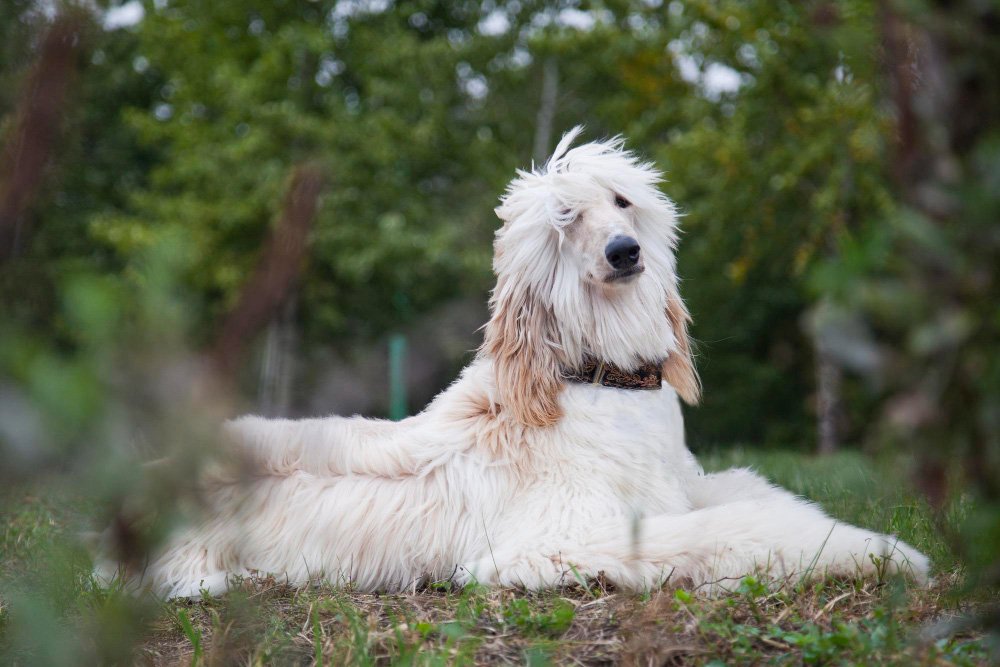







Elegant, independent, and breathtakingly beautiful — a graceful companion with a proud and dignified nature.
🧠 QUICK SNAPSHOT
- Temperament: Independent, gentle, dignified
- Energy Level: Moderate to high
- Size: Large
- Good With Families: Yes
- Trainability: Moderate to low
- Grooming: Very high
- Best For: Experienced owners, active homes, companionship
📚 OVERVIEW
The Afghan Hound is one of the most elegant and distinctive dog breeds in the world, famous for its flowing silky coat and regal appearance. Originally bred to hunt across the rugged mountains of Afghanistan, these dogs combine athletic ability with remarkable grace.
While affectionate with their family, Afghan Hounds tend to be independent thinkers and often display a reserved, almost cat-like personality.
✅ PROS & CONS
Pros
- Stunning and unique appearance
- Gentle and affectionate with family
- Athletic and surprisingly fast
- Calm and dignified nature indoors
Cons
- Requires extensive grooming
- Can be difficult to train
- Strong prey drive
- Independent personality may not suit all owners
Is an Afghan Hound a Good Family Dog?
Yes, an Afghan Hound can be a wonderful family dog, particularly in a household that understands its independent personality.
Afghan Hounds often form strong bonds with their families but aren’t usually as eager to please as breeds developed to work closely under human direction. They can be affectionate, gentle and occasionally wonderfully silly at home while appearing dignified and reserved around strangers.
They can live successfully with respectful children, although their size and sensitivity make supervision important around younger children.
The Afghan Hound suits families who appreciate a dog with its own personality and opinions, rather than expecting instant obedience to every request.
How Much Exercise Does an Afghan Hound Need?
An adult Afghan Hound generally needs around one to two hours of exercise each day, with opportunities to run safely being particularly valuable.
These dogs were developed as fast hunting sighthounds capable of pursuing animals across difficult terrain.
Walking is important, but many Afghans also love the opportunity to stretch their legs at speed in a securely enclosed area.
Activities such as lure coursing can provide an excellent outlet for their natural abilities.
Their recall can be unreliable when prey drive takes over, so unrestricted off-lead exercise in unsecured areas can be risky.
Underneath all that glamorous hair is a serious athlete built to run.
Is an Afghan Hound Easy to Train?
Afghan Hounds are intelligent but famously independent, so they’re not generally considered one of the easiest breeds to train.
This doesn’t mean they’re unintelligent.
Quite the opposite.
Afghans were developed to hunt across difficult terrain where they sometimes needed to make decisions without constant human instruction.
Training works best when sessions are positive, interesting and relatively short.
Harsh or repetitive training can quickly cause an Afghan to disengage.
Recall deserves particular attention because the breed’s powerful prey drive can override training when something interesting starts running.
An Afghan Hound may understand perfectly well what you’ve asked.
Whether it considers your request the most interesting option currently available can be another question.
Does an Afghan Hound Shed?
Yes, Afghan Hounds do shed, although their spectacular coat behaves differently from the fur of many heavy-shedding breeds.
The bigger issue is grooming rather than the amount of loose hair.
An adult Afghan’s long, silky coat can tangle and mat without frequent, thorough maintenance. Several grooming sessions each week are typically required, and many owners bathe their dogs regularly to keep the coat manageable.
The ears also require particular attention because their long hair can become dirty around food and water.
Owners keeping an Afghan in full show coat face a substantial grooming commitment.
That magnificent flowing coat isn’t self-maintaining.
Looking like canine royalty requires staff.
What Health Problems Are Common in Afghan Hounds?
Afghan Hounds are generally relatively healthy, but several conditions deserve attention.
Hip dysplasia can occur, making appropriate screening of breeding dogs important.
Eye disorders, including inherited cataracts, have also been reported within the breed.
Afghans can experience bloat or gastric dilatation-volvulus (GDV), a potentially fatal emergency in which the stomach expands and may twist. Owners should understand the warning signs and seek immediate veterinary treatment if GDV is suspected.
The breed can also be particularly sensitive to certain anaesthetic drugs because of its lean sighthound physiology, making an experienced veterinarian valuable.
Responsible breeders should provide appropriate health information and screening results rather than relying on the Afghan’s athletic appearance as evidence of good health.
How Long Do Afghan Hounds Live?
Afghan Hounds typically live around 12–14 years, although individual dogs can live longer.
That’s a respectable lifespan for a relatively large dog.
Maintaining an appropriate body condition, providing regular exercise, good dental care and routine veterinary checks can support healthy ageing.
Because Afghans naturally have a lean sighthound build, owners unfamiliar with the breed shouldn’t automatically assume that a healthy, slender dog is underweight.
Senior dogs may need adjustments to exercise and diet while still benefiting from regular opportunities to remain active.
The elegant young athlete eventually becomes an elegant senior — usually with exactly the same opinion about whether your commands are optional.
Are Afghan Hounds Affectionate?
Yes, Afghan Hounds can be extremely affectionate with the people they trust, although their affection is often more reserved than that of highly demonstrative breeds.
Many develop deep attachments to their families while remaining aloof around unfamiliar people.
At home, the dignified public image can disappear surprisingly quickly.
Owners frequently describe playful, clownish behaviour from dogs that look extraordinarily serious in photographs.
They may seek attention and companionship without constantly demanding physical contact.
The Afghan Hound is a good reminder that a dog doesn’t need to greet every stranger like a long-lost friend to form very powerful relationships with its own family.
Are Afghan Hounds Good With Other Dogs?
Afghan Hounds can generally live successfully with other compatible dogs, especially when appropriately socialised from puppyhood.
Many enjoy canine companionship and can be playful with dogs they know.
Their interactions with smaller animals require more caution.
The Afghan Hound is a hunting sighthound with a potentially powerful prey drive. Small animals running rapidly can trigger instinctive pursuit.
Individual temperament varies considerably, and some Afghans successfully live with cats when raised alongside them.
However, peaceful behaviour with the family cat doesn’t necessarily mean the same dog will ignore an unfamiliar cat running outdoors.
Prey drive is something to manage rather than assume training has completely erased.
Can an Afghan Hound Live in an Apartment?
An Afghan Hound can adapt to apartment living, but only when its exercise and space requirements are properly addressed.
Despite their athletic ability, adult Afghans can be surprisingly relaxed indoors after adequate exercise.
The challenge is providing opportunities for daily walking and safe running.
Their large size and enormous coat also make compact living arrangements less convenient.
Access to a secure exercise area is extremely valuable.
A large garden isn’t automatically enough either — an Afghan still needs interaction, enrichment and meaningful exercise.
Apartment or house, the important requirement is the same:
this dog needs somewhere safe to unleash the sighthound underneath the hairstyle.
Can Afghan Hounds Be Trusted Off Lead?
Afghan Hounds should generally not be trusted off lead in unsecured areas, even when they have received good recall training.
Their powerful prey drive and extraordinary speed create a difficult combination.
A dog that normally responds well may suddenly notice a rabbit, cat or other fast-moving animal and instinctively give chase.
Once an Afghan is running at full speed, catching it on foot isn’t a realistic backup plan.
Securely fenced areas provide much safer opportunities for unrestricted running.
Long lines can also provide additional freedom during appropriate training situations.
With this breed, excellent recall training remains valuable.
It simply shouldn’t be mistaken for a guarantee against thousands of years of hunting instinct.
How Fast Can an Afghan Hound Run?
Afghan Hounds are extremely fast runners, with frequently cited estimates placing their top speed at around 60 km/h (roughly 37 mph).
Exact maximum speed varies between individual dogs and isn’t something every Afghan will achieve.
What matters more is why they’re so fast.
The breed was developed as a sighthound capable of pursuing game across challenging mountainous terrain in and around Afghanistan and neighbouring regions.
Their long legs, powerful hindquarters, flexible athletic bodies and large lungs contribute to impressive speed and endurance.
The elegant dog standing beside the sofa therefore hides some serious machinery.
When an Afghan decides to run, the hairstyle travels remarkably quickly.
Why Do Afghan Hounds Have Such Long Hair?
The Afghan Hound’s spectacular coat wasn’t originally developed simply for appearance.
Its ancestors worked in harsh mountainous environments, where a substantial coat offered protection against cold and challenging weather.
The modern show coat has been strongly shaped by selective breeding, but its roots lie in practical adaptation.
Interestingly, adult Afghans don’t have equally long hair everywhere.
They typically have shorter hair across parts of the back known as the saddle, while long silky hair covers much of the remainder of the body.
Puppies also look dramatically different from glamorous adults because their mature coat develops gradually.
The famous Afghan hairstyle began with function.
Humans subsequently decided to make it spectacular.
Where Does the Afghan Hound Come From?
The Afghan Hound is an ancient-type sighthound associated primarily with Afghanistan and surrounding regions of Central and South Asia.
Dogs of different regional types were historically used to pursue game across environments ranging from mountains to more open terrain.
Rather than being created recently from a carefully documented series of crosses, the Afghan developed from longstanding populations of hunting dogs adapted to local conditions.
Afghan Hounds began attracting significant attention in Britain during the late 19th and early 20th centuries, and imported dogs eventually helped establish the modern international breed.
One famous early Afghan was Zardin, whose appearance influenced an early British breed standard.
The glamorous modern show dog therefore descends from dogs with a much tougher original occupation:
finding and pursuing game across some exceptionally difficult country.