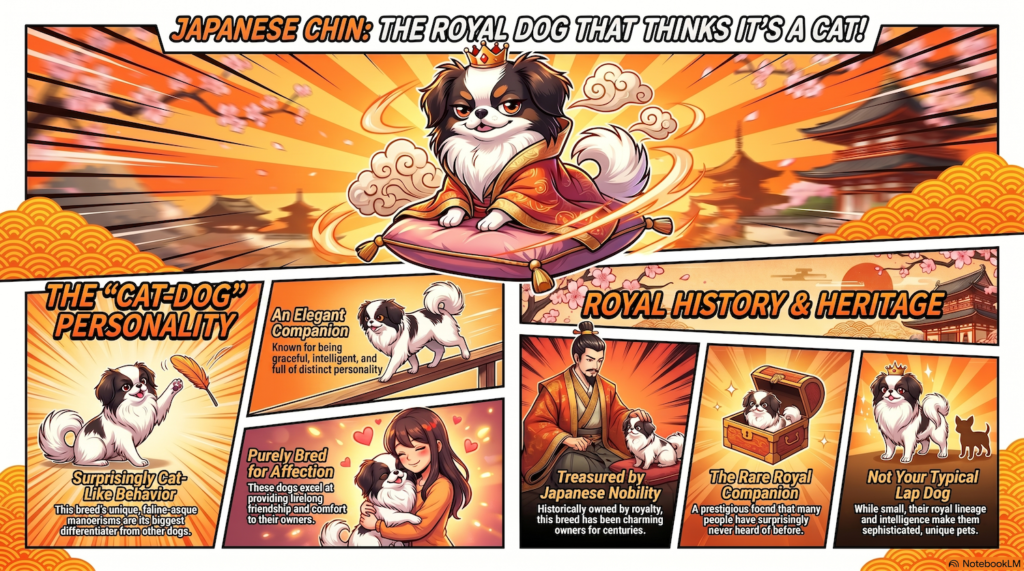







Elegant, affectionate, and full of charm — a graceful companion that thrives on attention and companionship.
🧠 QUICK SNAPSHOT
- Temperament: Affectionate, intelligent, gentle
- Energy Level: Low to moderate
- Size: Small
- Good With Families: Yes
- Trainability: Moderate
- Grooming: Moderate
- Best For: Apartments, companionship, relaxed households
📚 OVERVIEW
The Japanese Chin is a refined toy breed known for its silky coat, expressive face, and elegant mannerisms. Originally treasured by Japanese nobility, these dogs were bred primarily as companions and remain devoted lap dogs today.
They are affectionate and entertaining companions, often displaying cat-like behaviours such as climbing, perching on furniture, and carefully grooming themselves.
✅ PROS & CONS
Pros
- Loving and affectionate companion
- Well suited to apartment living
- Quiet and gentle nature
- Unique, elegant appearance
Cons
- Can be sensitive to heat
- Requires regular coat maintenance
- May be reserved around strangers
- Doesn’t enjoy being left alone for long periods
Is a Japanese Chin a Good Family Dog?
Yes. Japanese Chins are generally affectionate, gentle, playful and deeply attached to their families.
They’re small and physically delicate, so homes with very young or rough children require extra supervision.
Unlike many small dogs, the Japanese Chin was developed primarily as an indoor companion rather than a working dog.
How Much Exercise Does a Japanese Chin Need?
Most Japanese Chins need only around 20–40 minutes of gentle daily exercise, along with indoor play.
Short walks and games are usually sufficient.
They’re companion dogs rather than endurance athletes, and their short muzzle makes strenuous exercise in hot weather inappropriate.
Is a Japanese Chin Easy to Train?
Usually, although they have an independent streak.
Japanese Chins are intelligent and often learn tricks quickly, but they may become bored with repetitive training.
Gentle positive reinforcement suits their sensitive personality best.
Are Japanese Chins Intelligent?
Yes.
They’re observant, quick to recognise routines and surprisingly good problem-solvers.
Their intelligence is often described as somewhat cat-like because they can be independent and selective about when they cooperate.
Why Is the Japanese Chin Called a Cat-Like Dog?
Japanese Chins display several behaviours owners frequently compare with cats.
They may climb onto high furniture, groom themselves with their paws, balance surprisingly well and choose elevated resting places.
Their independent but affectionate personality strengthens the comparison.
Do Japanese Chins Clean Their Faces Like Cats?
Some do.
Japanese Chins are known for using their paws to wash or rub around their faces.
This behaviour is one reason the breed has acquired such a strong reputation as the “cat of the dog world.”
Do Japanese Chins Like to Climb?
Many do.
They’re surprisingly agile and may seek the backs of sofas, cushions or other elevated places.
Their climbing behaviour is unusual enough to be regularly mentioned by breed enthusiasts.
Does a Japanese Chin Shed?
Yes.
Despite the silky coat, Japanese Chins are moderate shedders.
Regular brushing helps remove loose hair and prevent tangles.
Is a Japanese Chin Hypoallergenic?
No.
Japanese Chins shed and produce normal canine allergens through their skin and saliva.
They’re not considered a hypoallergenic breed.
How Often Should You Groom a Japanese Chin?
Brushing around two or three times each week is generally sufficient for most companion dogs.
Extra attention may be needed behind the ears, around feathering and in other areas where tangles develop.
The coat is less difficult to maintain than its luxurious appearance suggests.
Does a Japanese Chin Have an Undercoat?
The Japanese Chin’s coat is traditionally described as silky, straight and relatively light rather than heavily woolly.
The degree of undercoat can vary.
Its coat should fall naturally rather than having the dense, sculpted appearance of some other long-haired toy breeds.
Does a Japanese Chin Need Haircuts?
Not usually.
The natural flowing coat is part of the breed’s appearance and doesn’t require routine full-body clipping.
Owners may carefully tidy hair around the feet or hygiene areas when necessary.
Can You Shave a Japanese Chin?
There’s usually no reason to routinely shave a healthy Japanese Chin.
Regular brushing and sensible trimming are generally preferable.
If severe matting or a medical issue requires clipping, a veterinarian or experienced groomer can advise.
What Health Problems Are Common in Japanese Chins?
Potential concerns include brachycephalic airway problems, patellar luxation, eye disorders, heart disease and dental problems.
Their prominent eyes can also be vulnerable to injury.
Responsible breeding should prioritise functional breathing and overall health rather than exaggerating the flat face.
Do Japanese Chins Have Breathing Problems?
Some do.
Japanese Chins are brachycephalic, meaning they have shortened skulls and muzzles.
Dogs with more extreme anatomy may experience noisy or restricted breathing, reduced exercise tolerance and greater heat risk.
Do Japanese Chins Overheat Easily?
They can.
A shortened muzzle reduces the efficiency of cooling through panting.
Exercise should therefore be restricted during hot and humid weather, particularly during Australian summers.
Why Do Japanese Chins Snort?
Shortened nasal passages can produce snorting, snuffling and other respiratory sounds.
Occasional noises can occur without serious disease, but persistent breathing difficulty shouldn’t simply be dismissed as normal for the breed.
What Is Reverse Sneezing in a Japanese Chin?
Reverse sneezing is a sudden episode involving rapid inward breaths through the nose.
It can sound alarming but often resolves quickly.
Frequent or severe episodes should be discussed with a veterinarian because other respiratory problems can produce similar symptoms.
Are Japanese Chins Prone to Eye Problems?
Yes.
Their large, prominent eyes can be vulnerable to injury, irritation, corneal problems and certain inherited eye disorders.
Squinting, redness, discharge or sudden eye pain deserves prompt veterinary attention.
Why Are a Japanese Chin’s Eyes So Large?
Large, widely spaced eyes became a defining feature through selective breeding for an expressive companion-dog appearance.
Historically, this contributed to the breed’s distinctive almost human-like expression.
Extreme prominence, however, can increase eye vulnerability.
Are Japanese Chins Prone to Patellar Luxation?
Yes.
Patellar luxation, where the kneecap slips out of its normal position, occurs in many toy breeds including Japanese Chins.
Signs can include intermittent skipping or suddenly carrying a hind leg.
Do Japanese Chins Have Heart Problems?
Heart disease can occur within the breed, including mitral valve disease and other cardiac conditions.
Responsible breeders should follow appropriate health-screening recommendations.
Regular veterinary examinations become increasingly important as the dog ages.
Are Japanese Chins Prone to Dental Problems?
Yes.
Their small jaws can lead to crowded teeth and increased periodontal disease risk.
Regular tooth brushing and professional veterinary dental assessment are important.
How Long Does a Japanese Chin Live?
Japanese Chins commonly live around 10–14 years, with some reaching their mid-teens.
Healthy weight, dental care, responsible breeding and avoiding excessive heat can all contribute to longevity.
How Big Does a Japanese Chin Get?
Japanese Chins are tiny dogs, generally standing around 20–28 cm tall and commonly weighing approximately 2–5 kg.
Individual size varies somewhat between breeding populations and kennel standards.
Is There a Miniature Japanese Chin?
No.
The Japanese Chin is already a Toy breed and there is no recognised Miniature Japanese Chin variety.
Very small dogs occur naturally, but “Mini” is generally a marketing term.
Is There a Teacup Japanese Chin?
No recognised Teacup Japanese Chin exists.
Deliberately selecting for extreme smallness can increase risks associated with fragile bones, dental crowding and other health problems.
Responsible breeders focus on healthy structure rather than producing the smallest possible puppy.
Can a Japanese Chin Live in an Apartment?
Yes. Japanese Chins are excellent apartment dogs.
They’re small, require relatively modest exercise and were historically developed specifically for close indoor companionship.
Their lifestyle can suit urban households extremely well.
Does a Japanese Chin Need a Backyard?
No.
Regular short walks and indoor play can provide sufficient activity.
A secure garden can be enjoyable but isn’t essential.
Can a Japanese Chin Be Left Alone?
They can learn to tolerate reasonable periods alone, but they’re strongly companion-oriented.
Long periods of isolation generally don’t suit them.
Gradual independence training from puppyhood can help prevent separation-related problems.
Are Japanese Chins Velcro Dogs?
Many are strongly attached to their favourite people.
However, they can combine affection with a slightly independent, almost feline personality.
They may follow you everywhere and then decide they’d rather supervise from the back of the sofa.
Are Japanese Chins Cuddly?
Yes, many are exceptionally affectionate.
They were bred primarily as companion dogs and often enjoy laps and close physical contact.
Their small size makes them particularly well suited to this original job.
Are Japanese Chins Lap Dogs?
Very much so.
Unlike many breeds that became household companions after originally performing another job, Japanese Chins have a centuries-long history centred largely on companionship.
Sitting comfortably with people is therefore not a retirement career. It’s the traditional occupation.
Are Japanese Chins Good With Children?
They can be good with calm, respectful children.
However, their tiny size and relatively delicate body mean rough play can cause injury.
They’re often better suited to older children who understand gentle handling.
Are Japanese Chins Good With Other Dogs?
Usually.
They’re often sociable with other gentle dogs and can enjoy canine companionship.
Care is needed around large or extremely boisterous dogs because of the size difference.
Are Japanese Chins Good With Cats?
Often very good.
Their gentle temperament, small size and somewhat cat-like behaviour can make them compatible with feline companions.
Introductions should still be gradual and supervised.
Do Japanese Chins Have a Strong Prey Drive?
Usually not compared with terriers or sighthounds.
They were developed primarily as companions rather than hunters.
Individuals may still chase birds or small animals, but intense prey drive isn’t generally a defining characteristic.
Are Japanese Chins Good Off Leash?
They can learn recall, but secure areas are preferable.
Their tiny size makes roads, larger dogs and wildlife potentially dangerous.
An independent streak can also appear when something more interesting catches their attention.
Do Japanese Chins Bark a Lot?
Usually they’re not extreme barkers.
Many will alert to visitors or unusual noises but aren’t generally known for constant vocalisation.
Individual dogs can develop nuisance barking through boredom or anxiety.
Are Japanese Chins Good Watchdogs?
They can be effective little alarm dogs.
They’re observant and often notice unusual activity quickly.
Their ability to physically confront an intruder is, naturally, rather less impressive.
Are Japanese Chins Aggressive?
They shouldn’t be.
The ideal Japanese Chin is gentle, affectionate, dignified and playful.
Poor socialisation, fear or inappropriate handling can still create defensive behaviour in any small dog.
Are Japanese Chins Shy With Strangers?
Some are reserved initially.
Their traditional temperament is often more dignified and discerning than exuberantly social.
Good socialisation helps ensure reserve doesn’t develop into fearfulness.
Are Japanese Chins High-Energy Dogs?
No.
They enjoy play and can have surprisingly energetic bursts, but their overall exercise requirements are modest.
They’re far more suited to companion life than prolonged strenuous activity.
Do Japanese Chins Get the Zoomies?
Yes.
Despite their dignified appearance, many suddenly race around the house during brief explosions of enthusiasm.
The performance is usually followed by a rapid return to normal lapdog operations.
Are Japanese Chins Good Running Dogs?
Not for serious distance running.
Their tiny size and brachycephalic anatomy make them poorly suited to prolonged strenuous exercise.
Short playful runs are much more appropriate.
Are Japanese Chins Good for Older People?
They can be excellent companions for older adults.
Their small size, moderate exercise requirements and affectionate temperament are advantages.
Owners still need to manage grooming, dental care and the physical safety of such a tiny dog.
What Does a Japanese Chin Look Like?
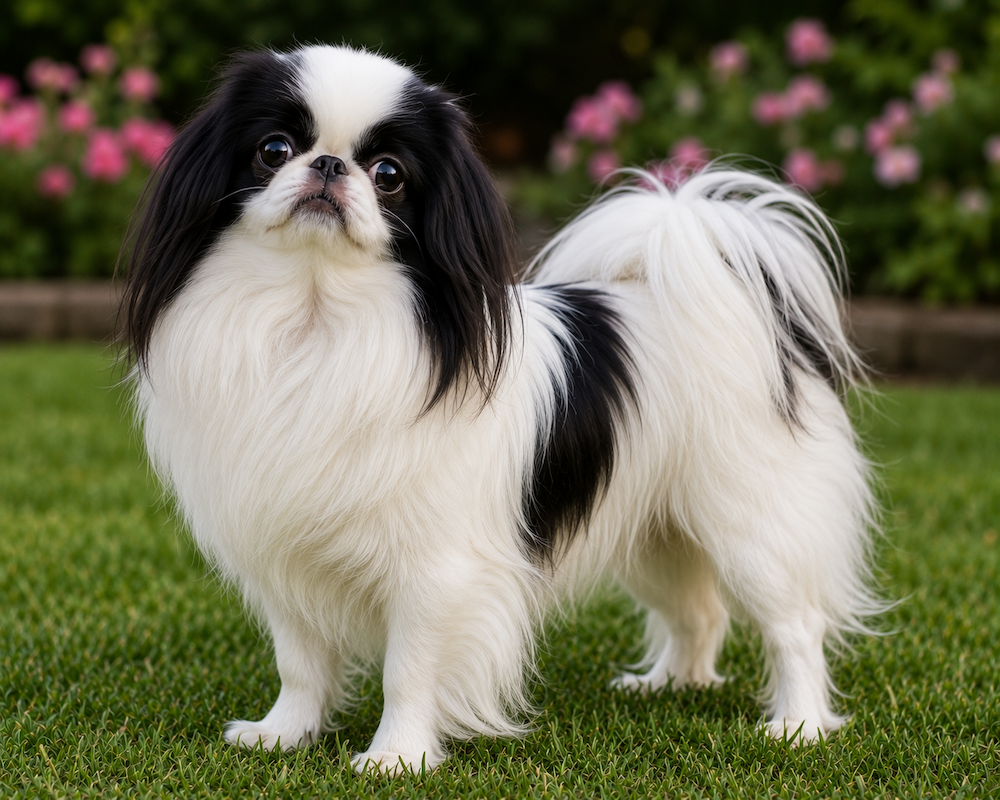
The Japanese Chin is a tiny, elegant dog with a broad head, short muzzle, large dark eyes, feathered ears, silky coat and plumed tail carried over the back.
Its body is relatively square and lightly built.
The breed’s expression is one of its most distinctive characteristics.
What Colours Can Japanese Chins Be?
The classic colours are black and white or red and white.
Some standards also recognise black-and-white dogs with tan points.
Red can range considerably in shade.
Can a Japanese Chin Be Black and White?
Yes.
Black and white is probably the breed’s most instantly recognisable colour combination.
Symmetrical facial markings are particularly striking but aren’t perfectly identical in every dog.
Can a Japanese Chin Be Red and White?
Yes.
Red-and-white Japanese Chins are a traditional colour.
“Red” can range from pale lemon or orange tones through to richer reddish shades depending on genetics and terminology.
What Are Japanese Chin Tan Points?
Some black-and-white Japanese Chins also display tan markings, often above the eyes, on the cheeks or around the ears.
These dogs may be described as black and white with tan points or tricolour, depending on the standard and terminology.
Why Does a Japanese Chin Have a White Blaze on Its Face?
A broad white facial blaze separating coloured patches is part of the traditional breed appearance.
Historically, balanced facial markings became particularly prized.
The markings help produce the distinctive almost mask-like Japanese Chin expression.
What Is the Japanese Chin’s “Buddha’s Thumbprint”?
A small coloured spot or marking on the top of the head is sometimes romantically called “Buddha’s thumbprint.”
Breed folklore associates it with a blessing from Buddha.
It’s a charming traditional story rather than a biological feature with special significance.
Why Does a Japanese Chin Have a Plumed Tail?
The long feathered tail carried over the back contributes to the breed’s elegant outline.
Selective breeding emphasised this luxurious feature as Japanese Chins became prized ornamental companions.
Why Does the Japanese Chin Walk Differently From Other Dogs?
The breed standard traditionally values stylish, light and elegant movement.
Their straight front legs, compact body and feathered coat can create a distinctive high-stepping appearance.
Movement should remain sound and functional rather than exaggerated.
Is a Japanese Chin the Same as a Pekingese?
No.
Both are ancient East Asian companion breeds, but they’re distinct.
Pekingese are generally heavier, lower and more heavily coated, while Japanese Chins are lighter, more delicate and more squarely built.
Is a Japanese Chin the Same as a Shih Tzu?
No.
Shih Tzus are sturdier and carry a much denser coat.
Japanese Chins are finer-boned and have a lighter, silkier coat with a distinctly different outline.
Is a Japanese Chin Related to the Pekingese?
They probably share broad ancestry among the ancient small companion dogs of East Asia.
Exactly how breeds such as the Japanese Chin, Pekingese and Tibetan companion dogs contributed to one another isn’t completely documented.
Their modern identities were established much later than their earliest ancestors.
Is a Japanese Chin Related to the Tibetan Spaniel?
Possible historical connections exist among the small companion dogs that moved between China, Tibet, Korea and Japan.
However, simple direct ancestry claims are difficult to prove.
These dogs developed over centuries of cultural exchange.
Is the Japanese Chin Really a Spaniel?
Despite historically being called the Japanese Spaniel, it isn’t a sporting spaniel in the sense of a Cocker or Springer Spaniel.
It wasn’t developed to flush birds.
The name “spaniel” was historically applied more loosely to certain small companion dogs.
Why Was the Japanese Chin Called the Japanese Spaniel?
Westerners commonly called the breed the Japanese Spaniel during the 19th and early 20th centuries.
As understanding of the breed’s distinct Japanese identity increased, Japanese Chin became the preferred official name.
What Does “Chin” Mean in Japanese Chin?
The precise linguistic history is debated, and simple translations should be treated cautiously.
In the breed’s cultural context, Chin became associated with a special type of small ornamental companion dog, distinct from ordinary working dogs.
Is the Japanese Chin Actually From Japan?
Japan is central to the breed’s development, but its deeper ancestry probably originated elsewhere in East Asia.
Small companion dogs likely reached Japan from China or the Korean Peninsula many centuries ago.
Japanese aristocratic breeding then transformed them into the distinctive Chin known today.
Did the Japanese Chin Originate in China?
Chinese ancestry is one prominent theory.
Ancient China had a long tradition of breeding tiny companion dogs for imperial households, and dogs moved between East Asian courts as diplomatic gifts.
However, the exact route leading to the Japanese Chin isn’t perfectly documented.
Did the Japanese Chin Come From Korea?
Korea also features prominently in breed histories.
One traditional account describes small dogs being presented to the Japanese imperial court by Korean rulers or envoys, potentially as early as the first millennium.
The precise details and dates remain uncertain.
How Old Is the Japanese Chin Breed?
Its ancestral companion-dog tradition is many centuries old, potentially extending back more than a thousand years.
However, the modern standardised Japanese Chin developed much later.
Claims about an exact ancient founding date should therefore be treated cautiously.
Were Japanese Chins Imperial Dogs?
They became strongly associated with the Japanese imperial court and aristocracy.
Small ornamental dogs were highly valued as elite companions.
Selective breeding for tiny size, beauty and distinctive appearance helped transform the Chin into a prestigious court dog.
Were Japanese Chins Owned by Japanese Nobility?
Yes.
The breed was particularly associated with noble and aristocratic households.
Keeping these delicate little dogs indoors distinguished them sharply from larger working dogs maintained for hunting or guarding.
Were Japanese Chins Given as Royal Gifts?
Yes.
Small companion dogs frequently moved between Asian courts as prestigious diplomatic gifts.
This practice probably played an important role in bringing ancestral Chin-type dogs to Japan and later introducing Japanese dogs to Western visitors.
Were Japanese Chins Carried in Sleeves?
Stories often describe tiny Japanese Chins being carried in the sleeves of aristocratic robes or in small baskets.
Extremely small companion dogs certainly became fashionable.
Some of the more dramatic “sleeve dog” stories are difficult to verify precisely, but they reflect the historical preference for tiny ornamental companions.
Were Japanese Chins Kept in Cages?
Historical accounts sometimes describe elite companion dogs being kept in elaborate indoor settings, including decorative enclosures.
It’s important not to interpret historical husbandry automatically as appropriate modern welfare practice.
Today’s Japanese Chin needs normal exercise, social interaction and freedom of movement.
Why Were Japanese Chins Bred So Small?
Small size made them ideal indoor companions for aristocratic households.
Unlike working breeds, they didn’t need strength to herd livestock, retrieve birds or protect property.
Their principal functions were companionship, beauty and prestige.
Were Japanese Chins Considered Different From Ordinary Dogs in Japan?
Historically, Chin occupied an unusual cultural position as highly valued ornamental companion animals.
They were associated with courtly life rather than ordinary working-dog roles.
This helps explain why their temperament and appearance differ so dramatically from native Japanese working breeds such as the Akita or Shiba Inu.
Is the Japanese Chin Related to the Shiba Inu?
Not in any close functional sense.
The Shiba developed as a native Japanese hunting dog, while the Chin descends from a very different East Asian companion-dog tradition.
Sharing Japan as an important country of development doesn’t make them closely related breeds.
Why Doesn’t the Japanese Chin Look Like Other Japanese Dog Breeds?
Because its ancestry and historical role are completely different.
Breeds such as the Akita and Shiba developed from native hunting and working populations.
The Chin developed from tiny court companion dogs with broader East Asian ancestry.
When Did Japanese Chins Come to Europe?
Small Japanese dogs occasionally reached Europe through early trade, but substantial Western interest developed during the 19th century, when Japan increasingly opened to international contact.
They quickly became fashionable among wealthy European dog enthusiasts.
When Did Japanese Chins Come to America?
Japanese companion dogs reached the United States during the mid-19th century, around the period when American contact with Japan increased dramatically.
The exact identity of every early imported dog isn’t always clear from historical records.
What Does Commodore Perry Have to Do With Japanese Chins?
American naval officer Commodore Matthew Perry is frequently associated with the breed’s Western history.
During his expeditions to Japan in the 1850s, small Japanese dogs were reportedly presented as gifts.
Some were subsequently taken or sent to prominent Western recipients.
Did Commodore Perry Bring Japanese Chins to America?
Perry is traditionally credited with helping introduce Japanese companion dogs to the West following his 1853–1854 expeditions to Japan.
Exactly what happened to each individual dog is difficult to reconstruct.
Nevertheless, his visits became an important part of Japanese Chin history.
Did Queen Victoria Own Japanese Chins?
Queen Victoria received Japanese dogs during the period when the breed was becoming known in the West.
Royal interest helped make exotic Japanese companion dogs fashionable among European aristocracy.
The breed subsequently became well established in Britain.
Why Did Japanese Chins Become Popular in Victorian Britain?
Victorian society developed enormous enthusiasm for unusual imported breeds.
The Japanese Chin offered an irresistible combination of tiny size, exotic origins, aristocratic history and striking appearance.
Royal ownership added even greater prestige.
When Was the Japanese Chin Recognised by the AKC?
The breed was recognised by the American Kennel Club in 1888, originally under the name Japanese Spaniel.
This makes it one of the relatively early Toy breeds established within organised American dog showing.
When Did the Name Change From Japanese Spaniel to Japanese Chin?
The official name was changed in the United States from Japanese Spaniel to Japanese Chin in 1977.
The newer name better reflected the breed’s distinctive cultural identity rather than incorrectly suggesting a conventional sporting-spaniel background.
Did Japanese Chins Nearly Disappear During World War II?
The breed faced serious challenges in Japan during wartime.
Food shortages, bombing and social disruption made maintaining companion dogs extremely difficult.
Established populations overseas helped ensure the breed survived internationally.
Why Are Japanese Chins Relatively Rare Today?
They’ve never achieved the mass popularity of breeds such as Pugs, French Bulldogs or Cavalier King Charles Spaniels.
Their delicate size, grooming requirements and health considerations appeal to a more specialised group of owners.
They’re established internationally but remain relatively uncommon.
Is a Japanese Chin a Good First Dog?
It can be an excellent first dog for someone wanting a small, affectionate and relatively low-exercise companion.
Owners should still understand brachycephalic health concerns, dental care, eye vulnerability and coat maintenance.
Their sensitive temperament responds best to gentle handling.
What Makes the Japanese Chin Unique?
The Japanese Chin is unusual because it was never really expected to earn its living.
While terriers chased vermin and retrievers collected birds, generations of Chin were refined primarily to live alongside aristocrats, look beautiful and provide companionship.
That history remains obvious today.
They’re elegant lapdogs that climb furniture, wash their faces with their paws, seek elevated sleeping positions and frequently behave enough like cats that even devoted owners wonder whether anyone informed them they’re dogs.
How Did the Japanese Chin Become Japan’s Aristocratic Lapdog?
The breed’s deeper ancestry probably lies among the small companion dogs exchanged between the courts of China, Korea and Japan many centuries ago. The exact route remains uncertain, and simple claims that the breed was created entirely in one country overlook centuries of East Asian cultural exchange.
Once established in Japan, these little dogs became closely associated with the imperial court and aristocratic households. Breeders emphasised tiny size, a silky coat, large expressive eyes, distinctive facial markings and an elegant personality. They were companions rather than hunters, herders or guards.
The outside world became particularly fascinated with them during the 19th century. Commodore Matthew Perry’s expeditions to Japan in the 1850s became closely associated with their introduction to Western society, and Japanese dogs subsequently attracted royal admirers including Queen Victoria. The breed was recognised in America in 1888 as the Japanese Spaniel before officially becoming the Japanese Chin decades later.
Its surroundings may have changed from imperial residences to modern apartments, but its job description remains remarkably similar: find the most comfortable place in the house, preferably somewhere elevated, and allow the humans the privilege of providing everything else.