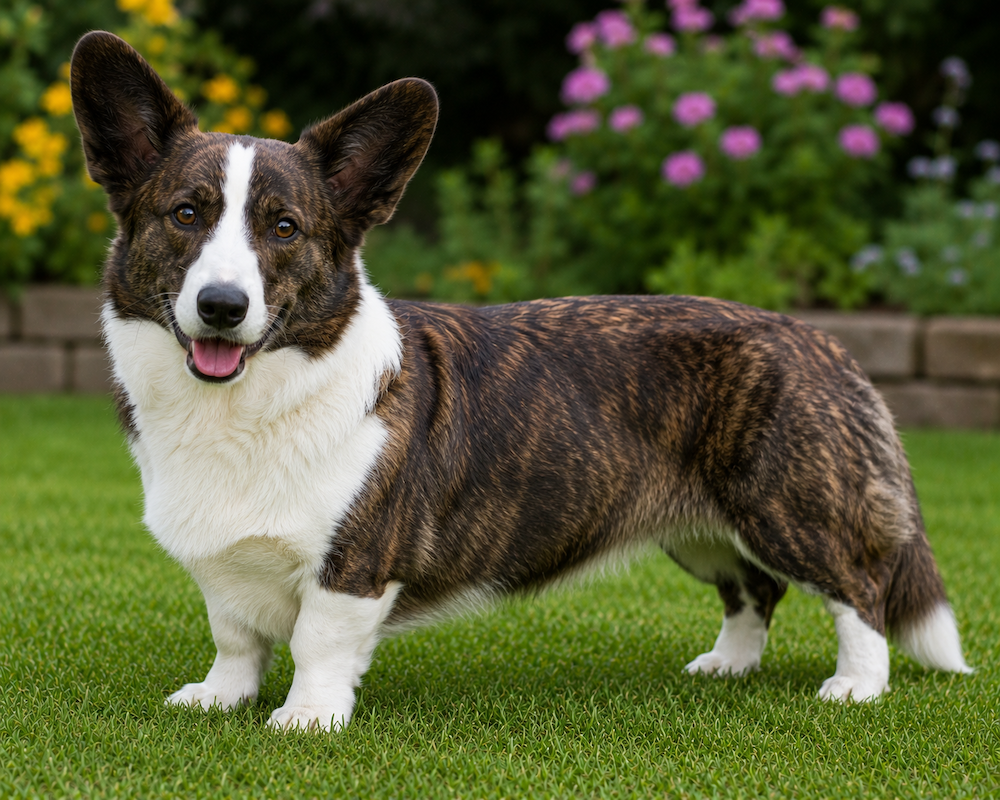






Intelligent, loyal, and full of character — a sturdy little companion with a big heart and endless charm.
🧠 QUICK SNAPSHOT
- Temperament: Loyal, intelligent, affectionate
- Energy Level: Moderate
- Size: Small to medium
- Good With Families: Yes
- Trainability: High
- Grooming: Moderate
- Best For: Families, companionship, active households
📚 OVERVIEW
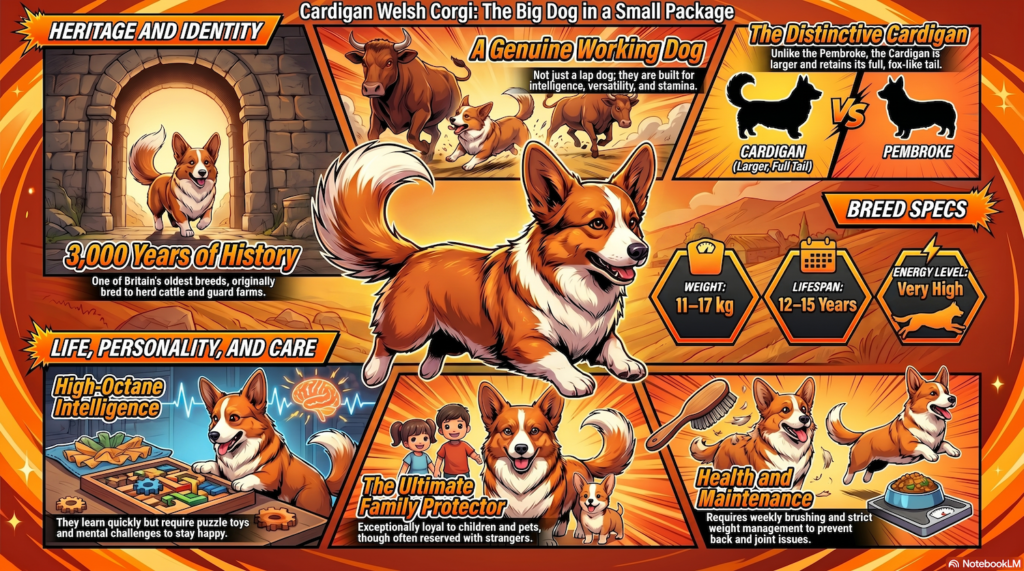
The Cardigan Welsh Corgi is one of the oldest herding breeds, known for its long body, fox-like face, and distinctive tail. Unlike the Pembroke Welsh Corgi, the Cardigan has a long, full tail and a slightly larger, sturdier build.
They are intelligent, adaptable dogs that enjoy being part of family life and are well known for their loyalty and affectionate nature.
✅ PROS & CONS
Pros
- Highly intelligent and trainable
- Loyal and devoted to family
- Great with children and families
- Adaptable to many living situations
Cons
- Can be vocal when alerting owners
- Sheds heavily, especially seasonally
- Needs regular exercise and stimulation
- May try to herd children or other pets
Is a Cardigan Welsh Corgi a Good Family Dog?
Yes, the Cardigan Welsh Corgi can be an excellent family dog for households wanting an intelligent, affectionate and active companion.
Cardigans tend to form strong bonds with their families and are often good with respectful children. They can be somewhat more reserved with strangers than their Pembroke Welsh Corgi cousins.
Despite their short legs, these are genuine working herding dogs rather than delicate lap dogs.
They generally thrive when included in family activities and given something interesting to do.
How Much Exercise Does a Cardigan Welsh Corgi Need?
Most Cardigan Welsh Corgis need around 60 minutes of exercise each day, together with mental stimulation.
Daily walks, sniffing opportunities, training, puzzle toys and controlled games can all help.
Many enjoy activities such as obedience, rally, scent work and appropriately managed agility.
Their short legs can make them look less athletic than they really are.
A Cardigan is essentially a cattle dog operating unusually close to ground level.
Is a Cardigan Welsh Corgi Easy to Train?
Yes. Cardigan Welsh Corgis are generally intelligent and highly trainable.
Their herding ancestry required dogs capable of thinking independently while responding to their handlers.
Positive reinforcement usually produces excellent results.
However, intelligence doesn’t automatically mean unquestioning obedience. Cardigans can have definite opinions of their own.
Early training should concentrate on recall, calm greetings, lead manners and controlling inappropriate herding behaviour.
Does a Cardigan Welsh Corgi Shed?
Yes. Cardigan Welsh Corgis can shed quite heavily.
They have a dense double coat consisting of a weather-resistant outer layer and insulating undercoat.
Shedding usually becomes particularly noticeable during seasonal coat changes.
Regular brushing helps remove dead undercoat and reduces the amount of hair distributed around the home.
Anyone looking for a low-shedding dog should probably look elsewhere.
Is a Cardigan Welsh Corgi Hypoallergenic?
No. Cardigan Welsh Corgis aren’t considered hypoallergenic.
Their double coats shed regularly and can release considerable hair and dander into the environment.
People with dog allergies react primarily to proteins found in saliva, skin secretions and dander rather than simply the hair itself.
Anyone with significant allergies should spend time around adult Cardigans before considering one.
What Health Problems Are Common in Cardigan Welsh Corgis?
Cardigan Welsh Corgis are generally robust dogs, but several inherited conditions deserve attention.
Potential concerns include hip dysplasia, progressive retinal atrophy and degenerative myelopathy.
Their long-backed, short-legged structure can also make spinal health particularly important.
Maintaining a lean body weight reduces unnecessary strain on the back and joints.
Responsible breeders should undertake appropriate health and genetic testing rather than selecting dogs primarily for appearance.
How Long Do Cardigan Welsh Corgis Live?
Cardigan Welsh Corgis commonly live around 12–15 years.
Many remain active well into their senior years.
Genetics, body weight, exercise and preventive veterinary care all influence longevity.
Obesity is particularly undesirable because additional weight places greater strain on the dog’s relatively long spine and short limbs.
Keeping a Cardigan lean is one of the simplest ways owners can support long-term mobility.
How Big Does a Cardigan Welsh Corgi Get?
The Cardigan Welsh Corgi is a small-to-medium-sized but surprisingly substantial dog.
Adults generally stand around 27–32 cm at the shoulder and commonly weigh approximately 11–17 kg, with males usually larger.
Their long body, deep chest and substantial bone make them considerably heavier than they may initially appear.
They’re low to the ground, but they’re certainly not fragile.
Can a Cardigan Welsh Corgi Live in an Apartment?
Yes. A Cardigan Welsh Corgi can live successfully in an apartment if provided with enough daily exercise and mental stimulation.
Their moderate size is convenient for smaller homes.
Barking can be the greater challenge.
Cardigans are naturally alert and may announce people, dogs or unusual noises outside.
Training calm behaviour early is particularly valuable when living close to neighbours.
Can a Cardigan Welsh Corgi Be Left Alone?
Cardigans can usually learn to spend reasonable periods alone, but they generally prefer being involved with their families.
They are intelligent dogs and can become bored without sufficient stimulation.
Boredom may result in barking, chewing or other unwanted behaviour.
Gradual independence training, exercise and appropriate enrichment can help.
They’re usually happiest when they’re treated as genuine household companions rather than dogs left outside for long periods.
Do Cardigan Welsh Corgis Bark a Lot?
Cardigan Welsh Corgis can be quite vocal.
Historically, barking was useful when moving cattle and alerting farms to unusual activity.
Many modern Cardigans retain this tendency.
They may bark at visitors, noises outside or simply because something interesting has happened.
Training can control excessive barking, but expecting a naturally silent Cardigan may be unrealistic.
Are Cardigan Welsh Corgis Good With Other Dogs?
Cardigans are generally good with other dogs when properly socialised.
They tend to be confident and may occasionally behave as though they’re considerably larger than they really are.
Early positive experiences with different dogs are useful.
As with any breed, individual temperament matters more than breed stereotypes.
A well-socialised Cardigan can live very happily in a multi-dog household.
Are Cardigan Welsh Corgis Good With Cats?
Yes, many Cardigan Welsh Corgis can live successfully with cats, particularly when raised alongside them.
Their herding instincts may occasionally produce chasing behaviour.
Teaching puppies that cats aren’t livestock can therefore be useful.
Slow introductions and providing cats with escape routes help establish a peaceful household.
Many Cardigans eventually accept feline housemates as perfectly normal members of the family.
Why Do Cardigan Welsh Corgis Try to Herd People?
Cardigans may attempt to herd children, adults or other pets because herding behaviour is deeply embedded in their working ancestry.
Movement can trigger chasing, circling or attempts to control direction.
Some individuals may also nip towards ankles or heels.
These behaviours shouldn’t simply be accepted because they’re “what Corgis do.”
Training can redirect herding instincts into appropriate activities such as organised herding, scent work, obedience and games.
Why Are Cardigan Welsh Corgis So Short?
Cardigans have disproportionately short legs because of a genetic form of dwarfism called chondrodysplasia.
This characteristic is produced by changes affecting normal long-bone development.
Historically, their low stature was useful when working cattle.
The dog could move close to the ground and potentially avoid some of the force of a cow’s kick.
The same basic short-legged body pattern appears in several other breeds, including Dachshunds.
Why Were Corgis Used to Herd Cattle?
Their low stature, agility and courage made Corgis surprisingly effective cattle-driving dogs.
Rather than herding sheep from a distance like a Border Collie, these little dogs could work close to cattle and nip at their heels to encourage movement.
Being low to the ground helped them avoid kicking hooves.
It’s one of the great contrasts in the dog world: the cheerful short-legged companion on today’s sofa descends from dogs expected to confront animals weighing hundreds of kilograms.
What Does “Corgi” Mean?
The exact origin of the word Corgi is debated.
A popular explanation derives it from Welsh elements interpreted as something like “dwarf dog”, while another interpretation links the first element with gathering or watching.
Because Welsh language and historical terminology have evolved over centuries, simple translations should be treated cautiously.
Whatever its precise linguistic origin, the word has been associated with these distinctive Welsh cattle dogs for generations.
Why Does a Cardigan Welsh Corgi Have a Long Tail?
The Cardigan Welsh Corgi naturally has a long, fox-like tail, which is one of the easiest ways to distinguish it from the traditionally short-tailed Pembroke.
The tail should flow naturally from the body and is often carried relatively low.
Historically, Pembrokes were frequently docked in countries where docking was permitted, making the contrast even more obvious.
Cardigans have always been strongly identified with their long tails.
What Is the Difference Between a Cardigan Welsh Corgi and a Pembroke Welsh Corgi?
The Cardigan and Pembroke are two distinct Welsh breeds, not simply long-tailed and short-tailed versions of the same dog.
Cardigans are generally larger, heavier-boned and have rounded ears and long tails.
Pembrokes tend to be somewhat lighter, with more pointed ears and historically docked or naturally short tails in some lines.
They also have different ancestral histories.
Cardigans are generally associated with older Central European-type dogs, while Pembrokes are more closely connected with Spitz-type ancestry.
Which Is Older: the Cardigan or Pembroke Welsh Corgi?
The Cardigan Welsh Corgi is generally regarded as the older of the two Corgi breeds.
Its ancestors are traditionally believed to have arrived in Wales many centuries ago with migrating Celtic peoples.
However, precise claims that the breed itself is “3,000 years old” should be treated cautiously.
Ancient working populations weren’t modern pedigree breeds with closed stud books.
The Cardigan’s ancestral type may be extremely old, while the formally standardised breed is much more recent.
Are Cardigan and Pembroke Welsh Corgis Closely Related?
They share Welsh working history and were interbred at various points, but their deeper ancestry appears to involve different dog populations.
Cardigans are traditionally linked to the Teckel or Dachshund-type family of dogs, while Pembrokes are associated more strongly with Spitz-type dogs.
Their similarities partly reflect generations of performing similar cattle-herding work.
Modern kennel organisations recognise them as separate breeds.
What Colours Can Cardigan Welsh Corgis Be?
Cardigan Welsh Corgis occur in a wider range of colours than Pembrokes.
Recognised colours can include red, sable, brindle, black with brindle or tan points, and blue merle, usually accompanied by varying amounts of white.
Exact accepted patterns depend on the kennel standard.
Colour genetics require responsible management, particularly with merle dogs.
Health and temperament should always take priority over unusual colouring.
Can a Cardigan Welsh Corgi Be Blue Merle?
Yes. Blue merle is a recognised and characteristic Cardigan Welsh Corgi colour.
The merle gene creates patches of diluted and fully pigmented colour, producing the familiar mottled appearance.
Merle can also influence eye colour, so some blue-merle Cardigans have blue or partially blue eyes.
Responsible breeding is essential because breeding two merle dogs together substantially increases the risk of puppies with serious hearing and vision abnormalities.
Why Do Some Cardigan Welsh Corgis Have Blue Eyes?
Blue eyes can occur in blue-merle Cardigan Welsh Corgis because the merle gene can reduce pigmentation within the iris.
One or both eyes may be blue, or an eye may contain both blue and brown areas.
This can be perfectly normal in appropriately bred merle Cardigans.
Blue eyes in themselves don’t automatically indicate poor vision.
However, double-merle breeding can dramatically increase the risk of serious eye and hearing abnormalities.
What Is a Fluffy Cardigan Welsh Corgi?
A “fluffy” Cardigan has a longer, softer coat than the standard working-type coat.
The long coat results from inherited genetics and can produce an extremely attractive dog.
However, it’s generally considered undesirable in traditional show standards because the longer coat isn’t as practical or weather-resistant as the normal coat.
A fluffy Cardigan can still make a perfectly wonderful companion — it simply requires additional grooming.
Do Cardigan Welsh Corgis Have a Connection to Dachshunds?
Cardigans and Dachshunds aren’t simply different versions of the same breed, but they are often considered part of a broader short-legged ancestral grouping.
Traditional breed histories connect the Cardigan’s ancestors with Central European dogs related to the Teckel family.
Both breeds also share the chondrodysplastic body form responsible for their short legs.
The exact ancient relationships are difficult to reconstruct, so claims of a simple direct descent should be treated cautiously.
Are There Welsh Legends About Corgis and Fairies?
Yes. One of the most charming pieces of Corgi folklore claims that these dogs were ridden by Welsh fairies and elves.
According to versions of the story, fairies used Corgis to pull tiny carriages, herd fairy cattle or carry them into battle.
Some storytellers even describe the markings across a Corgi’s shoulders as a “fairy saddle.”
It’s folklore rather than breed history, but it has become one of the most famous legends associated with Corgis.
Did Queen Elizabeth II Own Cardigan Welsh Corgis?
Queen Elizabeth II is famously associated with Corgis, but her dogs were primarily Pembroke Welsh Corgis, not Cardigans.
Her lifelong connection with Pembrokes helped make the word “Corgi” internationally famous.
This sometimes causes people to assume every Corgi is a Pembroke.
The Cardigan is a separate breed with its own appearance, ancestry and history — and is actually generally regarded as the older Corgi type.
Where Does the Cardigan Welsh Corgi Come From?
The Cardigan Welsh Corgi comes from Cardiganshire — now Ceredigion — in Wales.
Its ancestors were hardy working dogs used by Welsh farmers to move cattle, guard farms and perform general-purpose rural work.
The breed developed a long body, short legs, courage and remarkable agility that allowed it to work around livestock far larger than itself.
Although today it’s often recognised by its enormous ears, long tail and cheerful expression, the Cardigan was created for serious work.
Behind those short legs is one of Britain’s oldest and toughest little cattle dogs.