





Strong, loyal, and family-focused — a powerful companion with a loving heart and protective instincts.
🧠 QUICK SNAPSHOT
- Temperament: Loyal, confident, affectionate
- Energy Level: High
- Size: Large
- Good With Families: Yes
- Trainability: High
- Grooming: Low
- Best For: Active families, experienced owners, homes with space
📚 OVERVIEW
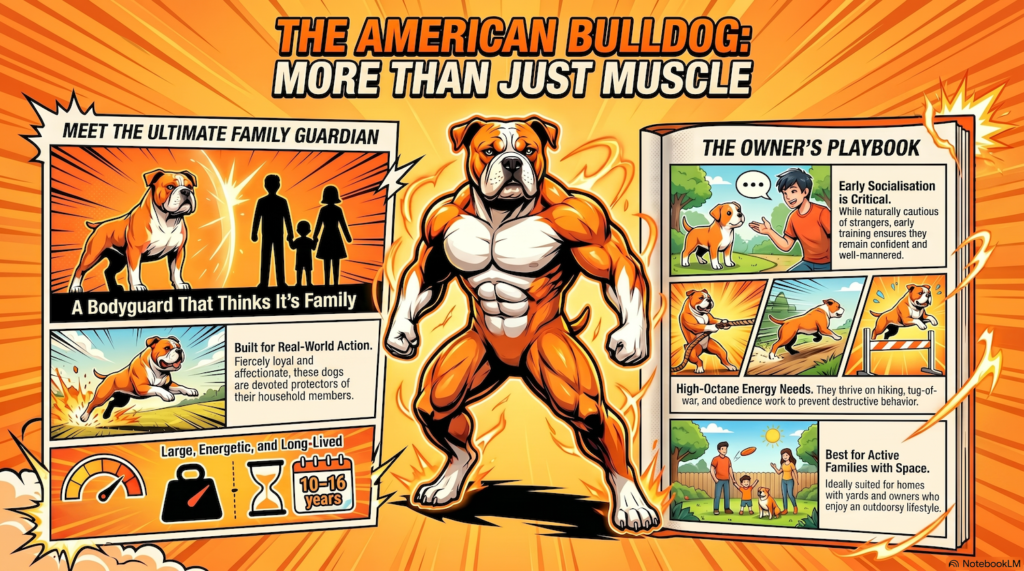
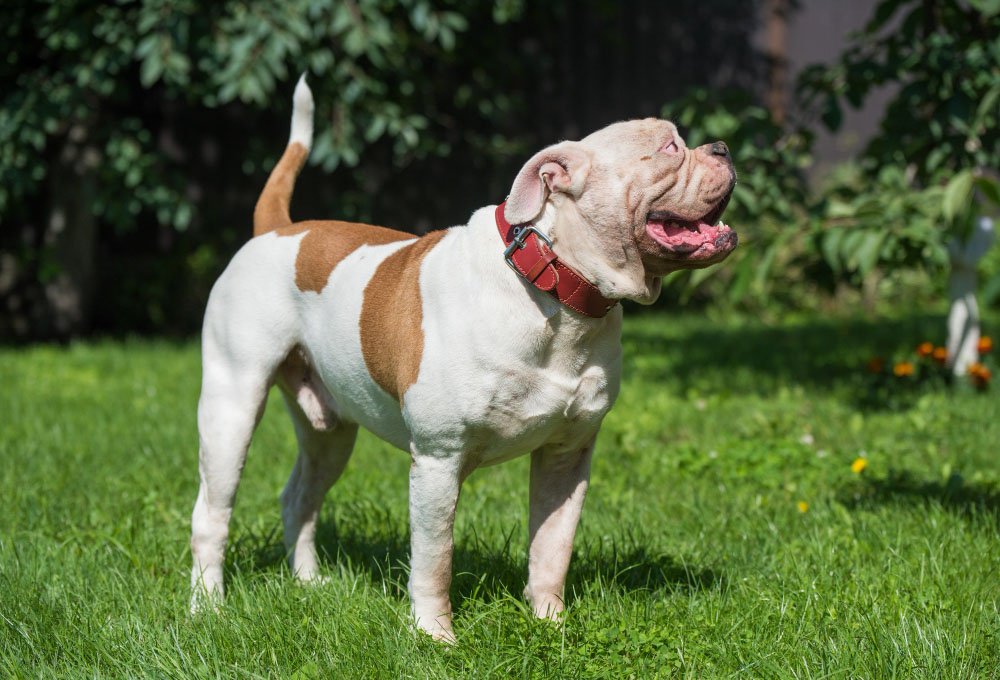
The American Bulldog is a muscular, athletic breed known for its strength, confidence, and devotion to its family. Originally developed as a working farm dog in the United States, it combines impressive physical ability with a surprisingly affectionate and people-oriented personality.
They are protective without being unnecessarily aggressive and thrive when given structure, training, and plenty of interaction with their family.
✅ PROS & CONS
Pros
- Extremely loyal and devoted
- Great family companion
- Intelligent and trainable
- Strong and athletic build
Cons
- Needs regular exercise and stimulation
- Can be strong-willed
- Requires early socialisation
- Large size may not suit all homes
Is an American Bulldog a Good Family Dog?
Yes, an American Bulldog can be an excellent family dog when properly bred, trained and socialised.
American Bulldogs are typically loyal, affectionate and strongly attached to their families. Despite their muscular appearance, many are playful, enthusiastic companions that enjoy being closely involved in everyday family life.
They can be very good with children, but their strength and exuberance mean supervision is important, particularly around younger kids.
Early socialisation and consistent training are essential because this is a large, powerful dog.
For the right household, the American Bulldog can combine the appearance of a formidable working dog with the personality of an oversized family companion.
How Much Exercise Does an American Bulldog Need?
A healthy adult American Bulldog generally needs around 60–90 minutes of exercise each day, although younger and more athletic individuals may need more.
Daily walks can be combined with training, games, hiking and other activities that challenge both body and mind.
American Bulldogs were developed as working farm dogs rather than sedentary companions, so they usually thrive when given something meaningful to do.
Exercise requirements vary somewhat between different bloodlines and body types. More athletic American Bulldogs can be surprisingly energetic.
Care is needed during hot weather, particularly with shorter-muzzled individuals, as overheating can become a concern.
Is an American Bulldog Easy to Train?
American Bulldogs are intelligent and capable of learning quickly, but their strength, confidence and occasional stubbornness mean consistent training is important.
Positive reinforcement works particularly well.
Training should begin while the dog is young, before an enthusiastic puppy develops into a powerful adult capable of physically ignoring poor leash manners.
Socialisation is equally important. Puppies should have controlled positive experiences with different people, animals, environments and everyday situations.
American Bulldogs often respond best when owners provide clear boundaries without relying on harsh training methods.
Teaching a 10-kilogram puppy not to pull is considerably easier than attempting the same negotiation when that puppy has become a 40-kilogram bulldozer.
Does an American Bulldog Shed?
Yes. American Bulldogs shed moderately throughout the year, although their short coat is relatively easy to maintain.
Weekly brushing with a grooming mitt or soft brush is usually enough to remove loose hair and keep the coat in good condition.
Seasonal increases in shedding can occur.
Their short coat doesn’t require trimming or complicated professional grooming.
Skin folds around the face, if present, should be checked and kept clean and dry. Nails, ears and teeth also require routine attention.
American Bulldogs aren’t considered hypoallergenic, and their short hairs have an impressive ability to attach themselves to clothing and furniture despite being considerably less dramatic than the shedding of a heavy double-coated breed.
What Health Problems Are Common in American Bulldogs?
American Bulldogs can be affected by several inherited health conditions, making responsible breeding and health screening important.
Hip and elbow dysplasia are significant concerns because of the breed’s size and powerful build.
Certain inherited eye disorders can occur, along with skin allergies and other dermatological problems.
Some lines are affected by neuronal ceroid lipofuscinosis (NCL), a serious inherited neurological disorder for which genetic testing is available.
American Bulldogs with shorter muzzles may also experience breathing difficulties, particularly during strenuous exercise or hot weather.
Maintaining a healthy body weight is particularly important because obesity places additional stress on joints and can worsen respiratory and mobility problems.
How Long Do American Bulldogs Live?
American Bulldogs typically live around 10–13 years, although individual lifespan varies.
Genetics, body condition, exercise, nutrition and preventive veterinary care can all influence longevity.
Keeping the dog lean and physically active can be particularly beneficial for joint health.
Regular veterinary examinations can also help identify problems before they become advanced.
As American Bulldogs age, exercise may need to become less intense, but they still benefit from regular walks, interaction and mental stimulation.
Many retain their playful personality well into their senior years.
Are American Bulldogs Aggressive?
A well-bred and properly socialised American Bulldog should not be indiscriminately aggressive, but the breed can be naturally confident, protective and territorial.
Their historical work required courage and determination, characteristics that remain evident in modern dogs.
Some American Bulldogs can be wary of unfamiliar people or assertive with other dogs.
Early socialisation is therefore essential.
Owners shouldn’t encourage aggressive behaviour in an attempt to make the dog more protective. Their size, strength and natural confidence already provide considerable deterrence.
Responsible ownership focuses on producing a dog that is stable, controllable and capable of making good decisions around unfamiliar situations.
Are American Bulldogs Good With Other Dogs?
American Bulldogs can live successfully with other dogs, particularly when raised and socialised appropriately.
However, dog-to-dog aggression or intolerance can occur in some individuals, especially as they reach social maturity.
Compatibility depends on temperament, sex, upbringing and the personalities of the individual dogs.
Careful introductions are important when bringing another dog into the household.
Owners should also recognise that puppy friendliness doesn’t guarantee an adult dog will enjoy every unfamiliar dog it meets.
Because American Bulldogs are extremely strong, developing calm behaviour around other dogs should be an important part of early training.
Are American Bulldogs Good With Cats?
Some American Bulldogs can live successfully with cats, particularly when raised alongside them from puppyhood.
However, prey drive varies considerably between individuals.
American Bulldogs historically performed several types of farm work, including catching and controlling livestock and dealing with unwanted animals.
Rapid movement from a cat or smaller animal can therefore trigger chasing behaviour in some dogs.
A Bulldog that peacefully shares its home with a familiar cat may still chase an unfamiliar cat outdoors.
Introductions should be gradual and supervised, and smaller pets should be carefully protected.
Can an American Bulldog Live in an Apartment?
An American Bulldog can live in an apartment if provided with sufficient daily exercise, although its size and strength can make a larger home more convenient.
Many adult American Bulldogs are reasonably relaxed indoors after their exercise requirements have been met.
The bigger challenges are providing adequate physical activity, training and mental stimulation.
Apartment residents also need to consider shared corridors, lifts and other situations where the dog may frequently encounter unfamiliar people and animals at close range.
A garden is useful but isn’t essential.
Likewise, owning a large backyard doesn’t compensate for never taking the dog anywhere.
What Is the Difference Between an American Bulldog and an American Bully?
The American Bulldog and American Bully are separate breeds with different development histories and breed standards.
The American Bulldog descends from working bulldog-type dogs brought to the United States, particularly the American South. It was maintained largely as a versatile farm and catch dog.
The American Bully was developed much more recently, beginning in the United States during the late 20th century using several bull-type breeds.
American Bullies are generally bred primarily as companion dogs and occur in several recognised size varieties depending on the registry.
The names sound similar, and individual dogs can sometimes look similar, but American Bulldog and American Bully aren’t interchangeable terms.
What Is the Difference Between an American Bulldog and an English Bulldog?
American Bulldogs are generally taller, more athletic and more traditionally working-oriented than modern English Bulldogs.
Both ultimately share bulldog-type ancestry, but their development moved in very different directions.
The American Bulldog remained associated with farm work in the United States, where athletic ability, strength and functional movement were important.
The modern English Bulldog became considerably shorter, heavier-set and more exaggerated in appearance through selective breeding.
American Bulldogs usually have longer legs and a less extremely shortened muzzle.
Although they’re relatives within the broader bulldog family, seeing them standing side by side makes it clear that they’ve travelled very different paths from their common ancestry.
What Were American Bulldogs Originally Bred to Do?
American Bulldogs developed as versatile working farm dogs in the United States, particularly in the South.
Their ancestors accompanied immigrants to North America and were used for practical jobs including guarding property, handling livestock and catching difficult animals.
One particularly important role was controlling feral pigs, which could damage crops and threaten livestock.
These jobs required strength, courage, athletic ability and determination.
The breed wasn’t originally developed primarily for appearance.
A useful American Bulldog needed to be physically capable of doing demanding work.
That heritage explains why today’s American Bulldog can look like a heavyweight while still possessing surprising speed and athleticism.
What Are Johnson and Scott American Bulldogs?
“Johnson” and “Scott” are terms associated with two influential lines in the modern development of the American Bulldog.
After World War II, the breed’s numbers had declined substantially. Breeders including John D. Johnson and Alan Scott played important roles in preserving and developing American Bulldogs.
Johnson-type dogs became associated with a heavier, more substantial build and often a shorter muzzle.
Scott-type dogs were generally more athletic and performance-oriented, sometimes referred to as Standard or Performance types.
Modern breeding has produced considerable overlap, and many American Bulldogs combine ancestry from different lines.
These aren’t different breeds.
They’re better understood as different types within the broader American Bulldog population.
Is the American Bulldog the Same as a Pit Bull?
No. The American Bulldog is not the same breed as the American Pit Bull Terrier, although both belong to the broader family of bull-type dogs and can sometimes be confused visually.
American Bulldogs are generally larger and heavier and developed primarily from working bulldog-type dogs used on American farms.
The American Pit Bull Terrier has a different breed history and typically has a lighter, more compact athletic build.
Breed identification based purely on appearance can be unreliable, particularly with mixed-breed dogs.
This distinction can also matter legally because some jurisdictions regulate particular breeds or types of dogs.
Owners should therefore check the rules applying where they live rather than assuming that all muscular, short-coated dogs are classified in the same way.