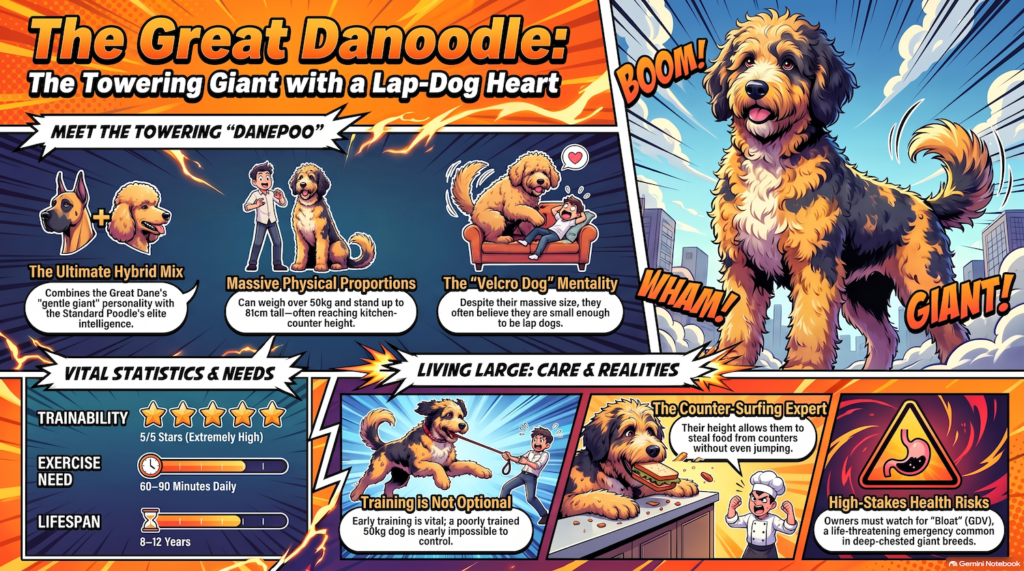





Gentle, intelligent, and impossible to overlook — the Great Danoodle combines the enormous but affectionate Great Dane with the clever and athletic Standard Poodle to create a truly impressive family companion.
🧠 QUICK SNAPSHOT
- Temperament: Affectionate, intelligent, gentle
- Energy Level: Moderate to High
- Size: Giant
- Good With Families: Yes
- Trainability: High
- Grooming: Moderate to High
- Best For: Families, active owners, homes with plenty of space
📚 OVERVIEW
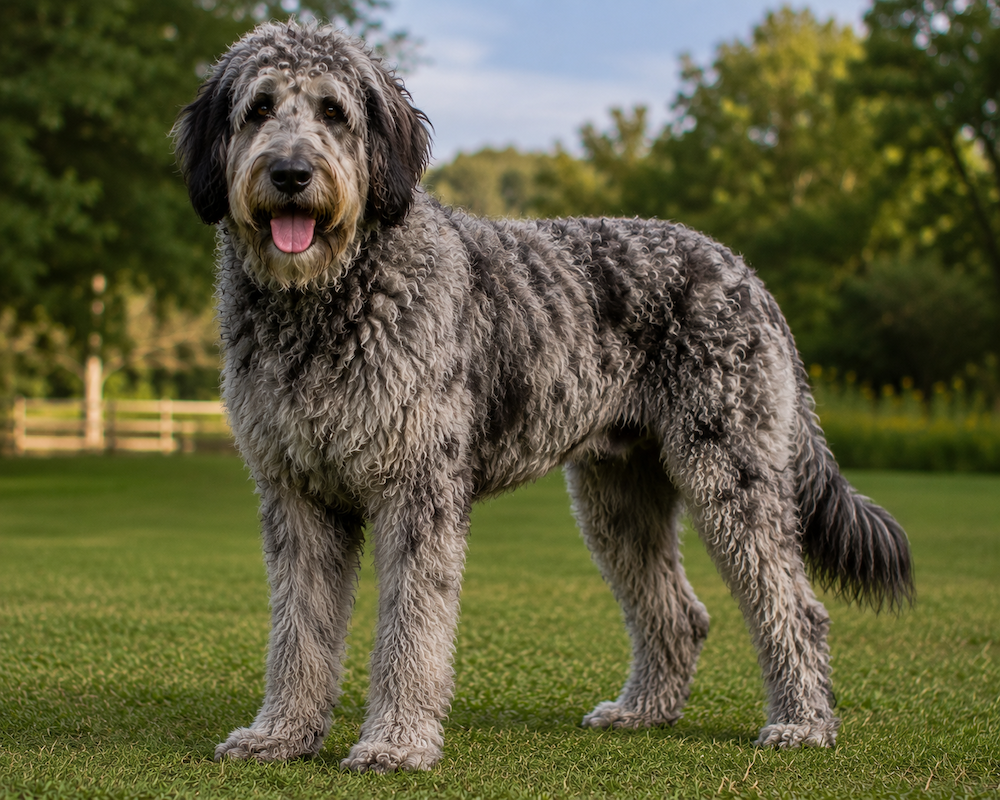
The Great Danoodle, sometimes called the Great Danepoo, is a designer crossbreed created by combining the enormous Great Dane with the highly intelligent Standard Poodle. The result is typically a large or giant dog that blends the Great Dane’s affectionate, easy-going personality with the Poodle’s intelligence, athleticism, and potentially lower-shedding coat.
Great Danoodles can vary considerably in appearance. Some develop loose waves or curls, while others inherit a shorter, straighter coat. Their size can also vary significantly, although prospective owners should be prepared for a very large adult dog. Temperament may differ between individuals, but well-bred Great Danoodles are generally affectionate, playful, people-focused, and highly trainable.
Despite their imposing size, many Great Danoodles think of themselves as lap dogs and want to remain close to their owners. They are best suited to households capable of providing sufficient space, early training, regular exercise, and plenty of companionship.
✅ PROS & CONS
Pros
- Gentle and affectionate with family
- Highly intelligent and trainable
- Usually excellent with children
- Playful and people-oriented
- Some inherit a lower-shedding coat
Cons
- Giant size requires plenty of space
- Grooming requirements can be substantial
- Expensive to feed and maintain
- Can suffer from separation anxiety
- Potential for serious large-breed health conditions
Is a Great Danoodle a Good Family Dog?
Yes, the Great Danoodle can be an excellent family dog when responsibly bred, socialised, and trained. Both parent breeds are known for forming close relationships with people, and Great Danoodles are typically affectionate companions that want to be involved in everyday family life.
They generally enjoy living with respectful children and can make enthusiastic playmates. However, their enormous size means even a friendly dog can accidentally knock over a small child, so supervision is essential. Great Danoodles can also live successfully with other dogs and cats, particularly when introduced to them early.
These dogs tend to thrive on companionship rather than independence. A Great Danoodle that spends most of its life isolated from its family is unlikely to be happy. For households with enough room, time for training, and a desire for a large dog that genuinely wants to be part of the family, the Great Danoodle can be a wonderfully devoted companion.
How Much Exercise Does a Great Danoodle Need?
An adult Great Danoodle generally needs around 60 to 90 minutes of exercise each day, although individual requirements vary according to size, age, health, and which parent it most resembles. Most enjoy being active without requiring constant high-intensity exercise.
Daily walks, swimming, hiking, retrieving games, and supervised play provide excellent outlets for their energy. The Poodle influence can produce a surprisingly athletic dog, so prospective owners shouldn’t assume that enormous size automatically means low energy.
Exercise requires particular care during puppyhood. Great Danoodles can grow extremely quickly, and repeated jumping, forced running, or excessive high-impact exercise should be avoided while bones and joints are developing.
Mental exercise is equally valuable. Training, puzzle feeders, scent games, and problem-solving activities help satisfy the intelligence inherited from the Poodle and create a calmer companion around the home.
Is a Great Danoodle Easy to Train?
Yes, most Great Danoodles are relatively easy to train because they combine the Poodle’s exceptional intelligence with the Great Dane’s generally cooperative temperament. However, early training is essential because an untrained giant dog can become extremely difficult to manage regardless of how friendly it is.
Positive reinforcement using food rewards, praise, toys, and play usually produces excellent results. Puppies should learn loose-lead walking, recall, polite greetings, and basic obedience before they reach their enormous adult size.
Early socialisation is equally important. Positive exposure to different people, dogs, sounds, surfaces, environments, and everyday situations helps create a confident adult.
The Great Danoodle can also become bored if training consists solely of repetitive commands. Introducing tricks, scent games, and problem-solving activities keeps lessons interesting and makes excellent use of the breed’s intelligence.
Does a Great Danoodle Shed?
A Great Danoodle’s shedding level can range from low to moderate or higher, depending on the coat inherited from its parents. A curly Poodle-type coat may shed relatively little, while a straighter Great Dane-type coat can release noticeably more hair.
Lower shedding does not necessarily mean lower maintenance. Curly and wavy coats need thorough brushing several times each week because loose hairs can remain trapped within the coat and create mats. Many Great Danoodles also require professional grooming approximately every six to eight weeks.
Straighter-coated individuals are usually easier to brush but may leave more hair around the home. Regular nail trimming, dental care, and ear checks are also important.
Great Danoodles should not automatically be described as hypoallergenic. No breeder can reliably guarantee that a mixed-breed puppy will inherit the Poodle’s coat or be suitable for someone with dog allergies.
What Health Problems Are Common in a Great Danoodle?
Great Danoodles can inherit health conditions found in either Great Danes or Standard Poodles, making comprehensive health testing of both parents particularly important. Their large size also introduces additional orthopaedic and developmental considerations.
Potential concerns include hip dysplasia, elbow dysplasia, certain heart conditions, and inherited eye disorders. One particularly important risk is gastric dilatation-volvulus (GDV or bloat), a life-threatening emergency associated with large, deep-chested dogs. Owners should discuss GDV risk and preventative options with their veterinarian.
Great Danes unfortunately have shorter average lifespans than many breeds, so crossing one with a Poodle does not guarantee a longer-lived dog. Prospective owners should ask breeders for documented health screening rather than relying on claims of “hybrid vigour.”
Keeping a Great Danoodle lean, providing age-appropriate exercise, feeding a nutritionally balanced diet, and arranging regular veterinary care can help support long-term health. Depending on genetics and size, a Great Danoodle may live approximately 8 to 13 years, although individual lifespan can vary considerably.