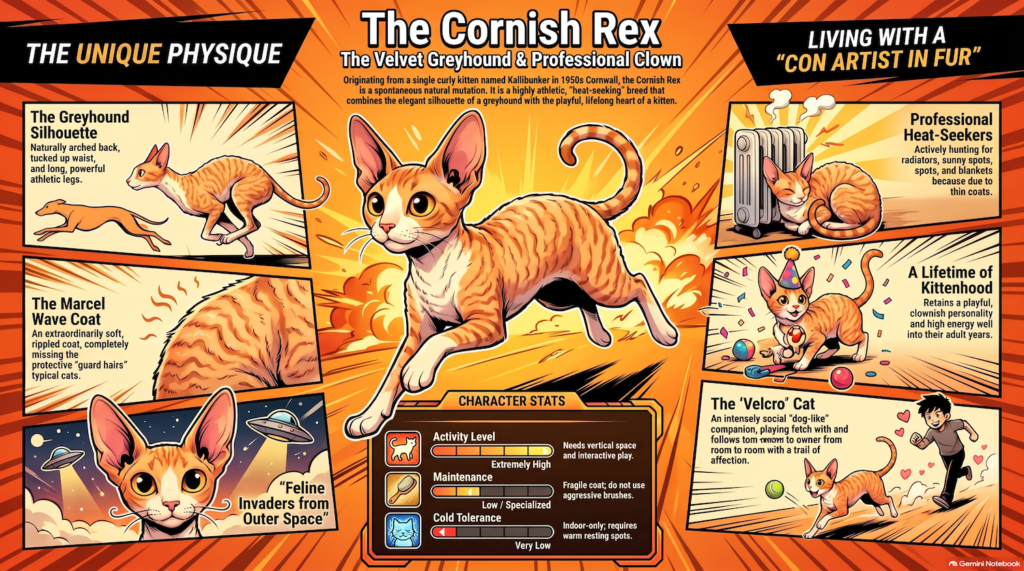
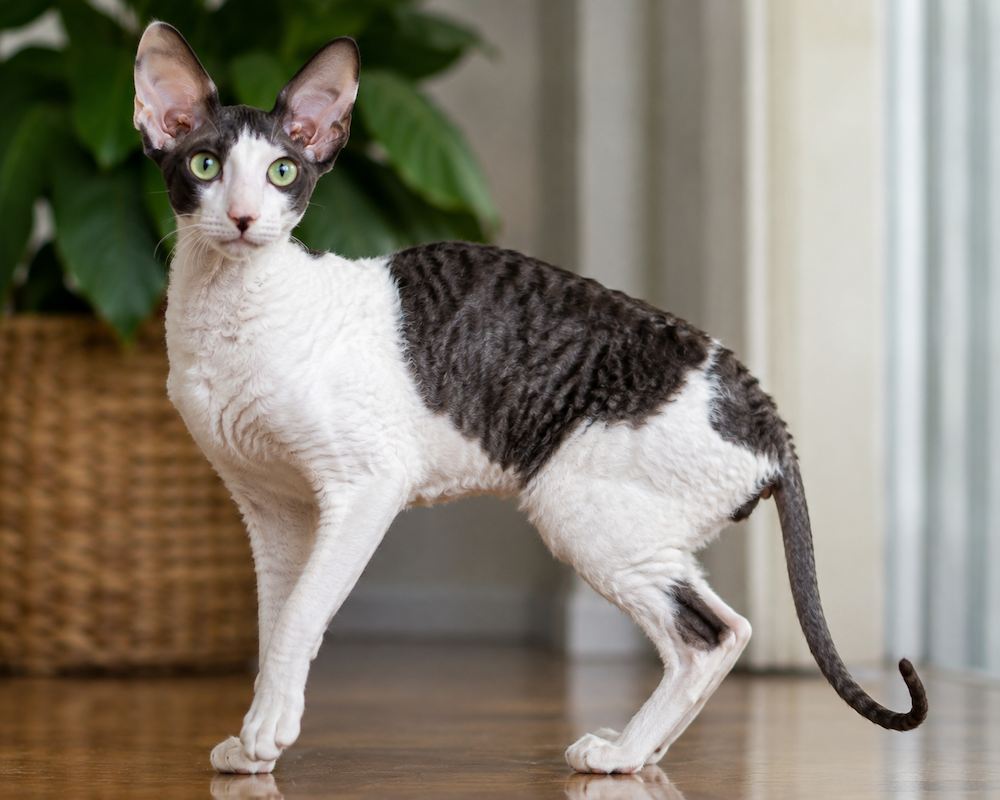







Curly-coated, energetic, and endlessly entertaining — the Cornish Rex is an extraordinary British cat with huge ears, a slender athletic body, and a mischievous personality that often remains kitten-like well into adulthood.
🧠 QUICK SNAPSHOT
- Temperament: Affectionate, playful, outgoing
- Energy Level: High
- Size: Small to Medium
- Good With Families: Excellent
- Indoor Living: Excellent with sufficient enrichment
- Trainability: Very High
- Grooming: Low
- Best For: Families, apartment homes, active owners, multi-pet households
- Typical Lifespan: Around 12–16 years
📚 OVERVIEW
The Cornish Rex is one of the most instantly recognisable cats in the world. Its enormous ears, egg-shaped head, arched body, long legs, and extraordinarily soft wavy coat give it an appearance unlike almost any conventional domestic cat.
The breed began in Cornwall, England, in 1950, when an unusual curly-coated kitten named Kallibunker was born in a litter of otherwise ordinary farm cats. Breeding demonstrated that his unusual coat resulted from a spontaneous genetic mutation, and Kallibunker became the foundation of the Cornish Rex breed.
Unlike most cats, which have different layers of guard hairs, awn hairs, and down, the Cornish Rex coat consists predominantly of the exceptionally fine undercoat or down hairs. These form the characteristic waves that run across the body and make the coat feel remarkably soft.
But the unusual coat isn’t even the whole story.
Cornish Rex cats are famously active, intelligent, affectionate, and mischievous. Many retain a remarkably playful temperament throughout adulthood and actively seek interaction with their owners.
✅ PROS & CONS
Pros
- Exceptionally affectionate and people-oriented
- Highly playful and entertaining
- Very intelligent and trainable
- Minimal coat grooming
- Excellent indoor and apartment cat
- Often enjoys living with other social pets
Cons
- Needs substantial interaction and stimulation
- Can become mischievous when bored
- Doesn’t enjoy prolonged isolation
- Feels the cold more than heavily coated breeds
- Skin and coat require gentle handling
- Not truly hypoallergenic
Is a Cornish Rex a Good Family Cat?
Yes, the Cornish Rex is generally an excellent family cat, particularly for households wanting an energetic and highly interactive companion. These cats are typically affectionate, outgoing, and enthusiastic about participating in whatever their humans are doing.
Cornish Rex cats often get along extremely well with respectful children. Their playful temperament can make them entertaining companions for children who enjoy games, provided the cat is handled gently.
They can also thrive in multi-pet households. Another playful cat can provide valuable companionship, and many Cornish Rex cats adapt successfully to living with cat-friendly dogs after appropriate introductions.
This breed generally doesn’t want to spend its life quietly observing the household from another room. Many Cornish Rex cats follow their owners around, seek warm laps, climb onto shoulders, and repeatedly initiate games.
For families wanting an affectionate cat with an enormous personality packed into a relatively small body, the Cornish Rex can be an outstanding choice.
Can a Cornish Rex Live Indoors or in an Apartment?
Yes, the Cornish Rex is very well suited to indoor and apartment living, provided it receives enough exercise, climbing opportunities, mental enrichment, and companionship.
Its relatively small size means enormous amounts of floor space aren’t necessary, but vertical space is extremely valuable. Tall cat trees, shelves, window perches, scratching towers, and other safe elevated areas allow this agile breed to climb and jump.
Indoor living has another particular advantage for the Cornish Rex: temperature control.
Its extremely fine coat provides less insulation than the coats of most cats, making the breed more sensitive to cold conditions. Warm sleeping areas and protection from extreme temperatures are important.
Owners can supplement indoor life with a secure cat enclosure or appropriately introduced harness adventures.
The Cornish Rex can therefore make an excellent apartment cat, but “apartment friendly” shouldn’t be confused with “inactive.” This little athlete still needs plenty to do.
How Much Exercise and Play Does a Cornish Rex Need?
The Cornish Rex is a high-energy cat that needs plenty of daily play and mental stimulation. Several interactive sessions spread throughout the day are ideal, and young cats may appear ready to play whenever anyone is willing to participate.
Fishing-wand toys, balls, tunnels, climbing structures, chasing games, and toys that encourage jumping can all help satisfy its athletic instincts.
Many Cornish Rex cats enjoy retrieving toys and can become surprisingly enthusiastic about games of fetch. Their intelligence also makes puzzle feeders, clicker training, treat hunts, and trick training excellent forms of enrichment.
Don’t underestimate their jumping ability. The breed’s slender appearance hides powerful muscles and long legs capable of launching a Cornish Rex onto surprisingly high surfaces.
Without enough stimulation, these clever cats may simply create their own entertainment — potentially involving cupboards, shelves, desks, and possessions their owners had assumed were safely out of reach.
Is a Cornish Rex Easy to Train?
Yes, the Cornish Rex is highly trainable and often enjoys learning because training provides exactly what it likes most: mental stimulation, rewards, and interaction with people.
Positive reinforcement can be used to teach behaviours such as coming when called, sitting, retrieving toys, giving a paw, entering a carrier voluntarily, and walking on a harness.
Clicker training can work particularly well because it gives the cat an immediate signal when it performs the desired behaviour.
Practical training is valuable too. Teaching a Cornish Rex to accept nail trimming, dental checks, carrier travel, and gentle body handling can make routine care considerably easier.
Short, enthusiastic training sessions generally work better than long repetitive ones. Punishment should be avoided.
The Cornish Rex’s intelligence has a downside: it can also learn how cupboards open, where treats are stored, and which behaviours reliably get its owner’s attention.
Living with one can occasionally feel like negotiating with a very athletic little problem solver.
Does a Cornish Rex Shed?
Yes, but the Cornish Rex generally sheds considerably less visibly than many conventionally coated cats because its unusual coat consists primarily of fine down hairs.
The breed lacks the typical outer guard hairs that make up much of the visible shedding from ordinary cat coats.
Surprisingly, this doesn’t mean the Cornish Rex needs frequent brushing. Its delicate hairs can be damaged by excessive grooming, so gentle handling is preferable. Often, stroking with the hands or using an exceptionally soft grooming method is sufficient.
Some individuals can develop oily skin because there is less hair to absorb natural skin oils, making occasional bathing necessary. The ears and paws can also accumulate oils and may need appropriate cleaning.
The Cornish Rex is often described online as hypoallergenic, but this is misleading. Cat allergens are primarily proteins found in saliva and skin secretions, so even a cat that sheds very little can still trigger an allergic reaction.
What Health Problems Are Common in a Cornish Rex?
The Cornish Rex is generally a healthy breed, but several inherited and breed-associated conditions deserve attention.
Hypertrophic cardiomyopathy (HCM), involving abnormal thickening of the heart muscle, can occur in cats and has been reported within Cornish Rex populations. Responsible breeders should understand heart health within their lines and follow appropriate veterinary screening recommendations.
Patellar luxation, where the kneecap moves out of its normal position, can also occur. Certain inherited eye conditions may be relevant within particular breeding lines.
Because of its fine coat, the Cornish Rex can be more susceptible to temperature extremes and skin problems than more heavily coated cats. Excessive sun exposure can also damage poorly protected skin.
Responsible breeding, regular veterinary examinations, good dental care, appropriate nutrition, weight management, and early investigation of unusual symptoms all contribute to long-term wellbeing.
With good care, many Cornish Rex cats live approximately 12–16 years, and some reach considerably older ages.
⭐ Why Is the Cornish Rex’s Coat Curly?
The Cornish Rex’s curls originated with one remarkable kitten.
In 1950, a curly-coated male kitten named Kallibunker was born on a farm in Cornwall, England. His unusual appearance resulted from a spontaneous genetic mutation affecting the structure of his coat.
Most cats have three principal types of hair: longer protective guard hairs, intermediate awn hairs, and soft down hairs.
The Cornish Rex lacks the conventional outer layers and is covered predominantly by exceptionally fine down hairs. Instead of lying straight, these hairs form characteristic tight waves across the body.
The mutation responsible is recessive, meaning a kitten needs to inherit the relevant gene from both parents to display the Cornish Rex coat.
That single genetic quirk created one of the most distinctive textures in the cat world.
And despite the name “Rex,” the Cornish Rex isn’t related to a tiny dinosaur — the term was borrowed from curly-coated rabbits where “Rex” had already become associated with unusual coat texture.
⭐ Is the Cornish Rex the Same as the Devon Rex?
No. They may both be curly-coated British cats with enormous ears, but the Cornish Rex and Devon Rex developed from different genetic mutations.
The Cornish Rex originated in Cornwall in 1950.
A curly-coated cat later discovered in neighbouring Devon initially appeared as though it might provide another breeding line for the Cornish Rex. When breeders crossed the cats, however, the resulting kittens had normal coats.
That unexpected result demonstrated something fascinating: the two curly coats were caused by different recessive genes.
The Devon Rex subsequently became a separate breed.
Their appearances also differ. The Cornish Rex generally has a longer, more elegant body and an egg-shaped head, while the Devon Rex has a shorter face and a distinctly pixie-like appearance.
So Britain didn’t produce one curly-cat mutation.
It produced two completely separate ones, in neighbouring counties, within little more than a decade.