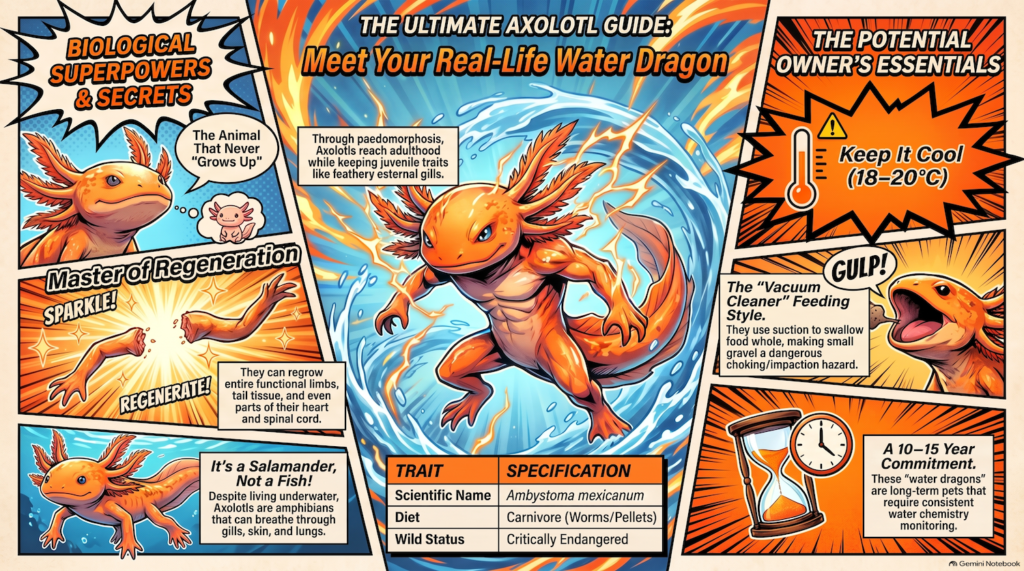
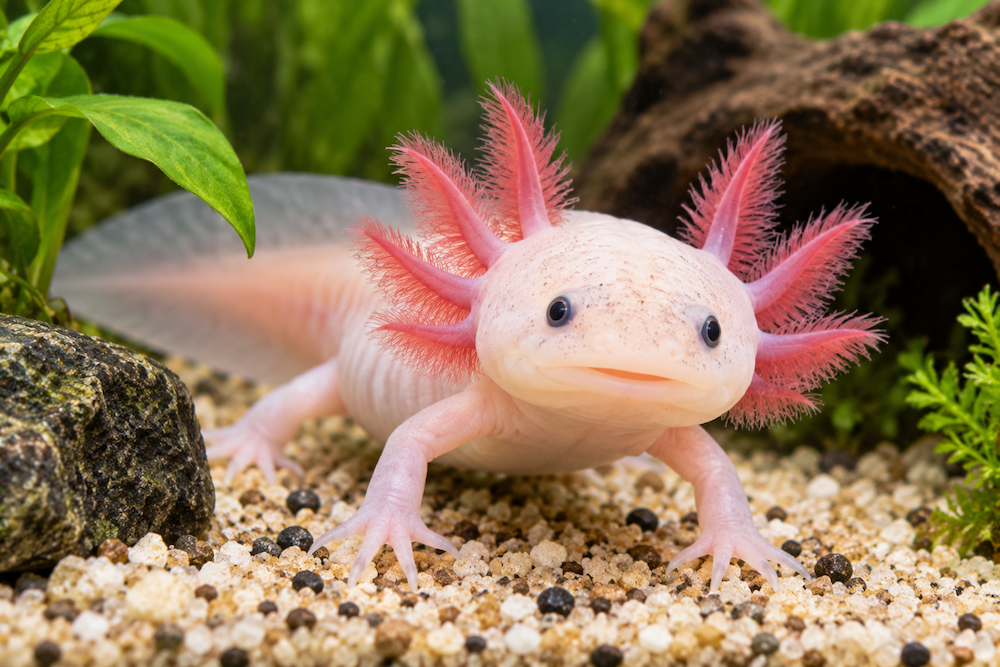







Part salamander, part underwater alien and permanently youthful in appearance, the Axolotl is one of the strangest pets on Earth — famous for its feathery gills and extraordinary ability to regenerate lost body parts.
🧠 QUICK SNAPSHOT
- Scientific Name: Ambystoma mexicanum
- Animal Type: Amphibian / salamander
- Origin: Mexico
- Adult Size: Usually around 20–30 cm
- Typical Lifespan: Around 10–15 years in good captive conditions
- Temperament: Quiet, solitary, generally non-aggressive
- Activity: Mostly aquatic; often most active during lower-light periods
- Housing: Fully aquatic, cool freshwater aquarium
- Ideal Water Temperature: Roughly 16–18°C
- Diet: Carnivorous
- Handling: Best avoided except when necessary
- Difficulty: Intermediate — water quality and temperature are critical
- Best For: Aquarists prepared to maintain cool, stable, high-quality water
- Special Feature: Extraordinary regenerative abilities
📚 OVERVIEW
The Axolotl looks like something invented for a fantasy film, but this extraordinary amphibian is very real — and far more unusual than its famous smiling face suggests.
Axolotls are salamanders native to the waterways of the Valley of Mexico. Unlike most salamanders, they normally remain aquatic throughout their lives and retain juvenile characteristics such as their spectacular external gills. This phenomenon is called neoteny.
Those three feathery structures extending from either side of the head aren’t decorative. They’re external gills used for respiration.
Axolotls are also famous among scientists because they can regenerate damaged tissues and complex structures, including limbs and parts of several organs, without the same kind of scarring humans experience.
Unfortunately, the wild Axolotl is in serious trouble. Habitat destruction, pollution and introduced species have pushed wild populations towards extinction, even while captive Axolotls have become increasingly popular around the world.
As pets, they’re fascinating but aren’t as easy as their motionless appearance suggests. They require cool, carefully maintained water, an appropriately cycled aquarium, suitable food and minimal handling.
✅ PROS & CONS
Pros
- Extraordinary and unusual appearance
- Completely aquatic
- Generally quiet
- Doesn’t require walking or conventional exercise
- Fascinating natural behaviour
- Available in several striking captive colour forms
- Can live for more than a decade with good care
- Relatively straightforward feeding once properly established
- Doesn’t require social companionship
- One of the world’s most scientifically fascinating amphibians
Cons
- Water quality must be carefully maintained
- Requires a fully cycled aquarium
- Very sensitive to excessive heat
- Aquarium cooling may be necessary in warm climates
- Handling should be minimised
- Small gravel can cause dangerous impaction
- Tank mates can injure their delicate gills
- Produces more waste than its calm behaviour might suggest
- Requires access to an exotic or amphibian-experienced veterinarian
- Ownership is restricted or prohibited in some locations
- Not a cuddly or interactive pet in the traditional sense
Is an Axolotl a Good Pet?
An Axolotl can be an excellent pet for someone interested in aquarium animals, but it isn’t ideal for everyone.
Axolotls are fascinating to observe and relatively quiet, but their water requirements are demanding.
Maintaining appropriate temperature, ammonia, nitrite, nitrate and other water parameters is essential.
They’re much better suited to someone who enjoys maintaining an aquarium ecosystem than someone looking for an animal they can regularly hold and interact with physically.
Is an Axolotl a Fish?
No. An Axolotl is an amphibian, specifically a type of salamander.
Its fully aquatic lifestyle and external gills make it look somewhat fish-like, but biologically it belongs with salamanders and newts.
The scientific name is Ambystoma mexicanum.
Is an Axolotl a Salamander?
Yes. The Axolotl is a salamander belonging to the family Ambystomatidae, commonly known as mole salamanders.
What makes it extraordinary is that it normally retains several juvenile characteristics throughout adulthood.
Most closely related salamanders transform into terrestrial adults.
Axolotls generally don’t.
Where Do Axolotls Come From?
Axolotls are native to the Valley of Mexico, particularly the lake and wetland system associated with Xochimilco near Mexico City.
Historically they also inhabited Lake Chalco.
Urban development radically altered these ancient lake systems, leaving wild Axolotls restricted to a dramatically smaller habitat.
Are Axolotls Endangered?
Yes. Wild Axolotls are considered Critically Endangered.
Habitat destruction, urbanisation, water pollution and introduced fish have all contributed to their decline.
This creates one of the strangest conservation situations in the animal world.
Millions of people recognise Axolotls, and large numbers exist in captivity, yet the wild animal is perilously close to disappearing from its natural habitat.
Are Pet Axolotls the Same as Wild Axolotls?
They’re the same species, but captive populations have been selectively bred for generations and can differ substantially in appearance and genetic background.
Wild Axolotls are generally dark, mottled animals that blend into their environment.
Captive breeding has produced leucistic, albino, golden and other colour forms.
Captive Axolotls should never be released into natural waterways.
How Big Does an Axolotl Get?
Adult Axolotls commonly reach around 20–30 cm long, although individuals can fall outside this range.
Females often develop broader bodies, particularly when carrying eggs.
Their long tails account for a substantial proportion of total body length.
Despite looking tiny in pet-shop aquariums, young Axolotls have considerable growing to do.
How Long Do Axolotls Live?
With good care, Axolotls commonly live around 10–15 years.
Some individuals may live longer.
Water quality, temperature, nutrition and genetics all influence longevity.
An Axolotl therefore represents a much longer commitment than many people expect from an aquarium animal.
What Size Tank Does an Axolotl Need?
An adult Axolotl requires a large aquarium with plenty of horizontal floor space.
For a single adult, many experienced keepers recommend starting around 75 litres or larger, with larger tanks generally making water quality easier to stabilise.
Floor area is particularly valuable because Axolotls spend most of their time near the bottom.
A bigger aquarium also dilutes waste more effectively.
Do Axolotls Need a Cycled Tank?
Yes. An Axolotl should be placed into a properly cycled aquarium.
The nitrogen cycle allows beneficial bacteria to convert toxic ammonia from animal waste first into nitrite and then into less toxic nitrate.
Both ammonia and nitrite should remain at zero in an established aquarium.
Putting an Axolotl into an uncycled tank can expose it to dangerous concentrations of toxic waste.
What Temperature Should an Axolotl Tank Be?
Axolotls require cool water, with approximately 16–18°C often considered an excellent target range.
Prolonged temperatures above roughly 20°C can cause stress and increase susceptibility to disease.
Temperatures around 24°C or higher can become dangerous.
This is particularly important for owners living in warm climates.
Aquarium chillers may be necessary where room temperature can’t reliably keep the water cool.
Do Axolotls Need a Heater?
Usually not.
Unlike tropical aquarium animals, Axolotls require cool water.
In many homes, the challenge isn’t heating the aquarium but keeping it sufficiently cool.
A heater should only be used if conditions are unusually cold and water temperatures fall below an appropriate range.
Do Axolotls Need an Aquarium Chiller?
An aquarium chiller may be necessary if the tank regularly becomes too warm.
Whether one is required depends on local climate, room temperature and aquarium setup.
Fans can sometimes reduce water temperature through evaporation, but they’re less effective in hot or humid environments.
In warm regions, a reliable aquarium chiller can be one of the most important pieces of Axolotl equipment.
Do Axolotls Need a Filter?
Yes. Axolotls benefit from effective biological filtration, but they generally dislike strong water currents.
A filter should therefore provide adequate waste processing without creating excessive flow.
Sponge filters and appropriately adjusted aquarium filters are commonly used.
Even with filtration, regular partial water changes remain necessary.
Why Do Axolotls Hate Strong Water Flow?
Axolotls evolved in relatively slow-moving lake and canal environments rather than fast-flowing rivers.
Strong currents can create chronic stress.
Signs can include difficulty settling, excessive movement or gills appearing curled forward.
Filters should therefore provide good biological filtration without turning the aquarium into a washing machine.
What Water Parameters Do Axolotls Need?
Axolotls require clean, dechlorinated, stable freshwater.
In a properly cycled tank, ammonia and nitrite should remain at zero, while nitrate should be controlled through regular water changes.
pH should remain reasonably stable rather than constantly being manipulated.
Owners should use a reliable liquid test kit and understand the aquarium nitrogen cycle before bringing an Axolotl home.
Can Axolotls Live in Tap Water?
They can live in appropriately treated tap water if the water chemistry is suitable.
Tap water containing chlorine or chloramine must be treated with an aquarium water conditioner before exposure.
Water should also be temperature-matched appropriately during changes.
Local water chemistry varies, so owners need to test rather than assume their tap water is automatically suitable.
Do Axolotls Need Light?
Axolotls don’t require bright aquarium lighting.
They have sensitive eyes and no eyelids, so intense illumination can be stressful.
Low lighting combined with shaded areas and hides is generally preferable.
If aquarium lights are used for plants or viewing, they shouldn’t leave the Axolotl with nowhere to escape the brightness.
Do Axolotls Have Eyelids?
No. Axolotls don’t have movable eyelids.
This is one reason strong aquarium lighting can be uncomfortable.
Their exposed eyes contribute to the unusual juvenile appearance that makes them instantly recognisable.
Do Axolotls Need Hiding Places?
Yes. Axolotls should have secure, dark hiding places where they can retreat.
Caves, appropriately sized pipes and aquarium-safe hides can work well.
Every Axolotl should have access to shelter.
Hides are particularly important in tanks with lighting because they allow the animal to escape bright conditions.
What Substrate Is Safe for an Axolotl?
Bare-bottom tanks and very fine sand are commonly used for Axolotls.
Young animals are often kept on bare bottoms until they’re larger.
Any substrate needs to be considered carefully because Axolotls can accidentally swallow material while feeding.
Large stable rocks can sometimes be used if they’re far too large to fit into the animal’s mouth.
Why Is Gravel Dangerous for Axolotls?
Small gravel can be accidentally swallowed while an Axolotl eats.
If pieces can’t pass through the digestive system, they may cause intestinal obstruction or impaction.
This can become life-threatening.
The Axolotl’s tendency to suddenly vacuum food into its mouth makes loose mouth-sized stones particularly risky.
What Do Axolotls Eat?
Axolotls are carnivores.
Earthworms are widely considered an excellent staple food for adults because they provide good nutrition.
High-quality Axolotl or salamander pellets can also be useful.
Depending on age and circumstances, appropriate aquatic worms and other suitable foods may be offered.
Diet should be based on nutritionally complete foods rather than relying heavily on treats.
Can Axolotls Eat Earthworms?
Yes. Earthworms are generally considered one of the best staple foods for adult Axolotls.
They’re nutritious, readily accepted by many individuals and resemble the type of soft-bodied prey salamanders naturally consume.
Large worms can be cut into smaller pieces when necessary.
Worms should come from safe sources without pesticide or chemical exposure.
Can Axolotls Eat Fish?
Small fish can form part of a wild Axolotl’s diet, but live feeder fish aren’t generally recommended as a routine captive food.
They can introduce parasites or disease, may nip the Axolotl’s gills and aren’t necessarily nutritionally balanced.
Earthworms and appropriate formulated foods are generally safer staples.
Can Axolotls Eat Meat From the Kitchen?
Human meats such as beef or chicken shouldn’t be the regular foundation of an Axolotl’s diet.
They aren’t nutritionally equivalent to appropriate whole-prey or formulated amphibian foods.
Occasional feeding practices vary among keepers, but a diet centred around earthworms and suitable pellets is generally more appropriate.
How Often Should You Feed an Axolotl?
Young Axolotls require more frequent feeding than adults.
Healthy adults are commonly fed several times each week, with frequency adjusted according to age, body condition, food type and veterinary advice.
Overfeeding can contribute to obesity and poor water quality.
Uneaten food should be removed promptly.
Do Axolotls Have Teeth?
Yes, but their teeth are tiny and relatively simple.
Axolotls don’t chew food like mammals.
Instead, they rapidly open their mouths and create suction that pulls prey inside.
The small teeth help grip food rather than tear it into pieces.
Can an Axolotl Bite You?
An Axolotl can attempt to bite, particularly if it mistakes a finger for food, but its tiny teeth aren’t designed to inflict serious injuries on humans.
The greater concern is usually the Axolotl.
Human hands can damage its delicate skin and protective mucus layer.
Feeding tongs can be useful for offering food without unnecessary contact.
Can You Hold an Axolotl?
Axolotls are best treated as look-don’t-touch pets.
Their skin is delicate and covered by a protective mucus layer that can be damaged through handling.
Human hands can also carry oils, soaps and other contaminants.
Handling should therefore be limited to situations where it’s genuinely necessary for health or husbandry.
Are Axolotls Poisonous?
Axolotls aren’t generally considered poisonous to humans in the way some amphibians produce potent defensive toxins.
However, amphibians can carry microorganisms such as Salmonella, so sensible hygiene is important.
Hands should be washed after aquarium maintenance, and aquarium equipment shouldn’t be cleaned in food-preparation areas.
Can Axolotls Live With Fish?
Fish generally aren’t ideal Axolotl tank mates.
Fish may nip the Axolotl’s delicate external gills, while an Axolotl may attempt to eat sufficiently small fish.
Fish can also introduce disease or parasites.
A species-only aquarium is usually the safest and simplest option.
Can Two Axolotls Live Together?
Adult Axolotls of similar size can sometimes be housed together if sufficient space, hides and food are provided.
However, accidental biting can occur, particularly during feeding.
Young Axolotls are more prone to cannibalistic behaviour.
Tank mates should be monitored carefully, and owners should be prepared to separate incompatible animals.
Do Axolotls Need a Friend?
No. Axolotls don’t require companionship in the way highly social mammals or birds do.
A single Axolotl can live perfectly well without another Axolotl.
Keeping multiple animals is primarily for the owner’s interest rather than an essential social requirement.
From a husbandry perspective, one Axolotl can actually be considerably simpler.
Are Axolotls Nocturnal?
Axolotls often become more active during dim-light periods and at night, although captive individuals can also be active during the day.
Their preference for lower light levels reflects their natural aquatic habitat and lack of eyelids.
Rather than thinking of them as strictly nocturnal, it’s useful to recognise that they generally prefer subdued conditions.
Do Axolotls Sleep?
Axolotls do have periods of reduced activity and rest, although sleep in amphibians doesn’t look exactly like human sleep.
Because they can’t close their eyes, an Axolotl may appear awake even while resting.
A motionless Axolotl isn’t necessarily bored or unwell.
Remaining still for long periods is normal behaviour.
Why Does My Axolotl Float?
Occasional floating can be normal, particularly if an Axolotl has swallowed air.
Persistent floating, inability to remain submerged or unusual buoyancy can sometimes indicate digestive problems, stress, inappropriate water conditions or illness.
The complete situation matters.
Persistent abnormal behaviour should prompt water testing and, where necessary, veterinary assessment.
Why Is My Axolotl’s Tail Curled?
A tightly curled tail tip can sometimes be associated with stress, although posture needs to be interpreted alongside other signs and water conditions.
Axolotls naturally move and bend their tails while swimming.
Sudden persistent changes accompanied by abnormal gill posture, poor appetite or unusual behaviour deserve investigation.
Why Are My Axolotl’s Gills Curled Forward?
Forward-curled gill stalks can sometimes indicate stress, particularly when accompanied by other abnormal behaviour.
Strong water flow, poor water quality or inappropriate temperature should be investigated.
However, individual gill shape varies.
Owners should avoid diagnosing health purely from one photograph or physical feature.
What Are the Feathery Things on an Axolotl’s Head?
Those spectacular feathery structures are the Axolotl’s external gills.
There are three gill stalks on each side of the head, covered with fine filaments that provide a large surface area for gas exchange.
Blood flowing through the filaments absorbs oxygen from the surrounding water.
They’re functional respiratory organs, not decorative frills.
Can Axolotls Breathe Air?
Yes. Axolotls have several methods of respiration.
They use their external gills, skin and lungs.
An Axolotl may occasionally swim to the surface and gulp air into its lungs.
Frequent surface gasping, however, can indicate water-quality or oxygen problems and should be investigated.
Do Axolotls Have Lungs?
Yes. Despite spending their entire lives underwater under normal conditions, Axolotls possess functional lungs.
They can swim to the surface and take gulps of atmospheric air.
Their ability to use external gills, skin and lungs makes their respiratory biology particularly fascinating.
Why Do Axolotls Look Like Babies Their Entire Lives?
Axolotls display a phenomenon called neoteny.
This means they become sexually mature while retaining juvenile characteristics such as external gills, an aquatic lifestyle and a tail fin.
Most related salamanders undergo metamorphosis and become more terrestrial.
The Axolotl effectively reaches adulthood without completing the usual salamander transformation.
What Is Neoteny?
Neoteny is the retention of juvenile physical characteristics into adulthood.
The Axolotl is one of biology’s most famous examples.
It reaches reproductive maturity while maintaining the aquatic body form that resembles a larval salamander.
This unusual developmental strategy is closely linked to the animal’s hormonal biology.
Can an Axolotl Turn Into a Salamander?
Axolotls are already salamanders, but the real question is whether they can metamorphose into a terrestrial form.
Under unusual circumstances, metamorphosis can occur.
Exposure to thyroid hormones can trigger dramatic changes, including loss of the external gills and development of a more terrestrial salamander body.
This shouldn’t be deliberately attempted by pet owners because forced metamorphosis can create serious welfare risks and shorten lifespan.
What Does a Metamorphosed Axolotl Look Like?
A metamorphosed Axolotl loses its prominent external gills, develops more terrestrial skin and body characteristics, and begins resembling other mole salamanders.
Its lifestyle and husbandry requirements change dramatically.
Metamorphosis is uncommon under normal captive conditions.
It should never be induced simply because an owner wants to see what happens.
Can Axolotls Regrow Their Legs?
Yes. Axolotls can regenerate lost limbs.
Instead of simply sealing the injury with scar tissue, specialised biological processes allow the animal to rebuild bone, muscle, nerves, blood vessels and skin.
The replacement limb can become remarkably functional.
This ability has made the Axolotl one of the most important animals in regenerative-biology research.
Can Axolotls Regrow Their Tail?
Yes. Axolotls can regenerate significant portions of their tail, including multiple tissue types.
Their regenerative abilities extend far beyond what humans can achieve naturally.
However, this extraordinary ability isn’t a reason to allow injuries to occur.
Repeated trauma, infection or severe damage can still cause suffering and complications.
Can Axolotls Regrow Their Heart?
Axolotls can regenerate damaged heart tissue to an extraordinary degree, which is one reason scientists study them.
Their regenerative abilities also extend to parts of the spinal cord and other tissues.
Research aims to understand the cellular and molecular mechanisms involved and whether any of those pathways could eventually inform human medicine.
Can Axolotls Regrow Their Brain?
Axolotls can regenerate parts of nervous-system tissue, including areas of the brain under experimental conditions.
This doesn’t mean an Axolotl can simply regenerate an entire destroyed brain.
Regeneration has biological limits and depends on the nature and extent of injury.
Nevertheless, their nervous-system regeneration is extraordinary compared with mammals.
Can Axolotls Regrow Their Spinal Cord?
Yes. Axolotls can regenerate damaged spinal cord tissue and restore substantial function following injuries that would cause permanent disability in many mammals.
Scientists study this process intensively.
Understanding how Axolotls control inflammation, cell growth and tissue organisation may provide clues for future regenerative medicine.
Can Axolotls Regenerate Forever?
No. The popular idea that Axolotls can regenerate anything indefinitely exaggerates their abilities.
They have exceptional regenerative capacity, but age, injury severity, repeated trauma, infection and other factors can affect outcomes.
Axolotls can also become sick, develop tumours and die like other animals.
Regeneration is remarkable biology, not immortality.
Do Axolotls Feel Pain?
Axolotls are vertebrate animals with nervous systems and should be treated as capable of experiencing pain and distress.
Their regenerative ability doesn’t make injuries harmless.
An animal capable of regrowing a limb still shouldn’t be placed in circumstances where another animal can bite that limb off.
Good husbandry aims to prevent injury rather than relying on regeneration afterwards.
Why Are Axolotls Used in Scientific Research?
Axolotls are valuable research animals because of their extraordinary regenerative abilities, large embryos and unusual developmental biology.
Scientists study them to understand limb regeneration, spinal-cord repair, wound healing, development, genetics and cancer biology.
Their cells and tissues provide insights into biological processes that mammals largely lose after early development.
How Big Is the Axolotl Genome?
The Axolotl has an enormous genome — roughly ten times larger than the human genome.
Its genome contains around 32 billion DNA base pairs.
Much of that enormous size comes from repetitive and non-coding DNA rather than an equally enormous number of genes.
Sequencing the Axolotl genome was therefore a major technical achievement.
Why Is the Axolotl Genome So Huge?
The Axolotl genome accumulated enormous quantities of repetitive DNA and large genetic regions over evolutionary time.
Genome size doesn’t directly correspond to how complex an animal is.
Humans are not ten times simpler because our genome is much smaller.
The Axolotl is a spectacular example of why genome size and organism complexity aren’t the same thing.
What Colour Are Wild Axolotls?
Wild Axolotls are generally dark brown, olive or greyish with mottled pigmentation.
This provides camouflage against the muddy, vegetated environment.
The pale pink Axolotl familiar from social media is therefore not what most wild Axolotls naturally look like.
Why Are Some Axolotls Pink?
The famous pink-looking Axolotl is usually a leucistic colour morph.
Leucistic Axolotls have greatly reduced pigmentation, producing pale skin through which blood vessels can contribute a pink appearance.
Their eyes remain dark.
Selective captive breeding made this colour extraordinarily popular.
What Is the Difference Between a Leucistic and Albino Axolotl?
A leucistic Axolotl generally has pale pinkish-white skin with dark eyes.
An albino Axolotl lacks normal melanin pigmentation and typically has much lighter or reddish-looking eyes.
The two can appear similar at first glance but result from different pigmentation genetics.
What Colours Can Axolotls Be?
Captive Axolotls occur in several colour morphs, including:
- Wild type
- Leucistic
- White albino
- Golden albino
- Melanoid
- Copper
Additional combinations and specialised breeding lines also exist.
Colour doesn’t fundamentally change the animal’s basic care requirements.
Do Axolotls Glow in the Dark?
Some captive Axolotls carry green fluorescent protein (GFP) and can fluoresce brightly under appropriate blue or ultraviolet illumination.
They don’t simply glow spontaneously in a dark room.
GFP Axolotls originated through scientific genetic techniques and were subsequently incorporated into some captive breeding populations.
The effect can be spectacular, but specialised lighting shouldn’t be used in ways that stress the animal.
Why Do Some Axolotls Have Green Fluorescent Protein?
GFP was introduced into research Axolotls so scientists could track cells and tissues during experiments, particularly studies of development and regeneration.
The protein fluoresces under appropriate wavelengths of light.
Some descendants entered the broader captive population.
This makes GFP Axolotls an unusual example of a laboratory research tool becoming visually recognisable within the pet hobby.
Why Does an Axolotl Look Like It’s Smiling?
The Axolotl’s famous “smile” comes primarily from the natural shape of its mouth and head.
It doesn’t necessarily indicate happiness.
Humans are extremely prone to interpreting animal facial structures as emotional expressions.
An Axolotl can therefore look permanently delighted while having absolutely no intention of providing an emotional status update.
What Does the Name Axolotl Mean?
The word Axolotl comes from Nahuatl, the language associated historically with the Aztec world and still spoken in Mexico today.
The name is strongly connected with Xolotl, an Aztec deity associated with transformation, death, fire, lightning and other complex roles.
Translations of “Axolotl” vary, and simplistic literal translations should be treated cautiously.
The animal’s cultural history extends far beyond its modern internet fame.
What Does the Axolotl Have to Do With the Aztec God Xolotl?
In Aztec mythology, the god Xolotl was associated with transformation and is linked in traditional stories with the Axolotl.
One famous narrative tells of Xolotl transforming himself into different forms while attempting to escape sacrifice, eventually becoming an Axolotl in the water.
The precise mythology is more complex than many simplified retellings, but the cultural connection is genuine.
The animal’s name preserves this ancient association.
Did the Aztecs Eat Axolotls?
Axolotls were historically used as food in the Valley of Mexico, and they also had cultural and medicinal significance.
They were part of an ecosystem that supported large human populations long before modern Mexico City transformed the landscape.
Their historical relationship with humans therefore extends far beyond being kept as unusual pets.
Where Do Wild Axolotls Live Today?
Wild Axolotls survive primarily in the canals and remaining wetlands of Xochimilco in Mexico City.
This is only a fraction of their former range.
Lake Chalco, another important historical habitat, was largely drained and transformed.
The surviving Xochimilco ecosystem is under intense pressure from urbanisation, pollution and invasive species.
Why Are Wild Axolotls Disappearing?
The major threats include habitat loss, declining water quality, urban development and introduced fish such as tilapia and carp.
Introduced fish can compete for food and consume Axolotl eggs and juveniles.
Mexico City’s expansion has also radically transformed the original lake ecosystem.
Conservation therefore requires protecting and restoring habitat, not simply breeding more Axolotls in aquariums.
If Axolotls Are Common Pets, Why Are They Critically Endangered?
Because conservation status refers primarily to the wild population, not how many animals exist in captivity.
Captive Axolotls are abundant.
Wild Axolotls occupy a tiny, degraded remnant of their original habitat.
Captive populations also aren’t genetically identical to the remaining wild population.
This makes the Axolotl an extraordinary example of an animal that can be globally famous and common in captivity while simultaneously approaching extinction in nature.
Can Pet Axolotls Be Released Into the Wild to Save the Species?
No. Pet Axolotls should never simply be released into Xochimilco or any other natural waterway.
Captive animals may carry pathogens, have inappropriate genetics or be poorly adapted to wild conditions.
Conservation reintroduction requires carefully managed breeding, disease screening, habitat restoration and scientific monitoring.
Releasing aquarium animals independently can cause more harm than good.
Are Axolotls Legal to Keep as Pets?
Axolotl ownership laws vary by country, state and region.
Some jurisdictions allow them freely, while others restrict or prohibit ownership, importation, breeding or transport.
These regulations can change.
Prospective owners should check current wildlife, biosecurity and exotic-animal regulations where they live before obtaining one.
Can You Keep an Axolotl as a Pet in Australia?
Axolotl ownership in Australia is subject to state and territory regulations, and rules can differ between jurisdictions.
They have been kept in Australia for many years, but prospective owners shouldn’t assume that sale, possession or movement is automatically unrestricted everywhere.
Local wildlife, fisheries and biosecurity requirements should be checked before purchasing or transporting an Axolotl.
Why Is the Axolotl So Popular on the Internet?
Few animals combine a permanent-looking smile, feathery pink gills, tiny hands and genuine biological superpowers quite like the Axolotl.
Its unusual appearance made it perfect for social media, memes, toys and merchandise.
Its popularity increased further through games such as Minecraft, where Axolotls became familiar to millions of younger players.
The internet didn’t invent the Axolotl’s strangeness — it simply discovered an animal that already looked as though someone had designed it for the internet.
Are Axolotls in Minecraft?
Yes. Axolotls were added to Minecraft in 2021 as aquatic creatures.
Their inclusion dramatically increased awareness of the real animal among younger audiences.
The game’s Axolotls come in several colours and can assist players underwater.
Minecraft’s version is obviously fictionalised, but it introduced millions of people to an animal many had never previously heard of.
Is the Axolotl Really One of the Strangest Animals in the World?
It certainly has a strong claim.
The Axolotl is an adult salamander that keeps its larval gills, spends its life underwater, can regenerate limbs and spinal tissue, has a genome roughly ten times larger than ours, is critically endangered in the wild yet common in captivity, and appears to smile permanently.
Most animals would be famous for just one of those facts.
The Axolotl somehow collected all of them.
Where Does the Axolotl Come From?
The Axolotl comes from the ancient lake system of the Valley of Mexico, particularly Xochimilco and historically Lake Chalco.
Its story connects modern conservation with the history of Mexico City, Aztec mythology and cutting-edge regenerative medicine.
Today, captive Axolotls live in aquariums and laboratories around the world while their wild relatives survive in a tiny fragment of their original habitat.
That makes the Axolotl much more than an unusual pet. It is simultaneously a cultural icon, a conservation emergency and one of biology’s most remarkable experiments in regeneration.
🔘 Thinking About an Axolotl?
Axolotls can be fascinating pets, but their unusual biology comes with very specific husbandry requirements.
The key isn’t constant interaction — it’s providing cool, clean, stable water, appropriate food, safe substrate, sufficient space and minimal unnecessary handling.
Get those fundamentals right and you can spend years observing one of the most extraordinary amphibians on Earth.
👉 Explore More Pet Guides at EatWagLove