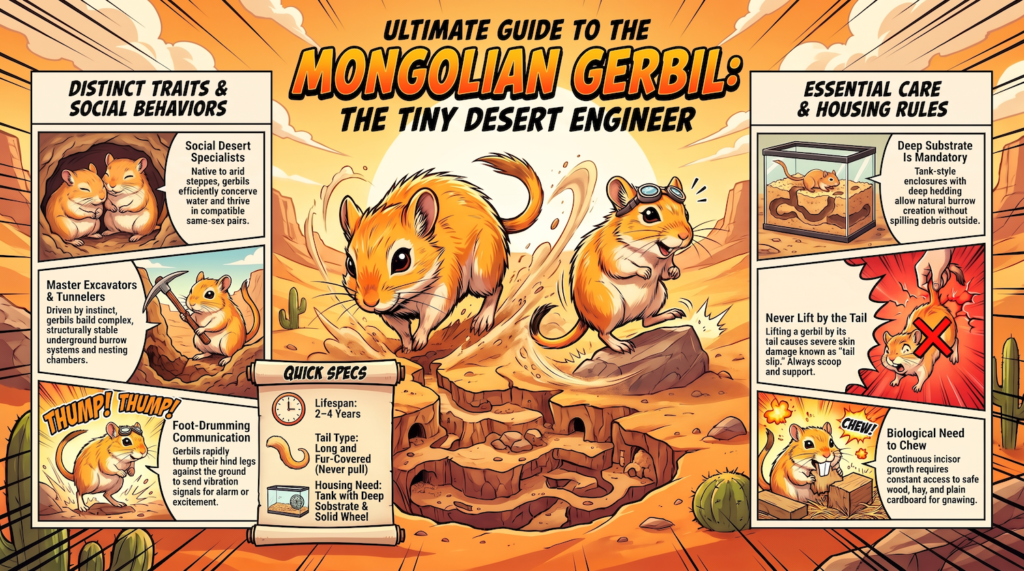
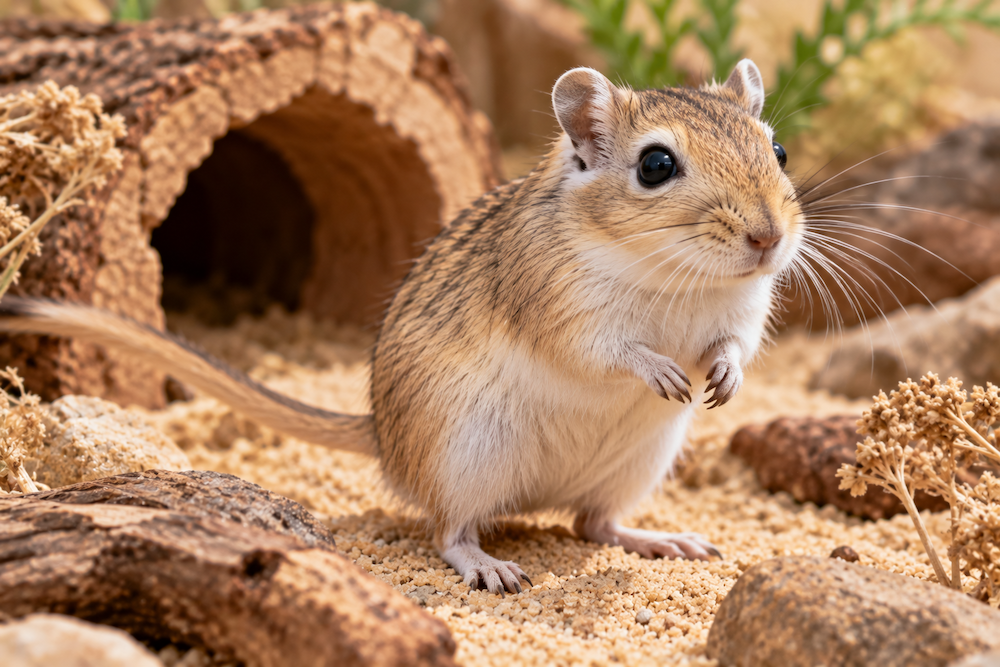







Social, curious and endlessly busy, the Mongolian Gerbil is a fascinating little pet famous for digging, tunnelling and standing upright to investigate its surroundings. Gerbils are relatively easy to care for, but companionship and plenty of deep bedding are essential.
🧠 QUICK SNAPSHOT
| Trait | Mongolian Gerbil |
|---|---|
| Scientific Name | Meriones unguiculatus |
| Pet Type | Small mammal / Rodent |
| Natural Range | Mongolia and surrounding parts of Asia |
| Typical Lifespan | Around 2–4 years |
| Adult Size | Around 10–13 cm body length, plus tail |
| Typical Weight | Roughly 60–120 g |
| Diet | Omnivore |
| Activity | Active in short periods throughout day and night |
| Temperament | Social, curious and energetic |
| Housing | Secure enclosure with deep digging substrate |
| Social Needs | High — normally kept with compatible gerbils |
| Beginner Friendly? | Yes |
| Famous Feature | Extraordinary tunnelling behaviour |
📚 OVERVIEW
The Mongolian Gerbil (Meriones unguiculatus) is a small burrowing rodent originating from the dry grasslands and semi-desert environments of Mongolia and neighbouring regions.
Unlike many small pets, gerbils are highly social and should normally live with a compatible companion. Much of their entertainment comes from watching them dig, tunnel, chew and completely redesign their enclosure.
Their desert ancestry also makes them efficient with water, so they typically produce less urine and odour than many other rodents.
Gerbils aren’t usually lap pets, but well-socialised animals can become confident around people and may happily climb onto a hand to explore.
The key to keeping them well is allowing them to behave like gerbils: deep bedding, tunnels, safe chewing materials, companionship and plenty of opportunities to dig.
✅ PROS & CONS
Pros
- Social and entertaining to watch
- Generally friendly when well socialised
- Usually relatively low odour
- Fascinating digging and tunnelling behaviour
- Active at various times during the day
- Relatively straightforward care
- Intelligent and curious
- Doesn’t require a huge amount of space
- Often a good first small pet
Cons
- Shouldn’t normally be kept alone
- Needs substantial deep bedding
- Can chew through unsuitable equipment
- Not usually a cuddly lap pet
- Tail can be seriously injured by incorrect handling
- Introductions between unfamiliar adults can be difficult
- Shorter lifespan than many larger pets
- Enclosures can become impressively rearranged overnight
Are Mongolian Gerbils Good Pets?
Yes. Mongolian Gerbils can make excellent small pets, particularly for people who enjoy observing natural animal behaviour.
They’re social, curious, relatively clean and usually become comfortable interacting with gentle owners.
Are Gerbils Good Pets for Beginners?
Yes. Gerbils are often suitable for first-time small-pet owners.
Their basic care is relatively manageable, but owners need to understand their need for companionship, deep bedding, chewing opportunities and safe handling.
Are Gerbils Good Pets for Children?
Gerbils can suit responsible older children with adult supervision.
They’re quick and relatively delicate, so young children may find them difficult to handle safely.
Adults should remain responsible for feeding, enclosure maintenance and health care.
How Long Do Mongolian Gerbils Live?
Mongolian Gerbils commonly live around 2–4 years.
Some individuals can live longer with excellent care.
Their relatively short lifespan is worth considering before bringing them into the family.
How Big Do Mongolian Gerbils Get?
Adults generally have a body around 10–13 cm long, plus a long furry tail.
They commonly weigh approximately 60–120 grams, with males often somewhat larger than females.
Should Gerbils Be Kept in Pairs?
Yes. Mongolian Gerbils are highly social animals and are generally happiest living with compatible members of their own species.
Same-sex pairs established while young are often a practical arrangement.
Human interaction doesn’t fully replace gerbil companionship.
Can a Gerbil Live Alone?
Gerbils shouldn’t normally be kept alone unless there is a particular health, behavioural or compatibility reason.
They naturally sleep together, groom one another and participate in social activities.
A solitary gerbil may miss important opportunities for normal social behaviour.
Is It Better to Have Two or Three Gerbils?
A bonded pair is often the simplest arrangement.
Larger groups can work, particularly when established appropriately, but group dynamics can sometimes become more complicated.
Compatibility is more important than simply increasing the number of animals.
What Size Enclosure Do Gerbils Need?
Gerbils need enough space for exercise and, critically, a deep layer of suitable substrate for burrowing.
An enclosure with a deep solid base is particularly useful because it allows substantial bedding without everything immediately being kicked onto the floor.
More usable space and digging depth generally allow better expression of natural behaviour.
How Deep Should Gerbil Bedding Be?
Gerbils should have a generous depth of bedding that allows them to create proper tunnels and underground chambers.
Around 20–30 cm or more can provide much better burrowing opportunities than a thin layer covering the enclosure floor.
Suitable materials can be mixed to help tunnels hold their structure.
Why Do Gerbils Dig So Much?
Digging is fundamental gerbil behaviour.
Wild Mongolian Gerbils construct extensive burrow systems containing nesting, food-storage and escape areas.
A captive gerbil digging constantly isn’t necessarily trying to escape — it may simply be doing exactly what evolution designed it to do.
What Do Mongolian Gerbils Eat?
Gerbils are omnivores.
A nutritionally balanced commercial gerbil food can form the foundation of their diet, with appropriate fresh foods and occasional suitable treats providing variety.
High-fat seeds and treats shouldn’t dominate the diet.
Do Gerbils Need Water?
Yes.
Their dry-environment ancestry makes gerbils extremely efficient at conserving water, but pet gerbils still require continuous access to fresh drinking water.
A water bottle or other safe system should be checked regularly.
Do Gerbils Smell?
Gerbils are generally relatively low-odour pets.
Because they’re adapted to dry environments, they produce comparatively small amounts of urine.
Their enclosure still needs regular spot cleaning and maintenance, but excessive cleaning can unnecessarily destroy established tunnels and familiar scents.
Do Gerbils Like Being Held?
Some gerbils become comfortable climbing onto hands and being gently handled.
They’re generally more interested in exploring than sitting still for cuddles.
Building trust by allowing the gerbil to approach voluntarily usually works better than chasing it around the enclosure.
Can You Pick a Gerbil Up by Its Tail?
No. Never lift a gerbil by its tail.
The tail can be seriously injured through inappropriate handling, including a severe injury known as tail slip.
Gerbils should instead be gently scooped and supported with the hands.
Do Gerbils Bite?
Well-socialised gerbils generally aren’t aggressive towards people.
They may bite if frightened, restrained roughly or threatened.
Gentle handling and allowing a new gerbil time to become accustomed to its owner greatly reduces the risk.
Are Gerbils Nocturnal?
Not strictly.
Mongolian Gerbils often alternate between periods of activity and sleep throughout both the day and night rather than following a completely nocturnal schedule.
This means owners may see considerably more daytime activity than with some other small rodents.
Do Gerbils Need an Exercise Wheel?
A suitable solid-surface exercise wheel can provide valuable additional activity.
It should be large enough for the gerbil to run without excessively arching its back.
Wire or mesh running surfaces can create unnecessary injury risks.
Why Do Gerbils Stand on Their Back Legs?
Gerbils frequently stand upright to survey their surroundings, investigate sounds and sniff the air.
Their relatively powerful hind legs make this characteristic posture easy.
An alert gerbil standing like a tiny meerkat is one of the species’ most recognisable behaviours.
Why Do Gerbils Thump Their Feet?
Gerbils can rapidly drum their hind feet against the ground.
Foot thumping may act as an alarm signal warning other gerbils of potential danger.
It can also occur during excitement or courtship.
Why Do Gerbils Chew Everything?
Like other rodents, gerbils have continuously growing incisors.
Chewing helps maintain their teeth while also providing natural enrichment.
Cardboard and appropriate wooden chew items can therefore disappear with impressive speed.
Can Gerbils Live With Hamsters?
No. Gerbils and hamsters shouldn’t be housed together.
They’re different animals with different social structures and behaviours, and fighting or serious injury could occur.
Gerbils should live with appropriately matched gerbils.
What Health Problems Are Common in Gerbils?
Potential health problems include dental disease, respiratory infections, skin problems, scent-gland tumours and injuries.
Changes in appetite, weight, breathing, movement or behaviour should be investigated promptly.
Good husbandry and appropriate veterinary care remain important despite their small size.
What Is the Scent Gland on a Gerbil’s Belly?
Gerbils have a scent gland on the abdomen that they use to mark their territory.
They may rub their belly against objects to leave scent signals.
The gland should be monitored because abnormalities or growths can occasionally develop there.
What Colours Do Mongolian Gerbils Come In?
Wild-type Mongolian Gerbils have sandy-brown colouring that provides excellent camouflage in their natural environment.
Selective breeding has produced many additional colours, including black, grey, cream, white and various patterned combinations.
They’re colour varieties of the same domesticated species.
Where Do Mongolian Gerbils Come From?
Mongolian Gerbils originate from Mongolia and surrounding regions of Asia, where they inhabit dry grasslands, steppes and semi-desert environments.
Their efficient water conservation, burrowing behaviour and sandy wild colouring all reflect life in these challenging habitats.
Are Mongolian Gerbils Legal to Keep as Pets?
Legality varies around the world.
Some countries or regions restrict or prohibit keeping gerbils as pets, often because of environmental or biosecurity concerns.
Prospective owners should always check current local regulations before obtaining them.
Are Mongolian Gerbils Good First Pets?
Yes. Mongolian Gerbils can be excellent first small pets when kept appropriately.
They’re social, curious, relatively low odour and fascinating to observe.
The most important lesson is that a good gerbil enclosure shouldn’t simply look tidy to a human.
It should give the gerbils enough bedding to completely destroy your carefully planned interior design and replace it with their own.
What Makes the Mongolian Gerbil Unique?
The Mongolian Gerbil is essentially a tiny underground architect.
Give a pair a deep enclosure filled with suitable bedding and they’ll start constructing.
Tunnels appear. Chambers develop. Cardboard disappears. Bedding moves from one end of the enclosure to the other.
This isn’t random destruction.
Wild gerbils survive challenging dry environments by building elaborate burrow systems that provide shelter and protection.
They also have powerful hind legs that allow them to stand upright and survey their surroundings — and to thump warnings through the ground when something seems wrong.
Add their remarkable ability to conserve water and you have a small rodent beautifully adapted to a harsh environment.
The domestic version may now have food delivered and a comfortable enclosure.
But give it a pile of bedding and some cardboard and its ancient instructions immediately return:
Dig first. Remodel everything. Ask questions later.
Discover why Mongolian Gerbils build tunnels, thump their feet, stand like tiny meerkats and completely redesign their homes overnight.
Watch our Mongolian Gerbil video and discover what makes this little desert rodent such a fascinating pet.