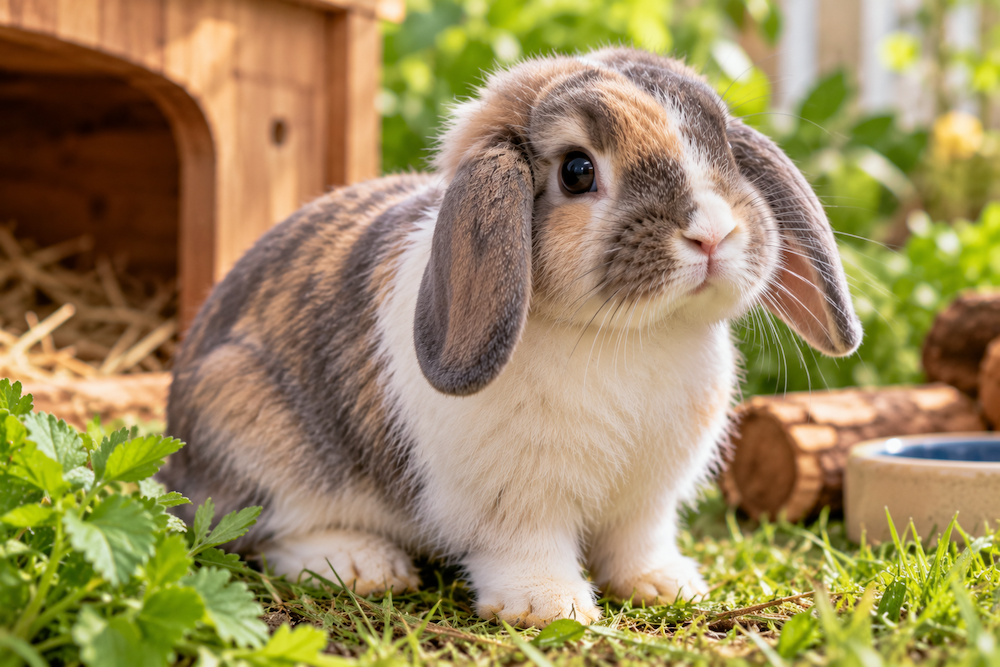







Tiny, charming and instantly recognisable by those floppy ears, the Holland Lop is one of the most popular pet rabbit breeds. They're playful and sociable, but need far more space, enrichment and specialised care than their compact size suggests.
🧠 QUICK SNAPSHOT
| Trait | Holland Lop Rabbit |
|---|---|
| Species | Domestic Rabbit (Oryctolagus cuniculus domesticus) |
| Breed Type | Small lop-eared rabbit |
| Origin | Netherlands |
| Typical Lifespan | Around 7–12 years |
| Adult Weight | Commonly around 0.9–1.8 kg |
| Diet | Herbivore |
| Activity | Most active around dawn and dusk |
| Temperament | Curious, sociable and often affectionate |
| Coat | Short, dense and relatively easy to maintain |
| Famous Feature | Compact body and floppy ears |
| Social Needs | High |
| Beginner Friendly? | Yes, with proper rabbit care |
📚 OVERVIEW
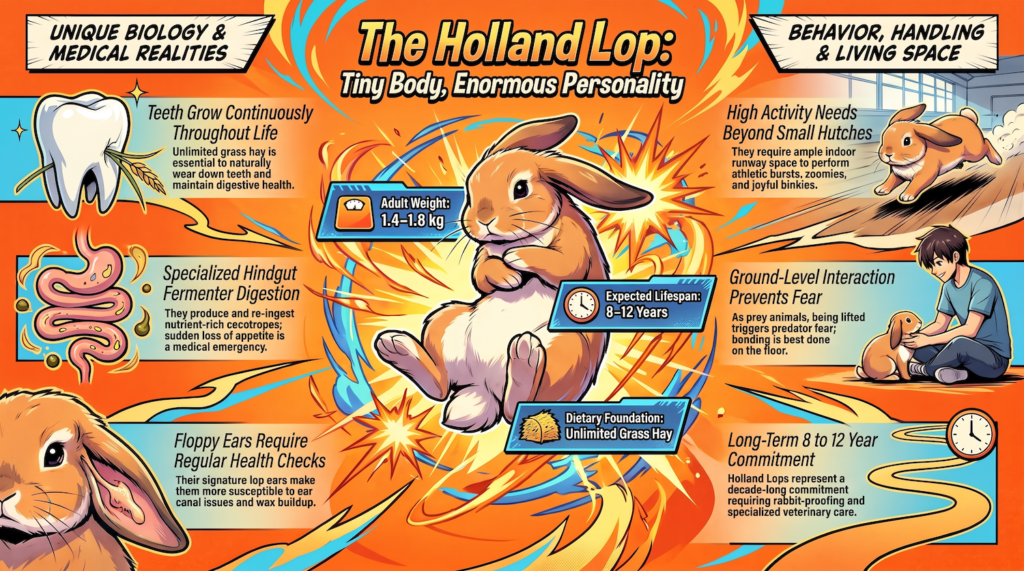
The Holland Lop is a small domestic rabbit developed in the Netherlands and famous for its compact body, broad head and characteristic hanging ears.
Their combination of tiny size and teddy-bear appearance has made them enormously popular, but Holland Lops are much more than cute cage pets. They’re intelligent, active animals that need room to run, explore, forage and interact.
Many become affectionate with patient handling and can learn routines, use a litter tray and respond to reward-based training.
Like other rabbits, their health depends heavily on unlimited grass hay, appropriate nutrition, dental health, exercise and suitable veterinary care. Their lop ears also require regular attention because ear problems can occur.
✅ PROS & CONS
Pros
- Small and manageable size
- Friendly and sociable personality
- Often forms strong bonds with owners
- Intelligent and trainable
- Can learn to use a litter tray
- Usually relatively quiet
- Distinctive floppy-eared appearance
- Can live for a decade or longer
- Entertaining and playful companion
Cons
- Needs considerably more space than a small cage
- Requires unlimited hay and specialised rabbit nutrition
- Teeth grow continuously and can develop problems
- Lop ears can be susceptible to health issues
- Doesn’t usually enjoy being picked up
- Needs substantial daily exercise and enrichment
- Can chew furniture, cables and household objects
- Requires rabbit-experienced veterinary care
- Long-term commitment despite its small size
Are Holland Lop Rabbits Good Pets?
Yes. Holland Lops can make friendly, intelligent and entertaining companion rabbits.
They’re relatively small and often become strongly bonded with their owners. However, they need substantial exercise, enrichment and interaction rather than spending their lives confined to a cage.
Are Holland Lops Good Pets for Beginners?
They can be.
Their small size is manageable, but rabbit care is more specialised than many first-time owners expect.
Understanding diet, dental health, housing, handling and rabbit behaviour is essential before bringing one home.
Are Holland Lop Rabbits Good With Children?
They can suit calm, respectful children when adults supervise interactions.
Rabbits are physically delicate and generally prefer keeping their feet on the ground rather than being carried around.
Young children should never be solely responsible for a rabbit’s care.
How Long Do Holland Lop Rabbits Live?
Holland Lops commonly live around 7–12 years with good care.
Some may live longer.
Their lifespan makes them a substantial commitment rather than a short-term children’s pet.
How Big Do Holland Lop Rabbits Get?
Holland Lops are one of the smaller lop-eared rabbit breeds.
Adults commonly weigh around 0.9–1.8 kg, although breed standards and individual size can vary.
Their compact appearance makes them look particularly small beside larger lop breeds.
What Do Holland Lop Rabbits Eat?
The foundation of an adult Holland Lop’s diet should be unlimited good-quality grass hay.
This is supplemented with appropriate leafy greens and a measured amount of nutritionally balanced rabbit pellets.
Fresh water should always be available.
Why Is Hay So Important for Holland Lops?
Hay supports two critical areas of rabbit health: digestion and dental wear.
Rabbit teeth grow continuously, and the repetitive chewing required to process fibrous hay helps maintain them.
Hay also provides the fibre necessary for healthy gastrointestinal function.
Can Holland Lop Rabbits Live Indoors?
Yes. Holland Lops can make excellent indoor pets.
Indoor living can make interaction and monitoring easier, provided the rabbit has plenty of safe exercise space rather than being permanently confined to a small cage.
The home should also be thoroughly rabbit-proofed.
How Much Space Does a Holland Lop Need?
Much more than its tiny body suggests.
A Holland Lop needs enough permanent space to hop, stretch, stand upright and move naturally, together with regular access to a larger exercise area.
Traditional small rabbit cages aren’t suitable as complete living environments.
Do Holland Lop Rabbits Need Exercise?
Yes. Holland Lops are active animals and need several hours of exercise and exploration each day.
Running, hopping, digging, foraging and investigating are all important natural behaviours.
Exercise also helps support healthy body weight and mental wellbeing.
Can Holland Lop Rabbits Be Litter Trained?
Yes. Rabbits can often be successfully litter trained.
They naturally tend to choose particular toilet areas, which owners can use to encourage litter-tray habits.
Desexing can also improve litter habits and reduce territorial marking.
Are Holland Lop Rabbits Affectionate?
Many are.
A comfortable Holland Lop may approach its owner for attention, nudge their hand or relax while being gently stroked.
Rabbit affection tends to happen at ground level, rather than through being picked up and cuddled.
Do Holland Lop Rabbits Like Being Held?
Many rabbits don’t particularly enjoy being lifted.
As prey animals, having their feet suddenly leave the ground can feel threatening.
Building trust through interaction on the floor generally creates a better relationship than frequently picking a rabbit up unnecessarily.
Do Holland Lop Rabbits Bite?
They can, but biting isn’t normally a characteristic of a well-socialised, comfortable rabbit.
A rabbit may bite because of fear, pain, territorial behaviour or unwanted handling.
Sudden aggression can also indicate an underlying health problem.
Do Holland Lop Rabbits Need a Companion?
Rabbits are highly social animals and can benefit enormously from living with a compatible bonded rabbit.
Human interaction is valuable but doesn’t reproduce every aspect of rabbit-to-rabbit companionship.
Introductions need to be handled carefully because unfamiliar rabbits can fight.
Can Holland Lops Live With Other Rabbit Breeds?
Yes. Compatibility is based much more on individual temperament and successful bonding than breed.
A Holland Lop can potentially form an excellent bond with a rabbit of a completely different breed or size.
Careful introductions are essential.
Are Holland Lop Rabbits Smart?
Yes. Rabbits are much more intelligent than they’re sometimes given credit for.
Holland Lops can learn routines, recognise familiar people, use litter trays and respond to reward-based training.
Food puzzles and foraging activities provide excellent mental stimulation.
Can You Train a Holland Lop Rabbit?
Yes. Positive reinforcement can be used to teach behaviours such as coming when called, entering a carrier, standing up or completing simple tricks.
Training can also make everyday handling and veterinary care easier.
Why Do Holland Lop Rabbits Binky?
A binky is an energetic jump in which a happy or excited rabbit may leap, twist and kick its feet in the air.
It’s one of the most entertaining rabbit behaviours.
Young, energetic rabbits may combine binkies with sudden high-speed runs around the room.
Why Do Holland Lop Rabbits Thump Their Feet?
Rabbits thump their powerful hind feet to communicate alarm, fear or displeasure.
In the wild, the vibration can help warn other rabbits of potential danger.
A pet rabbit may also thump when something in its environment has made it suspicious.
What Are Rabbit Zoomies?
Zoomies are sudden bursts of high-speed running.
A Holland Lop may race around its exercise area, rapidly change direction and combine its run with binkies.
This energetic behaviour commonly occurs when a rabbit is feeling excited and playful.
Do Holland Lop Rabbits Shed?
Yes.
Holland Lops shed throughout the year and may experience heavier seasonal moults.
Regular brushing helps remove loose fur, which is useful because rabbits groom themselves and cannot vomit swallowed hair like cats can.
How Often Should You Groom a Holland Lop?
Their short coat is relatively manageable and generally benefits from regular brushing, with more frequent grooming during heavy shedding periods.
Nails also need routine trimming.
The ears, teeth, skin and underside should be checked regularly for abnormalities.
Why Do Holland Lops Have Floppy Ears?
The characteristic lop ears are the result of selective breeding affecting ear carriage and skull structure.
Unlike rabbits with upright ears, mature Holland Lops carry their ears hanging down beside the head.
It’s their defining appearance — but the altered ear anatomy can also increase susceptibility to ear problems.
What Health Problems Are Common in Holland Lop Rabbits?
Potential concerns include dental disease, gastrointestinal stasis, ear disease, obesity and respiratory problems.
Lop-eared rabbits can be particularly susceptible to ear canal problems.
Changes in eating, droppings or activity should always be taken seriously because rabbits can deteriorate rapidly.
What Is GI Stasis in Rabbits?
Gastrointestinal stasis occurs when normal movement through the digestive system slows dramatically or stops.
Signs can include reduced appetite, fewer droppings, lethargy and abdominal discomfort.
It’s potentially life-threatening and requires prompt veterinary attention rather than waiting to see whether the rabbit improves.
What Is the Difference Between a Holland Lop and a Mini Lop?
They’re separate rabbit breeds.
Despite the confusing names, the Holland Lop is generally smaller than the Mini Lop recognised by major rabbit organisations.
Both have lop ears, but their breed standards, body type and development histories differ.
Where Did the Holland Lop Rabbit Come From?
The Holland Lop was developed in the Netherlands by rabbit breeder Adriann de Cock, beginning in the mid-20th century.
His goal was to create a much smaller lop-eared rabbit by combining characteristics from larger lop breeds with smaller rabbits.
The resulting compact lop eventually became internationally popular.
Is a Holland Lop Rabbit a Good First Rabbit?
Yes, provided the owner understands that small rabbit doesn’t mean small responsibility.
Holland Lops are intelligent, social and relatively manageable in size, but they still require substantial space, excellent nutrition, daily exercise and appropriate veterinary care.
What Makes the Holland Lop Rabbit Unique?
The Holland Lop looks almost purpose-designed to be cute.
Tiny body.
Round head.
And two floppy ears hanging down either side.
But underneath that teddy-bear appearance is still a rabbit — an animal built to run, dig, forage, investigate and communicate.
A happy Holland Lop might suddenly race across the room, leap into the air, twist its entire body and land facing another direction.
That’s a binky.
A strange noise occurs?
THUMP.
Something exciting happens?
Zoomies.
And when the excitement is over, your little rabbit may stretch out completely on the floor in a dramatic “flop” that can briefly convince an inexperienced owner that something terrible has happened.
The Holland Lop may be one of the smallest lop-eared rabbits.
Its personality didn’t get the memo.
Discover why Holland Lops binky, thump and flop, how their famous ears developed and what these tiny rabbits really need to live happy, healthy lives.
Watch our Holland Lop Rabbit video and discover what makes this little lop such a fascinating companion.