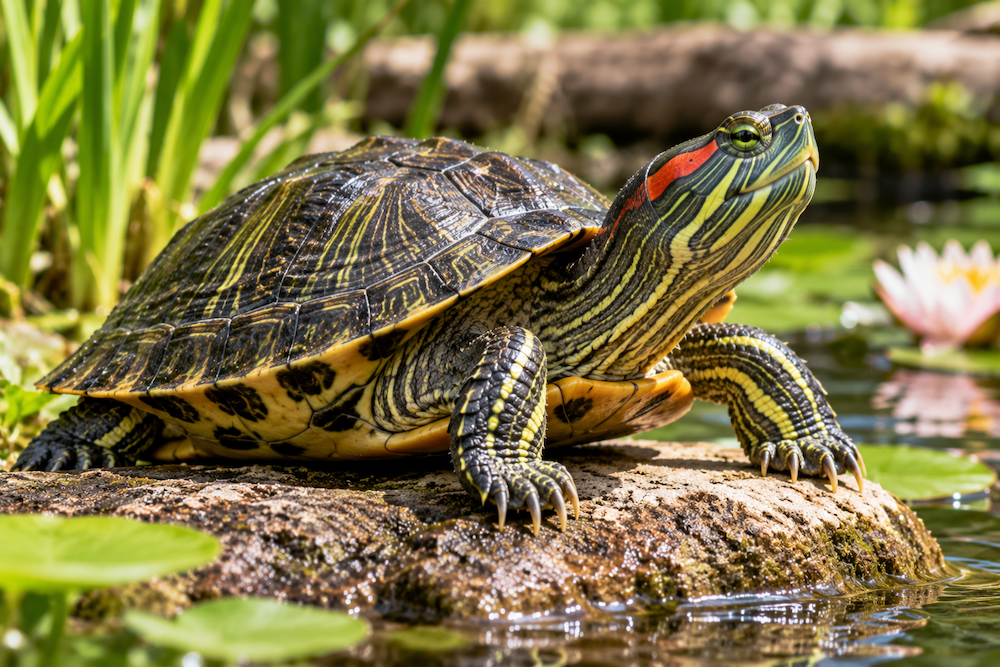







Hardy, inquisitive and instantly recognisable by the red markings behind its eyes, the Red-Eared Slider is one of the world's best-known pet turtles.
🧠 QUICK SNAPSHOT
| Trait | Red-Eared Slider Turtle |
|---|---|
| Scientific Name | Trachemys scripta elegans |
| Pet Type | Aquatic turtle / Reptile |
| Natural Range | North America |
| Typical Lifespan | Around 20–40+ years |
| Adult Shell Length | Around 15–30 cm |
| Diet | Omnivore |
| Activity | Diurnal |
| Temperament | Alert, curious and generally independent |
| Housing | Large heated aquatic enclosure with dry basking area |
| UVB Lighting | Essential |
| Filtration | Powerful filtration required |
| Social Needs | Can be housed individually |
| Beginner Friendly? | Moderate |
| Famous Feature | Distinctive red patch behind each eye |
📚 OVERVIEW
The Red-Eared Slider (Trachemys scripta elegans) is a semi-aquatic turtle named for the distinctive red stripe behind each eye and its habit of quickly sliding from rocks or logs into the water when threatened.
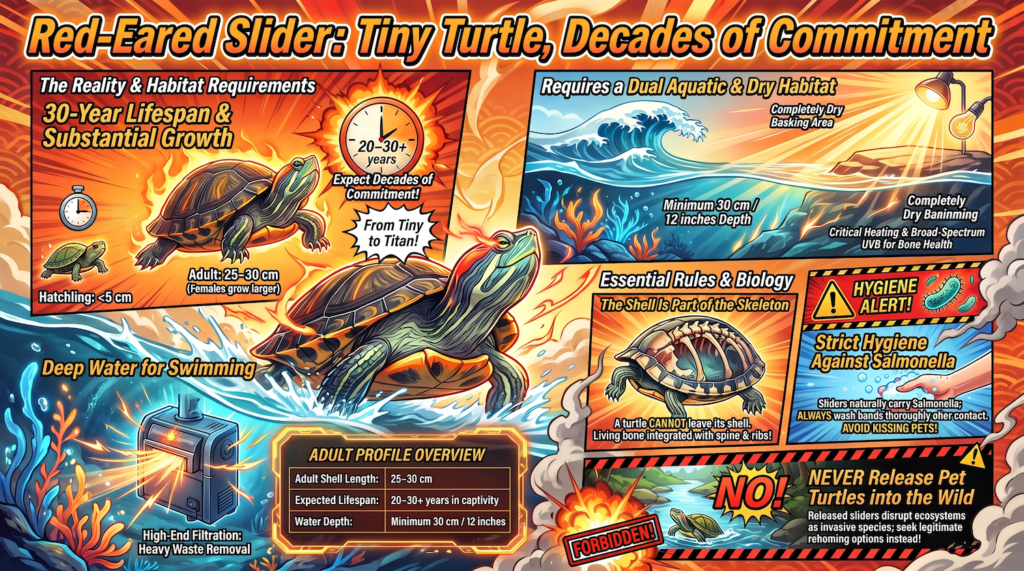
Small hatchlings can look deceptively easy to keep. Adults are another matter. Females in particular can develop shells approaching 30 cm long and require substantial swimming space, strong filtration and a completely dry basking area with appropriate heat and UVB.
Red-Eared Sliders can learn feeding routines and may eagerly approach when familiar people appear, but they’re primarily animals to observe rather than cuddle.
Their greatest consideration is longevity: with proper care, a Red-Eared Slider may be a companion for several decades.
✅ PROS & CONS
Pros
- Fascinating aquatic behaviour
- Active during the daytime
- Hardy when properly cared for
- Can learn feeding routines
- Doesn’t require constant human attention
- Can be housed individually
- Interesting basking and swimming behaviour
- Potentially very long-lived
Cons
- Grows much larger than many buyers expect
- Requires a substantial aquatic enclosure
- Powerful filtration is essential
- Needs both heat and UVB lighting
- Can be messy
- Long lifespan is a major commitment
- Not generally a cuddly or hands-on pet
- Ownership is restricted in some regions
Are Red-Eared Slider Turtles Good Pets?
They can be excellent pets for people prepared to provide substantial aquatic housing and long-term care.
They’re fascinating to watch and can become responsive to familiar routines, but they’re much more demanding than their reputation as an easy beginner turtle suggests.
Are Red-Eared Sliders Good for Beginners?
They can be, but only with proper preparation.
Their husbandry isn’t especially complicated once correctly established, but the size of the adult enclosure, filtration requirements, UVB lighting and long lifespan can surprise first-time owners.
How Long Do Red-Eared Slider Turtles Live?
Red-Eared Sliders can commonly live 20–40 years or longer with appropriate care.
Buying a hatchling can therefore mean taking responsibility for an animal that may remain with the family for several decades.
How Big Do Red-Eared Sliders Get?
Adult shell length is commonly around 15–30 cm, with females generally growing substantially larger than males.
That tiny juvenile sold as a pet can eventually become a sizeable turtle requiring a very large aquatic habitat.
Why Are They Called Red-Eared Sliders?
The “red-eared” part refers to the prominent red or reddish stripe behind each eye.
“Slider” describes their tendency to rapidly slide from basking sites into the water when they sense danger.
They don’t actually have external ears like mammals.
What Size Tank Does a Red-Eared Slider Need?
Adult Red-Eared Sliders require large aquatic enclosures with substantial swimming space.
A useful traditional guideline is approximately 10 US gallons of water capacity for each inch of shell length, although larger appropriately designed environments are preferable.
The enclosure also needs room for a completely dry basking area.
Do Red-Eared Sliders Need a Basking Area?
Yes.
They need an easily accessible platform where they can climb completely out of the water, dry themselves and warm under appropriate lighting.
Basking is an important part of normal turtle behaviour and health.
Do Red-Eared Sliders Need UVB Light?
Yes. Appropriate UVB exposure is essential for captive Red-Eared Sliders.
UVB helps support vitamin D3 production and calcium metabolism, both of which are critical for healthy bones and shell development.
UVB lamps need replacing according to manufacturer recommendations because output declines over time.
Do Red-Eared Sliders Need a Heat Lamp?
Yes. A basking heat source allows the turtle to raise its body temperature when it leaves the water.
Water temperature also needs appropriate management, particularly for younger turtles.
Temperatures should be measured accurately rather than estimated by touch.
Do Red-Eared Sliders Need a Filter?
Absolutely.
Aquatic turtles produce considerable waste, so powerful filtration is one of the most important parts of their enclosure.
Filtration doesn’t eliminate the need for water changes, but it helps maintain far healthier and more stable water conditions.
Why Is My Red-Eared Slider’s Tank So Dirty?
Turtles are messy animals.
Food scraps, faeces and other organic material can rapidly reduce water quality, particularly in an undersized enclosure.
A larger water volume, strong filtration, sensible feeding and regular maintenance make a major difference.
What Do Red-Eared Slider Turtles Eat?
Red-Eared Sliders are omnivores.
A suitable diet can combine quality aquatic turtle food with appropriate plant material and animal-based foods, depending on the turtle’s age.
Young sliders generally consume proportionally more animal matter, while adults typically eat more vegetation.
Do Red-Eared Sliders Eat Vegetables?
Yes. Plant foods become particularly important as Red-Eared Sliders mature.
Appropriate leafy greens and aquatic vegetation can form part of a varied adult diet.
A turtle shouldn’t be raised solely on dried shrimp or one favourite commercial treat.
Do Red-Eared Sliders Drink Water?
Yes, although it’s not always obvious because they live and feed in water.
Maintaining clean water is therefore important for far more than simply keeping the enclosure attractive.
Can Red-Eared Sliders Live Alone?
Yes. Red-Eared Sliders don’t require another turtle for companionship.
Keeping one turtle alone can actually make housing and feeding easier and eliminates risks associated with aggression between incompatible individuals.
Can Two Red-Eared Sliders Live Together?
Sometimes, but successful cohabitation shouldn’t be assumed.
Turtles can compete for food and basking areas, and aggression can occur.
Multiple turtles require considerably more space, resources and careful monitoring than a single animal.
Do Red-Eared Sliders Recognise Their Owners?
They can learn to associate familiar people with food and predictable routines.
Many captive sliders quickly swim towards the front of their enclosure when their regular caregiver approaches.
This is best understood as recognition and learned association rather than mammal-like affection.
Do Red-Eared Sliders Like Being Held?
Generally, unnecessary handling should be kept to a minimum.
Red-Eared Sliders are better suited to observation than cuddling, and frequent handling can cause stress.
Handling is sometimes necessary for health checks and enclosure management.
Do Red-Eared Sliders Bite?
They can.
A frightened or defensive adult has strong jaws and can deliver a painful bite.
Supporting the turtle securely and keeping fingers away from its mouth reduces unnecessary risk.
Can Red-Eared Sliders Leave the Water?
Yes. They’re semi-aquatic turtles and naturally leave the water to bask in warmth and light.
Females also need access to appropriate nesting conditions when carrying eggs, even if no male is present.
Can Female Red-Eared Sliders Lay Eggs Without a Male?
Yes.
Adult females can produce and lay unfertilised eggs without mating.
A female carrying eggs needs access to an appropriate nesting area because being unable to lay can result in serious reproductive complications.
How Can You Tell a Male Red-Eared Slider From a Female?
Adult males are generally smaller and develop longer front claws and a longer, thicker tail.
Females usually grow considerably larger.
Sex differences become easier to identify as turtles mature.
Do Red-Eared Sliders Hibernate?
Wild Red-Eared Sliders can enter a period of reduced winter activity known as brumation when environmental temperatures fall.
Pet turtles shouldn’t simply be allowed to become cold in an uncontrolled environment in an attempt to reproduce this behaviour.
What Health Problems Are Common in Red-Eared Sliders?
Potential problems include shell disease, respiratory infections, nutritional deficiencies, metabolic bone disease and reproductive disorders.
Many illnesses are strongly associated with inadequate UVB, incorrect temperatures, poor nutrition or poor water quality.
Why Is My Turtle’s Shell Soft?
A persistently soft or abnormally developing shell can indicate a serious husbandry or health problem, including inadequate calcium or UVB exposure.
Young turtles naturally have some differences in shell firmness, but abnormal softness warrants veterinary assessment.
Do Red-Eared Sliders Carry Salmonella?
Like many reptiles, turtles can carry Salmonella bacteria without appearing sick.
Good hygiene is important after handling the turtle, aquarium water or enclosure equipment.
Hands should be washed thoroughly and turtle equipment kept away from human food-preparation areas.
Where Do Red-Eared Sliders Come From?
Red-Eared Sliders are native to North America, particularly freshwater environments around the Mississippi River basin and surrounding regions.
They inhabit ponds, lakes, wetlands and slow-moving waterways with abundant basking opportunities.
Why Are Red-Eared Sliders Invasive in Some Places?
Red-Eared Sliders have been introduced to many areas outside their natural range, often following the release or escape of unwanted pets.
Established populations can compete with native wildlife and disrupt local ecosystems.
A pet turtle should therefore never be released into the wild.
Are Red-Eared Sliders Legal to Keep as Pets?
Regulations vary considerably.
Some countries or regions restrict or prohibit their sale, importation or ownership, particularly because of their potential to become invasive.
Always check current local regulations before obtaining one.
Is a Red-Eared Slider a Good First Turtle?
It can be, but only if the owner plans for the adult turtle rather than the tiny hatchling.
A properly equipped Red-Eared Slider setup requires considerable swimming space, powerful filtration, heating, UVB lighting and potentially decades of care.
What Makes the Red-Eared Slider Turtle Unique?
A baby Red-Eared Slider can fit comfortably in your hand.
That’s where many people make their first mistake.
Because that tiny turtle can grow into a substantial adult and potentially remain with you for 30 years or more.
Its name tells part of its story.
The red patch behind each eye gives us “Red-Eared.”
Approach one basking beside the water and you’ll discover the “Slider” part — it can disappear into the water remarkably quickly.
They’re also excellent swimmers, enthusiastic baskers and surprisingly good at learning exactly which enormous human normally delivers dinner.
But perhaps the most important fact about the Red-Eared Slider isn’t how cute the hatchling is.
It’s what that hatchling becomes.
A large, intelligent, long-lived aquatic reptile that deserves an environment designed for the turtle it will be — not the tiny turtle it was when you brought it home.
Discover why Red-Eared Sliders bask, how they got their unusual name, how large they really become and why these famous turtles can be a decades-long commitment.
Watch our Red-Eared Slider Turtle video and discover what life with this remarkable aquatic reptile is really like.