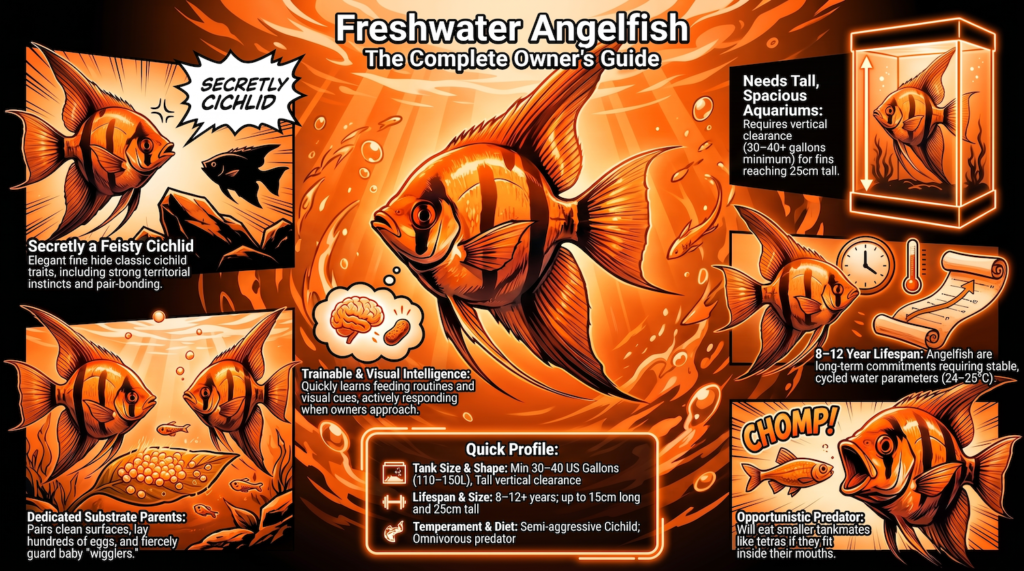
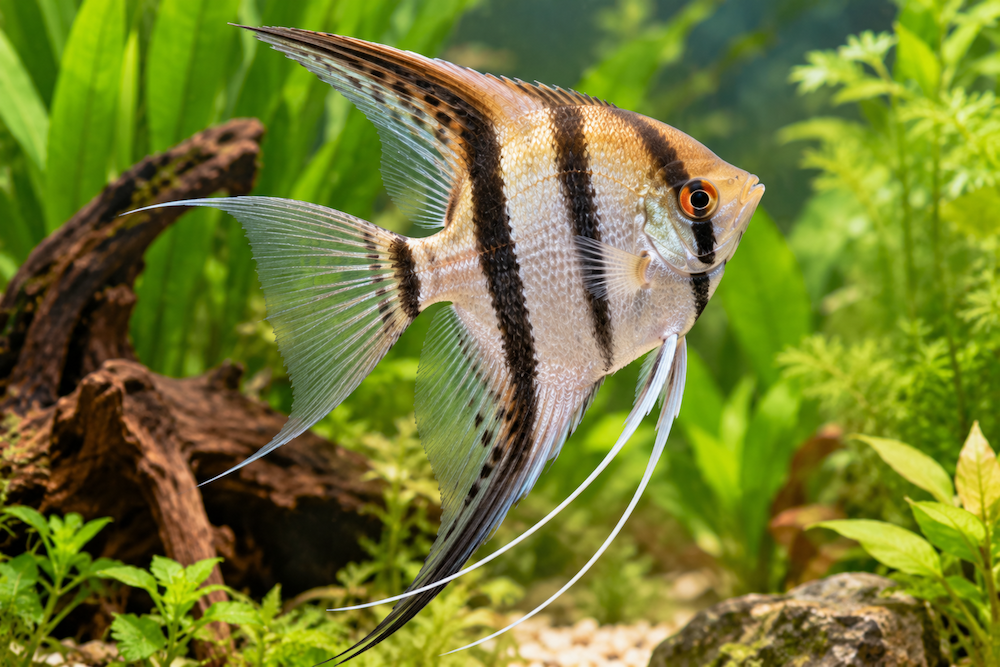







Elegant, intelligent and instantly recognisable, the freshwater Angelfish is one of the aquarium world's most iconic fish. Its tall body and sweeping fins give it an almost graceful appearance.
🧠 QUICK SNAPSHOT
| Trait | Angelfish |
|---|---|
| Scientific Genus | Pterophyllum |
| Pet Type | Freshwater tropical fish |
| Family | Cichlidae |
| Natural Origin | South America |
| Typical Lifespan | Around 8–12+ years |
| Adult Body Length | Around 10–15 cm |
| Overall Height | Can exceed 20 cm including fins |
| Diet | Omnivore |
| Activity | Diurnal |
| Temperament | Generally calm but territorial at times |
| Water Type | Tropical freshwater |
| Tank Shape | Taller aquariums particularly suitable |
| Beginner Friendly? | Moderate |
| Famous Feature | Tall triangular body and long flowing fins |
📚 OVERVIEW
Freshwater Angelfish belong to the South American cichlid genus Pterophyllum. Most aquarium Angelfish are domesticated forms derived primarily from Pterophyllum scalare.
Their compressed, vertically elongated bodies and extended fins give them one of the most distinctive silhouettes in freshwater aquariums.
Angelfish can be peaceful community residents under suitable conditions, but they’re still cichlids. Adults may become territorial, established pairs can defend breeding sites aggressively, and very small fish may be viewed as food.
They also grow much taller than many new owners expect, making aquarium height, water quality and careful choice of tank mates particularly important.
✅ PROS & CONS
Pros
- Spectacular, elegant appearance
- Many colours and patterns available
- Intelligent and observant
- Interesting social behaviour
- Can live for many years
- Suitable for planted aquariums
- Fascinating breeding behaviour
- Strong individual personalities
Cons
- Needs a suitably large, tall aquarium
- Can become territorial
- May eat very small fish
- Long fins can attract fin-nipping
- Breeding pairs can become aggressive
- Requires stable water quality
- Grows considerably larger than juveniles suggest
- Tank mates need careful selection
Are Angelfish Good Pet Fish?
Yes. Angelfish can be excellent aquarium fish for keepers wanting a beautiful, intelligent and interactive freshwater species.
Their combination of appearance and personality has helped make them aquarium favourites for generations.
Are Angelfish Good for Beginners?
Angelfish can suit a well-prepared beginner, but they’re not necessarily the easiest first fish.
Their adult size, territorial behaviour and need for stable water conditions mean they’re better suited to someone who understands basic aquarium cycling and maintenance.
How Long Do Angelfish Live?
Freshwater Angelfish commonly live around 8–12 years, with some individuals potentially living longer under excellent conditions.
Good water quality, appropriate nutrition and adequate space all contribute to longevity.
How Big Do Angelfish Get?
Adult Angelfish commonly reach around 10–15 cm in body length, but their dramatic fins make their overall vertical size considerably greater.
This is why tank height matters.
A tiny juvenile in an aquarium shop can eventually become an impressively tall adult.
Why Are Angelfish So Tall and Thin?
Their unusual shape is an adaptation to their natural environment.
A laterally compressed body allows Angelfish to manoeuvre through roots, branches and tall aquatic vegetation, while their vertical stripes can help break up their outline.
What Do Angelfish Eat?
Angelfish are omnivores.
A good-quality formulated tropical or cichlid food can form the basis of the diet, supplemented with suitable frozen, live or other appropriate foods for variety.
A varied diet helps support healthy growth and condition.
How Often Should Angelfish Be Fed?
Adult Angelfish are commonly fed small portions once or twice daily.
Food should be consumed promptly rather than accumulating in the aquarium.
Overfeeding can contribute to obesity and deteriorating water quality.
Do Angelfish Need a Heater?
Yes, in environments where the aquarium won’t naturally remain within an appropriate tropical temperature range.
Angelfish originate from warm South American waters and require stable tropical temperatures rather than large fluctuations.
Do Angelfish Need a Filter?
Yes.
Effective filtration helps maintain water quality and supports the beneficial bacteria responsible for processing fish waste.
Like other aquarium fish, Angelfish should be kept in a properly cycled aquarium.
What Size Tank Does an Angelfish Need?
Angelfish need considerably more space than their juvenile size suggests.
Because adults are both tall and territorial, a large, tall aquarium is preferable, with even more space required when keeping groups or community fish.
Aquarium dimensions matter as much as the quoted volume.
Do Angelfish Like Tall Tanks?
Yes.
Their unusual body shape and extended dorsal and anal fins make vertical swimming space particularly important.
A shallow aquarium may have substantial water volume while still being poorly proportioned for adult Angelfish.
Do Angelfish Like Plants?
Yes. Plants can create an excellent environment for Angelfish.
Tall vegetation provides cover, visual barriers and potential spawning surfaces, while also creating an aquarium that resembles aspects of their natural habitat.
Are Angelfish Aggressive?
Angelfish are generally less aggressive than many larger cichlids, but they’re certainly not completely peaceful.
Territorial disputes can occur, and aggression often becomes much more obvious when a pair begins breeding.
Individual temperament also varies.
Can Angelfish Live Together?
Yes, but group dynamics need to be monitored.
Young Angelfish may live relatively peacefully together before adult hierarchies and breeding pairs develop.
Adequate space and visual barriers can help reduce conflict.
Can Angelfish Live With Other Fish?
Yes. Angelfish are commonly kept in community aquariums with appropriately chosen species.
Good tank mates should have compatible water requirements, suitable temperament and enough size not to become prey.
Avoid persistent fin-nippers.
Will Angelfish Eat Neon Tetras?
They can.
Adult Angelfish are capable of eating sufficiently small fish, and tiny tetras may fall within that category.
Interestingly, Angelfish and small tetras may occur within the broader South American ecosystem — but sharing an ecosystem doesn’t mean one isn’t capable of eating the other.
Can Angelfish Live With Bettas?
It’s generally a risky combination.
Both species can be territorial, and their prominent fins may trigger aggression or fin-nipping.
Individual personalities vary, but compatibility shouldn’t be assumed.
Do Angelfish Recognise Their Owners?
Angelfish can learn to associate familiar people with feeding and routine.
Many aquarium keepers notice their Angelfish approaching the front of the tank when they enter the room.
Whether that’s affection is debatable.
They definitely know who operates the restaurant.
Are Angelfish Intelligent?
Yes. As cichlids, Angelfish display relatively complex behaviour.
They can learn routines, recognise feeding cues, establish social hierarchies, defend territories and display elaborate parental behaviour.
How Can You Tell Male and Female Angelfish Apart?
Sexing Angelfish by appearance alone can be difficult.
Some mature males and females show subtle differences, but these aren’t always reliable.
The breeding tubes visible around spawning provide one of the more dependable clues.
How Do Angelfish Breed?
Angelfish form pairs and typically lay eggs on a vertical or angled surface, such as a broad plant leaf, piece of wood or aquarium surface.
The parents may clean the spawning site before eggs are laid.
Both parents can participate in guarding the eggs and fry.
Do Angelfish Care for Their Babies?
Yes — and this is one of their most fascinating behaviours.
As cichlids, Angelfish can display extensive parental care, including guarding eggs, fanning them and defending newly hatched young.
Inexperienced parents don’t always get everything right, but the instinctive behaviour can be remarkable to watch.
Why Are My Angelfish Fighting?
Angelfish may fight over territory, social hierarchy, breeding partners or spawning sites.
If aggression becomes persistent, additional space, visual barriers or separation may be necessary.
Repeated bullying shouldn’t simply be dismissed as normal behaviour.
Why Is My Angelfish Hiding?
Hiding can indicate stress, aggression from tank mates, inappropriate water conditions or simply a response to a new environment.
Check water parameters and observe the behaviour of other fish if an Angelfish suddenly begins hiding more than usual.
Why Is My Angelfish Not Eating?
Loss of appetite can result from stress, unsuitable water conditions, aggression or illness.
Testing aquarium water is an important first step.
Persistent appetite loss accompanied by behavioural or physical changes deserves further investigation.
What Health Problems Are Common in Angelfish?
Angelfish can experience problems including parasites, bacterial infections, fin damage and diseases associated with poor water quality or stress.
Stable conditions, appropriate stocking and quarantine of new fish can reduce many health risks.
What Colours Do Angelfish Come In?
Selective breeding has produced an extraordinary variety of aquarium Angelfish.
Depending on the breeding line, varieties can include silver, marble, black, gold, koi, zebra and numerous combinations and patterns.
Their wild ancestors are generally much more subdued.
What Is the Difference Between Freshwater and Marine Angelfish?
They’re completely different groups of fish.
Freshwater Angelfish belong to the cichlid genus Pterophyllum and originate from South America.
Marine Angelfish belong primarily to the family Pomacanthidae and live in saltwater environments.
They share a common name, not a close aquarium-care relationship.
Where Do Freshwater Angelfish Come From?
Wild Pterophyllum species occur in South American river systems, including parts of the Amazon and surrounding basins.
They inhabit slow-moving waters containing vegetation, submerged roots and other complex structures.
Is an Angelfish a Good First Aquarium Fish?
It can be, but gaining some basic aquarium experience first makes Angelfish ownership easier.
The most important things are a cycled aquarium, adequate adult-sized space, stable tropical conditions and compatible tank mates.
Don’t choose the aquarium for the little Angelfish you buy.
Choose it for the much bigger fish it’s going to become.
What Makes the Angelfish Unique?
There’s something almost impossible-looking about an Angelfish.
Most fish are built like torpedoes.
The Angelfish looks more like a living triangle.
Its body is compressed from side to side.
Its dorsal and anal fins extend dramatically above and below it.
And long pelvic filaments trail underneath as it moves slowly through the water.
That strange design has a purpose.
Among vegetation and submerged roots, being tall and narrow can help the fish manoeuvre through complicated spaces while its vertical pattern breaks up its outline.
Then breeding begins.
The graceful aquarium ornament suddenly remembers something important:
It’s a cichlid.
A pair selects a surface.
They clean it.
Eggs appear.
The parents guard them.
And that elegant fish that was peacefully drifting around the aquarium may suddenly become an extremely determined parent.
That’s what makes Angelfish so fascinating.
They combine the elegance of an ornamental fish with the intelligence, territoriality and complex family behaviour of a cichlid.
Discover why Angelfish have such unusual tall bodies, how intelligent these iconic cichlids really are, why breeding pairs suddenly become territorial and how they protect their eggs and young.