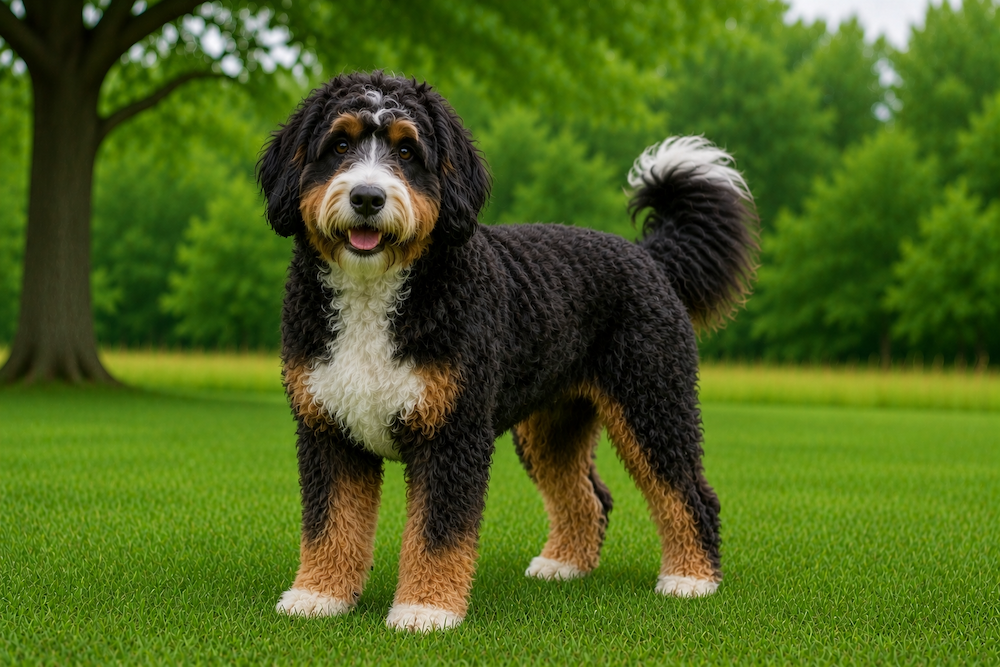







Gentle, playful, and incredibly affectionate — a fluffy companion that combines intelligence with a calm family nature.
🧠 QUICK SNAPSHOT
- Temperament: Friendly, affectionate, gentle
- Energy Level: Moderate
- Size: Medium to large
- Good With Families: Yes
- Trainability: High
- Grooming: High
- Best For: Families, companionship, active homes
📚 OVERVIEW
The Bernedoodle is a cross between a Bernese Mountain Dog and a Poodle, known for its fluffy coat and loving personality. They are social dogs that thrive on companionship and enjoy being included in family life.
Their calm nature combined with intelligence makes them popular companions for many household
✅ PROS & CONS
Pros
- Very affectionate and family-oriented
- Intelligent and trainable
- Playful but gentle temperament
- Low shedding (varies by coat type)
Cons
- Needs regular grooming
- Requires companionship and attention
- Can be prone to separation anxiety
- Size can vary significantly
Is a Bernedoodle a Good Family Dog?
Yes, Bernedoodles can be excellent family dogs, particularly for households wanting an affectionate, sociable and playful companion.
A Bernedoodle is a cross between a Bernese Mountain Dog and a Poodle, so temperament can vary considerably. Many inherit the Bernese Mountain Dog’s affectionate nature combined with the Poodle’s intelligence and enthusiasm.
They can be wonderful with respectful children, although larger Bernedoodles may accidentally knock over small children during energetic play.
Early socialisation and training remain important.
At their best, Bernedoodles combine the lovable personality of the Bernese with the brains and playfulness of the Poodle.
How Much Exercise Does a Bernedoodle Need?
Most adult Bernedoodles need around 60–90 minutes of exercise each day, although requirements vary with size, age and genetics.
Standard Bernedoodles can enjoy long walks, hiking, swimming and active family adventures.
Smaller Mini Bernedoodles may require somewhat less physical exercise but still benefit from daily activity.
Mental stimulation is particularly important because of the Poodle influence.
Puzzle toys, scent games, retrieving and training sessions can help prevent boredom.
A Bernedoodle doesn’t necessarily need extreme exercise, but it usually needs considerably more than a quick trip around the block followed by an entire day on the sofa.
Is a Bernedoodle Easy to Train?
Bernedoodles are generally intelligent and highly trainable, although individual temperament can vary.
Poodles rank among the most trainable dog breeds, while Bernese Mountain Dogs are intelligent but can sometimes be slower to mature or somewhat stubborn.
A Bernedoodle can inherit either combination.
Positive reinforcement, food rewards and short, enjoyable training sessions usually work particularly well.
Early training is important for Standard Bernedoodles because they can become large, powerful adults.
Many are extremely eager to interact with their owners, which can make training enjoyable for both dog and human.
Does a Bernedoodle Shed?
Bernedoodles can shed anywhere from very little to quite heavily, depending on which coat genes they inherit.
A curly, Poodle-like Bernedoodle will often shed less than one with a straighter, Bernese-like coat.
Wavy coats fall somewhere between the two, although appearance alone doesn’t perfectly predict shedding.
This variability is important because Bernedoodles are crossbreeds rather than dogs with a completely standardised coat.
Two puppies from the same litter can eventually have noticeably different coats.
A Bernedoodle is therefore not automatically a non-shedding dog simply because one parent is a Poodle.
Are Bernedoodles Hypoallergenic?
No Bernedoodle can be guaranteed to be hypoallergenic.
Some curly-coated Bernedoodles shed relatively little and may be easier for certain allergy sufferers to live with.
However, dog allergies are usually triggered by proteins found in saliva, dander and other secretions rather than the hair itself.
Even a very low-shedding Bernedoodle can therefore trigger an allergic reaction.
Anyone with significant allergies should spend time around adult dogs with similar coats before choosing a puppy.
Terms such as “hypoallergenic Bernedoodle” should be treated cautiously rather than as a guarantee.
How Often Does a Bernedoodle Need Grooming?
Most Bernedoodles require substantial regular grooming, particularly those with curly or thick wavy coats.
Brushing several times each week — and sometimes daily — helps prevent painful mats.
Professional grooming is commonly required approximately every six to eight weeks, depending on coat length and type.
Areas behind the ears, around the collar, under the legs and around the tail can mat particularly easily.
The low-shedding coats many owners want are often the coats requiring the most maintenance.
In other words, less hair on the furniture can mean considerably more time spent looking after the hair still attached to the dog.
What Health Problems Are Common in Bernedoodles?
Bernedoodles can potentially inherit health problems found in both Bernese Mountain Dogs and Poodles.
Important concerns can include hip and elbow dysplasia, inherited eye disorders and certain cardiac conditions.
Bernese Mountain Dogs also have an unusually high incidence of several cancers, while Standard Poodles can be predisposed to conditions including sebaceous adenitis and certain endocrine disorders.
Gastric dilatation-volvulus (GDV or bloat) is another concern in larger, deep-chested dogs.
Responsible breeding should involve appropriate health testing of both parent breeds.
Crossbreeding doesn’t automatically eliminate inherited disease.
How Long Do Bernedoodles Live?
Bernedoodles commonly live around 10–15 years, although size and genetics can make a substantial difference.
Smaller Bernedoodles may potentially live longer than Standard Bernedoodles.
Bernese Mountain Dogs unfortunately have relatively short average lifespans compared with many breeds of similar size, while Poodles often live considerably longer.
A Bernedoodle’s lifespan therefore can’t be predicted precisely simply from its crossbreed label.
Responsible breeding, healthy body weight, exercise, nutrition and preventive veterinary care all influence longevity.
How Big Does a Bernedoodle Get?
Bernedoodle size can vary enormously because different sizes of Poodle may be used.
A Standard Bernedoodle may weigh approximately 25–40 kg or more, while Mini Bernedoodles are usually considerably smaller.
Some breeders also advertise “Tiny” or “Micro” Bernedoodles, but these labels aren’t universally standardised.
Even puppies within the same litter can mature at noticeably different sizes.
Prospective owners should look at the actual parents and their weights rather than relying entirely on marketing terms such as Mini or Medium.
With designer crosses, the label on the puppy isn’t a measuring tape.
Can a Bernedoodle Live in an Apartment?
Some Bernedoodles can live successfully in apartments, particularly smaller individuals receiving sufficient daily exercise.
Standard Bernedoodles require considerably more room simply because of their size.
Exercise, training and the dog’s individual energy level are ultimately more important than having a large backyard.
Owners also need to consider barking and separation-related behaviour in shared buildings.
A calm, properly exercised Bernedoodle may adapt surprisingly well to a smaller home.
An under-exercised one can make even a very large house feel remarkably small.
Can a Bernedoodle Be Left Alone?
Bernedoodles are generally very people-oriented dogs and may struggle when routinely left alone for long periods.
Both Bernese Mountain Dogs and Poodles tend to form strong relationships with their families.
Some Bernedoodles can therefore develop separation-related behaviours if independence isn’t gradually taught.
Puppies should learn that spending reasonable periods alone is normal and safe.
Exercise, enrichment and predictable routines can also help.
A Bernedoodle is generally better suited to someone wanting an involved family companion than a dog expected to spend most of its life entertaining itself.
Are Bernedoodles Good With Other Dogs?
Bernedoodles are generally sociable with other dogs, particularly when appropriately socialised from puppyhood.
Many enjoy having another canine companion.
Individual temperament still matters, and the Bernedoodle’s size and energetic play style can sometimes overwhelm smaller dogs.
Early positive experiences and carefully managed introductions help develop appropriate social behaviour.
As with any crossbreed, personality can vary considerably depending on the traits inherited from each parent.
Are Bernedoodles Good With Cats?
Many Bernedoodles can live very successfully with cats, particularly when introduced carefully or raised alongside them.
Neither parent breed is primarily defined by extremely high prey drive, although individual dogs vary.
Young Bernedoodles can still chase cats simply because movement is exciting and play is fun.
Early training should teach calm behaviour around feline housemates.
Cats should always have elevated or dog-free areas where they can retreat when necessary.
Do Bernedoodles Like Water?
Many Bernedoodles enjoy swimming and playing in water, particularly those inheriting this enthusiasm from their Poodle parent.
The Poodle was originally developed as a water retriever, so swimming ability runs deep in its history.
However, not every Bernedoodle enjoys water.
Dogs should be introduced gradually and never forced to swim.
Their thick coats can also become extremely heavy when wet, and proper drying is important to prevent matting and skin problems.
Why Do Bernedoodles Sometimes Change Colour?
Some Bernedoodles change colour significantly as they mature, particularly when they inherit fading genes associated with the Poodle.
A puppy with dark black markings may gradually become silver, grey or considerably lighter.
This process can begin during puppyhood and continue as the adult coat develops.
Not every Bernedoodle fades, and the extent is difficult to predict perfectly.
This can surprise owners who selected a puppy largely because of its colouring.
With a Bernedoodle, the puppy’s original paint job isn’t always permanent.
Do All Bernedoodles Have the Bernese Mountain Dog’s Tricolour Coat?
No. Bernedoodles can occur in many different colours and patterns.
The classic black, white and rust tricolour associated with the Bernese Mountain Dog is highly popular, but puppies can also be black and white, solid coloured, sable, phantom, merle or display other patterns depending on their genetics.
Breeding specifically for unusual colours should never take priority over health and temperament.
Some colour genes also require careful breeding decisions. For example, breeding two merle-patterned dogs can significantly increase the risk of hearing and vision abnormalities in offspring.
What Is an F1, F1B or F2 Bernedoodle?
These labels describe different generations of Bernedoodle breeding.
An F1 Bernedoodle is generally a first-generation cross between a Bernese Mountain Dog and a Poodle.
An F1B usually results from breeding an F1 Bernedoodle back to a Poodle, although buyers should always confirm the actual parentage.
An F2 generally results from breeding two F1 Bernedoodles.
These labels describe ancestry rather than guaranteeing a particular coat, personality, size or shedding level.
Genetics doesn’t divide itself neatly according to marketing percentages.
Is a Bernedoodle a Recognised Dog Breed?
The Bernedoodle is generally considered a designer crossbreed rather than a standardised pedigree breed.
Major traditional kennel clubs don’t recognise the Bernedoodle in the same way they recognise the Bernese Mountain Dog or Poodle.
There is no single universally accepted Bernedoodle breed standard controlling size, coat, appearance and temperament.
This is why Bernedoodles can vary so dramatically.
One may strongly resemble a Bernese Mountain Dog, another may look predominantly Poodle-like, and another may fall somewhere in between.
Does Crossing a Bernese Mountain Dog With a Poodle Make Bernedoodles Healthier?
Crossbreeding can increase genetic diversity, but it doesn’t guarantee that a Bernedoodle will be healthier than its parent breeds.
A puppy can still inherit disease-associated genes from either side.
The idea sometimes called “hybrid vigour” has a legitimate genetic basis in certain circumstances, but it isn’t a substitute for careful breeding and health screening.
A responsible Bernedoodle breeder should test the Bernese Mountain Dog and Poodle parents for conditions relevant to their respective breeds.
The most important question isn’t simply whether the parents are different breeds.
It’s whether they were healthy, appropriately tested examples of those breeds.
Where Did the Bernedoodle Come From?
The Bernedoodle is a relatively modern designer crossbreed, combining the Bernese Mountain Dog with the Poodle.
The cross became increasingly popular during the 2000s as interest grew in Poodle crosses intended to combine companion-breed characteristics with potentially lower-shedding coats.
Canadian breeder Sherry Rupke of SwissRidge Kennels is frequently credited with deliberately developing and popularising the Bernedoodle name around 2003.
That doesn’t mean Bernese Mountain Dog–Poodle crosses could never have existed earlier; accidental or individual crosses almost certainly could have occurred.
The modern Bernedoodle is therefore best understood not as an ancient breed, but as a recent cross whose enormous popularity comes from combining two very different and much older breeds.