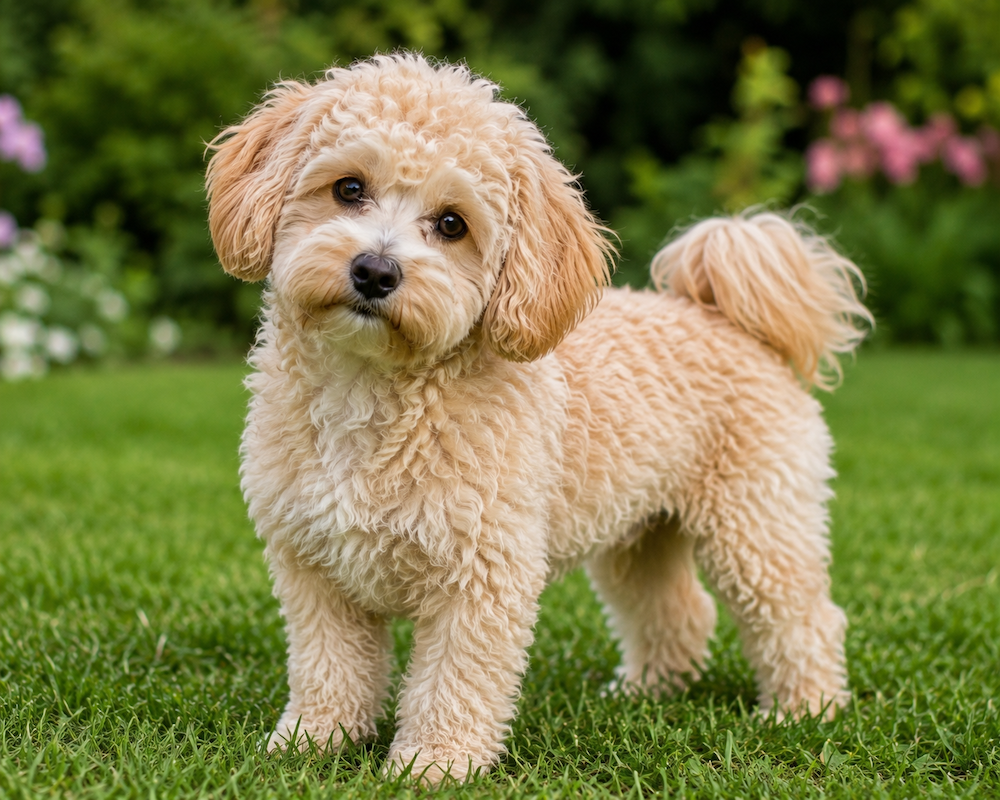





Cute, affectionate, and full of fun — a playful companion that loves attention and family life.
🧠 QUICK SNAPSHOT
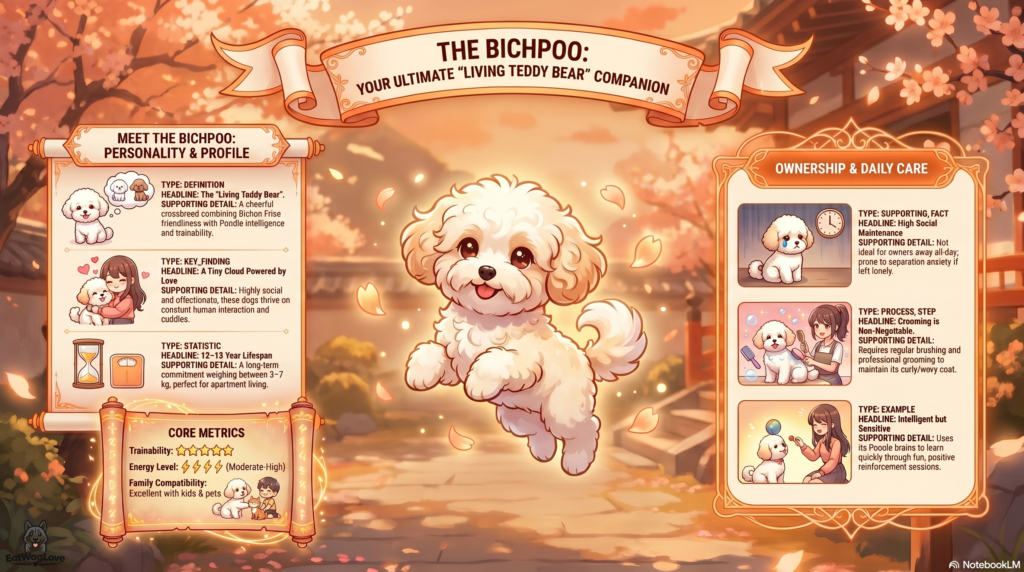
- Temperament: Friendly, affectionate, playful
- Energy Level: Moderate
- Size: Small
- Good With Families: Yes
- Trainability: High
- Grooming: Moderate
- Best For: Families, apartments, companionship
📚 OVERVIEW
The Bichpoo is a cross between a Bichon Frise and a Poodle, combining intelligence with a cheerful, loving personality. They are social dogs that enjoy attention and thrive in homes where they are part of everyday activities.
Their fluffy appearance and playful nature make them popular companion dogs.
✅ PROS & CONS
Pros
- Very affectionate and social
- Intelligent and easy to train
- Great for apartments and small homes
- Low shedding coat
Cons
- Needs regular grooming
- Can develop separation anxiety
- Requires attention and companionship
- Energy levels can vary between individuals
Is a Bichpoo a Good Family Dog?
Yes, the Bichpoo can be an excellent family dog, particularly for households wanting a small, affectionate and playful companion.
A Bichpoo is a cross between a Bichon Frise and a Poodle, usually a Toy or Miniature Poodle. Both parent breeds are intelligent, people-oriented companion dogs, so many Bichpoos thrive on close involvement with their families.
They can be very good with respectful children, although their small size means interactions with very young children should be supervised.
Individual temperament varies because the Bichpoo isn’t a standardised breed.
At its best, the Bichpoo combines the cheerful charm of the Bichon with the cleverness of the Poodle.
How Much Exercise Does a Bichpoo Need?
Most adult Bichpoos need around 30–60 minutes of exercise each day, along with regular play and mental stimulation.
They’re small dogs, but they can be surprisingly energetic.
Daily walks, retrieving games, puzzle toys and short training sessions provide excellent outlets.
The Poodle influence can produce a particularly clever and active little dog that needs more mental stimulation than its size might suggest.
Fortunately, much of this activity can be provided without an enormous backyard.
A Bichpoo may be small enough to carry around — but that doesn’t mean its preferred exercise programme involves being carried.
Is a Bichpoo Easy to Train?
Bichpoos are generally intelligent and highly trainable.
Both Bichon Frises and Poodles have long histories as clever performers and companion dogs capable of learning tricks and routines.
Positive reinforcement, food rewards and short, entertaining training sessions usually work extremely well.
Housetraining can sometimes require patience, particularly if the puppy inherits this tendency from the Bichon side.
Consistency is important.
Bichpoos can learn tricks, basic obedience and even activities such as agility surprisingly quickly.
The bigger challenge may be ensuring their intelligence is being used for your ideas rather than their own.
Does a Bichpoo Shed?
Most Bichpoos are low-shedding dogs, but shedding levels vary depending on the coat they inherit.
Both Bichon Frises and Poodles are known for low-shedding coats, making low shedding more predictable in this cross than in some other Poodle mixes.
However, individual Bichpoos can still vary in coat texture and shedding.
Loose hairs often become trapped within the curly or wavy coat rather than falling onto furniture.
This means low shedding doesn’t equal low maintenance.
Regular brushing is essential to prevent matting.
Is a Bichpoo Hypoallergenic?
Bichpoos are often promoted as hypoallergenic, but no dog can be guaranteed not to trigger allergies.
Dog allergens are primarily proteins found in saliva, dander and other secretions rather than the hair itself.
Because both parent breeds shed relatively little, some allergy sufferers may find a Bichpoo easier to tolerate than a heavily shedding breed.
However, individual reactions vary considerably.
Anyone with significant allergies should spend time around adult dogs with similar coats before bringing a Bichpoo home.
How Often Does a Bichpoo Need Grooming?
A Bichpoo generally requires brushing several times each week and regular professional grooming.
Dogs with particularly curly coats may need brushing every day to prevent mats.
Professional clipping is commonly required approximately every six to eight weeks, although this varies according to coat length and style.
Areas behind the ears, beneath the legs, around the collar and near the tail are especially prone to tangling.
The Bichpoo illustrates one of the fundamental rules of many Poodle crosses:
less shedding usually means more grooming, not less grooming.
What Health Problems Are Common in Bichpoos?
Bichpoos can potentially inherit health conditions associated with both the Bichon Frise and Poodle.
Possible concerns include patellar luxation, inherited eye disorders, allergies and dental disease.
Bladder stones occur within Bichon populations, while some Poodle lines can carry inherited eye diseases such as progressive retinal atrophy.
Legg-Calvé-Perthes disease can also affect small dogs, including Toy and Miniature Poodles.
Responsible breeders should health-test both parents for conditions relevant to their respective breeds.
Crossbreeding doesn’t automatically prevent inherited disease.
How Long Do Bichpoos Live?
Bichpoos commonly live around 12–16 years, with some potentially living longer.
Their relatively small size contributes to their generally good lifespan.
Genetics, body condition, nutrition, dental health and preventive veterinary care all influence longevity.
Regular dental care is particularly important because small companion dogs can be prone to periodontal disease.
Many Bichpoos retain their playful, puppy-like personality well into adulthood.
How Big Does a Bichpoo Get?
The Bichpoo is generally a small dog, but adult size depends heavily on whether a Toy or Miniature Poodle was used.
Many adults weigh approximately 4–9 kg, although individuals can fall outside this range.
Height and build can also vary considerably.
Terms such as “Toy,” “Mini” and “Teacup” aren’t universally standardised for Bichpoos, so prospective owners should look at the actual size of both parents rather than relying entirely on marketing labels.
With a crossbreed, the parents are usually a better size guide than the name on the advertisement.
Can a Bichpoo Live in an Apartment?
Yes, Bichpoos are generally very well suited to apartment living.
Their small size and moderate exercise requirements allow them to live comfortably without a large backyard.
They still require daily walks, play and mental stimulation.
Barking can become an issue in shared buildings if the dog reacts excessively to hallway noises or becomes bored.
Their strong attachment to people can also make separation training particularly important.
For owners prepared to provide regular interaction, a Bichpoo can be an excellent small-space companion.
Can a Bichpoo Be Left Alone?
Bichpoos generally prefer plenty of human companionship and may struggle if routinely left alone for very long periods.
Both parent breeds are strongly people-oriented.
Some Bichpoos can develop separation-related behaviours, particularly if they’ve never been taught to spend time independently.
Puppies should gradually learn that short periods alone are safe and normal.
Exercise, enrichment and predictable routines can help.
This is generally a breed cross for someone wanting a companion closely involved in everyday life.
Do Bichpoos Bark a Lot?
Bichpoos can be fairly alert and vocal, although barking varies substantially between individuals.
They may bark at visitors, unfamiliar noises, other dogs or activity outside the home.
Boredom and separation distress can also increase barking.
Early training is particularly useful in apartments, where repeated alert barking can quickly become a problem.
Owners should reward calm behaviour rather than accidentally teaching the puppy that barking always produces attention.
Are Bichpoos Good With Other Dogs?
Bichpoos are generally sociable with other dogs, particularly when properly socialised.
Both Bichons and Poodles can be playful and socially engaged, and many Bichpoos enjoy canine companionship.
Their small size means play with much larger dogs should be supervised carefully.
A confident Bichpoo may not fully appreciate the size difference between itself and its new 40-kilogram friend.
Are Bichpoos Good With Cats?
Yes, many Bichpoos can live very successfully with cats.
Neither parent breed is primarily known for an extreme prey drive, although individual dogs vary.
Dogs raised alongside cats often learn to coexist comfortably with them.
Introductions should still be gradual and supervised.
Cats should have elevated areas where they can escape an enthusiastic puppy when they want some peace.
Do Bichpoos Like Water?
Some Bichpoos enjoy swimming and playing in water, particularly if they inherit this tendency from their Poodle parent.
Poodles were originally developed as water retrievers, so an attraction to water has deep historical roots.
Other Bichpoos may show very little interest.
Dogs should always be introduced to water gradually and supervised around pools and other bodies of water.
Their curly coats should also be thoroughly dried and brushed after swimming to help prevent matting.
Why Do Bichpoos Get Tear Stains?
Bichpoos with pale coats can develop noticeable reddish-brown staining beneath the eyes.
This can be particularly obvious in dogs inheriting the Bichon Frise’s white colouring.
Tears contain compounds that can discolour light hair, but excessive tearing can also result from allergies, irritation, blocked tear drainage, eyelash abnormalities or other eye problems.
Persistent or suddenly worsening tearing should be checked by a veterinarian.
Regular gentle cleaning can help manage cosmetic staining once medical causes have been considered.
What Colours Can Bichpoos Be?
Bichpoos can occur in a surprisingly wide variety of colours.
While the Bichon Frise is famous for its white coat, Poodles occur in numerous colours, including black, brown, cream, apricot, red, silver and white.
Bichpoos can therefore be white, cream, apricot, brown, black or combinations of colours depending on their genetics.
Some coats can also lighten significantly as the dog matures, particularly when fading genes inherited from the Poodle are involved.
The puppy’s colour isn’t always the exact colour you’ll see several years later.
Is a Bichpoo the Same as a Poochon?
Yes. Bichpoo and Poochon usually refer to the same Bichon Frise–Poodle cross.
Other variations of the name may occasionally appear depending on breeder or country.
There isn’t a universally controlled naming system because this is a crossbreed rather than a standardised pedigree breed.
The name tells you the two parent breeds, but it doesn’t guarantee a particular size, coat or temperament.
Whether it’s advertised as a Bichpoo or Poochon, the important questions concern the actual parents, health testing and how the puppy was raised.
What Is an F1, F1B or F2 Bichpoo?
These labels describe different generations of Bichpoo breeding.
An F1 Bichpoo is generally a first-generation cross between a Bichon Frise and a Poodle.
An F1B usually refers to an F1 Bichpoo bred back to one of the parent breeds, commonly a Poodle.
An F2 generally results from breeding two F1 Bichpoos.
These labels describe ancestry but don’t guarantee an exact coat, shedding level, size or personality.
Even puppies with the same generation label can develop quite differently.
Is a Bichpoo a Recognised Dog Breed?
The Bichpoo is generally considered a designer crossbreed rather than a standardised pedigree breed.
Major traditional kennel clubs don’t recognise the Bichpoo in the same way they recognise the Bichon Frise or Poodle.
There is therefore no single universally accepted breed standard controlling size, coat, colour and temperament.
This helps explain why one Bichpoo can look very different from another.
The name describes its ancestry much more reliably than it predicts exactly what the adult dog will become.
Where Did the Bichpoo Come From?
The exact origin of the Bichpoo is not well documented, and there doesn’t appear to be a reliably established single breeder or date responsible for creating the cross.
Bichon Frise–Poodle crosses became increasingly popular during the broader growth of deliberately bred Poodle crosses in the late 20th and early 21st centuries.
The aim has generally been to combine the Bichon’s cheerful companion temperament with the Poodle’s intelligence and low-shedding coat.
Of course, accidental crosses between the two breeds may have existed long before the name became fashionable.
The modern Bichpoo is therefore best understood as a relatively recent designer cross built from two much older companion breeds.