






Tiny, elegant, and full of charm — a playful companion with a silky coat and affectionate personality.
🧠 QUICK SNAPSHOT
- Temperament: Affectionate, playful, lively
- Energy Level: Moderate
- Size: Small
- Good With Families: Yes
- Trainability: Moderate to high
- Grooming: High
- Best For: Families, apartments, companionship
📚 OVERVIEW
The Biewer Terrier is a small toy breed known for its long, silky coat and cheerful personality. Originally developed from Yorkshire Terriers, they are affectionate dogs that enjoy attention and companionship.
They are playful and curious, making them entertaining companions for both individuals and families.
✅ PROS & CONS
Pros
- Affectionate and people-focused
- Compact and adaptable
- Beautiful, silky coat
- Playful and entertaining personality
Cons
- Requires regular grooming
- Can be sensitive
- Needs companionship and attention
- Fragile around rough handling
Is a Biewer Terrier a Good Family Dog?
Yes, the Biewer Terrier can be an excellent family companion, particularly for households wanting a small, affectionate and playful dog.
Biewers tend to form close relationships with their people and are often cheerful, entertaining and surprisingly confident for their size. They can live well with respectful children, although their tiny build means rough handling can easily cause injury.
Unlike many traditional terriers, the Biewer was developed primarily as a companion rather than a working vermin hunter.
This is a little dog designed to be part of family life — and many Biewers take that responsibility very seriously indeed.
How Much Exercise Does a Biewer Terrier Need?
Most Biewer Terriers need around 30–45 minutes of daily exercise, combined with play and mental stimulation.
Their small size means they don’t need enormous distances, but they’re generally lively and energetic.
Short walks, retrieving games, puzzle toys and indoor play can provide plenty of activity.
They can also enjoy learning tricks and participating in small-dog sports.
Their exercise requirements are manageable, but a Biewer shouldn’t simply be treated as a decorative lap dog.
Is a Biewer Terrier Easy to Train?
Biewer Terriers are intelligent and capable of learning quickly, particularly when training is positive and enjoyable.
Food rewards, praise and short sessions usually work well.
Like many small companion dogs, housetraining can sometimes require patience and consistency.
Owners should also avoid allowing behaviours in a tiny puppy that they wouldn’t accept from a larger dog.
A Biewer may weigh only a few kilograms, but it can still develop a very large opinion about how the household should operate.
Does a Biewer Terrier Shed?
The Biewer Terrier is considered a very low-shedding breed.
Its long, silky coat is more hair-like than the dense shedding coats of many dogs.
However, low shedding doesn’t mean low maintenance.
Long-coated Biewers require frequent brushing to prevent tangles and mats. Many pet owners choose a shorter “puppy cut” because it’s easier to maintain.
Professional grooming is often needed regularly.
Is a Biewer Terrier Hypoallergenic?
Biewer Terriers are sometimes described as hypoallergenic because they shed very little, but no dog is completely allergen-free.
Allergens are found in saliva, dander and other secretions as well as being carried on hair.
Some people with dog allergies may tolerate a low-shedding Biewer better than a heavily shedding breed, but this isn’t guaranteed.
Anyone with significant allergies should spend time around adult Biewer Terriers before deciding whether the breed is suitable.
What Health Problems Are Common in Biewer Terriers?
Biewer Terriers can be affected by several health problems associated with small and toy-sized dogs.
Patellar luxation is an important concern, while dental disease can develop because small jaws often provide limited space for teeth.
Some individuals may also experience gastrointestinal sensitivity, liver-related disorders such as portosystemic shunts, and certain eye problems.
Because the breed has a relatively small foundation population, careful breeding and genetic diversity are particularly important.
Responsible breeders should undertake appropriate health screening rather than assuming that a relatively new breed is automatically free from inherited problems.
How Long Do Biewer Terriers Live?
Biewer Terriers commonly live around 14–16 years, and some may live longer.
Their small size contributes to their relatively good longevity.
Maintaining healthy body weight, providing regular dental care and arranging routine veterinary examinations can all support a long life.
Their long lifespan is worth considering before purchasing one.
A Biewer puppy can potentially remain part of the family for well over a decade and into its mid-teens.
How Big Does a Biewer Terrier Get?
The Biewer Terrier is a very small toy breed.
Adults generally stand around 18–28 cm tall and commonly weigh approximately 2–4 kg.
Despite their delicate appearance, they should be lively and well proportioned rather than excessively fragile.
Terms such as “teacup Biewer” aren’t separate recognised varieties and can sometimes be marketing terms for unusually small dogs.
Breeding for extreme miniaturisation can increase health and welfare concerns.
Can a Biewer Terrier Live in an Apartment?
Yes, the Biewer Terrier is very well suited to apartment living.
Its tiny size and manageable exercise requirements make it easy to accommodate in a smaller home.
Daily walks, indoor play and mental stimulation are still important.
Barking may need management because some Biewers are alert to noises and visitors.
Their small size also makes indoor toileting accidents particularly easy to overlook during puppy training, so establishing a consistent routine is important.
Can a Biewer Terrier Be Left Alone?
Biewer Terriers generally prefer being with their people and may struggle if regularly left alone for long periods.
The breed was developed primarily for companionship, and many individuals form very strong attachments to their owners.
Puppies should gradually learn to spend reasonable periods independently.
Without this training, separation-related behaviours such as barking or distress may develop.
A Biewer is usually happiest in a household where it can participate extensively in everyday family life.
Do Biewer Terriers Bark a Lot?
Biewer Terriers can be alert and fairly vocal, although individual dogs vary.
They may bark at visitors, unfamiliar noises or activity outside the home.
Boredom and separation distress can also increase barking.
Early training should reward calm behaviour and teach the dog when alerting is no longer necessary.
Their tiny size doesn’t prevent them from believing they’re perfectly qualified to manage household security.
Are Biewer Terriers Good With Other Dogs?
Biewer Terriers can be very sociable with other dogs when properly socialised.
Many enjoy living with another small companion dog.
Their confidence can occasionally exceed their physical size, so interactions with large or boisterous dogs require supervision.
A friendly 3-kilogram Biewer may have absolutely no concerns about approaching a 40-kilogram dog.
Its owner probably should.
Are Biewer Terriers Good With Cats?
Yes, Biewer Terriers can often live successfully with cats, particularly when raised together.
Although “Terrier” appears in the breed’s name, the modern Biewer was developed primarily as a companion dog rather than specifically for hunting vermin.
Individual prey drive still varies.
Gradual introductions and supervision are sensible, and cats should always have somewhere they can retreat if the dog becomes overly enthusiastic.
What Colours Can a Biewer Terrier Be?
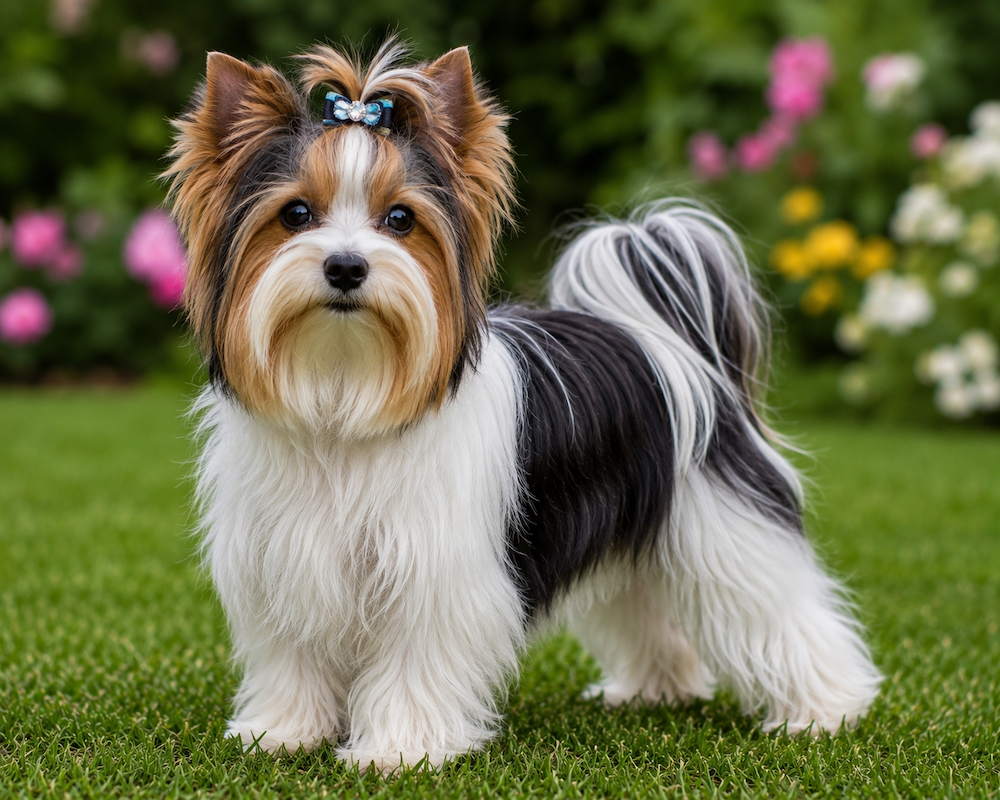
The Biewer Terrier is famous for its distinctive tricolour coat.
Depending on the breed standard and terminology used, the coat combines areas of white with black or blue and gold or tan markings.
The extensive white patterning is one of the features that originally distinguished these dogs from traditional Yorkshire Terriers.
The coat should be long, silky and flowing when maintained in full show condition.
Why Does the Biewer Terrier Have So Much White in Its Coat?
The Biewer Terrier’s distinctive white markings resulted from recessive piebald colouring appearing in Yorkshire Terrier breeding lines.
This produced puppies with large areas of white alongside the darker and tan/gold colouring associated with their Yorkshire Terrier ancestry.
Werner and Gertrud Biewer deliberately bred dogs carrying this appearance, eventually establishing the distinctive population that became today’s Biewer Terrier.
What began as an unexpected colour pattern ultimately helped create an entirely new breed.
Is a Biewer Terrier Just a Yorkshire Terrier With Different Colours?
No. Although the Biewer Terrier originated from Yorkshire Terrier bloodlines, it’s now recognised by several organisations as a distinct breed.
The earliest Biewers arose from Yorkshire Terriers carrying genes responsible for the unusual piebald colouring.
Selective breeding then established the Biewer’s appearance and companion-dog characteristics.
Modern genetic research has also played an interesting role in establishing the Biewer’s breed identity.
So historically, the Yorkshire Terrier is fundamental to the Biewer’s story — but the modern Biewer isn’t simply classified everywhere as a differently coloured Yorkie.
How Do You Pronounce Biewer Terrier?
The name Biewer is commonly pronounced approximately “bee-vair”, reflecting its German origin rather than being pronounced like the English word “beaver.”
The breed was named after German breeders Werner and Gertrud Biewer.
Mispronunciation is extremely common outside German-speaking countries, particularly because English speakers naturally try to pronounce the name phonetically.
So despite what the spelling may suggest, this little dog has nothing to do with beavers.
Who Were Werner and Gertrud Biewer?
Werner and Gertrud Biewer were German Yorkshire Terrier breeders whose dogs produced the unusual puppies that eventually led to the Biewer Terrier.
In the 1980s, their breeding programme produced Yorkshire Terrier puppies displaying significant white colouring.
Rather than treating the markings simply as an undesirable deviation, the Biewers became interested in developing the distinctive dogs.
Their surname ultimately became the breed’s name.
Few breeders can claim quite such a lasting legacy: their family name is now spoken every time someone identifies the breed.
When Was the First Biewer Terrier Born?
The breed’s history is generally traced to Germany in 1984, when a piebald puppy named Schneeflöckchen von Friedheck was born in Werner and Gertrud Biewer’s Yorkshire Terrier breeding programme.
The unusual white patterning attracted the breeders’ attention and became the foundation for further selective breeding.
The dogs were initially known by names including Biewer Yorkshire Terrier à la Pom Pon.
Over time, dedicated breeding programmes established the Biewer as a distinct breed rather than simply an unusual Yorkshire Terrier colour.
Is the Biewer Terrier a Recognised Dog Breed?
Yes. The Biewer Terrier is now recognised as a distinct breed by some major kennel organisations, most notably the American Kennel Club.
The AKC formally recognised the Biewer Terrier as a breed in 2021.
Its path to recognition was unusual because modern DNA analysis contributed to evaluating the breed’s genetic identity and ancestry.
Recognition can still differ between kennel organisations and countries, so its classification isn’t necessarily identical everywhere.
Where Does the Biewer Terrier Come From?
The Biewer Terrier comes from Germany, where Werner and Gertrud Biewer bred Yorkshire Terriers during the 1980s.
An unexpectedly piebald puppy born in their breeding programme in 1984 helped begin the development of the new type.
The Biewers selectively bred dogs displaying the unusual white, dark and gold colouring, and interest in these little companion dogs gradually spread internationally.
The breed later became particularly popular in the United States, where organised breeding and eventual kennel-club recognition helped establish its modern identity.
The Biewer Terrier therefore has one of the more unusual modern breed histories: an unexpected puppy colour appeared in Germany and, within a few decades, developed into an internationally recognised breed.