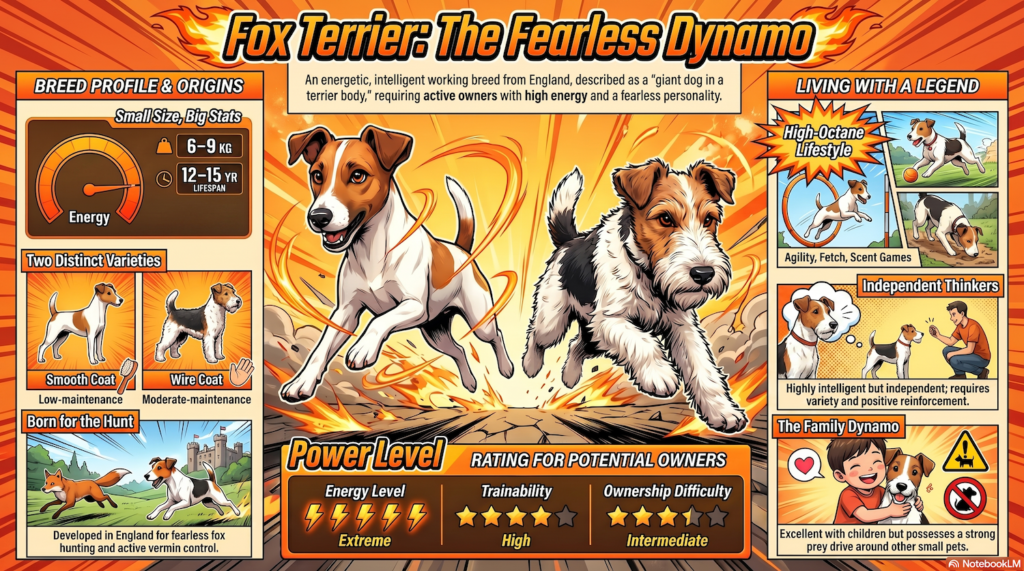







Energetic, fearless, and full of character — a lively companion that never seems to run out of enthusiasm.
🧠 QUICK SNAPSHOT
- Temperament: Energetic, intelligent, confident
- Energy Level: High
- Size: Small to medium
- Good With Families: Yes
- Trainability: Moderate to high
- Grooming: Low to moderate
- Best For: Active owners, families, outdoor lifestyles
📚 OVERVIEW
The Fox Terrier is a spirited breed originally developed for fox hunting, prized for its courage, agility, and determination. Available in both Smooth Fox Terrier and Wire Fox Terrier varieties, they share the same lively personality and strong terrier instincts.
These dogs are intelligent, entertaining, and always eager to be part of the action, making them ideal companions for active households.
✅ PROS & CONS
Pros
- Highly energetic and playful
- Intelligent and alert
- Loyal to family members
- Compact yet athletic build
Cons
- Strong prey drive
- Can be stubborn and independent
- Requires regular exercise and stimulation
- May bark frequently if bored
Is a Fox Terrier a Good Family Dog?
Yes. A Fox Terrier can be an excellent family dog for an active household that enjoys an energetic, intelligent and strong-minded companion.
Fox Terriers are typically playful, affectionate and entertaining, but they’re true working terriers rather than quiet lap dogs.
They usually thrive with owners who provide exercise, training and plenty of involvement in family life.
Are There Two Types of Fox Terrier?
Yes. There are two recognised Fox Terrier breeds: the Smooth Fox Terrier and Wire Fox Terrier.
They share much of their history and original working purpose but differ significantly in coat.
Modern kennel organisations generally recognise them as separate breeds rather than simply coat varieties of one breed.
What Is the Difference Between a Smooth Fox Terrier and a Wire Fox Terrier?
The most obvious difference is the coat.
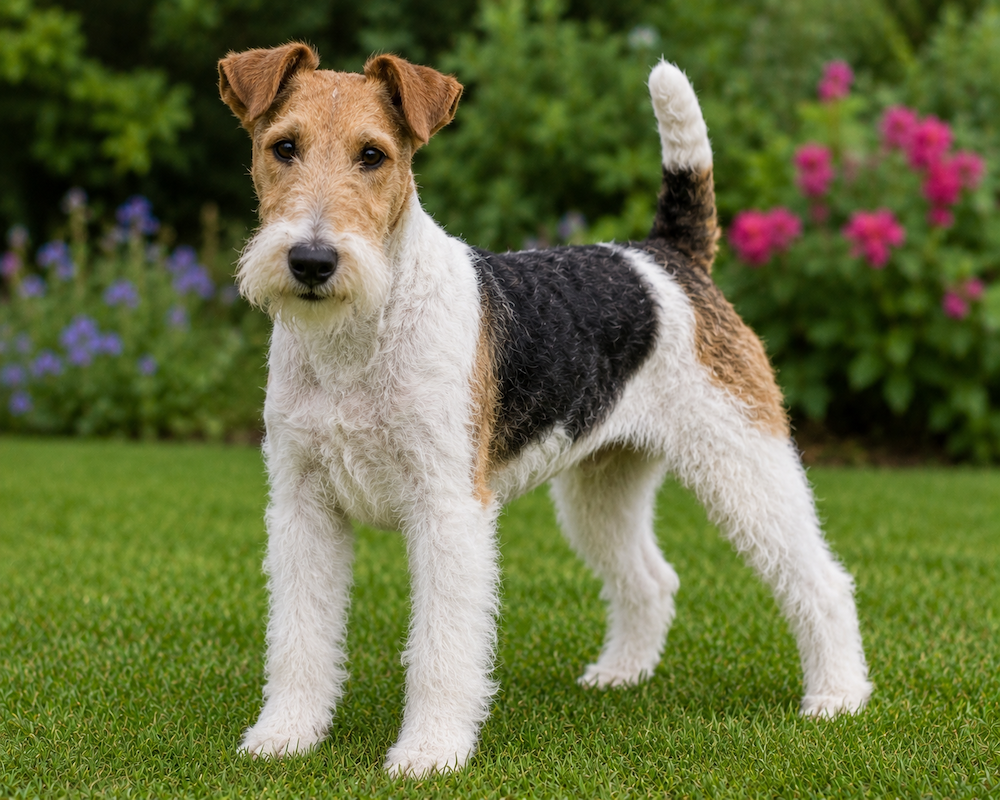
Smooth Fox Terriers have short, dense, flat coats. Wire Fox Terriers have harsh, wiry outer coats with softer undercoats and characteristic facial furnishings.
Wire Fox Terriers also require much more specialised grooming.
Temperament is broadly similar: lively, bold, curious and unmistakably terrier.
How Much Exercise Does a Fox Terrier Need?
Most adult Fox Terriers need around 60–90 minutes of exercise each day, plus mental stimulation.
Walks alone may not completely satisfy them.
Games, scent work, training, exploring and safe opportunities to run can help channel their considerable energy.
Despite their moderate size, Fox Terriers aren’t low-energy dogs.
Is a Fox Terrier Easy to Train?
Fox Terriers are highly intelligent but famously independent.
They can learn very quickly — including behaviours their owners never intended to teach.
Short, varied reward-based sessions usually work better than repetitive drilling.
Their hunting instincts can make recall particularly challenging around wildlife.
Does a Fox Terrier Shed?
It depends partly on which Fox Terrier you have.
Smooth Fox Terriers shed moderately, despite their short coats.
Wire Fox Terriers generally shed less visibly because loose hair tends to remain within the coat until removed through grooming.
Neither should be considered completely non-shedding.
Is a Fox Terrier Hypoallergenic?
No Fox Terrier can be guaranteed hypoallergenic.
Wire Fox Terriers are sometimes better tolerated because they release less loose hair when correctly groomed, but allergens are also produced through saliva and skin secretions.
Smooth Fox Terriers shed more conventionally.
How Often Does a Smooth Fox Terrier Need Grooming?
Smooth Fox Terriers are relatively easy to groom.
Weekly brushing usually removes loose hair and keeps the coat in good condition.
Occasional bathing, nail trimming, dental care and ear checks complete most routine grooming requirements.
Their coat may be short, but the small stiff hairs can become surprisingly good at attaching themselves to clothing and furniture.
How Often Does a Wire Fox Terrier Need Grooming?
Wire Fox Terriers require considerably more grooming.
Regular brushing helps prevent tangles, while maintaining the traditional harsh coat requires hand stripping.
Pet dogs are sometimes clipped instead, although repeated clipping changes the coat’s texture and appearance.
Show preparation can be particularly labour-intensive.
What Is Hand Stripping a Wire Fox Terrier?
Hand stripping involves removing dead outer hairs by hand or with specialised stripping tools once they’re ready to shed naturally.
This allows new harsh coat to grow through.
It isn’t the same as pulling healthy hair painfully from the skin when performed correctly.
Hand stripping helps preserve the Wire Fox Terrier’s characteristic colour and wiry texture.
Can You Clip a Wire Fox Terrier Instead of Hand Stripping?
Yes. Many pet Wire Fox Terriers are professionally clipped because it’s quicker and easier.
However, clipping cuts rather than removes dead outer hairs.
Over time the coat can become softer, paler and less weather-resistant.
Owners wanting the traditional harsh terrier coat generally choose hand stripping.
What Health Problems Are Common in Fox Terriers?
Fox Terriers are generally robust dogs, but potential concerns include patellar luxation, certain eye disorders, lens luxation, Legg-Calvé-Perthes disease and inherited deafness in some lines.
Health risks differ somewhat between Smooth and Wire populations.
Responsible breeders should use appropriate screening rather than relying solely on the breed’s reputation for toughness.
Are Fox Terriers Prone to Deafness?
Congenital deafness can occur in Fox Terriers, particularly in predominantly white dogs.
The relationship between extreme white spotting and inherited deafness occurs across several dog breeds.
Dogs can be deaf in one ear without owners immediately noticing.
BAER testing can objectively assess hearing in each ear.
How Long Do Fox Terriers Live?
Fox Terriers commonly live around 12–15 years, and some live longer.
Their relatively small size and athletic structure can support good longevity.
Maintaining a healthy body weight and providing regular exercise are important throughout life.
How Big Does a Fox Terrier Get?
Fox Terriers are small-to-medium athletic dogs.
Adults are generally around 35–40 cm at the shoulder and often weigh approximately 7–9 kg, although sex, breed variety and individual build create variation.
They’re relatively compact dogs containing a surprisingly large amount of personality.
Can a Fox Terrier Live in an Apartment?
Yes, but it requires commitment.
Fox Terriers are compact enough for apartment living, but their exercise requirements, barking and high stimulation needs can create challenges.
A garden isn’t essential if the dog receives enough meaningful activity.
Secure fencing becomes particularly important wherever outdoor space is available.
Do Fox Terriers Bark a Lot?
They can.
Fox Terriers are naturally alert, excitable and quick to notice movement, making barking common.
Their historical work rewarded persistence rather than quiet passivity.
Training can establish reasonable boundaries, but expecting a Fox Terrier never to announce something interesting is unrealistic.
Can a Fox Terrier Be Left Alone?
Adult Fox Terriers can learn to spend reasonable periods alone, but boredom can create trouble remarkably quickly.
An under-stimulated terrier may bark, dig, chew or conduct its own investigation into how household objects are constructed.
Exercise and enrichment before periods alone can make a substantial difference.
Are Fox Terriers Good With Children?
They can be excellent companions for respectful, active children.
Fox Terriers are playful, energetic and often enjoy games.
However, they can be boisterous and don’t always tolerate rough handling.
Supervision is particularly important around young children.
Are Fox Terriers Good With Other Dogs?
It depends heavily on the individual.
Fox Terriers can be confident, assertive and occasionally confrontational with other dogs.
Early socialisation helps, but their traditional terrier temperament shouldn’t be underestimated.
Some happily share homes with other dogs while others prefer more selective canine relationships.
Are Fox Terriers Good With Cats?
Some can live successfully with cats, especially when raised with them, but the breed’s strong prey drive makes compatibility unpredictable.
A familiar household cat may be accepted while unfamiliar cats outdoors trigger pursuit.
Careful introductions and management are important.
Do Fox Terriers Have a Strong Prey Drive?
Yes. Fox Terriers were specifically developed to pursue quarry, so chasing instinct can be extremely strong.
Rabbits, rodents, squirrels and other small animals can trigger immediate pursuit.
A secure garden and strong recall training are essential.
Small pets such as hamsters and rabbits require particularly careful separation.
Can a Fox Terrier Be Trusted Off Leash?
Some can develop excellent recall, but prey drive can override training extremely quickly.
A Fox Terrier spotting a rabbit may make an instantaneous decision.
Secure fenced areas are therefore often safer for unrestricted running.
Recall training should begin early and be practised around gradually increasing distractions.
Why Does My Fox Terrier Dig So Much?
Digging is deeply connected with terrier working behaviour.
Fox Terriers historically needed to investigate underground spaces where quarry might hide.
Digging can also result from boredom or excess energy.
Providing a designated digging area can be more realistic than expecting a determined terrier never to excavate anything.
Why Does My Fox Terrier Chase Everything?
Chasing movement is a natural expression of predatory and terrier instincts.
Fox Terriers were deliberately selected for courage, persistence and willingness to pursue quarry.
Bicycles, birds, rodents and running animals can therefore become highly stimulating.
Impulse-control training helps, but genetics don’t disappear simply because the dog now lives in suburbia.
Are Fox Terriers Good Ratters?
Yes. Fox Terriers can be excellent vermin hunters.
Although their name emphasises fox work, terriers were useful for controlling rats and other pests around farms, stables and properties.
Their speed, determination and prey drive made them effective all-purpose vermin dogs.
Are Fox Terriers Good Watchdogs?
Yes. Fox Terriers can make excellent alert watchdogs.
They’re observant, bold and quick to announce unusual activity.
Their size means they aren’t conventional protection dogs, but they can be remarkably confident when something appears suspicious.
Are Fox Terriers Aggressive?
Well-bred Fox Terriers shouldn’t be indiscriminately aggressive, but they can be bold, assertive and highly reactive to prey.
Terrier courage historically mattered.
Early socialisation and sensible training help ensure confidence doesn’t become uncontrolled confrontation.
Aggression towards humans isn’t an acceptable breed characteristic.
Are Fox Terriers Cuddly?
Many are surprisingly affectionate and cuddly once they’ve finished being busy.
They often form strong relationships with their families.
A Fox Terrier can spend an afternoon behaving like a miniature hunting machine and then decide that sleeping directly against its owner is the only acceptable evening arrangement.
Are Fox Terriers Good Running Dogs?
Healthy adult Fox Terriers can make excellent short-to-moderate distance running companions.
They’re athletic and energetic.
However, their prey drive means leash running is generally safer around wildlife and traffic.
Structured running should begin only after physical maturity.
Do Fox Terriers Like Water?
Some love swimming while others are indifferent.
Fox Terriers weren’t developed primarily as water-working dogs, so enthusiasm varies considerably.
Their confidence and curiosity can nevertheless lead many individuals straight into water.
Supervision remains important.
Can Fox Terriers Jump High?
Yes. Fox Terriers can be remarkably athletic jumpers.
Their compact size shouldn’t be mistaken for limited physical ability.
Some can jump or climb surprisingly high fencing, particularly when something interesting appears on the other side.
Secure gardens may therefore require higher and more carefully designed fencing than owners initially expect.
Why Are Fox Terriers So Energetic?
Their ancestors needed to keep pace with mounted hunts and then work intensely when quarry went to ground.
That required stamina, speed, courage and persistence.
The modern Fox Terrier still carries much of that working temperament.
Small body does not equal small exercise requirement.
What Was the Fox Terrier Originally Bred For?
Fox Terriers were developed primarily to assist traditional British fox hunts.
Their job wasn’t normally to chase foxes across miles of countryside ahead of horses.
Foxhounds performed that task.
The terrier became particularly valuable when a fox escaped underground.
Did Fox Terriers Actually Go Underground After Foxes?
Yes. A principal historical role was to enter fox earths and force or encourage the fox back above ground so the hunt could continue.
This required a relatively compact dog with exceptional courage.
The work explains the breed’s determination, digging instinct and willingness to enter confined spaces.
Did Fox Terriers Run With Foxhounds?
Yes. Fox Terriers were associated with packs of Foxhounds and mounted hunts.
Some were expected to accompany the hunt, while terriers could also be carried to where they were needed.
Their job complemented rather than replaced the Foxhound.
Foxhounds found and pursued the fox; terriers dealt with situations underground.
Why Were Fox Terriers Mostly White?
A predominantly white coat helped hunters distinguish the terrier from the fox and surrounding quarry, particularly during fast-moving hunts.
White also made the relatively small dog easier to see.
This practical preference became a defining feature of both Smooth and Wire Fox Terriers.
Why Does a Fox Terrier Have Such a Narrow Body?
Traditional working terriers needed bodies compact enough to enter underground fox dens and narrow passages.
An excessively broad or heavy dog would be less effective.
Although modern show breeding has influenced appearance, the basic Fox Terrier shape reflects a dog originally expected to work in confined spaces.
Why Is It Called a Terrier?
“Terrier” comes from the Latin terra, meaning earth.
Terriers were dogs developed to pursue quarry associated with the ground or underground burrows.
Few breeds demonstrate that origin more clearly than the Fox Terrier, whose historical work could literally involve disappearing beneath the earth after quarry.
Is the Fox Terrier a British Breed?
Yes. Fox Terriers were developed in Britain, particularly within the culture of organised fox hunting.
Their development became increasingly formalised during the 19th century.
They subsequently became enormously influential in the creation and development of numerous other terrier breeds around the world.
How Old Is the Fox Terrier?
Small working terriers existed in Britain for centuries, but the recognisable Fox Terrier emerged primarily during the 18th and 19th centuries.
Formal breed standards and organised showing arrived during the Victorian era.
The modern pedigree breeds are therefore younger than the working terrier tradition from which they developed.
What Breeds Created the Fox Terrier?
The exact ancestry of early Fox Terriers isn’t completely documented.
Historical accounts mention various British working terriers, with possible influence from other sporting dogs depending on particular lines.
Because development occurred before modern pedigree records became comprehensive, precise breed-percentage claims should be treated cautiously.
Was the Bull Terrier Used to Create Fox Terriers?
Bull-and-terrier ancestry is sometimes discussed in relation to various British terrier populations, but early Fox Terrier development was complex and not documented like a modern breeding experiment.
Different regional working dogs contributed to the developing type.
It’s safer to describe the Fox Terrier as emerging from Britain’s broader working-terrier tradition rather than assigning exact modern breed percentages.
Which Came First, the Smooth or Wire Fox Terrier?
Smooth-coated fox-working terriers were documented early, while Wire Fox Terriers developed from rough-coated working terrier populations.
The two varieties were historically closely associated and were even interbred at times.
Their formal separation occurred much later.
Were Smooth and Wire Fox Terriers Once Considered the Same Breed?
Yes. For much of their organised history, Smooth and Wire Fox Terriers were regarded as varieties within the broader Fox Terrier population.
They shared the same fundamental working purpose.
Over time their appearance and breeding populations became increasingly distinct, eventually leading major kennel organisations to recognise them separately.
Were Smooth and Wire Fox Terriers Ever Crossed?
Yes. Historical breeders sometimes crossed the varieties, particularly while developing Wire Fox Terrier type and coat quality.
Selective breeding subsequently established more distinct populations.
Modern pedigree breeding generally treats them as separate breeds.
When Did Fox Terriers Become Show Dogs?
Fox Terriers became prominent during the Victorian development of organised dog shows in the 19th century.
Their sharp outlines, attractive colouring and association with fashionable hunting culture made them popular show dogs.
Eventually show breeding became a major influence alongside their traditional working role.
Was the Fox Terrier One of the First Popular Show Breeds?
Yes. Fox Terriers became enormously prominent in early British dog showing.
Wire Fox Terriers in particular later became extraordinary show-ring competitors.
Their popularity helped establish the image of the sharply groomed, confident terrier still familiar today.
Why Is the Wire Fox Terrier So Successful at Dog Shows?
The Wire Fox Terrier combines dramatic presentation, distinctive outline and animated terrier attitude, qualities that can make it particularly eye-catching in the show ring.
Expert hand stripping and grooming emphasise its characteristic shape.
The breed has enjoyed exceptional historical success at major international dog shows.
Has the Wire Fox Terrier Won Westminster More Than Any Other Breed?
Yes. The Wire Fox Terrier has historically been the most successful breed in Best in Show competition at the Westminster Kennel Club Dog Show.
Its record is remarkable considering the enormous number of breeds competing.
Wire Fox Terriers have accumulated more Westminster Best in Show victories than any other breed.
Who Was Matford Vic?
Ch. Matford Vic was an influential early Wire Fox Terrier imported from Britain to the United States.
Dogs like Matford Vic helped establish the breed’s reputation and type in American breeding and showing.
Early transatlantic movement of influential terriers played an important role in making the Fox Terrier an international breed.
What Is the Difference Between a Fox Terrier and a Jack Russell Terrier?
Both are energetic British fox-working terriers, but they’re distinct breeds with different development and modern standards.
Jack Russell-type terriers generally retained a strong emphasis on practical earth work and occur in different coat types.
Fox Terriers developed their own characteristic structure and became particularly influential in organised dog showing.
Is a Fox Terrier the Same as a Parson Russell Terrier?
No. The Parson Russell Terrier and Fox Terrier are separate breeds.
They share British fox-hunting heritage and therefore have understandable similarities.
The Parson Russell developed from the working terriers associated with Reverend John Russell, while Fox Terriers followed their own increasingly standardised breeding history.
Did Reverend John Russell Own Fox Terriers?
Reverend John “Jack” Russell was a 19th-century hunting enthusiast famous for breeding working fox terriers.
His dogs contributed to the tradition that eventually produced modern Jack Russell and Parson Russell Terriers.
His preferred working dogs shouldn’t simply be equated with today’s standardised Fox Terrier breeds, however.
Is a Toy Fox Terrier Just a Small Fox Terrier?
No. The Toy Fox Terrier is a distinct American breed, although Smooth Fox Terriers contributed importantly to its ancestry.
Toy Fox Terriers were developed by breeding smaller Smooth Fox Terrier-type dogs with toy breeds.
The result became its own recognised breed rather than simply a miniature size of Fox Terrier.
Is the Brazilian Terrier Related to the Fox Terrier?
Fox Terrier-type dogs are believed to have contributed to the development of the Brazilian Terrier, alongside other small terriers brought to Brazil.
The Brazilian breed subsequently developed its own characteristics and identity.
This illustrates how influential European Fox Terriers became internationally.
Did Fox Terriers Help Create Other Dog Breeds?
Yes. Fox Terrier blood or Fox Terrier-type dogs contributed to the development of several modern terrier and companion breeds.
Their combination of manageable size, athleticism, courage and attractive markings made them useful foundation dogs.
Their influence extends far beyond the two modern Fox Terrier breeds.
What Colours Can Fox Terriers Be?
Both Smooth and Wire Fox Terriers are traditionally predominantly white, often with black, tan or black-and-tan markings.
White should dominate the overall appearance.
This colouring reflects the breed’s hunting history as well as later show standards.
Why Do Wire Fox Terriers Have Beards?
The Wire Fox Terrier’s characteristic beard results from the longer harsh facial furnishings of its wiry coat.
Selective grooming emphasises these hairs to produce the breed’s distinctive rectangular-looking muzzle.
The beard is one of the easiest visual ways to distinguish a Wire from a Smooth Fox Terrier.
Why Does a Wire Fox Terrier Look So Different After Grooming?
Traditional hand stripping and careful trimming can dramatically sculpt the outline of the coat.
Groomers preserve longer furnishings in selected areas while removing mature coat elsewhere.
The polished show-ring appearance therefore requires substantial skill.
An ungroomed Wire Fox Terrier can look considerably more rugged and less geometrically precise.
Did Fox Terriers Have Docked Tails?
Historically, Fox Terriers commonly had docked tails.
Working explanations often claimed the remaining tail provided a useful handhold if a dog needed assistance underground, although tail docking also became deeply embedded in breed tradition and show appearance.
Routine cosmetic docking is now prohibited or restricted in many countries, including Australia.
Why Is a Fox Terrier’s Tail Carried So Upright?
An erect, confident tail became part of the Fox Terrier’s characteristic appearance and could also help locate a relatively small dog moving through vegetation.
Traditional breed standards strongly emphasised confident tail carriage.
Modern undocked dogs naturally display a longer tail than historical show images may suggest.
Are Fox Terriers Rare Today?
Fox Terriers are well-established breeds but are less common as everyday pets than they once were.
Changes in hunting culture and the popularity of newer companion breeds have reduced their visibility.
Wire Fox Terriers remain particularly familiar through dog shows despite being relatively uncommon in many neighbourhoods.
Were Fox Terriers Once Much More Popular?
Yes. During the late 19th and early 20th centuries, Fox Terriers became extremely fashionable companion and show dogs.
Their popularity extended well beyond hunting families.
They appeared frequently in advertising, illustrations, films and popular culture.
Is Snowy From Tintin a Fox Terrier?
Yes. Snowy, Tintin’s famous white canine companion, is a Wire Fox Terrier.
In the original French-language comics, his name is Milou.
Creator Hergé gave Snowy many classic terrier characteristics: courage, curiosity, intelligence, stubbornness and an extraordinary ability to become involved in trouble.
Why Did Hergé Choose a Wire Fox Terrier for Snowy?
The exact creative decision is less important than how perfectly the breed suited the character.
Wire Fox Terriers were highly recognisable and fashionable European dogs when Tintin began appearing in 1929.
Their expressive faces and adventurous terrier personalities translated beautifully into cartoon form.
Snowy became one of the world’s most recognisable fictional dogs.
Is Asta From The Thin Man a Fox Terrier?
Yes. Asta, the famous dog from The Thin Man films, was a Wire Fox Terrier.
The role became strongly associated with a canine actor named Skippy, one of Hollywood’s best-known animal performers of the 1930s.
Asta’s popularity helped trigger enormous public interest in Wire Fox Terriers.
Who Was Skippy the Dog?
Skippy was a highly successful Wire Fox Terrier canine actor during Hollywood’s golden age.
He’s best remembered for playing Asta in The Thin Man, although he appeared in numerous films.
His intelligence and screen presence made him one of the era’s most famous animal stars.
Was a Fox Terrier Used in The Artist?
Yes. Uggie, one of the most famous modern movie dogs, was a Jack Russell Terrier rather than a Fox Terrier.
The confusion is understandable because Jack Russells and Fox Terriers share historical working-terrier ancestry and similar white-dominated colouring.
Uggie shouldn’t be listed as a famous Fox Terrier.
Is Nipper From the HMV Logo a Fox Terrier?
Nipper, the dog in the famous “His Master’s Voice” painting and trademark, is often described as a terrier or Fox Terrier-type dog, but his precise breed identity isn’t completely certain.
He has variously been described as a Fox Terrier, Jack Russell-type terrier or mixed terrier.
It’s safer to call him a terrier rather than confidently assigning a modern pedigree breed.
Are Fox Terriers Brave?
Extremely.
Courage was essential for a dog expected to enter a dark underground tunnel after a fox.
Breeders selected for persistence and confidence far beyond what might be expected from such a relatively small dog.
That boldness remains one of the breed’s defining characteristics.
Why Do Fox Terriers Seem to Think They’re Bigger Than They Are?
Terriers were selected for confidence rather than realistic self-assessment.
A working Fox Terrier couldn’t hesitate simply because the quarry was larger or the underground situation looked intimidating.
The result is a dog whose personality can appear considerably larger than its physical dimensions.
Is a Fox Terrier a Good First Dog?
Possibly, but it isn’t necessarily the easiest choice.
A committed first-time owner can succeed, but Fox Terriers require consistent training, significant exercise and realistic management of prey drive and independence.
Someone wanting an automatically obedient, quiet and low-energy companion may find the breed challenging.
Where Does the Fox Terrier Come From?
The Fox Terrier comes from Britain’s traditional fox-hunting culture, where small, courageous terriers worked alongside Foxhounds and mounted hunts.
When a fox escaped underground, the Fox Terrier’s moment arrived: it could enter the earth and help force the quarry back into the open.
That demanding job shaped almost everything about the modern dog — its compact body, predominantly white coat, digging instinct, independence, prey drive and extraordinary confidence.
Today there are two recognised breeds, Smooth and Wire, and most will never see a fox earth. But the original software is still running: give a Fox Terrier a suspicious hole in the garden and it may immediately conclude that centuries of selective breeding have finally prepared it for this exact moment.