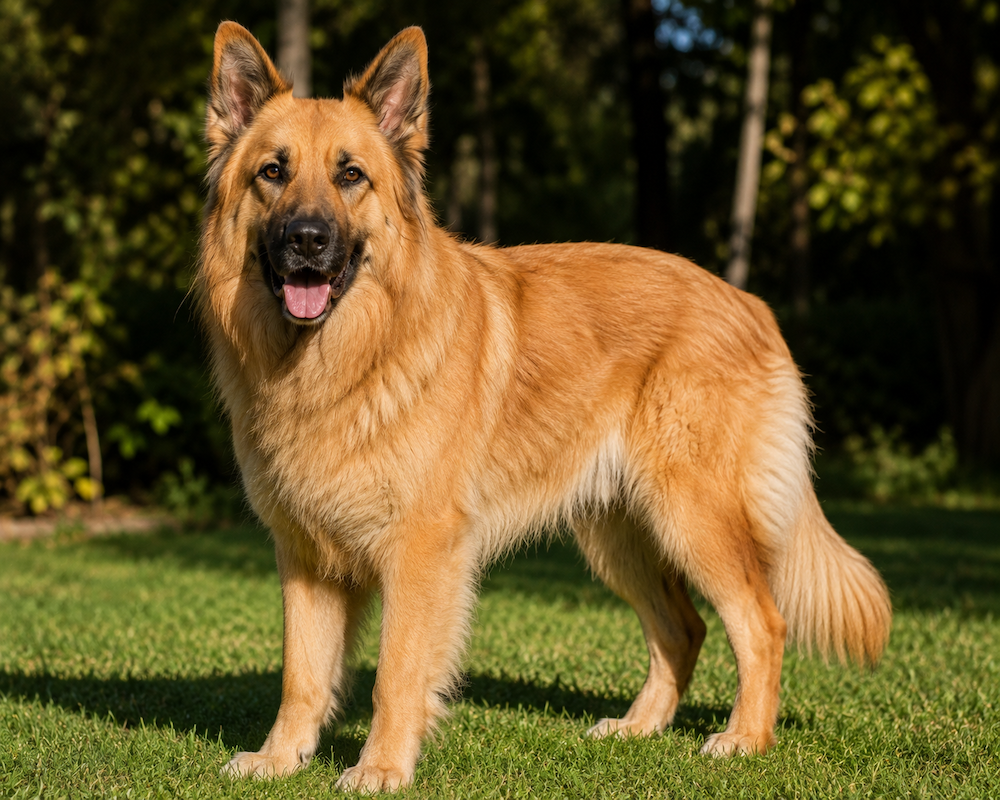







Intelligent, loyal, and family-focused — a beautiful companion that combines the best qualities of two beloved breeds.
🧠 QUICK SNAPSHOT
- Temperament: Loyal, intelligent, affectionate
- Energy Level: High
- Size: Large
- Good With Families: Yes
- Trainability: High
- Grooming: Moderate to high
- Best For: Active families, companionship, outdoor lifestyles
📚 OVERVIEW
The Golden Shepherd is a cross between a Golden Retriever and a German Shepherd, combining intelligence, loyalty, and a strong desire to please. These dogs are highly versatile and are often chosen as family companions because of their affectionate nature and trainability.
They tend to be energetic, social, and protective of their loved ones while remaining friendly and approachable.
✅ PROS & CONS
Pros
- Highly intelligent and trainable
- Loyal and devoted to family
- Great with children
- Excellent companion for active households
Cons
- Needs regular exercise and stimulation
- Can shed heavily throughout the year
- Requires consistent training
- May become bored if left alone too often
Is a Golden Shepherd a Good Family Dog?
Yes. A Golden Shepherd can be an excellent family dog for an active household.
This cross combines the Golden Retriever and German Shepherd, two highly intelligent, people-oriented working breeds. Many Golden Shepherds are affectionate, loyal and eager to participate in family life.
Temperament can vary considerably, particularly in protective instinct and energy level.
What Breeds Make a Golden Shepherd?
A Golden Shepherd is a cross between a Golden Retriever and German Shepherd Dog.
It’s sometimes called a German Retriever or German Shepherd Golden Retriever mix.
Because it isn’t a standardised breed, individual dogs can inherit very different combinations of appearance, temperament and working drive.
How Much Exercise Does a Golden Shepherd Need?
Most adult Golden Shepherds need around 90 minutes to two hours of daily exercise, together with mental stimulation.
Walking, hiking, retrieving, swimming, tracking and scent games are excellent activities.
Working-line German Shepherd ancestry can produce particularly energetic individuals.
Is a Golden Shepherd Easy to Train?
Usually, yes.
Both parent breeds are exceptionally trainable and accustomed to working closely with people.
Golden Shepherds often learn quickly and respond particularly well to reward-based training.
Their intelligence means early training is important — a clever dog learns unwanted habits just as efficiently as useful ones.
Does a Golden Shepherd Shed?
Yes — usually a lot.
Both German Shepherds and Golden Retrievers have dense double coats and substantial seasonal shedding.
A Golden Shepherd may have shorter German Shepherd-like fur or longer Golden-style feathering, but neither parent offers much hope for a hair-free sofa.
Is a Golden Shepherd Hypoallergenic?
No. Golden Shepherds aren’t considered hypoallergenic.
Both parent breeds shed heavily and produce normal canine allergens.
Anyone with significant dog allergies should spend time around adult dogs before considering this cross.
How Often Should You Brush a Golden Shepherd?
Most Golden Shepherds benefit from brushing several times each week, increasing to daily during heavy seasonal shedding.
Longer-coated individuals can develop tangles behind the ears and around the legs and tail.
Regular grooming also provides an opportunity to inspect the skin, ears and body for abnormalities.
Should You Shave a Golden Shepherd?
Generally, no.
Most Golden Shepherds inherit a protective double coat.
Routine shaving can interfere with normal coat function and regrowth.
Regular brushing and removal of loose undercoat are generally preferable unless clipping is required for veterinary reasons.
What Health Problems Are Common in Golden Shepherds?
Potential concerns include hip and elbow dysplasia, degenerative myelopathy, eye disorders, heart disease, gastric dilatation-volvulus and cancers.
The cross can inherit health problems from either parent.
Responsible breeding should include health screening of both the Golden Retriever and German Shepherd parents rather than relying on assumptions about hybrid vigour.
Are Golden Shepherds Prone to Hip Dysplasia?
Yes. Hip dysplasia occurs in both parent breeds, making proper hip screening particularly important.
The condition involves abnormal development of the hip joint and can eventually cause pain and arthritis.
Keeping growing puppies lean and avoiding excessive repetitive impact is also sensible.
Are Golden Shepherds Prone to Elbow Dysplasia?
Yes. Both German Shepherds and Golden Retrievers can develop elbow dysplasia.
Formal elbow assessment of breeding dogs is therefore important.
Lameness or stiffness in a young dog should be investigated rather than assumed to be simply “growing pains.”
Can Golden Shepherds Develop Degenerative Myelopathy?
Yes. German Shepherds have an important association with degenerative myelopathy (DM).
The disease progressively affects the spinal cord and can lead to hind-limb weakness and paralysis.
Genetic testing can identify risk variants, although possessing a risk genotype doesn’t mean an individual dog will definitely develop the disease.
Are Golden Shepherds Prone to Cancer?
Potentially.
Golden Retrievers have a significant predisposition to several cancers, and crossing them with another breed doesn’t guarantee that this genetic risk disappears.
Cancer risk is complex and influenced by multiple genes, age and environmental factors.
Family health history remains important when choosing a puppy.
Are Golden Shepherds Prone to Bloat?
They can be.
Both parent breeds have relatively deep chests, so Golden Shepherds may be vulnerable to gastric dilatation-volvulus (GDV).
Repeated unsuccessful attempts to vomit, abdominal enlargement, severe restlessness or collapse require immediate emergency veterinary treatment.
How Long Do Golden Shepherds Live?
Golden Shepherds commonly live around 10–14 years, although there isn’t a definitive breed-wide lifespan because the cross isn’t standardised.
Genetics, cancer risk, joint health, body condition and general veterinary care can all influence longevity.
How Big Does a Golden Shepherd Get?
Most Golden Shepherds are medium-to-large dogs, commonly weighing around 25–40 kg.
Height often falls roughly between 53 and 66 cm at the shoulder.
Individual size depends heavily on the parents and which side of the family the dog physically resembles.
Are There Mini Golden Shepherds?
There is no officially recognised Mini Golden Shepherd.
Dogs advertised under this name may involve smaller German Shepherds, smaller Golden Retrievers or additional breeds.
The actual pedigree should always be investigated rather than relying on a marketing label.
Can a Golden Shepherd Live in an Apartment?
Yes, but it can be challenging.
A well-exercised Golden Shepherd may settle calmly indoors, but this is generally a large, energetic and intelligent dog.
Daily outdoor exercise and training matter far more than simply having access to a backyard.
Can a Golden Shepherd Be Left Alone?
Adult Golden Shepherds can learn to spend reasonable periods alone, but both parent breeds are strongly people-oriented.
Some individuals develop separation-related behaviour.
Long periods of boredom can also produce chewing, digging, barking or other unwanted activities.
Are Golden Shepherds Velcro Dogs?
Many are.
German Shepherds often form intense handler relationships, while Golden Retrievers are famously social and affectionate.
Combining the two can produce a dog that takes family togetherness extremely seriously.
Following owners from room to room is common.
Are Golden Shepherds Cuddly?
Many are extremely affectionate with their families.
Golden Retriever influence can contribute enthusiastic sociability, while German Shepherds often form deep bonds with their household.
Some Golden Shepherds therefore combine serious working-dog appearance with surprisingly enthusiastic cuddling.
Are Golden Shepherds Good With Children?
Generally, yes, particularly when properly socialised.
They’re often affectionate, playful and loyal family dogs.
Their size and adolescent exuberance can accidentally knock over small children.
German Shepherd protective instincts also make early socialisation particularly important.
Are Golden Shepherds Good With Other Dogs?
Many are, particularly when socialised from puppyhood.
Golden Retriever influence often contributes sociability, while German Shepherd ancestry can sometimes produce greater selectivity or wariness around unfamiliar dogs.
Individual temperament matters more than assuming one parent will dominate.
Are Golden Shepherds Good With Cats?
Many can live successfully with cats, especially when raised together.
However, German Shepherds can have significant prey drive, and Golden Retrievers also have sporting instincts.
Careful introductions and supervision are important.
Do Golden Shepherds Have a Strong Prey Drive?
Some do.
German Shepherd working lines can contribute substantial chase and prey drive, while Golden Retrievers retain bird-oriented sporting instincts.
The strength of these behaviours varies greatly between individuals.
Early recall and impulse-control training are particularly useful.
Are Golden Shepherds Good Off Leash?
They can be excellent off-leash dogs with appropriate training.
Both parent breeds were developed to work cooperatively with people, giving many Golden Shepherds strong handler focus.
Wildlife and prey drive can still override recall in poorly trained dogs.
Are Golden Shepherds Protective?
Many are.
German Shepherd ancestry can contribute natural watchfulness, territorial awareness and protective behaviour.
Golden Retriever influence may produce a more openly social temperament.
Because inheritance is unpredictable, one Golden Shepherd may welcome every visitor while another is noticeably reserved.
Are Golden Shepherds Good Guard Dogs?
Some can be very capable guard dogs.
A Golden Shepherd inheriting substantial German Shepherd characteristics may be alert, imposing and naturally protective.
Others inherit more of the Golden Retriever’s enthusiastic friendliness.
Guarding ability therefore can’t be guaranteed simply from the cross.
Are Golden Shepherds Aggressive?
Aggression isn’t an inevitable characteristic of Golden Shepherds.
A well-bred dog should ideally be confident, stable and controllable.
However, German Shepherd protective instincts combined with poor socialisation or unstable breeding can create behavioural problems.
Early positive exposure to different people and environments is particularly important.
Do Golden Shepherds Bark a Lot?
They can be moderately vocal.
German Shepherd ancestry can contribute strong alert barking, while Golden Retrievers are generally less intense watchdogs.
Boredom, excitement and separation distress can also increase barking.
Are Golden Shepherds Good Watchdogs?
Usually, yes.
Their size and alertness alone can make them effective watchdogs.
Many quickly notice unfamiliar people and sounds.
Whether they subsequently treat the visitor as a security concern or a potential new best friend may depend on which parent won that particular genetic argument.
Are Golden Shepherds High-Energy Dogs?
Yes. Most are high-energy, athletic dogs.
Both parent breeds were developed for demanding work.
A young Golden Shepherd generally needs considerably more than a leisurely daily walk.
Mental work is equally important because physical exercise alone can simply create an increasingly fit bored dog.
When Do Golden Shepherds Calm Down?
Many begin becoming noticeably more settled around two to three years of age, although working-line dogs may remain highly energetic much longer.
Adolescent Golden Shepherds can combine Golden Retriever exuberance with German Shepherd intensity.
Teaching calm behaviour from puppyhood is therefore extremely valuable.
Are Golden Shepherds Good Running Dogs?
Yes. Healthy adult Golden Shepherds can make excellent running companions.
Both parent breeds possess considerable stamina.
Structured distance running should wait until skeletal maturity because joint health is particularly important in this cross.
Are Golden Shepherds Good Hiking Dogs?
Excellent.
Their combination of stamina, trainability and enthusiasm for outdoor activity makes them strong hiking companions.
Recall, wildlife management and conditioning are important.
Longer-coated dogs should also be checked for grass seeds, burrs and ticks.
Do Golden Shepherds Like Water?
Many do.
Golden Retrievers are famous for their love of swimming, while German Shepherds can also be capable swimmers.
Golden Shepherds inheriting strong Retriever characteristics may become enthusiastic water dogs.
Individual preference still varies.
Are Golden Shepherds Good Swimmers?
Many are excellent swimmers.
Golden Retriever ancestry contributes strong water-retrieving instincts and an efficient swimming build.
However, not every Golden Shepherd automatically loves water.
Positive gradual introduction is preferable to simply assuming the dog can swim confidently.
Do Golden Shepherds Like Playing Fetch?
Usually.
Golden Retriever genetics can produce extremely strong retrieving behaviour, while German Shepherds often enjoy ball and toy work because of their working drives.
Fetch can therefore be an excellent exercise and training activity for the cross.
Why Does My Golden Shepherd Carry Things Around?
Carrying objects commonly reflects Golden Retriever retrieving instincts.
Toys, socks, shoes and other household objects can become highly desirable.
German Shepherd working drive can add even more enthusiasm to object-based games.
Providing appropriate retrieving toys can channel the behaviour productively.
Are Golden Shepherds Good at Scent Work?
Potentially excellent.
German Shepherds have an outstanding history in tracking and detection, while Golden Retrievers are also successfully used in scent-based working roles.
A Golden Shepherd may therefore possess both strong olfactory ability and substantial motivation to search.
Can Golden Shepherds Work as Search-and-Rescue Dogs?
Potentially, yes.
Both parent breeds have proven themselves in search-and-rescue work.
A suitable Golden Shepherd could inherit the scenting ability, stamina, trainability and handler cooperation required.
Professional working suitability depends on the individual dog rather than breed ancestry alone.
Can Golden Shepherds Be Service Dogs?
Some can make excellent service dogs.
Golden Retriever ancestry contributes a strong history of assistance work, while German Shepherds were also important early guide and service dogs.
Temperament is critical.
A service dog needs exceptional stability, trainability and public neutrality, not simply intelligence.
Are Golden Shepherds Intelligent?
Usually, extremely.
Both German Shepherds and Golden Retrievers are known for rapid learning and close cooperation with people.
Golden Shepherds can excel in obedience, scent work and complex training.
Their intelligence also means boredom can become a significant problem if owners don’t provide enough mental stimulation.
Are Golden Shepherds Stubborn?
Some can be.
Golden Retrievers are generally eager to cooperate, while German Shepherds can combine handler focus with stronger independent judgement.
A Golden Shepherd may understand a command perfectly yet become distracted or decide another activity is more interesting.
Consistent reward-based training usually works well.
What Does a Golden Shepherd Look Like?
There’s no single Golden Shepherd appearance.
Many have a German Shepherd-like body and head combined with softer Golden Retriever facial features and longer fur.
Others look remarkably similar to one parent.
Ear shape, coat length, colour and body structure can all vary substantially.
Do Golden Shepherds Have Upright Ears?
Some do, while others have floppy or semi-erect ears.
German Shepherds contribute genes associated with large upright ears, while Golden Retrievers have hanging ears.
A puppy’s final ear carriage can therefore be difficult to predict.
When Do a Golden Shepherd’s Ears Stand Up?
If a puppy has inherited the structure for erect ears, they may begin standing during the first several months of life.
Some ears go through stages of standing and falling during teething.
Others remain permanently floppy or semi-erect because of Golden Retriever influence.
Can Golden Shepherds Have One Ear Up and One Ear Down?
Yes.
Mixed inheritance can produce asymmetrical ear carriage, particularly while puppies are developing.
Some eventually develop two upright ears, while others permanently retain one erect and one folded ear.
It can become one of the cross’s most distinctive features.
What Type of Coat Does a Golden Shepherd Have?
Most Golden Shepherds have a dense double coat, but length varies considerably.
Some inherit a medium German Shepherd-style coat.
Others develop longer Golden Retriever-like fur with feathering around the neck, legs and tail.
Either version can shed substantially.
Can Golden Shepherds Have Long Hair?
Yes.
Golden Retrievers carry genes for long coats, and long-coated German Shepherds also exist.
A Golden Shepherd can therefore inherit a medium-to-long coat with substantial feathering.
Long coats require more grooming but don’t necessarily mean greater overall shedding than shorter double coats.
What Colours Can Golden Shepherds Be?
Golden Shepherds can occur in gold, cream, black, sable, black-and-tan, reddish-gold and combinations of these colours.
Some strongly resemble German Shepherds in pattern.
Others appear almost like darker, more shepherd-shaped Golden Retrievers.
Can Golden Shepherds Be Black?
Yes.
German Shepherds can carry solid-black coat genetics, so black Golden Shepherds are possible.
Some may also show subtle lighter markings as they mature.
Colour doesn’t indicate which parent’s temperament the dog will inherit.
Can Golden Shepherds Be Golden?
Yes. Some inherit a predominantly gold or cream coat, particularly when Golden Retriever characteristics are visually strong.
Their body shape, ears or darker muzzle may still reveal German Shepherd ancestry.
Can Golden Shepherds Be Sable?
Yes.
Sable colouring is common in German Shepherd populations and can potentially appear in Golden Shepherd offspring.
Sable hairs contain multiple bands of pigment, producing a complex dark-tipped appearance.
Can Golden Shepherds Have a Black Mask?
Yes.
German Shepherd ancestry can produce dark facial masking, particularly on dogs with tan, gold or sable coats.
The extent varies substantially.
A black mask doesn’t indicate greater aggression or guarding ability.
Can Golden Shepherds Be White?
Very pale Golden Retriever ancestry and white German Shepherd genetics can theoretically contribute to extremely light offspring.
However, colour inheritance depends on the actual genetics of both parents.
A white-looking Golden Shepherd shouldn’t automatically be assumed to be a special variety.
Can Golden Shepherds Be Merle?
Merle isn’t a normal colour of either the Golden Retriever or German Shepherd.
A merle dog advertised as a Golden Shepherd therefore suggests additional ancestry somewhere in the breeding history.
Merle-to-merle breeding also creates significant risks of hearing and eye abnormalities.
Do Golden Shepherd Puppies Change Colour?
They can.
German Shepherd puppies often undergo substantial colour changes as adult pigmentation develops, while Golden Retriever coats can also darken or change in richness.
A Golden Shepherd puppy’s final adult colour may therefore be difficult to predict from its early puppy coat.
What Is an F1 Golden Shepherd?
An F1 Golden Shepherd is a first-generation cross between a purebred Golden Retriever and purebred German Shepherd.
The dog averages approximately 50% genetic ancestry from each breed.
That doesn’t mean every characteristic is divided neatly in half.
What Is an F1B Golden Shepherd?
An F1B Golden Shepherd is generally produced by breeding an F1 Golden Shepherd back to either a Golden Retriever or German Shepherd.
The resulting puppies average more ancestry from whichever parent breed was used.
Actual pedigree is more informative than the generation label alone.
What Is an F2 Golden Shepherd?
An F2 Golden Shepherd is generally produced by breeding two F1 Golden Shepherds together.
Second-generation puppies can still vary dramatically.
Breeding two mixed dogs doesn’t automatically create a predictable or standardised breed.
Is a Golden Shepherd a Designer Dog?
Yes. The Golden Shepherd is generally described as a designer crossbreed.
It’s an intentional combination of two established breeds rather than a recognised pedigree breed itself.
Quality can range enormously depending on health testing, temperament selection and breeder practices.
Is the Golden Shepherd Recognised by Major Kennel Clubs?
No. The Golden Shepherd isn’t generally recognised as a separate pedigree breed by major traditional kennel organisations.
The Golden Retriever and German Shepherd are individually recognised breeds, but their cross doesn’t have a universally accepted breed standard.
Is a Golden Shepherd Healthier Than a German Shepherd?
Not automatically.
Greater genetic diversity can potentially reduce the risk of some recessive disorders, but Golden Shepherds can still inherit German Shepherd joint and neurological problems.
They also introduce Golden Retriever health concerns, including significant cancer predispositions.
Crossbreed doesn’t mean disease-proof.
Is a Golden Shepherd Healthier Than a Golden Retriever?
Again, not automatically.
Crossbreeding can provide genetic diversity, but the puppy receives genes from both populations rather than simply inheriting the healthiest traits from each.
Responsible parent selection and health testing are far more important than the crossbreed label.
Does Hybrid Vigour Make Golden Shepherds Healthier?
Hybrid vigour is a real genetic phenomenon, but it’s frequently oversimplified in designer-dog marketing.
Crossing genetically different populations can reduce the likelihood of some recessive conditions.
It can’t eliminate disorders shared by both populations or prevent complex diseases influenced by many genes.
Is a Golden Shepherd the Same as a German Retriever?
“German Retriever” is sometimes used as an alternative name for the Golden Retriever-German Shepherd cross.
However, designer-dog naming isn’t standardised.
Whenever ancestry matters, describing the dog as a Golden Retriever × German Shepherd is considerably clearer.
Is a Golden Shepherd the Same as a Golden German Shepherd?
Usually, these names refer to the same basic cross.
Terms including Golden Shepherd, Golden German Shepherd and German Retriever can all appear online.
There’s no international naming authority governing designer crosses, so pedigree information is more reliable than the label.
Is a Golden Shepherd the Same as a Golden Retriever?
No.
The Golden Retriever is an established Scottish pedigree breed.
The Golden Shepherd is a Golden Retriever × German Shepherd cross.
Some golden-coloured Golden Shepherds can resemble unusual Golden Retrievers, but genetically they’re very different dogs.
Is a Golden Shepherd the Same as a German Shepherd?
No.
A German Shepherd is an established German working breed.
A Golden Shepherd combines German Shepherd and Golden Retriever ancestry.
The cross can inherit the German Shepherd’s appearance while displaying a more Retriever-like personality — or exactly the opposite.
Why Were Golden Retrievers Crossed With German Shepherds?
The attraction is understandable: both breeds are intelligent, trainable, versatile and strongly people-oriented.
The intended result is often a dog combining the Golden Retriever’s sociability with the German Shepherd’s alertness and working ability.
Genetics don’t guarantee that exact balance, however.
Do Golden Retrievers and German Shepherds Have Similar Working Abilities?
They have different historical specialities but share exceptional human cooperation and trainability.
Golden Retrievers were developed as sporting retrievers.
German Shepherds began as herding dogs and later became famous in service work.
Both subsequently excelled in assistance, detection and search roles.
What Was the Golden Retriever Originally Bred For?
Golden Retrievers were developed in 19th-century Scotland to retrieve shot game from land and water.
They needed excellent memory, swimming ability, a gentle mouth and strong cooperation with hunters.
Those traits contribute much of the Golden Shepherd’s potential retrieving ability and sociability.
What Was the German Shepherd Originally Bred For?
German Shepherds were developed in Germany around the end of the 19th century from regional sheep-herding dogs.
Their original purpose centred on controlling and protecting flocks.
Their intelligence and versatility later made them exceptionally successful police, military, detection and service dogs.
Does the Golden Shepherd Combine Two of the World’s Most Versatile Working Dogs?
Yes. That’s one of the most interesting aspects of the cross.
Golden Retrievers have worked as gundogs, guide dogs, assistance dogs, detection dogs and search-and-rescue dogs.
German Shepherds have worked in herding, policing, military service, detection, guiding and rescue.
The Golden Shepherd therefore starts with an unusually impressive working family tree.
When Was the Golden Shepherd First Created?
Golden Retrievers and German Shepherds have almost certainly been crossed informally for many decades.
The deliberately named Golden Shepherd became increasingly visible during the modern designer-dog movement, particularly from the late 20th century onwards.
There isn’t a reliably documented single creation date.
Who Created the First Golden Shepherd?
There is no well-documented single founder of the Golden Shepherd.
Unlike the Golden Retriever and German Shepherd — both of which have unusually well-recorded breed histories — their modern cross doesn’t have an equivalent recognised creator.
It likely emerged independently through multiple breeders.
Where Was the Golden Shepherd First Created?
The modern named cross is strongly associated with North American designer-dog breeding, although no definitive birthplace has been established.
Accidental and deliberate Golden Retriever-German Shepherd crosses almost certainly existed before the name became commercially popular.
Is the Golden Shepherd a Natural Breed?
No. It’s a deliberate cross between two established breeds, rather than an old landrace or naturally developed population.
Unless a structured breeding programme eventually establishes consistent characteristics over many generations, Golden Shepherds remain genetically variable crossbred dogs.
Is a Golden Shepherd a Good First Dog?
It can be, but it’s more demanding than a Golden Retriever alone.
A Golden Shepherd can combine Golden enthusiasm with German Shepherd intensity, strength and protective instincts.
A committed first-time owner willing to provide substantial exercise, training and socialisation can succeed, but this isn’t an effortless beginner dog.
Where Does the Golden Shepherd Come From?
The Golden Shepherd is a modern cross between the Golden Retriever and German Shepherd, with no reliably documented single founder or exact creation date.
What makes the cross particularly interesting is the history behind its parents. One side descends from Scottish gundogs developed to retrieve birds across land and water; the other from German sheepdogs developed for intelligent, controlled livestock work before becoming legendary police and service dogs.
Put those histories together and you potentially get a dog with retrieving instinct, scenting ability, athleticism, intelligence, loyalty and an extraordinary desire to work with people.
Of course, genetics doesn’t always read the brochure. A Golden Shepherd may inherit the German Shepherd’s security department, the Golden Retriever’s customer-relations department — and somehow decide that every visitor should be thoroughly investigated before being presented with a tennis ball.