
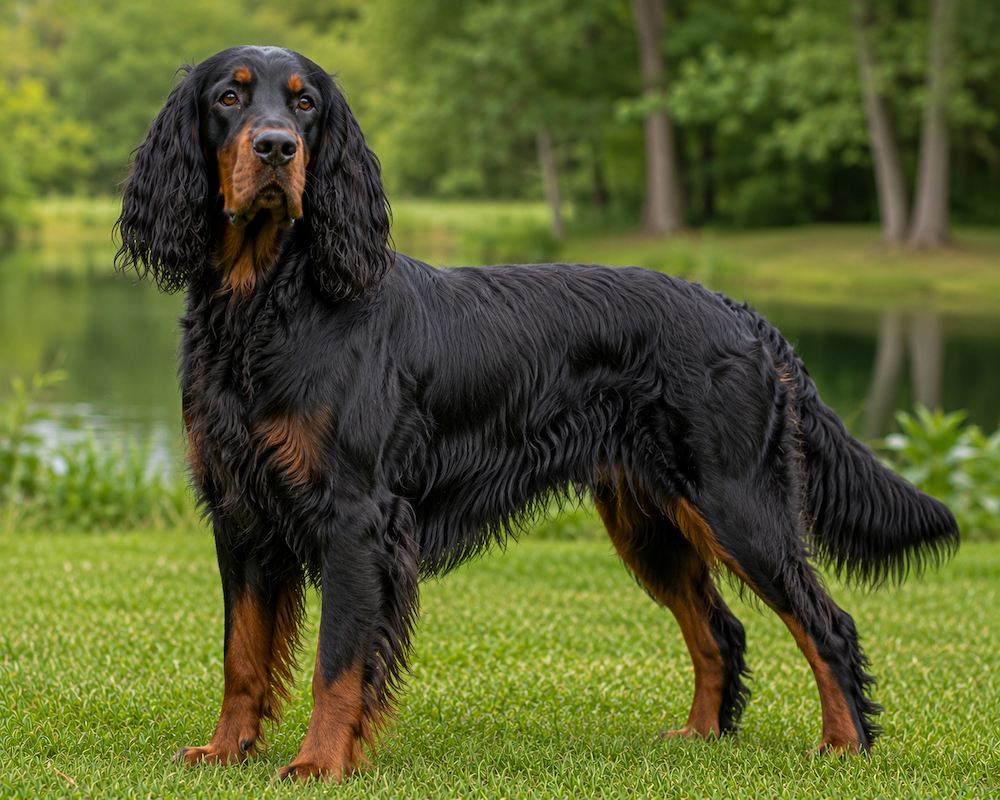







Loyal, intelligent, and full of endurance — a striking companion built for adventure and family life.
🧠 QUICK SNAPSHOT
- Temperament: Loyal, intelligent, affectionate
- Energy Level: High
- Size: Large
- Good With Families: Yes
- Trainability: High
- Grooming: Moderate to high
- Best For: Active families, outdoor enthusiasts, experienced owners
📚 OVERVIEW
The Gordon Setter is the largest of the setter breeds, known for its beautiful black-and-tan coat, athletic ability, and loyal personality. Originally bred in Scotland as a hunting companion, the Gordon Setter combines intelligence and endurance with a loving and devoted nature.
They form strong bonds with their family and thrive in homes where they can enjoy regular exercise, companionship, and outdoor activities.
✅ PROS & CONS
Pros
- Loyal and devoted to family
- Highly intelligent and trainable
- Excellent companion for active lifestyles
- Beautiful and distinctive appearance
Cons
- Needs significant daily exercise
- Requires regular grooming and coat maintenance
- Can become bored if under-stimulated
- May be slow to mature emotionally
Is a Gordon Setter a Good Family Dog?
Yes. Gordon Setters can be affectionate, loyal and gentle family dogs, particularly in active households.
They’re usually deeply attached to their people and often more reserved with strangers than some other Setter breeds.
Their size, energy and slow maturation mean they suit families prepared to provide substantial exercise, training and companionship.
How Much Exercise Does a Gordon Setter Need?
Most healthy adult Gordon Setters need around 90 minutes to two hours of daily exercise, with working-bred dogs potentially needing more.
Long walks, running, hiking, scent work and retrieving can all be excellent outlets.
They’re genuine sporting dogs built to spend hours searching large areas of countryside.
Is a Gordon Setter Easy to Train?
Gordon Setters are intelligent and trainable, but they can be independent and easily distracted by scent and wildlife.
Positive reinforcement generally works best.
Harsh handling can be counterproductive with this sensitive breed.
Training recall early is particularly important.
Does a Gordon Setter Shed?
Yes. Gordon Setters shed moderately, with seasonal increases.
Their medium-to-long coat also means shed hair can be particularly noticeable around the house.
Regular brushing helps remove loose hair and prevent tangles.
Is a Gordon Setter Hypoallergenic?
No. Gordon Setters aren’t considered hypoallergenic.
They shed hair and dander and produce normal canine allergens through saliva and skin secretions.
People with significant dog allergies should spend time around adult Gordons before considering ownership.
How Often Should You Groom a Gordon Setter?
A Gordon Setter generally needs brushing several times each week.
The feathering around the ears, chest, legs, belly and tail can tangle and collect debris.
Ears should also be checked regularly, particularly after swimming.
What Health Problems Are Common in Gordon Setters?
Potential health concerns include hip and elbow dysplasia, eye disorders, hypothyroidism and gastric dilatation-volvulus (GDV).
Certain inherited neurological and metabolic conditions also occur within the breed.
Responsible breeders should use appropriate health testing and understand disease history within their bloodlines.
Are Gordon Setters Prone to Hip Dysplasia?
Yes. Hip dysplasia is a recognised concern in Gordon Setters.
The condition occurs when the hip joint develops abnormally, potentially leading to instability, pain and arthritis.
Formal hip assessment of breeding dogs is important.
Are Gordon Setters Prone to Bloat?
Yes. Gordon Setters are large, deep-chested dogs and can be vulnerable to gastric dilatation-volvulus (GDV).
The stomach expands and may rotate, creating a life-threatening emergency.
Unproductive attempts to vomit, abdominal enlargement, severe restlessness or collapse require immediate veterinary treatment.
Are Gordon Setters Prone to Eye Problems?
They can be.
Inherited eye conditions, including forms of progressive retinal atrophy, occur within Setter populations.
Responsible breeders should use appropriate eye examinations and available genetic testing.
Changes in night vision or unexplained reluctance in dim conditions warrant veterinary investigation.
How Long Does a Gordon Setter Live?
Gordon Setters commonly live around 10–12 years, although some live longer.
Genetics, cancer risk, joint health, body condition and veterinary care all influence longevity.
Keeping such a large sporting dog lean is particularly beneficial for joint health.
How Big Does a Gordon Setter Get?
Gordon Setters are the largest and heaviest of the Setter breeds.
Males are typically around 66 cm at the shoulder and may weigh approximately 29 kg, while females are commonly around 62 cm and 25 kg, although standards and individual dogs vary.
They should remain athletic rather than excessively heavy.
Is the Gordon Setter the Largest Setter?
Yes. The Gordon Setter is generally considered the heaviest and most substantial of the recognised Setter breeds.
English and Irish Setters can also be tall dogs, but the Gordon typically has greater bone and substance.
That heavier build reflects its development as a powerful Scottish sporting dog.
Can a Gordon Setter Live in an Apartment?
It’s possible but challenging.
A sufficiently exercised Gordon Setter can settle indoors, but this is a large, energetic sporting breed.
Access to a garden doesn’t replace exercise, and apartment owners need to provide substantial outdoor activity every day.
Can a Gordon Setter Be Left Alone?
Gordon Setters tend to form strong attachments to their families and generally don’t enjoy prolonged isolation.
Adults can learn to spend reasonable periods alone.
Long daily absences without sufficient interaction or exercise can contribute to boredom, vocalisation and destructive behaviour.
Are Gordon Setters Velcro Dogs?
Many are.
Gordons are famous for developing deep relationships with their people.
They may follow family members from room to room and prefer remaining nearby.
Their dignified sporting-dog appearance can disguise a dog with a surprisingly strong interest in supervising every household activity.
Are Gordon Setters Cuddly?
Many are extremely affectionate with their families.
They can be gentle, devoted and physically affectionate, particularly once their exercise needs have been satisfied.
Some are more reserved than Golden Retrievers or Irish Setters but intensely loyal to the people they know.
Are Gordon Setters Good With Children?
Generally, yes.
Well-socialised Gordon Setters can be patient, affectionate and playful family companions.
Their size and youthful exuberance require supervision around small children.
They also tend to mature slowly, so a large adolescent Gordon may remain enthusiastically puppy-like for quite some time.
Are Gordon Setters Good With Other Dogs?
Usually.
Gordon Setters are generally sociable with other dogs when properly socialised.
Individual compatibility still matters.
Early positive experiences help prevent unnecessary fear or defensiveness.
Are Gordon Setters Good With Cats?
They can live successfully with cats, particularly when raised together.
However, Gordon Setters are serious bird-hunting dogs with substantial prey instincts.
A dog accepting its household cat shouldn’t automatically be trusted around unfamiliar small animals outdoors.
Do Gordon Setters Have a Strong Prey Drive?
Yes. Hunting instinct is fundamental to the breed.
Gordons were developed to search for and locate game birds, so movement, scent and wildlife can be extremely compelling.
Recall training and secure management are important.
Are Gordon Setters Good Off Leash?
They can become reliable with excellent training, but hunting instinct creates challenges.
A Gordon Setter may work at considerable distance while following scent.
Reliable recall needs to be established gradually before giving the dog freedom in areas containing wildlife.
Are Gordon Setters Protective?
Gordon Setters can be more reserved and watchful than many sporting breeds.
Some are naturally protective of their home and family.
However, they’re primarily hunting dogs rather than specialised protection dogs.
Stable confidence is preferable to excessive suspicion.
Are Gordon Setters Good Guard Dogs?
They’re better watchdogs than dedicated guard dogs.
Their large size, deep bark and reserved attitude towards strangers can provide deterrence.
However, serious guarding wasn’t their primary historical purpose.
Do Gordon Setters Bark a Lot?
They can be moderately vocal.
Gordons may bark to alert, communicate excitement or express boredom.
Adequate exercise and companionship generally reduce nuisance barking.
Some individuals are considerably more talkative than others.
Are Gordon Setters High-Energy Dogs?
Yes. Gordon Setters are high-energy sporting dogs with substantial stamina.
Their original work required searching large areas of difficult countryside for game.
A short walk around the block generally won’t satisfy a healthy adult.
When Do Gordon Setters Calm Down?
Gordon Setters are known for slow maturation.
Many don’t begin feeling truly adult until around three years of age, and some retain puppy-like enthusiasm considerably longer.
They usually become calmer with maturity but remain active sporting dogs throughout much of their lives.
Are Gordon Setters Good Running Dogs?
Yes. Healthy adult Gordons can make excellent running companions.
They’re built for endurance rather than short explosive speed.
Structured distance running should wait until skeletal maturity, particularly given the breed’s size and joint considerations.
Are Gordon Setters Good Hiking Dogs?
Excellent.
Gordon Setters have the stamina, athleticism and outdoor enthusiasm required for long hikes.
Their feathered coats should be checked for grass seeds, burrs and ticks afterwards.
Reliable recall is particularly important around birds and wildlife.
Can Gordon Setters Swim?
Yes. Many Gordon Setters are capable swimmers and enjoy water.
They’re versatile sporting dogs, although swimming wasn’t as central to their development as it was for specialised water retrievers.
Individual enthusiasm varies.
Are Gordon Setters Fast?
Yes. Gordons can run quickly, but their historical strength was endurance and methodical searching rather than pure sprinting speed.
They’re generally heavier than English and Irish Setters.
Their substantial build allowed them to work effectively across difficult Scottish terrain.
What Does a Gordon Setter Look Like?
The Gordon Setter is an elegant but substantial sporting dog with a glossy black coat, rich tan markings, long hanging ears and extensive feathering.
Tan markings typically appear above the eyes, on the muzzle, chest and legs.
Its heavier structure distinguishes it from the lighter English and Irish Setters.
Why Are Gordon Setters Black and Tan?
Black-and-tan colouring became a defining characteristic during the breed’s development.
The tan appears in characteristic locations including above the eyes, sides of the muzzle, throat, chest and legs.
Selective breeding eventually fixed the striking pattern strongly within the breed.
Can Gordon Setters Have White Markings?
Small amounts of white, particularly on the chest, can occur.
Breed standards generally favour the characteristic black-and-tan pattern, with extensive white undesirable.
Historical working dogs were more variable than modern show populations.
Can Gordon Setters Be Red?
A true modern Gordon Setter should display its characteristic black-and-tan colouring.
Recessive colour genetics can occasionally produce unexpected pigmentation, but red isn’t the normal recognised Gordon appearance.
An entirely red Setter is much more likely to be associated with Irish Setter ancestry.
Why Do Gordon Setters Have Tan Eyebrows?
The small tan markings above the eyes are part of the breed’s traditional tan-point pattern.
They’re produced by coat-colour genetics rather than serving a special functional purpose.
Those expressive “eyebrows” contribute considerably to the Gordon’s unmistakable face.
Why Does a Gordon Setter Have Such Long Ears?
Long hanging ears are characteristic of Setter and Spaniel-type sporting dogs.
They became part of the breed’s distinctive appearance through generations of selection.
Because hanging ears can reduce ventilation, regular checks for irritation and infection are important.
What Is the Difference Between a Gordon Setter and an English Setter?
Gordon Setters are generally heavier, more substantial and black-and-tan, while English Setters usually have predominantly white coats with coloured ticking or belton patterns.
Both locate game birds by scent and indicate their position.
Gordons are often described as more deliberate workers, while many English Setters cover ground more rapidly.
What Is the Difference Between a Gordon Setter and an Irish Setter?
The most obvious difference is colour.
Gordon Setters are black and tan, while Irish Setters are famous for their rich red coats.
Gordons are generally heavier and often somewhat more reserved.
Irish Setters tend to have a reputation for particularly outgoing, exuberant personalities.
Is the Gordon Setter Related to the Irish Setter?
Yes. Gordon, Irish and English Setters share the broader historical development of British and Irish bird-setting dogs.
Their populations became increasingly distinct as breeders selected for different colours, structures and working styles.
They’re separate modern breeds rather than simply colour variations.
Is the Gordon Setter Related to the English Setter?
Yes.
All Setter breeds descend from older populations of bird dogs developed to locate game and indicate its position.
The modern breeds were gradually standardised from different lines and regional populations.
Their shared working ancestry remains obvious in their hunting behaviour.
What Were Gordon Setters Originally Bred For?
Gordon Setters were developed to locate game birds such as grouse and indicate their position to hunters.
They used scent to search large areas of countryside.
Once game was located, the dog would freeze or “set,” allowing the hunter to approach.
Why Are They Called Setters?
The name comes from the dog’s traditional behaviour when locating birds.
Early setting dogs would crouch or “set” near the game, indicating its position.
This behaviour was particularly useful before firearms became dominant because hunters could throw nets over the birds and sometimes the dog.
Did Gordon Setters Hunt Before Guns Were Common?
Their Setter ancestors did.
Before modern firearms, hunters used nets and other techniques to capture game birds.
A dog that located birds and remained still rather than immediately flushing them was enormously useful.
The Setter’s distinctive working style therefore predates modern shooting sports.
Does a Gordon Setter Point?
Yes. In modern terminology, Gordon Setters are pointing gundogs.
When they locate game scent, they freeze and indicate the bird’s location with their body.
The historical term “setting” reflects an older form of this behaviour.
What Birds Did Gordon Setters Hunt?
Gordons were particularly suited to hunting grouse and other game birds across Scottish estates.
They could also work other upland game depending on region.
Their stamina and deliberate searching style suited difficult terrain where locating birds could require hours of work.
Do Gordon Setters Retrieve Birds?
They can retrieve, and many are trained to do so.
However, their defining traditional speciality is locating and pointing game, rather than retrieving being their primary role.
Specialised Retriever breeds were developed particularly for recovering shot game.
Why Were Gordon Setters Good in Scotland?
Scotland’s hunting country could involve rough vegetation, hills and challenging weather.
The Gordon Setter developed as a strong, substantial dog capable of searching patiently across this terrain.
Its reputation wasn’t based on being the fastest Setter, but on endurance, determination and reliable scent work.
Are Gordon Setters Slower Than Other Setters?
Historically, Gordons were often described as more deliberate and methodical workers than lighter Setter breeds.
“Slower” shouldn’t be confused with slow-moving.
They’re athletic dogs capable of considerable speed, but their traditional working reputation emphasised stamina and thoroughness.
Where Does the Gordon Setter Come From?
The Gordon Setter was developed in Scotland, with its history strongly associated with Gordon Castle and the Dukes of Gordon.
Black-and-tan setting dogs existed before the modern breed, but breeding at Gordon Castle helped establish and popularise the type.
Is the Gordon Setter Named After a Person?
Indirectly.
The breed takes its name from the Dukes of Gordon, whose Scottish estate became famous for breeding black-and-tan Setters.
It wasn’t named after an individual dog called Gordon.
What Is Gordon Castle?
Gordon Castle is a historic estate in Moray, Scotland, associated with the Dukes of Gordon.
Its kennels became particularly famous during the 18th and 19th centuries for black-and-tan setting dogs.
The estate’s reputation eventually became inseparable from the breed’s name.
Who Was the Duke of Gordon?
Several Dukes of Gordon were associated with the estate, but Alexander Gordon, 4th Duke of Gordon, is particularly connected with the development and promotion of the black-and-tan Setter type during the late 18th and early 19th centuries.
He was an enthusiastic sportsman and maintained substantial kennels.
Did the Duke of Gordon Create the Gordon Setter?
Not exactly.
Black-and-tan Setters existed before the 4th Duke of Gordon’s breeding programme.
His kennels helped develop, maintain and popularise a particular type that became highly influential.
The modern breed emerged from broader black-and-tan Setter populations as well as Gordon Castle dogs.
Were Early Gordon Setters Different From Modern Gordons?
Yes.
Historical black-and-tan Setters showed more variation in colour, structure and markings than today’s standardised breed.
Some early dogs associated with Gordon Castle reportedly had white markings.
Breed appearance became more consistent as organised dog showing and pedigree registration developed during the 19th century.
Were Gordon Setters Originally Called Gordon Setters?
No. They were historically known by terms including Black and Tan Setter.
The Gordon name became increasingly associated with the breed because of the famous Gordon Castle kennels.
“Gordon Setter” eventually became the established modern name.
Why Were Gordon Setters Called Black and Tan Setters?
Before breed standardisation, their most obvious distinguishing feature was their black coat with tan markings.
“Black and Tan Setter” was therefore a straightforward descriptive name.
The Gordon name became more prominent as the breed’s connection with the Dukes of Gordon became celebrated.
When Did the Gordon Setter Become a Recognised Breed?
The Gordon Setter became increasingly standardised during the 19th century, as organised dog shows and pedigree registration expanded.
It was eventually recognised as distinct from other Setter populations.
Formal breed organisations further stabilised its appearance and identity.
Were Gordon Setters Among the Earliest Show Dogs?
They were involved very early in organised dog showing.
At the famous Newcastle dog show of 1859, one of Britain’s earliest major dog shows, classes were specifically held for Pointers and Setters.
This was during the period when modern pedigree dog showing was beginning to take shape.
Was the Gordon Setter One of the First Breeds Recognised by the AKC?
Yes. The Gordon Setter was among the early breeds recognised by the American Kennel Club following its establishment in the 1880s.
Setters were already highly valued sporting dogs in North America by that period.
When Did Gordon Setters Arrive in America?
Black-and-tan Setters associated with Gordon Castle were imported to the United States during the 19th century.
Two particularly important early dogs were Rake and Rachel, imported in 1842.
Their arrival played a major role in establishing the breed in America.
Who Were Rake and Rachel?
Rake and Rachel were black-and-tan Setters imported to the United States from the Duke of Gordon’s kennels in 1842.
They were brought by George Blunt and Daniel Webster.
Their descendants became influential in the development of Gordon Setters in America.
Was Daniel Webster Involved With Gordon Setters?
Yes. American statesman Daniel Webster was involved in the importation of Rake and Rachel from the Gordon Castle kennels.
Webster was a prominent politician as well as an enthusiastic sportsman.
It’s an unusual intersection between American political history and dog-breed history.
Were Gordon Setters Crossed With Bloodhounds?
Bloodhound influence is frequently mentioned in historical discussions of Gordon Setter development.
However, exact breed recipes from the period are not documented with modern pedigree precision.
It’s safer to describe Bloodhound influence as a historical claim or possible contribution rather than a perfectly established foundation cross.
Were Collies Used to Create Gordon Setters?
Collie influence also appears in some historical accounts.
As with many old British breeds, early development occurred before comprehensive pedigree records.
The modern Gordon emerged from black-and-tan setting-dog populations shaped by selective breeding, rather than from one simple documented recipe.
Were Gordon Setters Crossed With Irish Setters?
Setter populations historically overlapped much more than today’s breed boundaries suggest.
Crossing and shared ancestry occurred during the period when Setter breeds were still developing.
Modern Gordon Setters are now bred as a distinct established breed.
Is the Gordon Setter an Ancient Breed?
Setter-type bird dogs have centuries of history, but the modern Gordon Setter shouldn’t be described as an unchanged ancient breed.
Its recognisable modern form emerged through organised breeding and standardisation primarily during the 18th and 19th centuries.
Are Gordon Setters Still Used for Hunting?
Yes.
Gordon Setters remain capable working gundogs, particularly among enthusiasts who value their endurance, scenting ability and deliberate hunting style.
They also participate in field trials and hunting tests.
The breed’s original instincts remain very much alive.
Are There Working and Show Gordon Setters?
Yes. As with many sporting breeds, some lines emphasise field performance, while others place greater emphasis on conformation.
Field-bred dogs may be lighter, faster and carry less coat.
Show-bred dogs often have heavier bone and more dramatic feathering.
They’re still the same breed.
Why Isn’t the Gordon Setter as Popular as the Golden Retriever?
Gordons are generally more specialised, more independent and less universally outgoing.
They also require substantial exercise and coat maintenance.
Golden Retrievers fit a broader range of companion homes, while the Gordon retains more of the character of a serious traditional bird dog.
Are Gordon Setters Rare?
They’re relatively uncommon compared with Golden Retrievers, Labradors and even some other Setters.
Their demanding exercise requirements and specialised sporting heritage limit their mass popularity.
For enthusiasts, their relative rarity is part of the appeal.
Is a Gordon Setter a Good First Dog?
It can be, but it isn’t among the easiest beginner breeds.
A committed owner who enjoys training, exercise and outdoor activity may do very well with one.
Their size, hunting instincts and slow maturation require patience.
Someone wanting a low-energy, instantly obedient dog should look elsewhere.
Where Does the Gordon Setter Come From?
The Gordon Setter comes from Scotland and developed from older black-and-tan setting dogs used to locate game birds.
Its history became particularly associated with the kennels of Gordon Castle, where the Dukes of Gordon — especially the 4th Duke — maintained and promoted black-and-tan Setters during the late 18th and early 19th centuries.
These dogs were built to search difficult Scottish countryside for grouse and other birds, using their noses to locate game and then freezing to indicate its position.
That history still explains the Gordon Setter remarkably well: powerful, patient, intelligent and capable of working for hours across rough country — while dressed in a magnificent black-and-tan coat that makes serious field work look unnecessarily elegant.