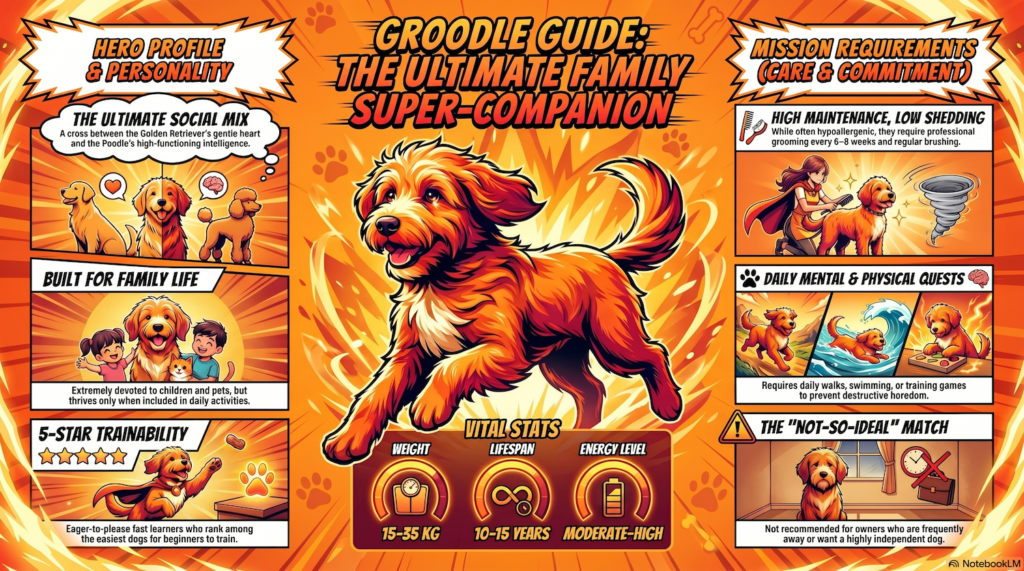






Friendly, intelligent, and full of fun — a lovable companion that combines a gentle nature with a playful spirit.
🧠 QUICK SNAPSHOT
- Temperament: Friendly, intelligent, affectionate
- Energy Level: Moderate to high
- Size: Medium to large
- Good With Families: Yes
- Trainability: High
- Grooming: High
- Best For: Families, active households, companionship
📚 OVERVIEW
The Groodle, also known as the Goldendoodle, is a cross between a Golden Retriever and a Poodle. Loved for its friendly personality and intelligence, the Groodle has become one of the most popular family dogs in the world.
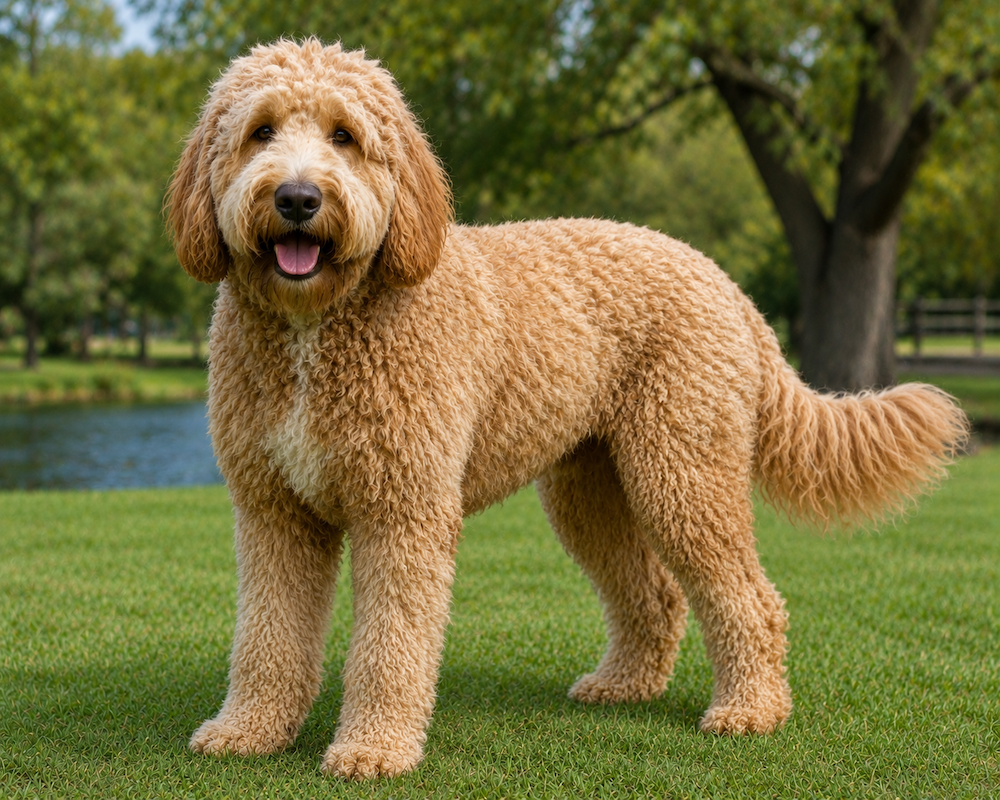
They are social, playful companions that thrive on human interaction and enjoy being included in family activities. Their appearance can vary depending on coat type, but most Groodles have a soft, wavy or curly coat and a cheerful expression.
✅ PROS & CONS
Pros
- Extremely friendly and affectionate
- Highly intelligent and trainable
- Great with children and families
- Often lower shedding than many breeds
Cons
- Requires regular grooming
- Needs companionship and attention
- Can develop separation anxiety
- High energy levels in younger dogs
Is a Groodle a Good Family Dog?
Yes. Groodles are generally affectionate, intelligent and sociable family dogs.
They combine Golden Retriever and Poodle ancestry, two breeds known for close relationships with people and excellent trainability.
Temperament can still vary substantially because the Groodle isn’t a standardised breed. Size, energy, coat and personality depend on the parents, generation and individual genetics.
Is a Groodle the Same as a Goldendoodle?
Yes. A Groodle and Goldendoodle are the same basic cross: Golden Retriever × Poodle.
“Groodle” is particularly common terminology in Australia, while “Goldendoodle” is more widely used in North America and internationally.
The different names don’t indicate different breeds.
What Breeds Make a Groodle?
A Groodle is produced from Golden Retriever and Poodle ancestry.
Standard Poodles are commonly used for larger Groodles, while Miniature Poodles may be used to produce smaller dogs.
Multigenerational Groodles can have considerably more complicated pedigrees than a simple 50/50 first-generation cross.
How Much Exercise Does a Groodle Need?
Most adult Groodles need around 60–90 minutes of daily exercise.
Larger or particularly energetic dogs may require more.
Walking, swimming, retrieving, hiking, scent games and training are excellent activities because both parent breeds have energetic sporting backgrounds.
Is a Groodle Easy to Train?
Usually, yes.
Golden Retrievers and Poodles are both highly intelligent, cooperative and trainable breeds.
Groodles often learn commands quickly and respond particularly well to positive reinforcement.
Their intelligence also means insufficient mental stimulation can result in unwanted behaviours.
Are Groodles Intelligent?
Yes. Groodles can be exceptionally intelligent.
Both parent breeds have long histories of complex working roles requiring cooperation with people.
Groodles can excel at obedience, tricks, scent work, retrieving and dog sports.
The downside is that a bored intelligent dog can become remarkably creative about entertaining itself.
Does a Groodle Shed?
It depends.
Some Groodles shed very little, while others shed moderately or substantially.
Coat inheritance is complicated, and even puppies from the same litter can have different adult coats.
The Groodle label alone doesn’t guarantee a non-shedding dog.
Is a Groodle Hypoallergenic?
Not reliably.
Groodles are frequently marketed as hypoallergenic, but no dog is completely allergen-free.
Some low-shedding Groodles may be better tolerated by certain allergy sufferers, while others can still trigger significant reactions.
Anyone with serious allergies should spend time with the individual dog before committing.
Why Do Some Groodles Shed More Than Others?
Golden Retrievers have shedding double coats, while Poodles have curly coats that retain much of their shed hair.
Groodles can inherit different combinations of coat length, curl, furnishings and shedding genes.
Generation labels such as F1 or F1B provide some information but don’t perfectly predict the adult coat.
What Does “Furnished” Mean in a Groodle?
Furnishings are the longer facial hairs that create the beard, moustache and eyebrows associated with the classic Groodle teddy-bear appearance.
Dogs without furnishings have smoother Retriever-like faces.
Genetic testing can help breeders predict furnishings more accurately than appearance alone.
Can a Groodle Have a Flat Coat?
Yes.
Some Groodles inherit a straight or relatively flat Golden Retriever-like coat rather than the familiar shaggy Doodle coat.
These dogs may have fewer facial furnishings and can shed more noticeably.
They’re still Groodles despite looking less like the stereotypical teddy-bear Doodle.
What Coat Types Can Groodles Have?
Groodles can have straight, wavy or curly coats.
Breeders may also use terms such as hair, fleece and wool.
These descriptions aren’t universally standardised, so one breeder’s “fleece” coat may differ from another’s.
What Is a Fleece-Coated Groodle?
“Fleece” usually describes a soft, wavy or loosely curled coat.
It’s particularly popular because it creates the classic fluffy Groodle appearance.
Fleece isn’t a scientifically standardised coat classification, however, and grooming requirements can still be substantial.
What Is a Wool-Coated Groodle?
A wool coat generally describes a dense, tightly curled Poodle-like coat.
These Groodles often shed relatively little visibly.
The trade-off is intensive grooming because loose hairs can remain trapped inside the coat and contribute to matting.
Are Groodles High-Maintenance to Groom?
Many are extremely high-maintenance.
Low shedding doesn’t mean low grooming.
Furnished, curly and wavy coats often need thorough brushing several times each week and professional grooming approximately every six to eight weeks.
Coat maintenance is one of the most commonly underestimated aspects of Groodle ownership.
How Often Should a Groodle Be Groomed?
Most furnished Groodles should be brushed several times each week, often daily when the coat is kept long.
Professional grooming is commonly needed every six to eight weeks.
Particular attention should be given behind the ears, under collars and harnesses, in the armpits and around the legs.
Why Does My Groodle Mat So Easily?
Groodle coats can trap loose hair within longer curly or wavy hair, creating tangles that progressively tighten.
Friction areas are particularly vulnerable.
A coat can appear fluffy on the surface while substantial matting develops closer to the skin, making thorough line brushing important.
Can You Shave a Groodle?
Yes.
Groodles with Poodle-like continuously growing coats are routinely clipped.
If severe matting develops, a short shave may be the most humane grooming option.
Regular brushing and scheduled grooming can usually prevent emergency shave-downs.
Why Does My Groodle Look Completely Different After Grooming?
Much of the famous Groodle appearance is created by coat length and grooming style.
Removing several centimetres of fluffy hair can reveal a surprisingly slender dog underneath.
The first dramatic haircut occasionally produces the unsettling feeling that the groomer has returned somebody else’s pet.
What Health Problems Are Common in Groodles?
Potential concerns include hip and elbow dysplasia, eye disease, heart problems, allergies, ear infections and inherited disorders from either parent breed.
Golden Retriever cancer predispositions also remain relevant.
Poodle-related risks vary partly according to whether Standard, Miniature or Toy ancestry is present.
Are Groodles Prone to Hip Dysplasia?
Yes.
Hip dysplasia occurs in both Golden Retrievers and Poodles, particularly larger varieties.
Responsible breeders should perform appropriate formal hip assessments on breeding dogs rather than assuming crossbreeding removes the risk.
Are Groodles Prone to Ear Infections?
They can be.
Groodles often combine hanging ears with dense hair around the ear canal, reducing ventilation.
Dogs that frequently swim can be particularly susceptible.
Regular ear checks and appropriate veterinary treatment of recurrent problems are important.
Are Groodles Prone to Allergies?
Yes, some are.
Both Golden Retrievers and Poodles can experience allergic skin disease.
Symptoms can include itching, paw licking, recurrent ear infections and skin inflammation.
Ironically, a dog marketed as potentially better for human allergy sufferers may have allergies of its own.
Are Groodles Prone to Cancer?
They can be.
Golden Retrievers have important genetic predispositions to several cancers.
Crossbreeding doesn’t automatically remove these risks.
Family health history and responsible selection of breeding animals remain important.
Are Standard Groodles Prone to Bloat?
They can be.
Golden Retrievers and Standard Poodles are both relatively deep-chested dogs, so larger Groodles may be vulnerable to gastric dilatation-volvulus (GDV).
Repeated unsuccessful attempts to vomit, abdominal swelling, restlessness or collapse require immediate emergency veterinary care.
How Long Does a Groodle Live?
Groodles commonly live around 10–15 years, depending partly on their size and ancestry.
Smaller Groodles may have greater average longevity than very large individuals.
Genetics, body condition, inherited disease and veterinary care all influence lifespan.
How Big Does a Groodle Get?
Groodle size varies enormously.
Standard Groodles commonly weigh around 20–35 kg or more, while Mini Groodles may weigh roughly 7–18 kg.
Because there’s no universally accepted breed standard, breeder size labels should always be compared with the actual parents.
What Is a Standard Groodle?
A Standard Groodle usually has Standard Poodle ancestry.
These are the largest commonly bred Groodles and can approach or occasionally exceed Golden Retriever size.
They’re athletic, substantial dogs requiring appropriate exercise and space.
What Is a Medium Groodle?
“Medium Groodle” is an informal size category used for dogs between Mini and Standard.
There is no universally accepted weight range.
Expected adult size should therefore be estimated from parental size, pedigree and previous litters rather than the word “Medium.”
What Is a Mini Groodle?
A Mini Groodle has Miniature Poodle ancestry incorporated to reduce adult size.
Some are first-generation Golden Retriever × Miniature Poodle crosses, while others are produced through multigenerational breeding.
Adult size can still vary considerably.
How Big Does a Mini Groodle Get?
Many Mini Groodles mature somewhere around 7–18 kg, but there’s no official standard.
A first-generation puppy from a Golden Retriever and much smaller Miniature Poodle can be particularly difficult to predict.
The parents’ actual sizes are more informative than marketing terminology.
Are Mini Groodles Really Miniature?
Not necessarily.
“Mini” means smaller than a typical Standard Groodle rather than genuinely tiny.
Golden Retriever ancestry can still produce a surprisingly substantial adult.
A puppy advertised as Mini should therefore come with realistic size expectations rather than an exact guaranteed adult weight.
Are There Toy Groodles?
Very small Groodles can be produced through Toy or small Miniature Poodle ancestry and multigenerational breeding.
However, Toy Groodle isn’t an officially standardised size category.
Very small size shouldn’t be prioritised over health, sound structure and temperament.
Are There Teacup Groodles?
“Teacup Groodle” is a marketing term rather than a recognised breed size.
Extreme miniaturisation can introduce health and structural concerns.
Prospective owners should be cautious when unusually tiny size is presented as the dog’s primary selling point.
Can a Groodle Live in an Apartment?
Yes, particularly Mini and Medium Groodles.
Standard Groodles can also adapt if given sufficient exercise and mental stimulation.
Their activity level matters considerably more than whether the home has a large backyard.
Can a Groodle Be Left Alone?
Groodles are generally very people-oriented and may struggle with long periods of isolation.
Some develop separation-related behaviour.
Teaching independence gradually from puppyhood can help prevent the dog becoming completely dependent on constant human company.
Are Groodles Velcro Dogs?
Many are.
Both Golden Retrievers and Poodles tend to develop strong relationships with their owners.
The resulting Groodle may consider following a human from the kitchen to the bathroom to be an essential family responsibility.
Are Groodles Cuddly?
Many are extremely affectionate.
They often enjoy physical contact and being close to family members.
Individual personality still varies, with some energetic young Groodles more interested in playing than remaining still long enough for a cuddle.
Are Groodles Good With Children?
Generally, yes.
Well-socialised Groodles are typically friendly, playful and affectionate with children.
Large young dogs can accidentally knock over toddlers, while small Groodles need protection from rough handling.
Supervision remains important.
Are Groodles Good With Other Dogs?
Usually.
Both parent breeds generally have good social potential with other dogs.
Early positive socialisation helps produce appropriate canine behaviour.
Individual temperament remains more important than assuming every Groodle will automatically love every other dog.
Are Groodles Good With Cats?
Many can live successfully with cats, especially when introduced appropriately.
Both parent breeds have hunting ancestry, so some chase instinct may occur.
Most Groodles aren’t generally known for extreme predatory behaviour, but individual prey drive varies.
Do Groodles Have a Strong Prey Drive?
Usually low to moderate, although individual dogs vary.
Golden Retrievers were developed to retrieve game, while Poodles were historically waterfowl retrievers.
Wildlife and birds can therefore be highly interesting even when the dog isn’t strongly predatory.
Do Groodles Bark a Lot?
Most are moderate barkers.
Barking can increase through boredom, excitement, alert behaviour or separation distress.
Smaller dogs may sometimes be more vocal depending on their Poodle ancestry and individual temperament.
Are Groodles Good Guard Dogs?
Generally, no.
Some will alert their owners to unfamiliar activity, but Groodles are typically social sporting and companion dogs rather than serious guardians.
A Standard Groodle may look imposing until it enthusiastically welcomes the suspected intruder.
Are Groodles High-Energy Dogs?
Many are.
Golden Retrievers and Poodles are both athletic sporting breeds, so the Groodle isn’t simply a fluffy lounge dog.
Young dogs in particular can require considerable physical exercise and mental stimulation.
When Do Groodles Calm Down?
Many begin becoming noticeably calmer around two to three years old.
Some energetic individuals take longer.
Teaching relaxation is useful because trying to solve every behaviour problem by adding more exercise can simply create an exceptionally fit dog that still doesn’t know how to settle.
Are Groodles Good Running Dogs?
Healthy adult Medium and Standard Groodles can make excellent running companions.
Their sporting ancestry provides stamina and athletic ability.
Structured distance running should wait until skeletal maturity.
Are Groodles Good Hiking Dogs?
Yes.
Many Groodles love hiking and outdoor exploration.
Their fluffy coats can collect burrs, grass seeds, mud and assorted pieces of the Australian landscape, so post-walk coat inspections are particularly useful.
Do Groodles Like Water?
Many absolutely love water.
Golden Retrievers are famous swimmers, while Poodles were originally developed as water retrievers.
The Groodle therefore combines two breeds with substantial aquatic working heritage.
Are Groodles Good Swimmers?
Many are excellent swimmers.
Their Golden Retriever and Poodle ancestry gives them a strong genetic background in water work.
Individual dogs should still be introduced gradually and supervised around deep or moving water.
Why Does My Groodle Love Playing Fetch?
Both parent breeds were historically retrievers.
Golden Retrievers were developed to retrieve shot game from land and water, while Poodles retrieved waterfowl.
A Groodle enthusiastically chasing and returning a ball is therefore expressing behaviour with deep roots on both sides of its family tree.
Why Does My Groodle Carry Things Around?
Carrying objects is strongly connected with its retrieving heritage.
Toys, shoes, socks and random household objects can all become desirable.
Providing appropriate retrieving toys can give this natural behaviour a more acceptable outlet.
Are Groodles Good Service Dogs?
Suitable individuals can make excellent assistance dogs.
Golden Retrievers have an outstanding history in service work, while Poodles contribute intelligence, trainability and potentially reduced shedding.
Service work still requires exceptional temperament and health, so not every Groodle is suitable.
Are Groodles Good Therapy Dogs?
Many can be excellent therapy dogs.
Their combination of affection, sociability and trainability can suit interaction with people in hospitals, schools and care environments.
The dog must still demonstrate calm behaviour rather than simply friendliness.
What Does a Groodle Look Like?
There is no single Groodle appearance.
They can have straight, wavy or curly coats, with body structure ranging from Retriever-like to Poodle-like.
The classic appearance involves a soft wavy coat, facial furnishings and the famous teddy-bear expression.
What Colours Can Groodles Be?
Groodles can occur in cream, gold, apricot, red, black, brown and various combinations involving white markings.
Poodle ancestry contributes substantially to this colour diversity.
Some colours also change considerably as the dog matures.
Can Groodles Be Black?
Yes.
Black pigmentation can come through Poodle ancestry.
A black Groodle may be born extremely dark and remain black or gradually develop lighter hairs depending on its genetics.
Can Groodles Be Chocolate?
Yes.
Brown or chocolate is possible through Poodle coat-colour genetics.
Some chocolate Groodles lighten considerably as they age.
Colour should never be considered more important than health or temperament.
Can Groodles Be Red?
Yes. Red is one of the most popular Groodle colours.
Rich red puppies can be particularly striking, although some become lighter apricot or gold as they mature.
The eventual adult shade can therefore be difficult to guarantee.
Why Does My Groodle’s Colour Fade?
Poodles can carry genetic factors causing coat colour to clear or fade with age.
A deeply coloured puppy may become considerably lighter as its adult coat develops.
This is usually a normal pigmentation change rather than a health problem.
Can Groodles Be Parti-Coloured?
Yes.
Parti Groodles have substantial white areas combined with another colour.
The white spotting generally comes through Poodle ancestry.
Patterns can vary dramatically between puppies.
Can Groodles Be Phantom?
Yes.
Phantom colouring involves distinct tan-point markings, commonly above the eyes, on the muzzle, chest and legs.
The pattern can be inherited through Poodle ancestry.
It doesn’t indicate a separate Groodle variety.
Can Groodles Be Merle?
Merle requires particular caution.
Merle isn’t a traditional colour of either the Golden Retriever or recognised purebred Poodle populations.
A merle Groodle therefore generally indicates that another breed introduced merle somewhere in the pedigree. Merle-to-merle breeding can also produce serious hearing and eye abnormalities.
What Is an F1 Groodle?
An F1 Groodle is a first-generation Golden Retriever × Poodle cross.
On average, its genetic ancestry is approximately 50% from each breed.
That doesn’t mean its coat, personality or appearance will be perfectly halfway between the parents.
What Is an F1B Groodle?
An F1B Groodle is usually an F1 Groodle bred back to a Poodle.
This produces approximately 75% Poodle ancestry on average.
The breeding is commonly used to increase the likelihood of furnishings and lower visible shedding.
Does an F1B Groodle Definitely Not Shed?
No.
F1B breeding increases the probability of certain Poodle-like coat characteristics but doesn’t guarantee a non-shedding dog.
Specific coat genes matter more than simply describing a dog as 75% Poodle.
What Is an F2 Groodle?
An F2 Groodle is generally produced by breeding two F1 Groodles together.
Because genes can recombine in numerous ways, F2 puppies can still show substantial variation.
Second generation doesn’t automatically mean more predictable.
What Is an F1BB Groodle?
An F1BB is generally produced by breeding an F1B Groodle back to a Poodle again.
The resulting dogs have a high average proportion of Poodle ancestry.
This is often done in an attempt to increase coat predictability and reduce shedding.
What Is a Multigenerational Groodle?
A multigenerational Groodle comes from several generations of Groodle breeding rather than a simple Golden Retriever × Poodle mating.
Careful multigenerational breeding can potentially increase predictability in size, coat and temperament.
“Multigen” by itself doesn’t guarantee responsible breeding.
Are Groodles a Recognised Breed?
Not generally.
Major traditional kennel organisations recognise Golden Retrievers and Poodles, but the Groodle isn’t currently recognised as an established pedigree breed.
There is no single internationally accepted Groodle standard.
Is a Groodle a Designer Dog?
Yes.
The Groodle is one of the world’s best-known designer crossbreeds, intentionally combining established breeds in an attempt to produce desired characteristics.
The label says nothing about breeder quality, however.
Are Groodles Healthier Than Purebred Dogs?
Not automatically.
Crossbreeding can increase genetic diversity and reduce the risk of certain recessive disorders, but Groodles can still inherit diseases from either parent population.
Responsible health testing remains essential.
What Is Hybrid Vigour in Groodles?
Hybrid vigour, or heterosis, describes improved biological performance that can sometimes occur when genetically different populations are crossed.
It can be beneficial, but it’s frequently oversimplified in Doodle marketing.
It doesn’t magically eliminate hip dysplasia, cancer, heart disease or other complex inherited conditions.
What Health Tests Should Groodle Parents Have?
Testing should reflect the health risks of both the Golden Retriever and the particular Poodle variety used.
Depending on the parents, appropriate screening may include hips, elbows, eyes, cardiac health and relevant DNA tests.
A routine veterinary check isn’t equivalent to comprehensive breeding health screening.
Is a Groodle a Type of Poodle?
No.
A Groodle is a Golden Retriever-Poodle cross, even when a backcross gives it a high percentage of Poodle ancestry.
Poodles themselves are an established breed with their own breed standard and pedigree population.
Is a Groodle the Same as a Labradoodle?
No.
A Groodle combines Golden Retriever and Poodle ancestry.
A Labradoodle combines Labrador Retriever and Poodle ancestry.
Their appearance can be very similar, but their Retriever ancestry differs.
What Is the Difference Between a Groodle and a Cavoodle?
A Groodle combines a Golden Retriever with a Poodle, while a Cavoodle combines a Cavalier King Charles Spaniel with a Poodle.
Cavoodles are generally considerably smaller.
Both can have variable coats because of their crossbred ancestry.
What Is the Difference Between a Groodle and a Spoodle?
A Spoodle usually combines a Cocker Spaniel and Poodle.
The Groodle uses a Golden Retriever instead.
Spoodles are generally smaller, although individual size depends on the Poodle variety involved.
What Is the Difference Between a Groodle and a Double Doodle?
A Double Doodle commonly combines Goldendoodle/Groodle and Labradoodle ancestry, giving it Golden Retriever, Labrador Retriever and Poodle heritage.
Terminology isn’t universally controlled, so pedigree information is more useful than the name alone.
Is a Groodle More Like a Golden Retriever or a Poodle?
It can be either — or an unpredictable combination of both.
One Groodle may have Golden Retriever sociability and a Poodle-like coat, while another inherits Retriever shedding and more Poodle-like independence.
Crossbreeding doesn’t divide characteristics neatly into percentages.
Why Were Golden Retrievers Crossed With Poodles?
The intention was generally to combine the Golden Retriever’s friendly, cooperative temperament with the Poodle’s intelligence and potential for reduced shedding.
The combination became enormously popular as a family companion.
However, early marketing sometimes exaggerated how predictable low-shedding coats would be.
Is the Poodle Really a Water Retriever?
Yes.
Long before Poodles became associated with elaborate show clips, they were working water retrievers used to retrieve birds.
The breed’s intelligence, swimming ability and retrieving instincts are fundamental parts of its history.
Do Groodles Have Retriever Instincts From Both Parents?
Yes — and this is one of the most interesting things about the cross.
The Golden Retriever is obviously a retriever, but the Poodle is also historically a water retriever.
A Groodle therefore receives ancestry from two breeds developed to find, carry and return game to humans.
Where Does the Name Groodle Come From?
“Groodle” combines elements of Golden Retriever and Poodle.
It’s particularly popular in Australia.
Internationally, “Goldendoodle” became the more widely recognised name for exactly the same cross.
Was the Groodle Created in Australia?
Australia is strongly associated with the Labradoodle, but the Groodle doesn’t have an equally well-documented Australian origin story.
Golden Retriever-Poodle crosses became increasingly popular internationally during the modern Doodle movement.
Australia adopted “Groodle” as the preferred local name.
Did Wally Conron Create the Groodle?
No.
Australian breeder Wally Conron is associated with the modern Labradoodle, developed through a Guide Dogs programme in the late 1980s.
He didn’t create the Groodle.
However, the enormous publicity surrounding Labradoodles helped stimulate demand for other Poodle crosses.
When Did Groodles Become Popular?
Golden Retriever-Poodle crosses became increasingly visible during the 1990s and early 2000s as interest in Doodle-type dogs expanded.
Their popularity subsequently exploded through family-dog marketing, online breeding and social media.
Who Created the First Groodle?
There is no reliably documented single creator of the Groodle/Goldendoodle.
Golden Retrievers and Poodles could have been crossed informally long before the modern name became popular.
Multiple breeders appear to have developed the cross independently.
Why Are Groodles So Popular in Australia?
They combine several characteristics Australian families often find attractive: friendly temperament, trainability, attractive appearance and the possibility of reduced shedding.
The popularity of Cavoodles and Labradoodles also helped make Poodle crosses familiar to Australian dog owners.
Why Do Groodles Look Like Teddy Bears?
The combination of facial furnishings, soft wavy or curly hair, expressive eyes and rounded grooming styles creates the teddy-bear appearance.
Professional grooming plays a substantial role.
Underneath that carefully shaped coat is usually a considerably more athletic dog than the teddy-bear image suggests.
Are Groodles Overbred?
Their enormous popularity has unfortunately encouraged irresponsible and high-volume breeding in some markets.
Poor breeding can result in inadequate health testing, unstable temperament and unpredictable coats.
A high purchase price or fashionable colour isn’t evidence of responsible breeding.
Why Are Groodles So Expensive?
High demand is a major reason.
Responsible breeding also involves substantial costs for health testing, veterinary care, quality puppy raising and appropriate parent selection.
However, very high prices based primarily on “rare” colours, tiny sizes or fashionable generation labels deserve scrutiny.
Can Two Groodles Eventually Produce a True Breed?
Potentially, over many generations.
Creating a stable breed requires careful selection, pedigree records, population management, consistent characteristics, health programmes and an agreed breed standard.
Simply breeding Groodles together doesn’t immediately turn them into a new established breed.
Could the Groodle Eventually Become a Recognised Breed?
Potentially.
Many modern pedigree breeds ultimately emerged through selective breeding of earlier populations and crosses.
For Groodles to become an established breed, breeders would need to move beyond repeatedly producing crosses and develop a stable, genetically sustainable population that reliably breeds true.
Is a Groodle a Good First Dog?
Often, yes.
Their generally friendly temperament and high trainability can suit first-time owners.
However, prospective owners shouldn’t underestimate exercise, professional grooming, coat maintenance and separation-related behaviour.
The fluffy family-dog image can make the breed look considerably easier than it actually is.
Where Does the Groodle Come From?
The Groodle is the Australian name commonly used for the Golden Retriever × Poodle cross, known internationally as the Goldendoodle.
Unlike the Labradoodle, the Groodle doesn’t have one clearly documented creator or founding event. Golden Retriever-Poodle crosses became increasingly popular during the broader Doodle movement of the 1990s and early 2000s, with the name Groodle becoming especially established in Australia.
What makes the combination particularly logical is that both parent breeds share genuine working history. Golden Retrievers were developed in Scotland to retrieve game, while Poodles were water retrievers. Both are intelligent, athletic dogs selected to cooperate closely with humans.
That shared history explains why so many Groodles love swimming, fetching, carrying things and learning new tasks.
It also explains one of the breed’s biggest misconceptions: underneath the fashionable haircut and teddy-bear face isn’t simply a cute designer companion. There’s potentially an energetic working retriever on both sides of the family tree — wearing a coat that needs an appointment every six weeks.