






Gentle, massive, and incredibly loyal — a majestic giant with a calm and affectionate heart.
🧠 QUICK SNAPSHOT
- Temperament: Gentle, loyal, calm
- Energy Level: Moderate
- Size: Giant
- Good With Families: Yes
- Trainability: Moderate to high
- Grooming: High
- Best For: Families with space, experienced owners
📚 OVERVIEW
The Leonberger is a giant working breed known for its lion-like appearance and gentle personality. Originally bred as a companion and draft dog, they are calm, affectionate, and incredibly devoted to their family.
Despite their massive size, they are patient and friendly dogs that thrive on companionship and inclusion.
✅ PROS & CONS
Pros
- Extremely gentle and affectionate
- Great with families and children
- Calm and steady temperament
- Impressive, majestic appearance
Cons
- Very large size requires space
- Heavy shedding and grooming needs
- Can drool significantly
- Needs regular exercise and socialisation
Is a Leonberger a Good Family Dog?
Yes. A well-bred Leonberger can be an affectionate, gentle, patient and deeply devoted family dog.
Despite their enormous size, Leonbergers are generally bred for stable, companionable temperaments rather than sharp guarding behaviour.
Their sheer strength means early training is essential, particularly around children and older or less mobile family members.
How Much Exercise Does a Leonberger Need?
Most healthy adults need around 60–90 minutes of moderate exercise each day.
Walking, hiking, swimming and controlled play are excellent activities.
Leonbergers are active giant dogs, but they shouldn’t be exercised like endurance athletes, particularly while growing.
How Much Exercise Does a Leonberger Puppy Need?
Exercise should be carefully managed while the skeleton is developing.
Free play, short walks and exploration are generally preferable to forced running, repetitive jumping or long-distance exercise.
Leonbergers grow extremely quickly, placing considerable stress on developing joints.
Is a Leonberger a High-Energy Dog?
They’re generally moderate-energy dogs.
Young Leonbergers can be playful and surprisingly exuberant, but adults usually combine outdoor enthusiasm with a good ability to relax at home.
They’re considerably more athletic than their enormous fluffy appearance suggests.
Is a Leonberger Easy to Train?
Generally, yes, although early training is extremely important.
Leonbergers are intelligent and typically eager to cooperate with their people.
Positive reinforcement works particularly well, and basic manners should be established before the puppy becomes a 60-kilogram adolescent with opinions.
Are Leonbergers Intelligent?
Yes.
They’re capable of obedience, water rescue, therapy work, carting and numerous dog sports.
Their intelligence tends to be practical and cooperative rather than intensely driven.
Are Leonbergers Stubborn?
They can have an independent streak.
A Leonberger is unlikely to respond well to repetitive drilling or harsh handling.
Consistent, patient training works best.
Does a Leonberger Shed?
Yes — heavily.
Leonbergers have a dense double coat and shed throughout the year, with substantial seasonal coat blows.
Anyone wanting a hair-free house should probably continue their search.
Is a Leonberger Hypoallergenic?
No.
They shed heavily and produce normal canine allergens.
The Leonberger isn’t considered suitable for people specifically seeking a hypoallergenic breed.
What Type of Coat Does a Leonberger Have?
The breed has a long, water-resistant double coat consisting of a relatively straight outer coat and substantial undercoat.
Males often develop an impressive mane around the neck and chest, contributing to the breed’s lion-like appearance.
How Often Should You Groom a Leonberger?
Thorough brushing several times each week is recommended.
During seasonal shedding, daily grooming may be necessary.
Particular attention should be given to areas behind the ears, feathering, trousers and tail where mats can develop.
Does a Leonberger Need Haircuts?
Usually not.
The natural coat shouldn’t require routine sculpting or clipping.
Minor tidying may occasionally be useful, but regular brushing is far more important.
Should You Shave a Leonberger?
Generally, no.
Its double coat provides insulation and environmental protection.
Shaving doesn’t solve heat intolerance and may interfere with normal coat function and regrowth.
Do Leonbergers Drool?
Some do, but they’re generally less extreme droolers than breeds such as Saint Bernards or some Mastiffs.
Individuals with looser lips may slobber more.
Water bowls can still become impressive splash zones.
What Health Problems Are Common in Leonbergers?
Important concerns include hip and elbow dysplasia, certain cancers, gastric dilatation-volvulus, heart disease, eye disorders and inherited neurological diseases.
Leonberger polyneuropathy and leukoencephalomyelopathy are particularly important breed-specific concerns.
Responsible breeders should use appropriate orthopaedic, cardiac, eye and genetic screening.
What Is Leonberger Polyneuropathy?
Leonberger polyneuropathy, or LPN, describes inherited neurological disease affecting peripheral nerves.
Symptoms can include weakness, abnormal gait, reduced reflexes, exercise intolerance and changes to breathing or vocalisation.
Genetic testing is available for some identified forms.
What Is Leukoencephalomyelopathy in Leonbergers?
Leonberger leukoencephalomyelopathy, often abbreviated LEMP, is an inherited neurological disorder affecting the brain and spinal cord’s white matter.
Affected dogs can develop progressive coordination and movement problems.
DNA testing allows breeders to manage known genetic risk.
Are Leonbergers Prone to Cancer?
Unfortunately, cancer is an important health concern within the breed.
Conditions including osteosarcoma and haemangiosarcoma can occur.
As with several giant breeds, cancer contributes significantly to mortality.
Are Leonbergers Prone to Hip Dysplasia?
Yes.
Hip dysplasia is an important concern in a dog this large.
Responsible breeders should have breeding animals assessed using recognised hip-screening programmes.
Are Leonbergers Prone to Elbow Dysplasia?
Yes.
Elbow dysplasia can cause pain, lameness and arthritis.
Screening breeding dogs and maintaining appropriate puppy growth and adult weight are important.
Are Leonbergers Prone to Bloat?
Yes.
Their large, deep chest puts them at risk of gastric dilatation-volvulus (GDV), commonly called bloat.
GDV is a life-threatening emergency requiring immediate veterinary treatment.
Owners should learn the warning signs and discuss preventive gastropexy with their veterinarian.
How Long Does a Leonberger Live?
Leonbergers commonly live around 8–10 years, although some live longer.
Like many giant breeds, their lifespan is shorter than that of most small and medium-sized dogs.
Responsible breeding and maintaining a lean body condition are particularly important.
How Big Does a Leonberger Get?
Leonbergers are giant dogs.
Males typically stand around 72–80 cm at the shoulder, while females are generally around 65–75 cm.
Adult males frequently weigh around 50–75 kg, with females commonly somewhat lighter.
How Fast Does a Leonberger Grow?
Extremely quickly.
A Leonberger puppy can transform from a manageable bundle of fluff into a very large adolescent within its first year.
Physical maturation continues considerably longer, often until around two to three years of age.
What Should You Feed a Leonberger Puppy?
A growing Leonberger should receive an appropriately formulated large- or giant-breed puppy diet designed to support controlled growth.
Faster growth isn’t better.
Excess calories or inappropriate mineral balance can place unnecessary stress on developing bones and joints.
Should Leonberger Puppies Receive Extra Calcium?
Not unless specifically recommended by a veterinarian.
A properly formulated giant-breed puppy food should already contain an appropriate calcium-phosphorus balance.
Unnecessary calcium supplementation can interfere with normal skeletal development.
Is the Leonberger One of the Largest Dog Breeds?
Yes.
The Leonberger belongs firmly among the world’s giant dog breeds.
However, it’s generally not as heavy as the largest English Mastiffs and isn’t usually as tall as the tallest Great Danes.
Is There a Miniature Leonberger?
No.
There is no recognised Miniature Leonberger.
A genuinely small dog marketed under that name would either be a cross or simply not representative of the breed.
Can a Leonberger Live in an Apartment?
Technically, yes, but it’s challenging.
Adult Leonbergers can be relatively calm indoors, yet their enormous size creates practical problems involving stairs, lifts, floor space and transport.
A spacious home with easy outdoor access is generally more suitable.
Does a Leonberger Need a Large Backyard?
A large securely fenced garden is useful but doesn’t replace exercise.
Leonbergers generally want to participate in family life rather than being left outside alone.
Space matters, but companionship matters more.
Can a Leonberger Be Left Alone?
Adult Leonbergers can learn to tolerate reasonable periods alone.
However, they’re strongly people-oriented and generally don’t thrive when routinely isolated for long periods.
They were developed substantially as companion dogs.
Are Leonbergers Prone to Separation Anxiety?
Some can be.
Their close attachment to their family can make prolonged separation difficult.
Gradual independence training from puppyhood is helpful.
Are Leonbergers Velcro Dogs?
Many are.
They often enjoy remaining close to their people and participating in whatever the household is doing.
A Leonberger can therefore be a Velcro dog with the slight logistical disadvantage of occupying roughly the floor area of a small coffee table.
Are Leonbergers Cuddly?
Usually.
Many are exceptionally affectionate and enjoy physical contact.
Some seem remarkably unaware that their adult body is considerably larger than the lap they are attempting to occupy.
Are Leonbergers Good With Children?
Generally, yes.
Their patient and gentle temperament can make them excellent family companions.
However, a huge enthusiastic dog can accidentally knock over a small child, so supervision remains essential.
Are Leonbergers Good With Other Dogs?
Usually.
Well-socialised Leonbergers tend to be sociable and tolerant.
Their size should be considered during play with very small dogs.
Are Leonbergers Good With Cats?
Many live successfully with cats, particularly when raised together.
They’re generally not characterised by extreme prey drive.
Controlled introductions are still recommended.
Do Leonbergers Have a Strong Prey Drive?
Usually low to moderate.
They weren’t developed primarily as independent hunting dogs.
Individual dogs can still chase wildlife, so training and management remain necessary.
Are Leonbergers Good Off Leash?
They can develop reliable recall with appropriate training.
They’re generally cooperative and handler-oriented.
Their enormous size makes dependable control particularly important in public areas.
Do Leonbergers Bark a Lot?
Usually not excessively.
They may bark to alert their family or when excited.
Persistent barking is generally more likely to reflect boredom, isolation or insufficient training than a defining breed characteristic.
Are Leonbergers Good Watchdogs?
Yes.
Their enormous size and deep bark can provide considerable deterrence.
Many will alert their family to unfamiliar activity.
Are Leonbergers Good Guard Dogs?
They can be naturally watchful, but they’re not generally intended to be aggressive protection dogs.
Their sheer appearance often provides all the deterrence necessary.
A stable Leonberger should be confident and composed rather than indiscriminately suspicious.
Are Leonbergers Aggressive?
Aggression isn’t characteristic of the ideal Leonberger temperament.
The breed standard emphasises confidence, steadiness and friendliness.
Poor breeding, inadequate socialisation, fear or pain can affect any dog’s behaviour.
Are Leonbergers Friendly With Strangers?
Many are friendly or politely reserved.
They should generally be self-assured rather than fearful.
Early socialisation is important because an anxious 65-kilogram dog can be extremely difficult to manage.
When Does a Leonberger Calm Down?
Many become noticeably more mature between two and three years old.
Physical and emotional development is relatively slow in giant breeds.
Adolescence can therefore involve a very large dog still behaving remarkably like a puppy.
Do Leonbergers Get the Zoomies?
Yes.
Watching a giant Leonberger perform high-speed laps can be simultaneously impressive and concerning for anyone standing near furniture.
Fortunately, adult dogs generally become calmer.
Are Leonbergers Good Running Dogs?
They’re not ideal long-distance running dogs.
Healthy adults can enjoy moderate jogging, but their giant size places substantial stress on joints.
Forced running should be avoided entirely during growth.
Are Leonbergers Good Hiking Dogs?
Healthy adults can make excellent moderate hiking companions.
They have useful stamina and enjoy outdoor activity with their owners.
Hot weather, steep terrain and excessive distance require careful management.
Can Leonbergers Swim?
Exceptionally well.
Swimming is one of the activities for which modern Leonbergers are particularly famous.
Their strength, coat and natural water ability have led to their use in water-rescue training.
Do Leonbergers Have Webbed Feet?
The breed has well-developed feet with some webbing between the toes, as dogs naturally do.
Their feet, powerful limbs and body structure contribute to strong swimming ability.
Claims that they have uniquely webbed feet should be treated cautiously, but they’re undeniably capable water dogs.
Are Leonbergers Used for Water Rescue?
Yes.
Leonbergers participate in organised water-rescue and lifesaving training, particularly in Europe.
They can learn to tow people, retrieve objects, pull boats and assist swimmers.
Their combination of size, strength, trainability and swimming ability makes them particularly suited to this work.
Can a Leonberger Tow a Person Through Water?
Yes.
A trained adult Leonberger is powerful enough to tow a swimmer toward shore.
Water-rescue exercises can involve towing people, retrieving flotation equipment and assisting multiple swimmers.
Training and conditioning are essential.
Can Leonbergers Pull Carts?
Yes.
Their strength makes them well suited to carting and draught work.
Modern owners sometimes participate in recreational carting as a way of preserving this practical working ability.
Heavy pulling should only begin after physical maturity.
Were Leonbergers Historically Draft Dogs?
They were used for practical tasks including pulling carts and working around farms.
Their great strength made them useful beyond companionship.
However, their original creation is unusually tied to appearance and civic symbolism rather than one single working occupation.
Are Leonbergers Good Therapy Dogs?
Many can be excellent therapy dogs.
Their gentle temperament and impressive appearance often attract people.
A suitable therapy Leonberger must be exceptionally calm and well trained because of its enormous size.
What Does a Leonberger Look Like?
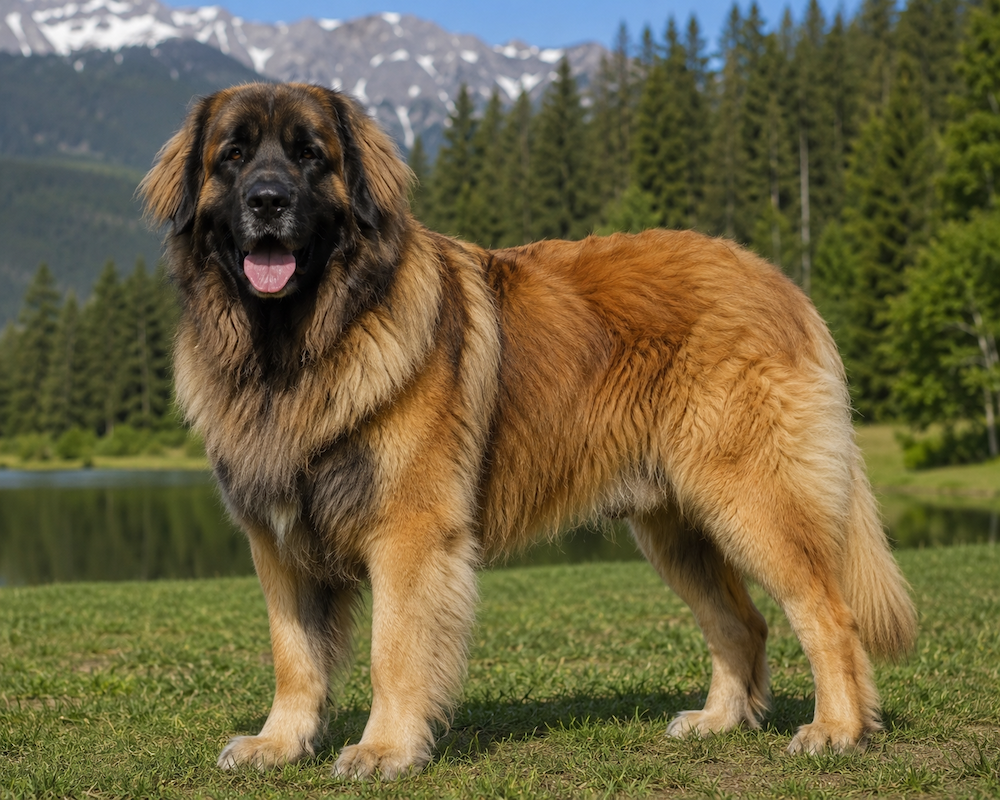
The Leonberger is a giant, powerful, long-coated dog with a distinctive black mask, substantial feathering and a lion-like outline.
Males usually have a particularly prominent mane around the neck and chest.
Despite their size, they should appear balanced and athletic rather than cumbersome.
What Colours Can Leonbergers Be?
Typical colours range from lion-yellow and golden to reddish-brown and sandy shades, generally with darker shading.
A black facial mask is a defining characteristic.
Large white markings aren’t typical, although a small amount of white may occur.
Why Do Leonbergers Have a Black Mask?
The dark mask is an important breed characteristic and contributes strongly to the Leonberger’s distinctive expression.
It contrasts dramatically with the golden or reddish body coat.
The mask shouldn’t extend into an entirely black head.
Why Does a Male Leonberger Have a Mane?
Adult males often develop longer, fuller coat around the neck and chest.
This creates the lion-like mane that became closely associated with the breed’s intended appearance.
Females generally have a less dramatic mane.
Do Leonbergers Look Like Lions?
That was very much the idea.
The breed’s creator wanted a large dog with an imposing, lion-like appearance, reflecting the lion associated with the German town of Leonberg.
The mane, golden coat and black mask help create that effect.
Is a Leonberger a Mastiff?
Not exactly.
Leonbergers share giant size and some historical ancestry with mastiff-type dogs, but the modern Leonberger is a distinct breed.
Its development also involved mountain and water-dog ancestry.
Is a Leonberger Related to the Saint Bernard?
Yes.
Saint Bernard-type dogs played an important role in the traditional account of Leonberger development.
The breeds remain visually similar in overall giant size and mountain-dog appearance.
Is a Leonberger Related to the Newfoundland?
Yes.
Newfoundland-type dogs were also important in Leonberger development.
This ancestry helps explain the breed’s dense coat, powerful build and excellent swimming ability.
Is a Leonberger Related to the Great Pyrenees?
According to traditional breed history, Pyrenean Mountain Dogs were incorporated during development.
Exactly how much each historical breed contributed is difficult to reconstruct with modern genetic precision.
The Leonberger nevertheless clearly emerged from Europe’s giant mountain and working-dog tradition.
Is a Leonberger the Same as an Estrela or Bernese Mountain Dog?
No.
Although all are large European working dogs, they’re separate breeds with different geographic origins and histories.
The Leonberger was deliberately developed in Germany during the 19th century.
Where Does the Leonberger Come From?
The Leonberger comes from Leonberg, a town in Baden-Württemberg in southwestern Germany.
Its name literally reflects its place of origin.
The breed’s creation is strongly associated with a 19th-century Leonberg politician and entrepreneur named Heinrich Essig.
Who Created the Leonberger?
Heinrich Essig, a prominent citizen and town councillor of Leonberg, is traditionally credited with creating the breed during the 19th century.
Essig was involved in dog breeding and dealing and wanted to produce an impressive giant dog associated with his hometown.
Why Did Heinrich Essig Create the Leonberger?
According to traditional breed history, Essig wanted to create a dog resembling the lion on Leonberg’s coat of arms.
He combined large European dogs to produce an imposing, long-coated animal with a lion-like appearance.
This makes the Leonberger unusual: civic branding was effectively part of the original breeding concept.
Does Leonberg Have a Lion on Its Coat of Arms?
Yes.
The town’s heraldic imagery features a lion.
The similarity between “Leonberg” and the German association with Löwe, or lion, became central to the breed’s story and symbolism.
Was the Leonberger Really Bred to Look Like a Town’s Coat of Arms?
That’s the traditional and widely repeated account.
Heinrich Essig promoted the breed as a lion-like dog representing Leonberg.
Some details of his exact breeding programme are difficult to verify independently because 19th-century records aren’t complete.
When Was the Leonberger Created?
Essig claimed to have produced the first dogs recognised as Leonbergers during the 1840s.
The commonly cited milestone is 1846.
The breed continued developing considerably after that point.
What Breeds Were Used to Create the Leonberger?
Traditional accounts describe crosses involving Saint Bernard-type dogs, Newfoundland or Landseer-type dogs and Pyrenean Mountain Dogs.
The exact genetic recipe is debated because documentation from Essig’s early breeding programme is incomplete.
Later breeders helped stabilise the type.
Was a Landseer Used to Create the Leonberger?
Traditional accounts frequently mention a black-and-white Newfoundland-type or Landseer dog among the early foundation animals.
At the time, breed boundaries weren’t necessarily identical to today’s formal kennel-club distinctions.
It’s therefore better to think in terms of historical dog populations rather than perfectly modern breed labels.
Was the Leonberger Created From Just Three Breeds?
Probably not in the neat recipe sometimes presented online.
Breed histories often simplify development into Saint Bernard + Newfoundland + Great Pyrenees.
The real 19th-century breeding process was likely more complicated, and surviving documentation doesn’t allow every mating to be reconstructed confidently.
Who Was Barry the Saint Bernard and Did He Influence the Leonberger?
The famous Alpine rescue dog Barry belonged to an earlier Saint Bernard tradition and wasn’t himself the founder of the Leonberger.
However, Saint Bernard-type dogs became part of the historical background from which Essig developed his giant dogs.
The two breeds’ histories therefore intersect without Barry literally being the Leonberger’s founding dog.
Why Did Heinrich Essig Give Leonbergers to Famous People?
Essig was an exceptionally effective promoter.
He sold or presented impressive dogs to royalty, aristocrats and prominent figures across Europe, helping turn the Leonberger into a fashionable status dog.
His marketing ability was almost as important to the breed’s early fame as his breeding.
Did European Royalty Own Leonbergers?
Yes.
Leonbergers became fashionable among European aristocracy and royalty during the 19th century.
Historical accounts associate them with several royal households, contributing to the breed’s prestige.
Did Empress Elisabeth of Austria Own Leonbergers?
Empress Elisabeth of Austria, better known as Sisi, is frequently associated with Leonbergers.
Historical breed accounts describe her owning several of the giant dogs.
Their imposing appearance suited the fashionable aristocratic image Essig had successfully cultivated.
Did Napoleon III Own a Leonberger?
Napoleon III is among the prominent figures traditionally listed as having received or owned Leonberger-type dogs.
Essig actively cultivated famous clientele, although individual ownership stories from this period aren’t always equally well documented.
Did the Prince of Wales Own a Leonberger?
British royalty and aristocracy were among those exposed to Essig’s dogs during their international spread.
Historical accounts connect Leonbergers with prominent European royal households, helping establish the breed outside Germany.
Was Heinrich Essig a Breeder or a Marketing Genius?
He was arguably both.
Essig didn’t merely produce dogs — he created an identity, story and international market around them.
A giant lion-like dog representing his hometown and appearing beside European royalty was remarkably effective 19th-century branding.
Did the Leonberger Become a Status Symbol?
Yes.
Its enormous size, dramatic coat and association with wealthy and royal owners made it fashionable during the 19th century.
Owning such a large dog also implied the resources necessary to house and feed it.
Did Leonbergers Work on Farms?
Yes.
Although early promotion emphasised their prestigious appearance, Leonbergers were also capable practical dogs.
Their strength allowed them to perform farm work, guard property and pull carts.
Did Leonbergers Pull Milk Carts?
Large European dogs, including Leonbergers and related working breeds, were historically used for carting tasks.
Accounts of Leonbergers pulling farm and delivery carts are consistent with their physical abilities.
Their draught heritage survives today in recreational carting.
Did the Leonberger Nearly Become Extinct?
Yes — more than once.
The breed’s population was devastated by World War I, when food shortages and wartime disruption made maintaining giant companion dogs extremely difficult.
World War II caused another severe population collapse.
How Many Leonbergers Survived World War I?
Popular breed histories sometimes give extremely small numbers of surviving dogs, but exact figures vary depending on what qualifies as breeding stock.
What is clear is that the population was dangerously reduced, requiring dedicated reconstruction.
How Was the Leonberger Saved After World War I?
German breed enthusiasts searched for surviving dogs considered suitable representatives of the breed.
A very small foundation population was used to rebuild numbers.
This created genetic bottlenecks that remain relevant to modern population health.
Did World War II Nearly Destroy the Leonberger Again?
Yes.
The Second World War again devastated breeding programmes across Europe.
Food shortages, destruction and human displacement made maintaining giant dogs exceptionally difficult.
Post-war breeders once again had to rebuild the population.
Do Modern Leonbergers Descend From Only a Small Number of Dogs?
Modern Leonbergers descend from a relatively restricted post-war breeding population.
This history makes genetic diversity and careful health management particularly important.
It’s also one reason international cooperation between responsible breeders matters.
When Was the First Leonberger Breed Club Established?
Organised Leonberger breeding began developing in Germany during the late 19th century.
Several clubs and organisations appeared as enthusiasts attempted to establish a consistent standard after Essig’s era.
Modern breed organisation developed progressively rather than through one uninterrupted club history.
When Was the Leonberger Officially Recognised?
Formal standards and organised registration developed during the late 19th and early 20th centuries.
International recognition expanded as the reconstructed breed spread beyond Germany.
The breed is now recognised by major kennel organisations worldwide.
When Did the AKC Recognise the Leonberger?
The American Kennel Club fully recognised the Leonberger in 2010.
That’s surprisingly recent given the breed’s 19th-century European history.
Why Was the Leonberger Recognised So Late in America?
The breed remained relatively uncommon in North America for much of the 20th century.
Developing a sufficiently organised population, registry and breed club takes time.
Its American recognition history is therefore much newer than its European heritage.
Are Leonbergers Rare?
They’re relatively uncommon.
Their enormous size, considerable food requirements, grooming, health concerns and shorter giant-breed lifespan naturally limit the number of suitable homes.
Dedicated populations nevertheless exist throughout Europe, North America, Australia and elsewhere.
How Much Does It Cost to Feed a Leonberger?
Considerably more than feeding a small or medium dog.
Food costs depend on diet and individual size, but prospective owners should budget for giant-breed quantities, along with correspondingly larger medications, beds, crates and veterinary procedures.
The purchase price is only the beginning.
Are Leonbergers Expensive to Own?
Yes.
Food, parasite prevention, veterinary medication, anaesthesia, boarding, grooming equipment and transport can all cost more because of the dog’s size.
Major orthopaedic or emergency procedures can be particularly expensive.
Can a Leonberger Fit in a Normal Car?
Usually, but vehicle choice matters.
A large hatchback, wagon or SUV is considerably more practical than a small car.
Owners also need to consider how they would transport an injured 60-kilogram dog that can’t climb into the vehicle itself.
Can Leonbergers Handle Hot Weather?
Heat requires careful management.
Their huge body and dense double coat make them vulnerable to overheating.
In hot Australian conditions, exercise should be scheduled for cooler periods with constant access to shade and water.
Are Leonbergers Good in Cold Weather?
Yes.
Their dense coat and European working ancestry make them naturally well equipped for cold conditions.
Many Leonbergers become noticeably more energetic when temperatures fall.
Why Do Leonbergers Love Mud and Water?
Water-loving ancestry and a dense weather-resistant coat make wet environments highly attractive to many individuals.
Unfortunately, the coat also has an extraordinary capacity to transport the environment back inside the house.
Why Does My Leonberger Lean on Me?
Leaning is common among large affectionate dogs.
It can be a way of seeking physical contact, attention or reassurance.
With a Leonberger, what would be a gentle affectionate gesture from a small dog can feel more like a slow-moving structural engineering problem.
Why Does My Leonberger Put a Paw on Me?
Pawing can be a learned way of requesting attention or physical contact.
Because Leonbergers are highly people-oriented, many develop distinctive ways of maintaining contact with their owners.
Given the size of the paw involved, these requests are difficult to overlook.
Is a Leonberger a Good First Dog?
It can be, but only for an owner prepared for the realities of a giant breed.
Their temperament is often forgiving and trainable, but size, grooming, veterinary costs, health risks, shedding and early socialisation require serious commitment.
A poorly trained 7-kilogram dog can be inconvenient. A poorly trained 70-kilogram Leonberger can rearrange the room.
What Makes the Leonberger Unique?
Few breeds have an origin story quite like the Leonberger.
In 19th-century Leonberg, Germany, Heinrich Essig set out to promote a huge, lion-like dog associated with his hometown and its heraldic lion. Using giant European working dogs, he developed an imposing animal and then did something remarkably modern: he marketed it.
Leonbergers appeared with aristocrats and royalty, becoming prestigious dogs across Europe. They later proved capable of farm work, carting and, eventually, impressive water-rescue work.
Then two world wars almost wiped them out.
Dedicated breeders rebuilt the population from a dangerously small number of survivors, allowing today’s Leonberger to retain its extraordinary combination of lion-like appearance, water-dog ability, giant strength and gentle companion temperament.
It may look like someone crossed a lion with a bear.
But perhaps the most Leonberger thing of all is that this enormous animal, created to impress European royalty, is often happiest doing something considerably less dignified:
leaning its entire body against its favourite person while dripping water across the floor.