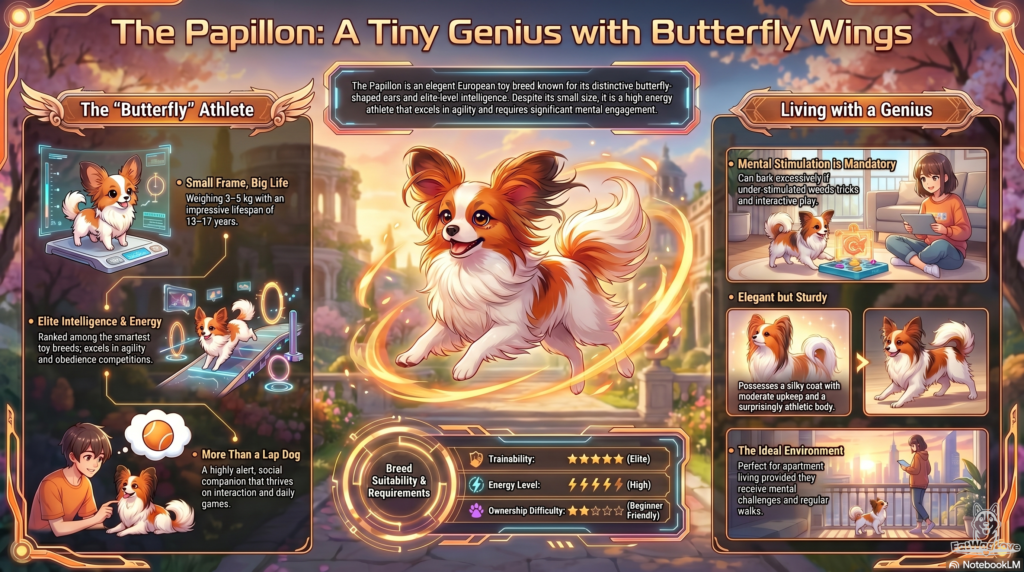







Elegant, intelligent, and full of energy — a tiny companion with butterfly-like ears and a huge personality.
🧠 QUICK SNAPSHOT
- Temperament: Intelligent, friendly, alert
- Energy Level: Moderate to high
- Size: Small
- Good With Families: Yes
- Trainability: Very high
- Grooming: Moderate
- Best For: Families, apartments, companionship
📚 OVERVIEW
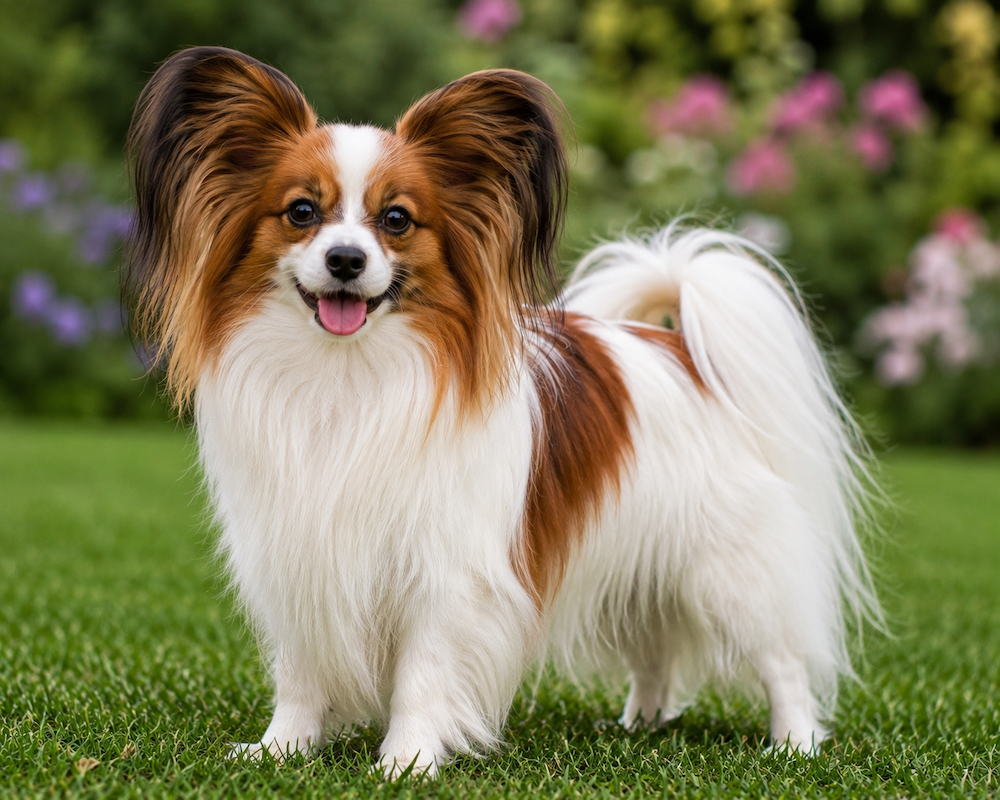
The Papillon is a small toy breed famous for its large, butterfly-shaped ears and lively personality. Despite its delicate appearance, it is an energetic and highly intelligent dog that loves activity and interaction.
They are affectionate companions that enjoy being involved in family life and often excel in training and dog sports.
✅ PROS & CONS
Pros
- Extremely intelligent and trainable
- Friendly and affectionate
- Compact and adaptable
- Alert and lively personality
Cons
- Can be vocal
- Needs regular attention and stimulation
- Sensitive temperament
- Fragile around rough handling
Is a Papillon a Good Family Dog?
Yes. The Papillon can be an affectionate, intelligent, cheerful and highly interactive family dog.
Despite its delicate appearance, this is a lively little spaniel with considerably more energy and confidence than many people expect. Papillons usually form strong bonds with their families and enjoy being involved in almost everything their owners do.
They’re best suited to families who want a small but active dog rather than a quiet lap dog.
Are Papillons Good With Children?
Yes, particularly with older, respectful children.
Papillons are playful and affectionate, but their small bodies can be injured by rough handling or accidental falls.
Families with very young children need particularly careful supervision.
How Much Exercise Does a Papillon Need?
Most Papillons need around 30–60 minutes of physical activity each day, together with regular mental stimulation.
They’re remarkably energetic for their size and often enjoy longer walks, games, agility and training.
A Papillon may look like a lap dog, but it shouldn’t be treated as one exclusively.
Is a Papillon a High-Energy Dog?
For a toy breed, yes.
Papillons are lively, athletic and curious dogs that usually enjoy being active.
Their small size makes their exercise needs relatively easy to accommodate, but they’re much more energetic than their elegant appearance suggests.
Is a Papillon Easy to Train?
Yes. The Papillon is generally considered a highly trainable toy breed.
They’re intelligent, attentive and usually enthusiastic about learning.
Positive reinforcement works particularly well, and many Papillons enjoy learning tricks simply because training gives them something interesting to do.
Are Papillons Intelligent?
Extremely.
Papillons have a strong reputation for intelligence and problem-solving ability.
They regularly perform well in obedience, agility, rally and trick training, demonstrating that physical size has very little relationship to learning ability.
Are Papillons Difficult to Toilet Train?
Usually not compared with some other toy breeds, although consistency is important.
Their intelligence can make training relatively straightforward.
Their tiny size means puppies have small bladders and need frequent opportunities to toilet outside.
Does a Papillon Shed?
Yes, but generally lightly to moderately.
Papillons have a long, silky coat without the extremely dense undercoat found in many heavy-shedding breeds.
Regular brushing helps control loose hair and prevents tangles.
Is a Papillon Hypoallergenic?
No.
Papillons aren’t considered hypoallergenic.
They produce the same types of canine allergens found in other breeds, even though their shedding may be relatively manageable.
How Often Should You Groom a Papillon?
Usually two or three times a week is sufficient, although areas behind the ears and around the feathering may need extra attention.
Their coat is surprisingly manageable because it isn’t as dense as it looks.
Regular nail trimming and dental care are particularly important.
Does a Papillon Need Haircuts?
Generally, no.
The Papillon’s natural silky coat doesn’t require routine clipping.
Owners may tidy hair around the feet or hygiene areas, but extensive trimming isn’t necessary to maintain the traditional breed appearance.
What Health Problems Are Common in Papillons?
Potential health concerns include patellar luxation, dental disease, eye disorders and certain inherited neurological conditions.
Very small individuals can also be vulnerable to injury.
Responsible breeders should use appropriate health screening and avoid selecting for increasingly extreme miniature size.
Are Papillons Prone to Patellar Luxation?
Yes.
Patellar luxation occurs when the kneecap moves out of its normal position and is relatively common among small dog breeds.
Affected dogs may intermittently skip on a hind leg or show persistent lameness in more severe cases.
Do Papillons Have Dental Problems?
They can.
Small jaws can create crowded teeth, increasing the risk of plaque accumulation and periodontal disease.
Regular tooth brushing and professional veterinary dental assessment are particularly valuable throughout a Papillon’s life.
How Long Does a Papillon Live?
Papillons commonly live around 13–16 years, with some reaching their late teens.
They’re generally a long-lived breed.
Healthy weight, dental care, appropriate exercise and responsible breeding can contribute to longevity.
How Big Does a Papillon Get?
Papillons generally stand around 20–28 cm at the shoulder and commonly weigh approximately 2.5–5 kg.
They’re firmly within the toy-dog category.
Their fine build and abundant coat can make their actual body size deceptive.
Is There a Miniature Papillon?
No.
The Papillon is already a recognised toy breed, and there’s no official Miniature Papillon variety.
Dogs advertised specifically as “mini Papillons” are simply being marketed as unusually small individuals.
Is There a Teacup Papillon?
No.
“Teacup Papillon” isn’t a recognised breed or size variety.
Deliberately breeding for extreme smallness can increase risks including fragile bones, dental crowding and other health problems.
Can a Papillon Live in an Apartment?
Yes. Papillons can make excellent apartment dogs.
They’re small and don’t require a large home, provided they receive sufficient walks, play and mental stimulation.
Barking is potentially a greater challenge than space.
Does a Papillon Need a Backyard?
No.
Papillons can thrive without a private yard.
Regular walks, indoor games and training can provide plenty of exercise.
Can a Papillon Be Left Alone?
Adult Papillons can learn to tolerate reasonable periods alone, but they’re strongly people-oriented.
They generally prefer being involved with their families.
Gradual independence training from puppyhood can help prevent problems.
Are Papillons Prone to Separation Anxiety?
Some can be.
Their strong attachment to people can make sudden long periods of isolation difficult.
Teaching a puppy that being alone briefly is safe and normal is worthwhile.
Are Papillons Cuddly?
Many are very affectionate and enjoy sitting on laps or sleeping beside their owners.
However, they’re often considerably more active than the stereotypical lap dog.
A Papillon may happily cuddle for an hour and then decide it’s time to organise an indoor athletics competition.
Are Papillons Good With Other Dogs?
Generally, yes.
They’re usually sociable when properly introduced and socialised.
Their confidence can sometimes make them behave as though they’re considerably larger than they actually are, so interactions with powerful dogs require sensible supervision.
Are Papillons Good With Cats?
Often, yes.
Papillons raised around cats commonly learn to live peacefully with them.
Their lively nature can occasionally result in chasing, particularly if the cat runs.
Do Papillons Have a Strong Prey Drive?
Usually moderate.
Their spaniel ancestry can contribute to interest in birds and small moving animals, although they’re not generally as intensely prey-driven as many terriers or specialised hunting breeds.
Individual variation is significant.
Are Papillons Good Off Leash?
They can develop excellent recall because they’re intelligent and often highly focused on their owners.
However, their tiny size makes roads, larger animals and unfamiliar environments particularly dangerous.
Off-leash activity should be limited to safe locations.
Do Papillons Bark a Lot?
They can be quite vocal.
Papillons are alert dogs that quickly notice visitors, unusual noises and activity outside.
Early training can help prevent alert barking from becoming excessive.
Are Papillons Good Watchdogs?
Yes — surprisingly good ones.
Their excellent hearing, alertness and willingness to bark make them effective little alarm systems.
They may notice someone approaching long before their owner does.
Are Papillons Good Guard Dogs?
No.
They can announce a stranger extremely effectively, but their tiny size prevents them from being serious physical protection dogs.
The Papillon is essentially an excellent alarm system with very limited enforcement capability.
Are Papillons Aggressive?
Aggression isn’t characteristic of a well-socialised Papillon.
They should generally be happy, confident and outgoing.
Fearfulness and defensive behaviour can develop if a tiny dog is poorly socialised or constantly protected from normal experiences.
Are Papillons Friendly With Strangers?
Many are friendly and outgoing.
Some initially announce unfamiliar people before becoming sociable.
Early exposure to different people and environments helps develop confidence.
When Does a Papillon Calm Down?
Many become noticeably more settled around two to three years old, although they often remain playful well into old age.
Papillons are famous for retaining considerable enthusiasm throughout life.
A mature dog may become calmer without ever becoming particularly lazy.
Do Papillons Get the Zoomies?
Absolutely.
They’re extremely quick and agile little dogs.
Their combination of speed, enthusiasm and tiny turning radius can produce impressive indoor zoomies.
Are Papillons Fast?
Yes.
Papillons are remarkably quick for their size and can accelerate and change direction extremely rapidly.
Their athleticism is one reason they perform so well in agility.
Are Papillons Good Walking Dogs?
Yes.
Healthy adult Papillons can walk considerably farther than many people expect.
Their small size doesn’t mean they should be carried everywhere.
Are Papillons Good Hiking Dogs?
They can be excellent companions on moderate hikes when properly conditioned.
Owners need to consider rough terrain, weather and larger wildlife because of the dog’s tiny size.
Are Papillons Good at Agility?
Exceptionally good.
Papillons are among the toy breeds most commonly associated with competitive agility.
They’re fast, intelligent, light, responsive and capable of learning complex obstacle sequences.
Are Papillons Good at Obedience?
Yes.
Their intelligence and eagerness to interact with people can make them outstanding obedience and rally dogs.
Papillons have competed successfully at very high levels despite their tiny size.
Can Papillons Swim?
Many can swim physically, but they’re not specialised water dogs.
Their small size means they can tire or become chilled quickly.
Supervision around pools and natural waterways is essential.
Do Papillons Get Cold Easily?
Yes.
Their fine bodies and lack of a heavy insulating undercoat make them more vulnerable to cold than many northern breeds.
A coat may be useful during cold winter walks.
Can Papillons Handle Hot Weather?
Generally, with sensible precautions.
They’re not heavily built or extremely brachycephalic, but their small bodies can still overheat.
Exercise should be avoided during the hottest part of the day.
What Does a Papillon Look Like?
The Papillon is a tiny, fine-boned spaniel with a long silky coat, plumed tail, expressive dark eyes and enormous fringed ears.
Those spectacular ears give the breed its unmistakable appearance.
Despite its elegant look, the body should remain athletic and functional.
Why Does a Papillon Have Butterfly Ears?
The large upright ears are covered with long feathering that spreads outward like butterfly wings.
This resemblance gave the breed its modern name.
“Papillon” is French for butterfly.
What Does Papillon Mean?
Papillon means “butterfly” in French.
The name refers to the dog’s enormous fringed upright ears, which resemble the wings of a butterfly.
It’s one of the most visually descriptive dog breed names.
Are All Papillons Born With Upright Ears?
No.
Papillon puppies can take time for their ears to develop their final carriage.
More importantly, the breed also has a recognised drop-eared form called the Phalène.
What Is a Phalène?
The Phalène is the drop-eared variety of the same Continental Toy Spaniel breed.
Instead of standing upright like butterfly wings, its ears hang downward.
“Phalène” means moth in French, creating the charming butterfly-and-moth naming distinction.
Is a Phalène a Different Breed From a Papillon?
That depends somewhat on the kennel organisation and terminology being used, but they’re fundamentally two ear varieties of the same historic Continental Toy Spaniel population.
Papillons have erect ears.
Phalènes have drop ears.
The underlying dogs are otherwise extremely closely related.
Can Papillons and Phalènes Be Born in the Same Litter?
Yes.
Because they’re varieties within the same breed population, puppies with different ear carriage can occur within related breeding lines.
Ear carriage is the major distinction rather than completely separate ancestry.
What Colours Can Papillons Be?
Papillons are traditionally parti-coloured dogs with white combined with patches of another colour.
Black, sable, red and combinations involving these colours are common.
Breed standards generally require substantial white rather than a completely solid-coloured dog.
Can a Papillon Be Black and White?
Yes.
Black and white is a classic Papillon colour combination.
The dramatic contrast can make the breed’s enormous fringed ears particularly noticeable.
Can a Papillon Be Brown and White?
Yes, depending on what is meant by brown.
Sable, red and related shades combined with white occur naturally in the breed.
Exact accepted terminology varies between breed standards.
Can a Papillon Be All White?
A completely white Papillon isn’t the normal breed pattern.
The traditional appearance includes clearly defined coloured patches on a predominantly white background.
Pigmentation around the head and ears is particularly characteristic.
Can a Papillon Be Merle?
Merle isn’t a traditional Papillon colour.
A merle dog marketed as a purebred Papillon should raise questions about ancestry.
“Rare colour” should never automatically be interpreted as desirable.
Is a Papillon a Spaniel?
Yes.
The breed descends from the Continental Toy Spaniel tradition.
Although today’s Papillon is classified primarily as a companion or toy dog, its spaniel ancestry remains central to its history and appearance.
Is a Papillon Related to the Cavalier King Charles Spaniel?
They’re not simply different sizes or varieties of the same modern breed, but both descend from Europe’s long tradition of small companion spaniels.
Historical paintings show toy spaniels across European courts long before today’s breeds were formally separated and standardised.
Is a Papillon Related to the Chihuahua?
No close historical relationship is required to explain their similar size and upright ears.
The Chihuahua developed from Mexican dog populations, while the Papillon emerged from European toy spaniels.
Their histories are fundamentally different.
Is a Papillon a French Breed?
France played an extremely important role in the breed’s development and gave it the name Papillon, but its ancestry belongs to the broader Continental European toy-spaniel tradition.
Belgium, France, Italy and other European regions all feature in its historical story.
Describing it simply as originating from one modern country can oversimplify centuries of development.
Where Does the Papillon Come From?
The Papillon developed from small Continental Toy Spaniels kept in European aristocratic households for centuries.
Dogs resembling its ancestors appear in paintings from Italy, France, Spain and elsewhere.
The modern butterfly-eared Papillon emerged later from this older drop-eared toy-spaniel population and became particularly associated with France and Belgium.
Is the Papillon an Ancient Breed?
It has a very old documented type and ancestry, although the modern standardised breed developed much later.
Small Continental Toy Spaniels resembling Papillon ancestors appear in European artwork going back several centuries.
This makes the breed’s history unusually visible because painters effectively left a pictorial record of its development.
Why Do Papillon-Like Dogs Appear in Old Paintings?
Small spaniels were fashionable companions among European nobility and wealthy households.
Artists frequently included them in portraits alongside their owners.
As a result, historical paintings provide fascinating evidence of how toy spaniels changed in appearance over several centuries.
Did Papillons Originally Have Drop Ears?
The ancestral Continental Toy Spaniels were primarily drop-eared, resembling today’s Phalène variety.
The erect butterfly ear became increasingly established later.
Eventually the butterfly-eared form became so popular that “Papillon” became the name most people associate with the breed.
When Did the Butterfly-Eared Papillon Develop?
The erect-eared form became particularly prominent around the late 19th and early 20th centuries.
Before that, drop-eared Continental Toy Spaniels were much more familiar.
Selective breeding helped establish the spectacular ear fringes seen today.
Was the Papillon a Royal Dog?
Yes, small Continental Toy Spaniels were strongly associated with European aristocracy and royal courts.
They were valuable companion animals and frequently appear in portraits of wealthy women and noble families.
Their tiny size made them ideal indoor companions in an era when many other dogs were primarily working animals.
Did Marie Antoinette Own a Papillon?
Marie Antoinette is frequently associated with Papillons in popular breed histories, sometimes with elaborate stories about a favourite dog accompanying her during her final days.
However, these stories are difficult to verify reliably.
It’s safer to say that toy spaniels of this general tradition were fashionable among European aristocracy than to treat every famous royal Papillon story as established fact.
Did Papillons Have a Working Job?
Their primary historical purpose was companionship rather than hunting, guarding or herding.
However, this doesn’t mean they lacked practical abilities.
Papillons are intelligent, alert and capable of catching small rodents, and modern dogs frequently excel in demanding canine sports.
Why Is the Papillon So Athletic if It Was a Lap Dog?
Historical companion dogs still needed to be physically sound and active.
The Papillon retained a light, functional spaniel structure rather than being bred into an extremely exaggerated body shape.
That helps explain why a dog developed primarily for companionship can perform so impressively in agility today.
Why Does My Papillon Chase Birds?
Its spaniel ancestry and normal canine prey instincts can make small moving animals interesting.
The breed wasn’t developed as a modern hunting spaniel, but the underlying behavioural heritage hasn’t completely disappeared.
Why Does My Papillon Follow Me Everywhere?
Papillons were bred primarily to be close companions to people.
Remaining near their owner is therefore extremely natural.
Hundreds of years ago that might have meant following someone around a European palace; today it may simply mean following you to the kitchen.
Why Does My Papillon Stare at Me?
Papillons are highly observant and people-focused.
Staring can be a way of anticipating instructions, requesting something or simply monitoring what their owner is doing.
Their intelligence makes them particularly good at learning the small routines that predict walks, meals and play.
Why Does My Papillon Shake Its Toys?
Grabbing and shaking objects is normal predatory play behaviour in dogs.
Small toys allow a Papillon to rehearse these instinctive movements safely.
The fact that the dog has butterfly ears doesn’t mean the dog itself thinks like a butterfly.
Why Does My Papillon Think It’s a Big Dog?
Papillons are typically confident and energetic despite their tiny size.
Unlike some extremely delicate companion breeds, they often approach life with the enthusiasm of a much larger working dog.
Owners need to protect them from situations where confidence exceeds physical reality.
Are Papillons Good Therapy Dogs?
Yes, suitable individuals can make excellent therapy dogs.
They’re portable, intelligent and often highly sociable.
A successful therapy Papillon still needs a calm temperament and comfort around unfamiliar people and environments.
Is a Papillon a Good Dog for Older People?
Often, yes.
Their small size makes them physically manageable, while their intelligence and affectionate nature provide plenty of companionship.
Owners should still be prepared for daily exercise and mental stimulation rather than expecting a completely sedentary lap dog.
Is a Papillon a Good First Dog?
Yes. A Papillon can be an excellent first dog for someone prepared to train and exercise it.
They’re intelligent, portable, generally trainable and don’t require the enormous grooming commitment of many other longhaired breeds.
The main considerations are physical fragility, barking, dental care and the need to keep a very clever little dog mentally occupied.
What Makes the Papillon Unique?
The Papillon is one of those breeds whose appearance gives completely the wrong impression of its personality.
Look at one and you see a tiny aristocratic dog with flowing hair and enormous butterfly-shaped ears.
And historically, that’s partly correct.
Its ancestors spent centuries as Continental Toy Spaniels, appearing beside European nobles in paintings and living primarily as prized companions.
But somewhere along the way, nobody told the Papillon that being a lap dog meant behaving like one.
Modern Papillons can compete brilliantly in agility, obedience, rally and trick training. They’re fast, highly intelligent and remarkably athletic for dogs weighing only a few kilograms.
Even the famous butterfly ears tell an interesting evolutionary story.
The older Continental Toy Spaniels were primarily drop-eared. That form still exists today as the Phalène — French for “moth.” The later erect-eared form resembled butterfly wings and became the Papillon — French for “butterfly.”
So within the same little spaniel tradition, we ended up with a moth and a butterfly.
And beneath both sets of ears remains a surprisingly serious little brain.
The Papillon may look as though it belongs on a silk cushion in a European palace.
Give it an agility course instead, and it will probably have more fun.