






Intelligent, energetic, and always ready for adventure — a loyal companion that loves both people and water.
🧠 QUICK SNAPSHOT
- Temperament: Intelligent, affectionate, energetic
- Energy Level: High
- Size: Medium to large
- Good With Families: Yes
- Trainability: High
- Grooming: Moderate to high
- Best For: Active families, outdoor lifestyles, water lovers
📚 OVERVIEW
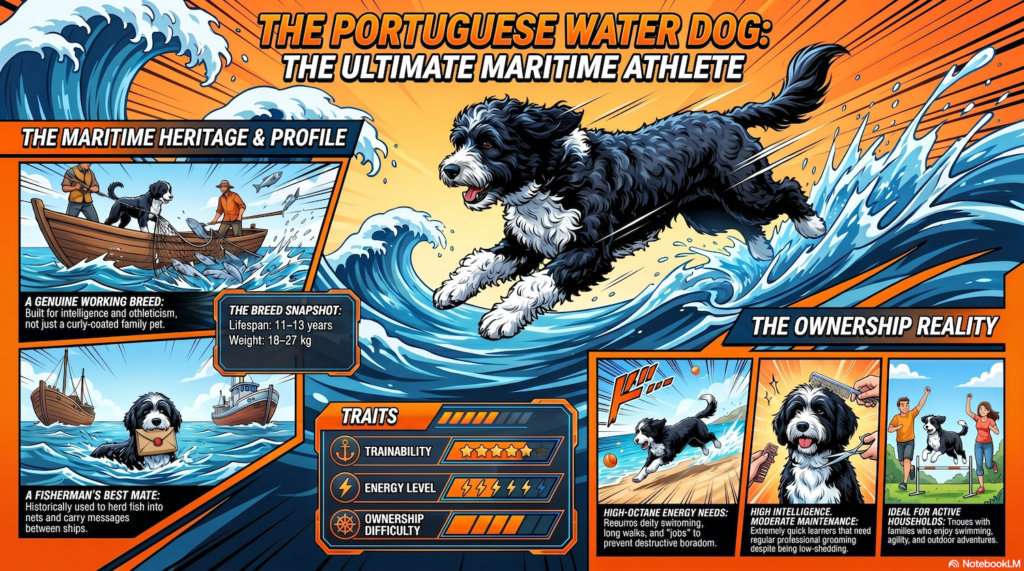
The Portuguese Water Dog was originally bred to assist fishermen along the coast of Portugal, helping retrieve nets, carry messages between boats, and recover lost equipment. As a result, this breed is an exceptional swimmer with a strong work ethic and a love of activity.
They are highly intelligent, loyal, and people-focused dogs that thrive when included in family adventures and given plenty of physical and mental stimulation.
✅ PROS & CONS
Pros
- Extremely intelligent and trainable
- Affectionate and family-oriented
- Excellent swimmer and outdoor companion
- Low shedding coat
Cons
- Needs significant exercise and stimulation
- Requires regular grooming
- Can become bored if left inactive
- Needs companionship and interaction
Is a Portuguese Water Dog a Good Family Dog?
Yes. Portuguese Water Dogs are affectionate, intelligent, energetic and highly people-oriented family dogs.
They tend to form strong bonds with their families and usually enjoy being involved in almost everything their owners do. Their playful nature can make them excellent companions for active households.
They need substantial exercise, training and interaction, so they’re better suited to families wanting an active participant rather than a quiet, low-maintenance dog.
Are Portuguese Water Dogs Good With Children?
Generally, yes.
Portuguese Water Dogs are typically playful and affectionate with children, particularly when properly socialised.
They can be energetic and exuberant, so young dogs may accidentally knock over small children during play. Supervision and early training are important.
How Much Exercise Does a Portuguese Water Dog Need?
Most Portuguese Water Dogs need around 60–90 minutes of exercise each day, with particularly energetic individuals benefiting from more.
Swimming, retrieving, walking, running and interactive games are excellent choices.
Mental exercise is equally important because this is an intelligent working breed that can become bored without enough to do.
Is a Portuguese Water Dog Easy to Train?
Yes. Portuguese Water Dogs are highly intelligent and generally very trainable.
They were developed to work closely with fishermen, so responsiveness and problem-solving ability were valuable working traits.
Positive reinforcement works particularly well, although their intelligence can also produce an independent or mischievous streak.
Do Portuguese Water Dogs Shed?
Portuguese Water Dogs are very low-shedding compared with most breeds.
Their hair tends to remain within the coat rather than falling heavily around the home.
Low shedding doesn’t mean low maintenance, however, because the coat requires regular brushing and clipping.
Are Portuguese Water Dogs Hypoallergenic?
Portuguese Water Dogs are often described as hypoallergenic because they shed very little, but no dog is completely allergen-free.
Dog allergens are found in saliva and skin secretions as well as hair.
Some people with allergies tolerate Portuguese Water Dogs better than heavily shedding breeds, but reactions vary between individuals.
How Often Should You Groom a Portuguese Water Dog?
Portuguese Water Dogs generally need brushing several times a week and regular professional trimming.
Without sufficient grooming, their curly or wavy coat can develop tangles and mats.
Many pet owners have their dogs clipped approximately every six to eight weeks, depending on the chosen coat length.
What Is a Lion Clip on a Portuguese Water Dog?
The traditional lion clip leaves the coat longer over the front portion of the body while the hindquarters and muzzle are clipped short, with hair retained toward the end of the tail.
The style is closely associated with the breed’s traditional working appearance.
A more even retriever clip is also popular, particularly for companion dogs.
What Health Problems Are Common in Portuguese Water Dogs?
Potential health concerns include hip dysplasia, progressive retinal atrophy and other eye disorders, juvenile dilated cardiomyopathy and GM1 gangliosidosis.
Some of these conditions have genetic tests available.
Responsible breeders should use appropriate DNA testing, eye examinations and joint screening to reduce inherited disease risk.
How Long Does a Portuguese Water Dog Live?
Portuguese Water Dogs commonly live around 11–14 years.
Individual longevity depends on genetics, health, body condition and veterinary care.
Maintaining a healthy weight is particularly important for an active breed expected to remain physically capable throughout much of its life.
How Big Does a Portuguese Water Dog Get?
Portuguese Water Dogs are medium-sized dogs.
Males generally stand around 50–57 cm tall and females around 43–52 cm, with adults commonly weighing approximately 16–27 kg.
Their athletic build should be strong and functional rather than excessively heavy.
When Is a Portuguese Water Dog Fully Grown?
Most Portuguese Water Dogs reach close to adult height at around 12–18 months.
They may continue developing muscle and filling out after this.
Mental maturity can take longer, and some retain an energetic, puppy-like personality well into early adulthood.
Can a Portuguese Water Dog Live in an Apartment?
Yes, provided its considerable exercise and mental-stimulation needs are met.
Physical size isn’t the main difficulty — energy and boredom are.
An actively exercised Portuguese Water Dog can adapt to apartment life, while an under-stimulated one can become noisy or destructive even in a large house.
Can Portuguese Water Dogs Be Left Alone?
Adult Portuguese Water Dogs can learn to tolerate reasonable periods alone, but they’re strongly people-oriented dogs.
They were bred to work closely alongside humans rather than operate completely independently.
Long periods of isolation can contribute to boredom, destructive behaviour or separation-related problems.
Are Portuguese Water Dogs Cuddly?
Many are extremely affectionate and enjoy close contact with their owners.
They often follow family members around the home and want to participate in whatever is happening.
Individual personalities vary, but this isn’t generally an aloof breed.
Do Portuguese Water Dogs Bark a Lot?
They can be moderately vocal.
Portuguese Water Dogs are alert and may bark at visitors, unfamiliar sounds or excitement.
Exercise, mental stimulation and early training can help prevent barking from becoming excessive.
Are Portuguese Water Dogs Good With Other Dogs?
Generally, yes.
Well-socialised Portuguese Water Dogs usually interact successfully with other dogs and often enjoy active canine play.
Individual temperament still matters, so introductions should be managed appropriately.
Are Portuguese Water Dogs Good With Cats?
Many can live successfully with cats, especially when introduced while young.
They have working and retrieving instincts, so some individuals may chase small animals.
Early socialisation and supervised introductions are important.
Do Portuguese Water Dogs Like to Swim?
Many absolutely do.
Swimming ability was central to the breed’s historical work, and Portuguese Water Dogs have a strong reputation for being enthusiastic and capable swimmers.
Not every individual automatically loves water, however, so puppies should still be introduced safely and gradually.
Do Portuguese Water Dogs Have Webbed Feet?
Portuguese Water Dogs have well-developed webbing between their toes, helping them move efficiently through water.
Webbing isn’t unique to this breed, but it complements their powerful swimming ability.
Their physical structure and coat developed around generations of demanding maritime work.
What Were Portuguese Water Dogs Bred For?
Portuguese Water Dogs were developed to work alongside fishermen.
Their duties included carrying messages between boats and shore, retrieving objects from the water and helping with fishing-related tasks.
They were working members of fishing crews rather than dogs developed simply to look impressive beside the sea.
Did Portuguese Water Dogs Herd Fish?
They’re frequently described as having helped fishermen drive or herd fish toward nets, and this has become one of the best-known stories about the breed.
Their broader historical role as maritime working dogs is well established, including retrieving objects and carrying messages.
Claims about specific fishing techniques can vary between historical accounts, so the breed is better understood as a versatile fisherman’s working dog rather than simply a “fish-herding dog.”
What Does a Portuguese Water Dog Look Like?
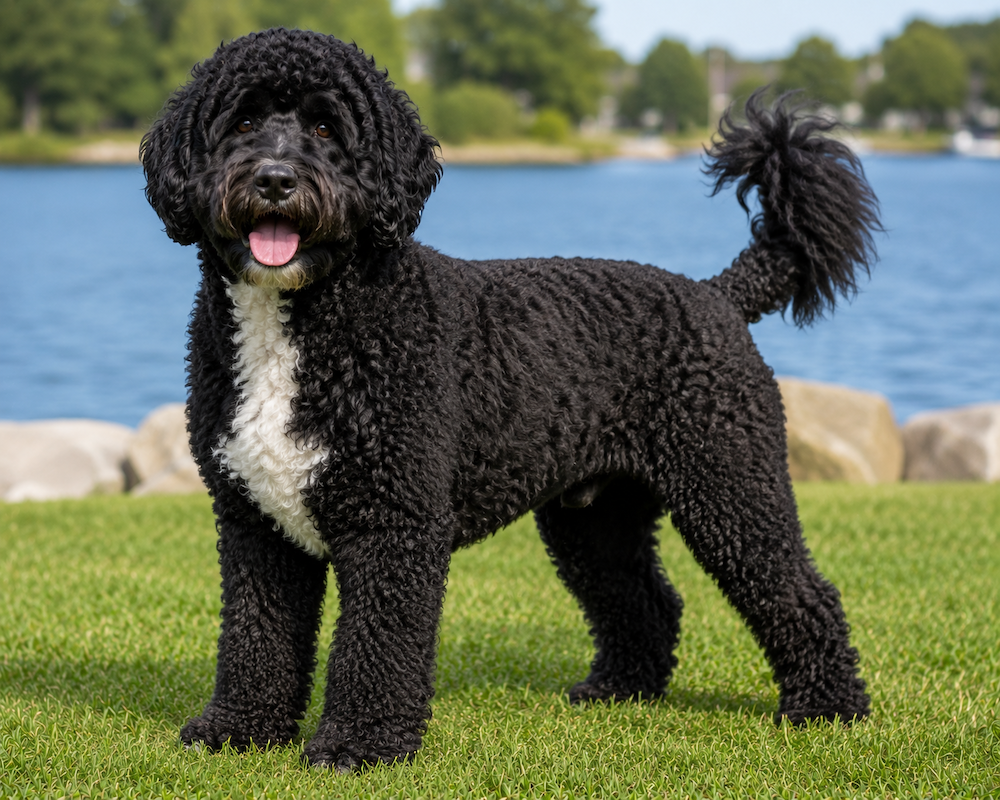
The Portuguese Water Dog is a medium-sized, strongly built and athletic dog with a distinctive curly or wavy coat.
It has a broad head, substantial muzzle and powerful body designed for active work.
Its appearance can change dramatically depending on whether it’s kept in a natural pet trim, retriever clip or traditional lion clip.
Do Portuguese Water Dogs Have Curly or Wavy Hair?
Both are normal.
Portuguese Water Dogs occur with curly coats and wavy coats.
The curly type forms compact curls, while the wavy type has longer, looser waves with more shine.
Both coat types belong to the same breed.
What Colours Can Portuguese Water Dogs Be?
Portuguese Water Dogs can be black, brown or white, as well as combinations involving white markings, depending on the breed standard.
Black with white markings is particularly familiar.
Colour doesn’t determine working ability, intelligence or temperament.
What Is the Difference Between a Portuguese Water Dog and a Poodle?
Both are intelligent, athletic, low-shedding dogs with historical connections to water work, but they’re distinct breeds.
The Portuguese Water Dog was closely associated with Portuguese fishing communities, while the Poodle developed as a specialised water retriever in continental Europe.
Poodles also occur in several recognised sizes, while the Portuguese Water Dog is a single medium-sized breed.
What Is the Difference Between a Portuguese Water Dog and a Spanish Water Dog?
Despite their similar names, they’re separate breeds.
The Portuguese Water Dog is strongly associated with maritime fishing work, while the Spanish Water Dog historically performed a broader mixture of herding, hunting and water-related work.
They also have different breed standards, coat traditions and histories.
Where Does the Portuguese Water Dog Come From?
The Portuguese Water Dog comes from Portugal, where dogs of this type worked with fishing communities along the coast.
They became particularly associated with the Algarve and Portuguese maritime life.
Their exact ancient ancestry isn’t fully documented, so claims that the modern breed can be traced unchanged for thousands of years should be treated cautiously.
Did the Portuguese Water Dog Almost Become Extinct?
The breed became extremely rare as modern fishing technology reduced the need for traditional canine crew members.
During the 20th century, Portuguese enthusiasts worked to preserve the remaining dogs and establish a viable modern breeding population.
This preservation effort was crucial to the survival of the breed.
Who Was Leão the Portuguese Water Dog?
Leão was an influential early Portuguese Water Dog associated with businessman and breed enthusiast Vasco Bensaude.
Leão became an important model for the developing breed standard and contributed significantly to modern breeding lines.
His influence is one reason he’s frequently encountered when researching the breed’s modern history.
Are Portuguese Water Dogs Related to Poodles?
Portuguese Water Dogs and Poodles share broad similarities as curly-coated European water-working dogs, and historical connections among European water-dog populations are plausible.
However, it’s misleading to describe the Portuguese Water Dog simply as a type of Poodle or to claim a simple direct parent-descendant relationship.
They’re distinct breeds with their own development and working histories.
Did Barack Obama Have a Portuguese Water Dog?
Yes. The Obama family had two Portuguese Water Dogs, Bo and Sunny, while Barack Obama was President of the United States.
Their visibility at the White House brought enormous international attention to the breed.
Bo joined the family in 2009, followed by Sunny in 2013.
Is a Portuguese Water Dog a Good First Dog?
It can be, particularly for an active first-time owner prepared for significant grooming and training.
Portuguese Water Dogs are intelligent and eager learners, but they need exercise, mental stimulation and human interaction.
They’re unlikely to suit someone looking for a sedentary or particularly independent dog.
What Makes the Portuguese Water Dog Unique?
The Portuguese Water Dog is a reminder that dogs once held some extraordinarily specialised jobs.
These weren’t simply dogs that happened to live near the ocean.
They worked with fishermen.
They swam between boats, retrieved objects from the sea and carried messages through the water. Historical accounts also associate them with helping fishermen manage fish around nets.
Their curly or wavy low-shedding coat, powerful body, webbed feet, intelligence and enthusiasm for water all make much more sense when viewed through that working history.
Then technology changed fishing.
The traditional jobs disappeared, and the breed itself became dangerously rare before dedicated breeders helped preserve it during the 20th century.
Today, most Portuguese Water Dogs will never work from a fishing boat.
But give one a lake, something to retrieve and a reason to use its brain, and the old working dog can become very obvious.
Just remember that centuries of maritime employment may also leave your Portuguese Water Dog wondering why you’re standing uselessly on the shore instead of throwing something back into the water.